
Stage 30 – Russia & Ukraine: Chernozem, Donbass And Crimea [1/2]
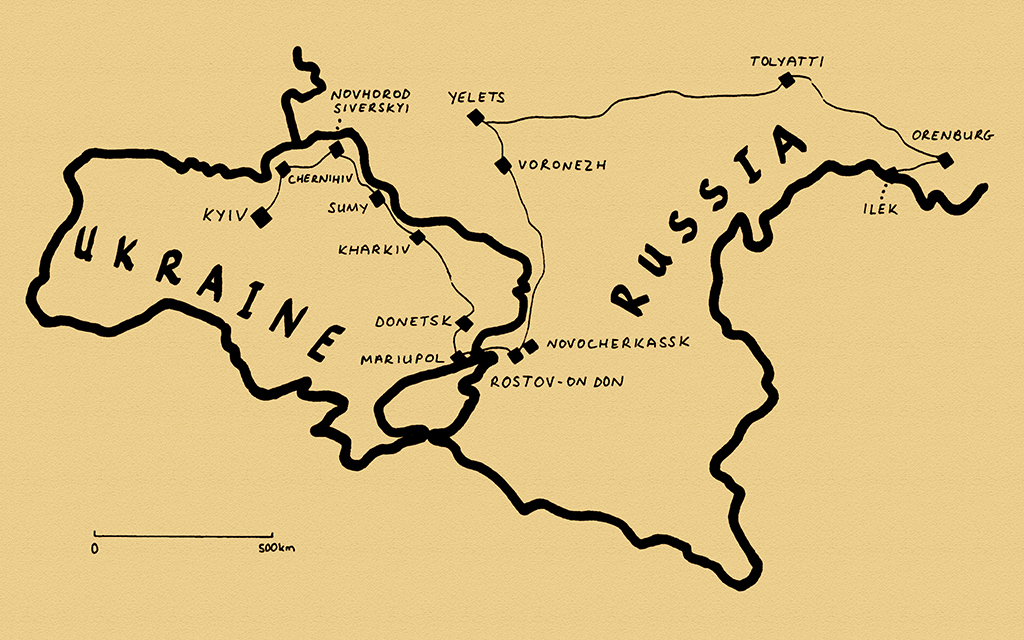
West of the dry steppes of Central Asia lies the Chernozem, the fertile, black earth region of Russia and Ukraine which constitutes the breadbasket of Eastern Europe, and has historically been a melting pot of Slavs, Cossacks and peoples from the Black Sea region and steppes beyond. After transiting the agricultural heartland of Russia, I would enter Ukraine and begin a lengthy tour of the country, more than four years after my original plans on the outward leg of the Odyssey had been scuppered by a robbery in Romania. Exploring Ukraine for the first time, from the industrial Donbass Region of the east, small towns of the far north, then to the capital and down the Dnieper River, south to Crimea and west through Odessa to the Danube Delta and the Moldovan border, I would find a highly divided country, one which at once had fostered the Eastern Slavs, a civilisation who gave rise to modern-day Ukrainians, Russians and Belarussians, yet at the same time one which had only existed for twenty years as a united and independent entity. Having for centuries existed as something of a frontier territory of a far larger, Russia-centred empire, this eastern half of Ukraine would reveal a surprisingly diverse country, set against beautiful, rolling countryside and the spectacular coastline of the Crimean Peninsula.
In the very early hours of the morning of the 9th August 2011 I leave the Kazakhstan – Russia border at Ilek and drive north-east parallel to the Ural River, reaching Orenburg at around 04:00, where I am happy to meet Ruslan, with whom I had stayed in April. I stay three lazy days with Ruslan, each night accompanying his friend Oleg delivering pizzas through the early hours, stopping frequently to smoke and enjoy the mesmerising passage of sodium-yellow street-lights as we drive the city’s empty streets. With just a ten-day transit visa however I am conscious that I do not presently have the luxury of time, and so my thoughts are on crossing the country to the Ukrainian border. West of Orenburg I drive through fields of ripe sunflowers towards the Volga, bypassing Samara on roads choked with lorry traffic, driving around the Samara Bend and stopping in the city of Tolyatti.
Named after a secretary of the Italian Communist Party, Tolyatti is a disjointed industrial city set attractively amidst leafy hills on the banks of the Volga, and is Russia’s motor city, home to the AvtoVAZ (Lada) plant, where the iconic Soviet Zhiguli was manufactured from the 1970s in cooperation with Fiat. I’m hosted in Tolyatti by Dmitriy and his wife Alena, who live in a fourteen-storey apartment block overlooking the city’s central park and golden domed Transfiguration Cathedral. Tolyatti is a nice example of a Soviet city, and I spend an enjoyable day walking along the sandy banks of the Volga. On my second day I am am interviewed about my long road journey by a friend of Dmitriy’s on Lada FM, the radio station broadcast in the AvtoVAZ factory, but my most lasting memory of Tolyatti, and indeed of the entirety of this short journey across Russia, is on my final evening. With Dmitriy and Alena and a group of their friends, we sit out in the warm evening on the grass in the park, next to the church, playing guitars and drums, drinking beer and simply enjoying the genuine company of friends in a free and unpretentious environment. Such simple and human experiences as these would make up my most lasting memories of Russian people, and their spontaneity and simple honesty would only serve to highlight the paucity of social life in western society.
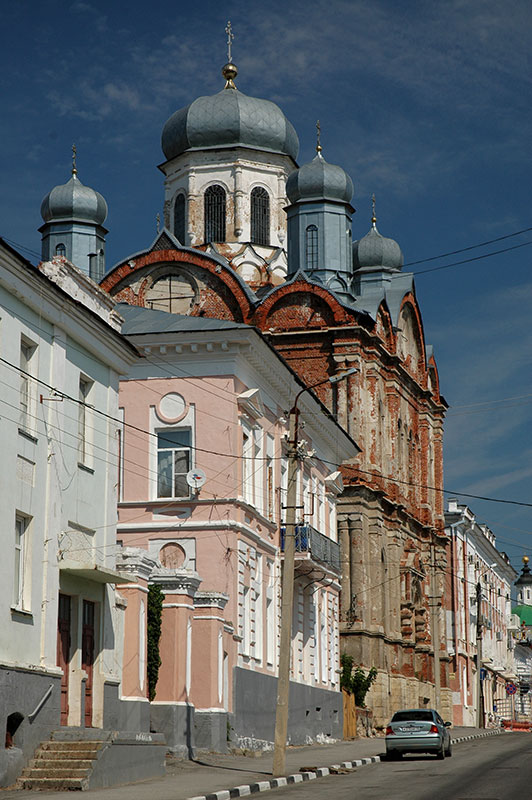
St Michael Church, Yelets, Lipetsk Region, Russia
From Tolyatti I proceed westwards via Syzran and Penza, through the beautiful, rolling Russian countryside which, whilst rarely spectacular, is soothingly wild in its unmanaged endlessness and a real pleasure to drive through. In the afternoon I enter Russia’s Central Black Earth Region, an agricultural heartland which stretches south almost to the Caucasus, encompassing some of the world’s most fertile soil. I stop in the city of Tambov long enough only to witness a drunken fight in a city park. Indeed, as I head west in Russia it seems that ever increasing numbers of sullen, pallid, disaffected, track-suit-clad youth and ugly advertising hoardings on every street mark an erosion of traditional Russian culture with increasing proximity to Western Europe.
It’s a blissful drive west out of Tambov in the late afternoon on a quiet provincial road, and I pass the city of Lipetsk after dark, stopping for the night at the roadside and continuing in the morning to the charming town of Yelets, the oldest in the Black Earth Region. Set on a hill on the western bank of the murky Sosna River, Yelets is a provincial town which retains an air of ‘real’ Russia, with beautiful pastel buildings, ancient churches and wooden, chocolate-box cottages set aside quiet, sloping streets. Down amid the wild, rambling green vegetation of the riverbank, overlooked by the light green Ascension Church, bronzed Russians are swimming, sun-bathing and fishing from small boats, enjoying the late-summer warmth in an almost Mediterranean-like atmosphere of torpor and relaxation.
From Yelets I continue southwards, joining the M4 Highway which links the capital to Rostov-on-Don and Russia’s southern, Black Sea coast, roughly tracking the Don River on its way to the Azov Sea. I stop in the afternoon in Voronezh, a city of roughly one million which typifies many of Russia’s western cities; heavily rebuilt following the destruction of the second world war and somehow lacking the charm of many of the cities located between Moscow and the Volga.
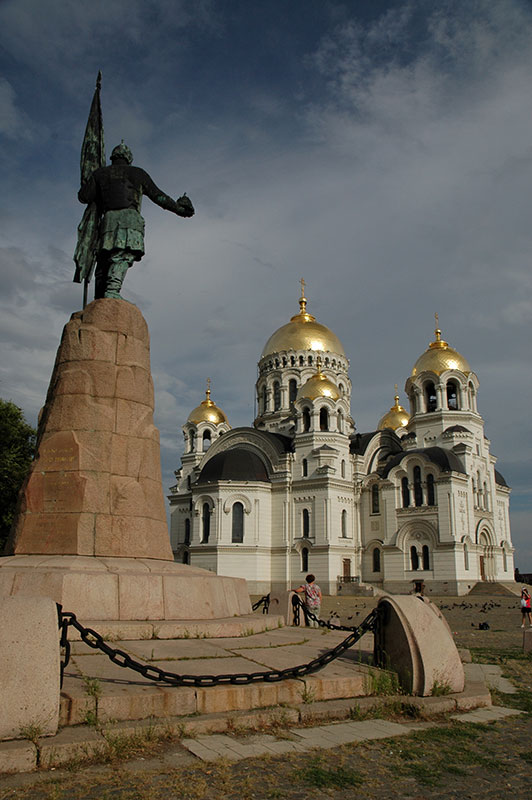
Ascension Cathedral, Novocherkassk, Rostov Region, Russia
Continuing southwards on the M4 the following day, amid the heavy summer traffic of Russian holidaymakers heading to and from the Black Sea coast, the landscape changes very gently from undulating fields and forests to the warm and verdant plains of Southern Russia’s Don Basin with its longer growing season and far milder winters. Trucks at the roadside selling melons remind me for a moment of Uzbekistan, though thankfully there is nothing like the terrible summer heat of Transoxiana. The area also feels more cosmopolitan with its proximity to the Caucasus and Black Sea, and as the homeland of the Don Cossack Host.
Although their origins are unclear, the Cossacks have long been a self-governing group of militaristic communities living in this southern region of what is now Russia and Ukraine, and have played a vital role in the history of both countries. Russia’s Don Cossack Host (one of several hosts) became allied with the Russian Tsars and were instrumental in the expansion of Russia in the sixteenth to eighteenth centuries, eastwards to the Volga, Urals and beyond across the entirety of Siberia, all the way to the Pacific Ocean. Later, the Cossacks became a recognised military class and fought in numerous wars for Russia, forming a strong counter-revolutionary force against the Bolsheviks following the 1917 Revolution.
I stop in the afternoon in the city of Novocherkassk, founded in 1805 by the ataman (supreme military leader) of the Don Host, as capital of the then Don Cossack Region. It’s a pleasant and laid back city with leafy, divided boulevards and low Tsarist-era houses. At the edge of the centre, in a huge cobble-stoned park sits the striking Ascension Cathedral, and next to it a statue to perhaps the most famous Cossack, Yermak Timofeyevich, who following Ivan The Terrible’s defeat of the Tatar Khanate of Kazan, led the first Russian conquests into Siberia, laying the foundations for Russia’s vast territorial expansion. There are few other obvious signs of Cossack culture, but Novocherkassk is a very likeable place, built on a low hill with views down chestnut and mulberry lined streets to the bucolic, plaited fields of the Don countryside.
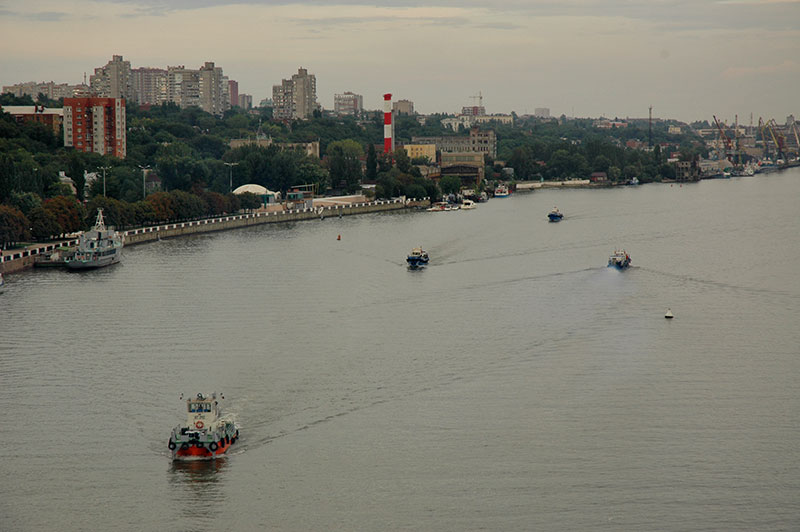
Don River, Rostov-on-Don, Rostov Region, Russia
It’s just forty kilometres from Novocherkassk to southern Russia’s largest city, Rostov-on-Don, which lies on the right bank of the river, not far from its outlet into the Sea of Azov. The traffic is horrendous and I see several accidents as I peel off the M4 into the suburbs, though I am immediately impressed by the city as I drive through the afternoon rush hour to the apartment of my host Oleg.
The region around Rostov has been inhabited since ancient times, but the city itself is relatively modern, established as a centre of commerce and industry on the Don River which is still busy with shipping, with the Volga-Don Canal allowing passage from the cities of inner Russia out into the Black Sea and beyond. Though lying about thirty kilometres inland, the huge, slow Don River gives Rostov the character of a sea port with a certain air of seediness and debauchery and a reputation for organised crime, though I never detect anything close to a threatening atmosphere. I am indeed quite surprised to find Rostov to be one of Russia’s most characterful and charming cities.
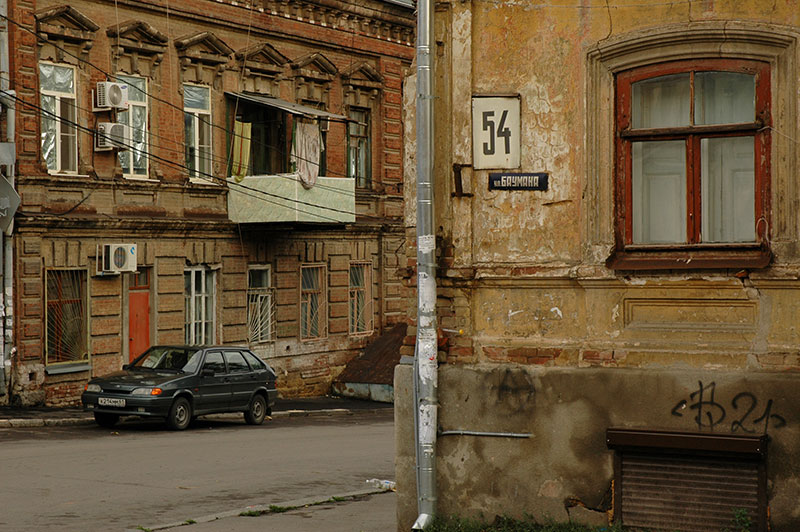
Old City, Rostov-On-Don, Rostov Region, Russia
Rostov’s raffish old centre stretches along a hill overlooking the Don in streets of old, damp, sometimes crumbling brick houses with a real, lived-in patina. The roads are broken and pot-holed, the tram lines are bowed and lifting from the road surface and bins overflow litter into the streets which are full of dogs and cats. The dogs are friendly characters; two sit patiently outside a pet-food shop, another admires his reflection in the broken glass of a ground floor window, and the cats are approachable and playful. I catch the central market as business is winding up for the day, the crowds thinning to leave behind the city’s alcoholics and madmen; one sleeps under the bench in a bus shelter, another dances jerkily to some awful Europop coming from a nearby music stand; others stagger aimlessly or sit on steps in front of shops. Amid this debauchery the general, sober populace of Rostov bustle on their way home, a colourful mix of Slavs, Armenians, other Caucasians and Asians, which together with the chaos and squalor give Rostov a character quite different from the cities of western and central Russia. I would gladly spend several days exploring Rostov, but my transit visa is due to expire, and so after just two nights I must move west into Ukraine.
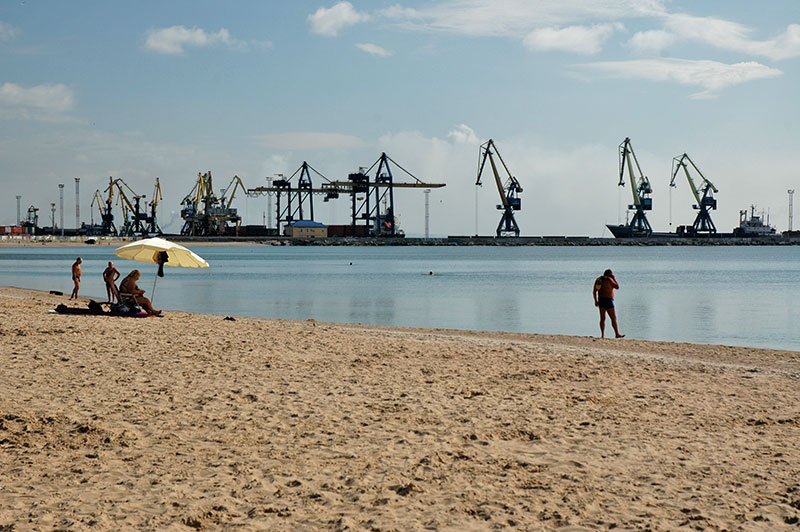
Azov Sea, Mariupol, Donetsk Region, Ukraine
The road to the Ukrainian border runs west parallel to the northern coast of the Azov Sea through intensively cultivated fields of black earth. The border crossing into Ukraine is swift and easy and leads me straight into the Donbass (Donetsk Basin) Region of eastern Ukraine, which in addition to agriculture is famed for its coal reserves and has been very heavily industrialised since the nineteenth century. I witness this industrialisation as I approach Mariupol where a huge, rusting, smoke-belching iron foundry sits on the coast amid piles of coal and grassy slag heaps which run straight into the sea. Once beyond the industrial suburbs however, Mariupol is a pleasant place, and I am lucky to be hosted by Pavel, or rather by his mother and mother-in-law, in Peschanka, a suburb of holiday homes at the western edge of the city overlooking the sea. I’m given a warm Ukrainian welcome with tea, ham, salo (cured pork fatback) and borscht, the classic Ukrainian beetroot soup.
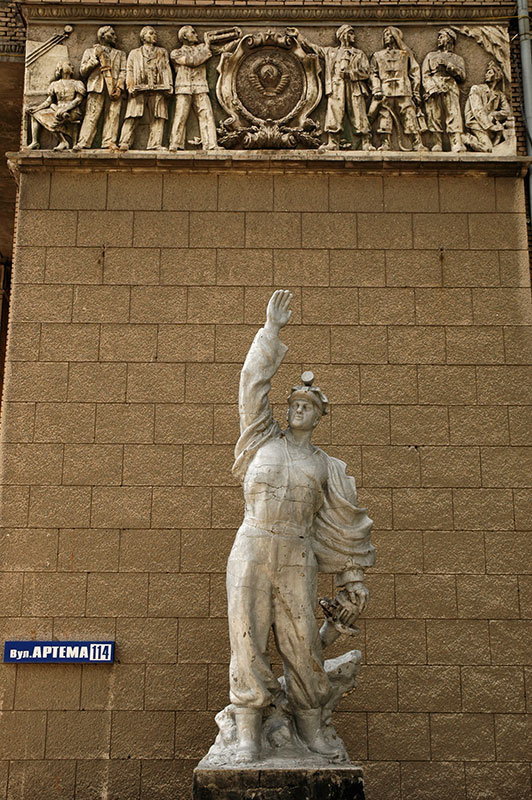
Miner Monument, Donetsk, Donetsk Region, Ukraine
Walking for a minute through walnut, cherry and apple trees brings me down to the beach which is a clean strand of yellow sand, though the Azov Sea is the dirtiest I have ever seen; my feet disappear in its murky green water long before my knees are wet. Not far beyond the beach are the cranes of the city’s docks, backed by smokestacks, and the sea is full of container ships waiting to dock, none of which deter the holidaymakers who are sunbathing on the beach. I meet Pavel the following day, an energetic self-made forty year old businessman and workaholic, though the three bullet wounds in his stomach (a ‘professional problem’) and pistol in his bag speak volumes of the way business is conducted in Ukraine.
Donetsk, the regional capital and my next stop lies a little over a hundred kilometres inland to the north of Mariupol and is effectively the centre of the Donbass. Founded in 1869 by the British industrialist John Hughes, and named Yuzovka until Soviet times, Donetsk is a thoroughly industrial city, centre of a sprawling conurbation of mining and heavy industry. Long renowned as a grim, dirty and polluted city, Donetsk was plagued by economic decline and organised crime following the collapse of the Soviet Union, but has very clearly made a great transformation in recent years and appears clean and prosperous, if a little dull, with the overgrown slag piles which can be seen throughout the city being perhaps its most distinctive sight. Judging by the number of expensive cars on the streets of Donetsk, there is certainly a lot of money here, though even more than in Russia, it seems very unevenly distributed.
This eastern region of Ukraine is predominantly Russian speaking with little assertion of Ukrainian national identity, and I notice that independence-day celebrations here are very low key. At the same time however, there are certainly differences from Russia; it’s noticeably less authoritarian, and there seems to be less state intervention in life; business seems freer, and prices are lower. People also seem slightly more European, smilier, more relaxed and a touch more worldly.
I drive north out of Donetsk, passing through a succession of run-down provincial towns such as Kramatorsk and Slavyansk which are set amidst moribund Soviet industry; places which have certainly not seen the same revival as Donetsk. Beyond these, the landscape changes as I leave the Donbass and return to the rolling fields of black earth which characterise north-eastern Ukraine, an area which has traditionally been a frontier of the Russian Empire, and from where the name Ukraine (from okraina, or borderland) may originate.
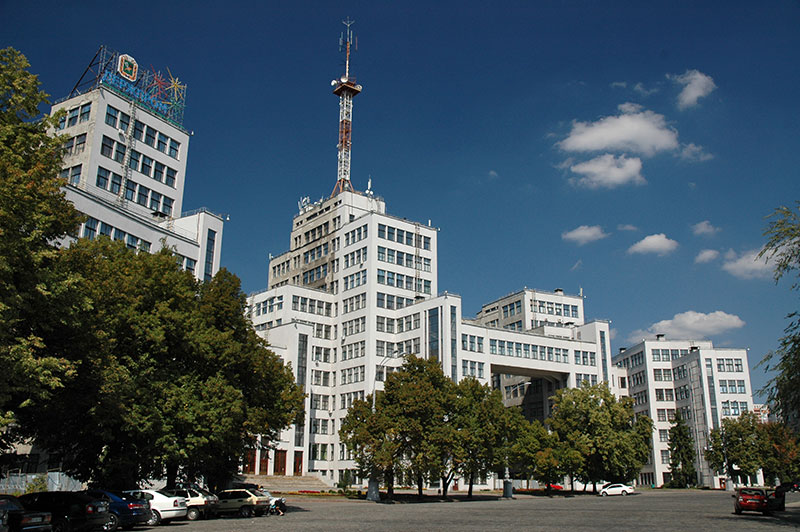
Derzhprom Building, Kharkiv, Kharkiv Region, Ukraine
My destination is Kharkiv, Ukraine’s second city, which has a markedly more cultured and sophisticated air than Donetsk. I am hosted here by Tatyana, in what she describes as a ‘squat’ though which is really more of a private bar and social club which she runs with a group of friends, hosting local musicians and generally cultivating a free and unpretentious atmosphere. I’m greeted at the squat by Lyosha, Tatyana’s husband and quite a character, with whom I visit a local supermarket. Lyosha seems to have very poor eyesight, and walks the aisles muttering madly, looking for me and forgetting utterly what we came in for. Only later would I realise that this was largely was alcohol related, and this encounter would set the tone for the nine days that I spent in Kharkiv, with numerous and rather debauched all-day drinking sessions and bouts of melancholy, evenings of meeting young intellectual types and playing vintage video games, and one lunchtime barbecue with Misha, the squat’s barman and some friends in a garden on the edge of town, enjoying the last of the summer heat with plenty of vodka.
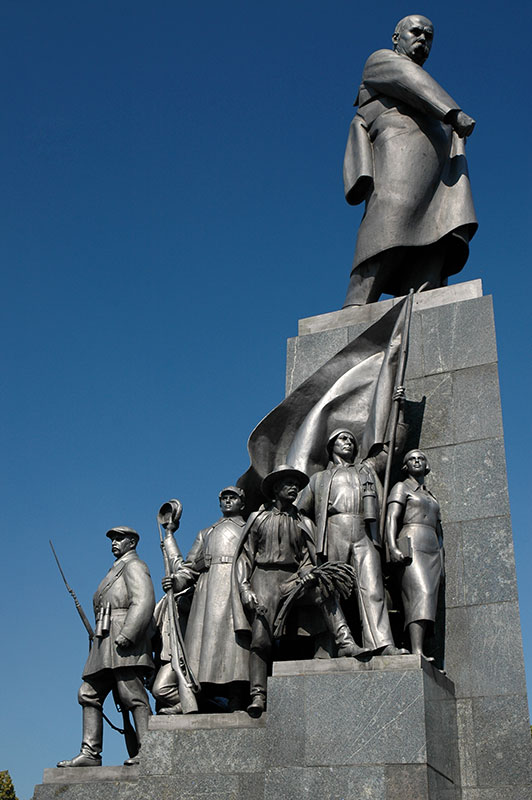
Taras Shevchenko Monument, Kharkiv, Kharkiv Region, Ukraine
Kharkiv, which was capital of the Ukrainian Soviet Socialist Republic from 1919 until 1934 has an elegant centre of grandiose, pre-war Soviet architecture. Walking north from the imposing regional administration building, one crosses cobbled Freedom Square, one of the largest squares in Europe, into a circular park from which streets radiate between the buildings of the National Medical University and the 1928 Derzhprom (State Industry) Building, a masterpiece of Constructivist architecture which combined technologically advanced construction techniques with communist purpose.
In contrast to Kharkiv’s architectural grandeur and youthful, educated population are rows of expensive black SUVs and sports cars (Porsches being especially popular), a sure sign of capitalism which here seems even more rampant than in Russia. While Kharkiv has a more worldly air than Donetsk, I am yet to be impressed with any real signs of a Ukrainian identity, though it is here that I see my first statue of Taras Shevchenko (who looks like a wild-eyed Nietzsche), the poet and ethnographer who was exiled in Kazakhstan for twelve years after insulting the wife of Tsar Nicholas I. As the father of modern Ukrainian literature and language, which are central to an independent Ukrainian identity, I would later see that Shevchenko has become something close to a national hero, his name for example often replacing that of Lenin in Ukrainian city streets.
I pull myself away from the squat and its lures of alcohol and indolence, and push further to the north-west, tracking the Russian border to Sumy where my host Borys accommodates me in the house of his grandparents who live on the edge of town. Borys’ grandmother produces wonderful home-cooked food, with vegetables grown in an impressive and meticulously tended cottage garden, while his grandfather, I am interested to learn, is a survivor of the 1948 earthquake in Ashgabat, which killed over one hundred thousand people. Sumy itself is an unremarkable and rather sleepy city, though from a war memorial on the city’s southern edge one gets a beautiful view over the flat, wooden countryside beyond the Psel River.
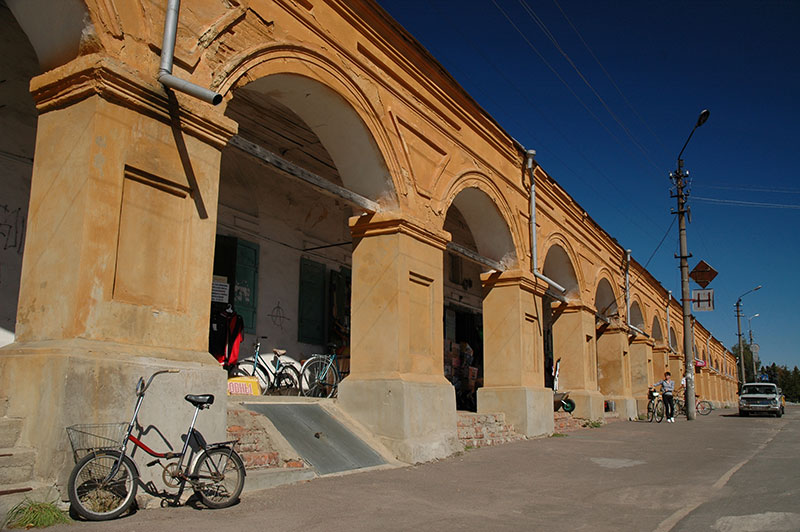
Trading Arches, Novhorod Siverskyi, Chernihiv Region, Ukraine
Beyond Sumy I enter the northernmost part of Ukraine, an area historically known as Severia after a native Slavic tribe, which was incorporated in the tenth century into the medieval state of Kievan Rus’, the progenitor of modern Russia, Ukraine and Belarus. Severia is a beautiful area of rivers, woodland and open countryside around sleepy provincial towns, such as Putyvl, which is overlooked from a forested hill by the gilt domes of the Movchansky Monastery, and Hlukhiv with its collection of churches and unusual Kyiv Gate, a Triumphal Arch which seems somewhat out of place in such a backwater.
Just after Hlukhiv I cross the highway leading from Kyiv to the Russian border along which I drove more than four years ago, on my way to enter Russia for the first time at the very start of the Odyssey. Shortly beyond lies my next stop, the delightful town of Novhorod Siverskyi, which sits on a hill overlooking the slow, overgrown Desna River, seemingly aloof from the modern world with quiet, rambling streets on which move more bicycles and horse-carts than cars, and small houses with burgeoning cottage gardens tended by stout peasant women. In the town’s low-rise centre there are a few Soviet-era buildings, though many are older, including a beautifully preserved example of trading arches, an Eastern Slavic version of an Asian bazaar which have long disappeared from most cities in Ukraine and Russia.
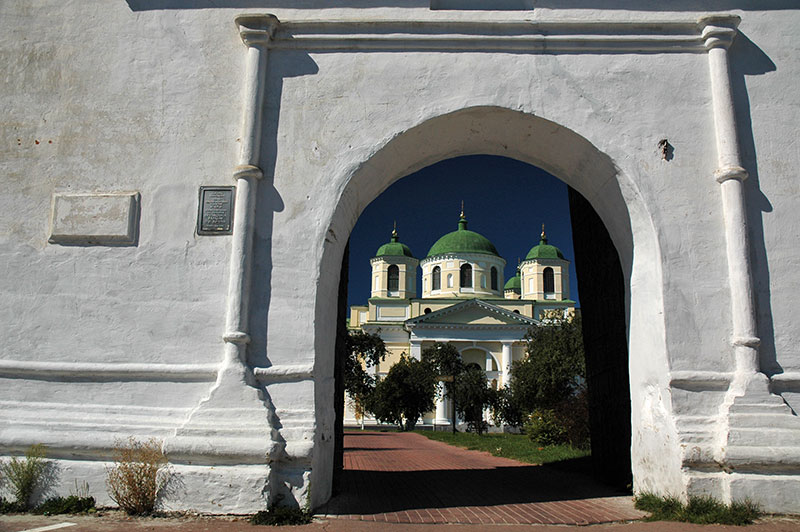
Transfiguration Of The Saviour Monastery, Novhorod Siverskyi, Chernihiv Region, Ukraine
Novhorod Siverskyi is indeed an ancient place with almost a thousand years of history, and was once capital of the Severian Principality. The town’s importance has certainly waned, but it is still famed for its architecture, most famously for the beautifully sited Transfiguration of the Saviour Monastery, a serene Ukrainian Orthodox complex surrounded by a blocky, whitewashed sixteenth century defensive wall, crowned in it corners with pitch-roofed wooden towers, which give it something of a fairytale appearance. In the monastery’s grassy inner grounds monks mow the lawns and gather fruit, and I’m free to wander and climb up a restored wooden staircase to the wall’s upper galleries, then climb to the south-eastern tower. From here there is an impressive view of the Desna as it meanders through rambling, languid vegetation, beyond fields and vegetable plots where women dig potatoes and gather pumpkins. Only the thud of falling apples punctuates the silence in this enchanting spot. In addition to Novhorod Siverskyi’s charming atmosphere, it is here that I first start to appreciate a noticeable difference in character from nearby Russia, one which would become increasingly obvious and assertive as I travelled west. Without Russia’s vast, sparsely populated wilderness, there is not such a stark urban – rural divide; villages and small towns such as this are not forlorn, isolated places eking out an existence, but agrarian communities of living villages and peasants.
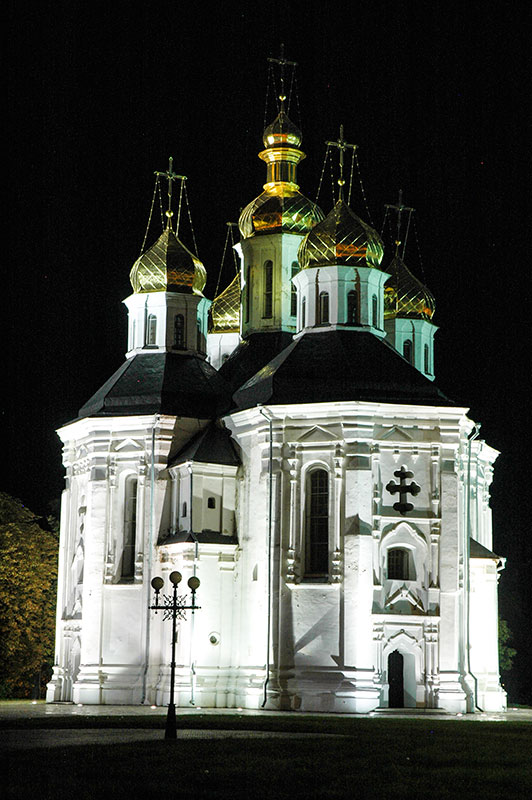
St Catherines Church, Chernihiv, Chernihiv Region, Ukraine
From Novhorod Siverskyi I turn westwards through sparsely populated farmland towards what is perhaps Ukraine’s most arresting geographical feature, the Dnieper River, which forms a backbone to the country. The Dnieper divides Ukraine roughly into two halves, with the territories lying either side of the river historically being referred to as Right Bank and Left Bank Ukraine. Both areas were formerly part of the Polish-Lithuanian Commonwealth, though Left Bank Ukraine was re-incorporated into the Russian state more than a century earlier than its counterpart on the right bank; a legacy which clearly continues to divide the now united country.
I stop short of the Dnieper, in the city of Chernihiv, which with more than a thousand years of history is one of Ukraine’s oldest cities, seat of the Principality of Chernihiv which historically vied for power with rulers of Kievan Rus’, and was later centre of the Cossack Hetmanate, the Ukrainian Cossack state formed by the uprising of Bohdan Khmelnytsky, the hetman (head of state) of the Zaporizhian Cossack Host against the Polish-Lithuanian Commonwealth in 1648.
Chernihiv feels rather spread out, no doubt in part due to the destruction wrought upon it by the Second World War, but it has a number of striking churches standing as testament to its long history; from early, strongly Byzantine-influenced churches dating from the time of the ancient principalities, to the Ukrainian Baroque of the distinctive, heavy-walled Catherine’s Church which sits upon a leafy mound overlooking the Desna on the city’s southern edge.
I leave Chernihiv feeling that I am beginning to find a real, distinct Ukrainian historical and cultural identity, and make the short journey south to the Dnieper where I cross into Kyiv, undoubtedly the cultural, historical and economic hub of the country.
Stage 29 – Kyrgyzstan, Tajikistan, Uzbekistan & Kazakhstan: Transoxiana [2/2]
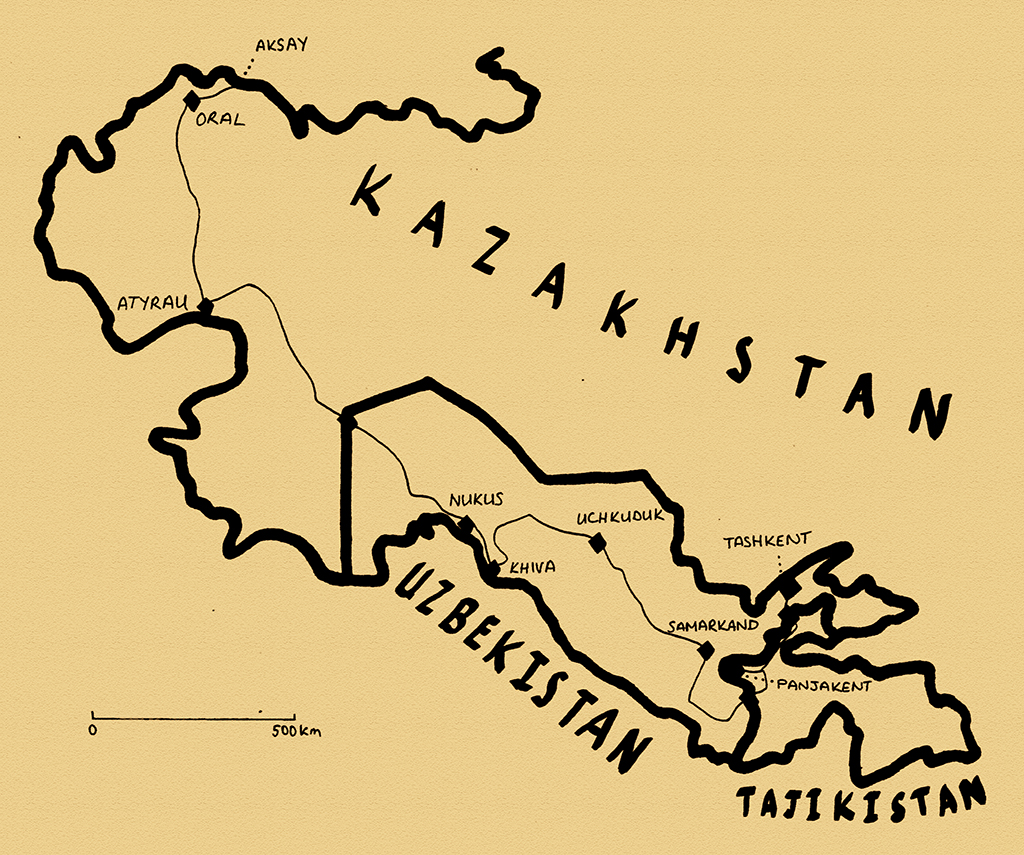
I arrive in Tashkent on the evening of the 4th July 2011, coming off the main road from the Fergana Valley, straight into the district of Lisunova. As in my three previous visits to Tashkent, I stay here in the vacant apartment owned by the family of Pasha, a Russian friend of mine from Novosibirsk whose family lived here until 1997. I am greeted by their former neighbour Gulya, who despite the late hour welcomes me with tea and cakes, as an old family friend.

Palace Of Culture Of Aircraft Builders, Tashkent, Uzbekistan
Lisunova is in the east of Tashkent, located between the city centre and the Eastern Airport, and grew up as a residential district to accommodate workers from the nearby Tashkent Aviation Production Association, which produces large Ilyushin cargo aircraft, though has suffered greatly since the collapse of the Soviet Union and has an uncertain future. The area has a distinctly aeronautical theme, with nearby apartments covered in murals depicting aircraft, wings and propellers, the Palace of Culture of Aircraft Builders, a beautiful piece of 1970s Soviet Modernism, and the nearby metro station named after Valery Chkalov, the Russia polar air pioneer who had a huge cult of personality during the pre-Space Age Soviet Union. In addition to these Soviet cultural touches however, Lisunova is somewhere I feel quite personally attached to through multiple visits, almost as a home neighbourhood. Previously, Lisunova was almost entirely Russian, though with a dwindling Russian population demographics are naturally shifting as Uzbeks come to replace the departed Russians. In Lisunova I am living in a safe, leafy, gentle, cosmopolitan slice of Soviet urban planning, and I spend each evening in a local bar drinking cheap, cold draught Qibroy beer, watching the world go by around me and pondering my strong attachment to this place.
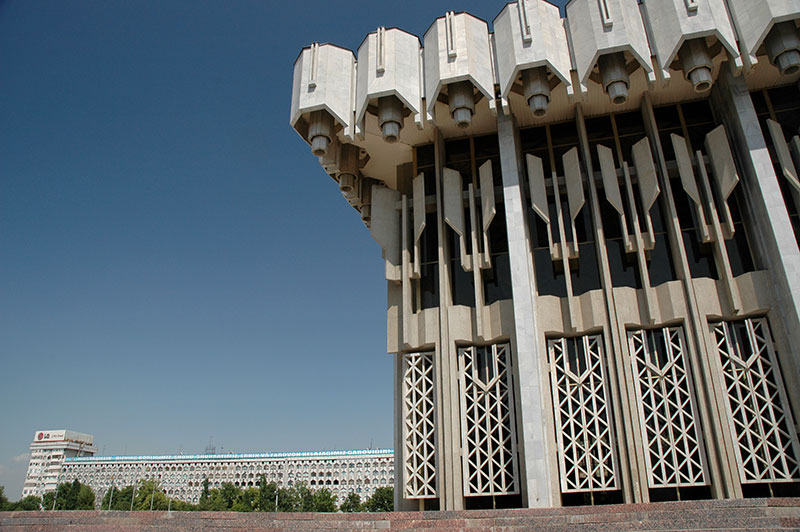
Palace Of Friendship Of Peoples, Tashkent, Uzbekistan
Tashkent is by far the largest city in Central Asia, making other capitals such as Bishkek, Dushanbe and Ashgabat look like the glorified provincial towns that they are. Tashkent is a real metropolis, a mature and urbane city, an island of European-styled sophistication amidst the endless agricultural towns and villages of Transoxiana. With the near-total destruction wrought by an earthquake in 1966, whose epicentre was directly below the city, there is nothing of any great age in Tashkent. Nevertheless it is perhaps my favourite city in the Former USSR, for it is a true showpiece of Soviet architecture and urban planning; a living example of Soviet communal living, a spacious and (sometimes quite strangely) uncrowded city of monumental boulevards, (dated) modernist architecture, huge apartment blocks and watered parks. I take myself on a nostalgic tour of my favourite places in the city; starting up in the Khast Imam complex, a rather impotent centre of Islamic study whose totally restored complex includes a beautiful Grand Mosque and the dazzling Barakhon Medressa. From here I move east to the powerful Socialist-Realist Earthquake Memorial, commemorating both the dead, and the fraternal assistance in rebuilding the city from workers and engineers across the Soviet Union. Turning through the shady, plane-lined banks of the Ankhor Canal, I reach the massively remodelled Independence Square, the showpiece of post-independence Tashkent.
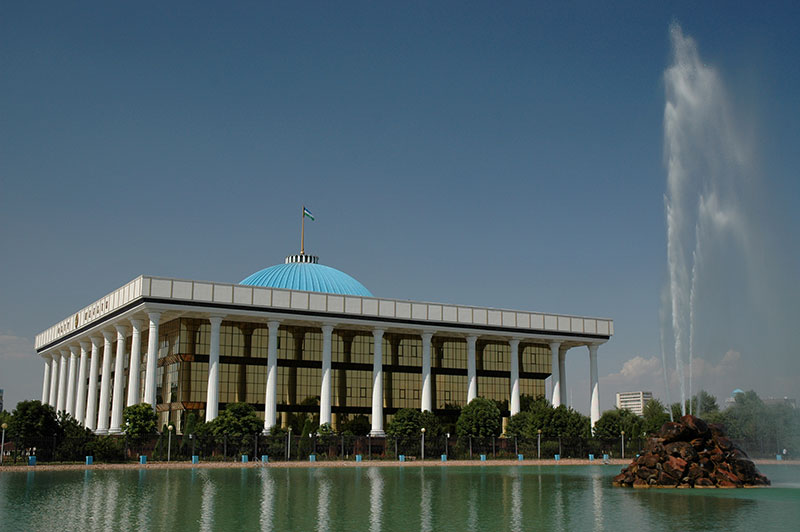
Parliament of Uzbekistan, Tashkent, Uzbekistan
Islam Karimov, Uzbekistan’s despotic president, has a clear wish to homogenise life across Uzbekistan; to impose an unnatural degree of order across the country, which robs many cities of character. At once Tashkent is too large to be robbed of its Soviet character, but simultaneously it is the site of Karimov’s greatest attention, nowhere more so than in Independence Square. Here absolute control and absolute order are manifested in a heavily policed park, whose grass is trimmed by squads of scissor-wielding women, and may not be walked on. A facade of prosperity, of absolute order and calm must be projected to the people, who seem rather out-of-place in this soulless park. Economic stability and reasonable salaries would probably impress people more. I strike west along Uzbekistan Avenue, passing some monumentalist Soviet giants and the nasty smoked-glass Uzbekistan Banking Building, whose pseudo-national style is typical of post independence architecture. From the huge Soviet rotunda of a circus I turn south, reaching the magnificent Palace of Friendship of Peoples, an iconic piece of Soviet Modernism which sits in a large, strangely empty park, backed by what must be some of the longest apartment buildings ever constructed. South from here I venture into Navoiy Park, where the Uzbekistan Parliament Building is one of the few tasteful new buildings, though what use a parliament is in such a dictatorship is highly questionable. From here I take a stroll down Beshagach Street, which runs through Neoclassical columns back to the very centre of the city at Amir Timur (formerly Lenin) Square. Here lies the Hotel Uzbekistan with its mesmerising latticework in the style of Timurid mosaic-work, though I am saddened to see that the ancient plane trees which previously filled the park have been cut down for no apparent reason; a move very unpopular with many of the city’s residents.

Hotel Uzbekistan, Tashkent, Uzbekistan
I spend five full days strolling around Tashkent, indulging myself in the odd sense of nostalgia I have for the city, though I can’t quite fully explain to myself just why I am so charmed by it. I have happy memories of Tashkent; of getting the truck’s suspension fixed here in 2007; of an impulsive decision to get a Pakistani visa here in October 2007, perhaps the most pivotal moment in how this journey came to be so long; and of a rather debauched three weeks of alcohol-fuelled recuperation here with Duncan in November 2009, in between visits to Afghanistan. Tashkent also perhaps best fulfils a hopeless ambition to visit the Soviet Union for real, though through my visits I can feel that the city is very slowly moving away from this past. On my final melancholic day here I walk around the centre, finding a pleasant urban park above one of the exits of the fantastically decorated Kosmonavtlar metro station. I sit on a bench amidst the plane trees, overlooked by a nine-storey apartment block. Around me are old Russian babushkas (grandmothers), Uzbek youngsters, Ukrainians, Tatars, Koreans; often mixed families, all parading gently on this warm Saturday afternoon, after the worst of the daytime heat has abated. Here I see what I fancy is the Soviet dream; a secure, safe, predictable life in a modern, cosmopolitan city built in the European style, way out in the middle of Central Asia. Next to me, an old Russian lady shifts her weight and levers up a loose slat from her bench with a disapproving look. I too wonder how long this island will survive.

Turkestan Range, Sughd Region, Tajikistan
I leave Tashkent in an air of sadness, and a lingering feeling of finality, heading south early on a Sunday morning, out of the city and into the nondescript small farming towns which spread towards the mountains of Tajikistan. I arrive at the border crossing at Oybek to find a sizeable crowd of people being largely ignored by the Uzbek guards. Political animosity between the two countries makes it difficult for their citizens to cross from one country to another across an arbitrary border which divides people who have lived easily as neighbours for centuries. I am the only vehicle waiting to cross the border, though I too must wait, until eventually an idiot of a young customs officer deigns to poke through the contents of the truck; seemingly confounded by anything of industrial manufacture such as mosquito coils or a pot of petroleum jelly. After twenty infuriating minutes of watching his mindless rifling, he gets a call on his mobile phone, cannot be bothered to search any further, and I’m free to leave.
After some poor attempts at extortion on the Tajikistani side of the border, I’m free at midday on the newly built Chinese road which runs first to Khujand, crossing the Syr Darya then heading south past Istaravshan, climbing into the Turkestan Range. As the road climbs steeply, hugging the mountainside, I can see that the Tajiks share the same mindless, belligerent incompetence behind the wheel as their Persian cousins, and the road is lined by the mangled wreckage of lorries which have crashed off a precipice on one of the switchbacks above. The asphalt disappears as I begin the climb of the 3350-metre Shakhristan Pass, which then leads down to the village of Ayni, where after a delicious meal of fatty mutton shashlik, I turn off the main highway onto the rough road above the Zarafshan River.
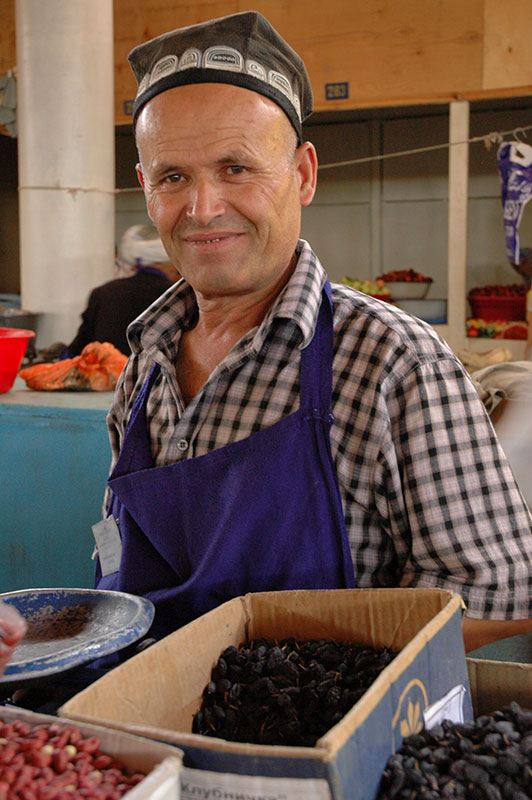
Tajik Fruitseller, Panjakent, Sughd Region, Tajikistan
Upon entering the Zarafshan Valley, the scenery is stunning, with small villages marked by patches of greenery squeezed onto narrow ledges above the river, and the road clinging onto the steep mountainside. I pass friendly villages with mixed Uzbek and Tajik populations on my way downstream along the Zarafshan, which flows eventually to Samarkand in Uzbekistan. After some distance, the valley starts to open up and the villages become larger, dotted with fields of sunflowers and even grapes, until I roll into Panjakent, the principal town of the valley. Panjakent is a bustling market town a with a friendly bazaar, but its main point of interest lies in the hills to the north. Here, I reach the ancient ruins of Panchekanth, which sit aloof from the modern town; a large, grassy terrace of well-weathered mud-brick buildings and walls with just the odd remaining arched doorway, perhaps the remains of ancient Zoroastrian fire temples. Panchekanth was a city of the Sogdians, who had existed in this corner of Central Asia since ancient times, Iranian peoples who formed a series of small states centred around nearby Samarkand, were incorporated into the empire of the Achamaenids and Alexander the Great, and were later famed as traders of the Silk Road until conquered by the Arabs in the eighth century. The legacy of the Sogdians remains however, with traces of Sogdian surviving in the Tajik language, and also in the name of the province in which Panjakent lies: Sughd. Opposite the site itself is an old, dusty museum, whose friendly curator Hikmatullah speaks to me for a long time, showing me a copy of the enchanting friezes unearthed here, whose beautifully coloured depictions of Sogdian kings, noblemen and woman show delicate Persian, Greek and Chinese influence; real art of the Silk Road. He also shows me a Sogdian jar burial, containing the remains of a human body whose bones would have been picked clean by vultures following a traditional Zoroastrian sky burial, and he points at a nearby dakhma (Zoroastrian ‘tower of silence’, where dead bodies were left) in the hills to the south-west.

Hazor Chashma Lake, Sughd Region, Tajikistan
Having stocked-up with provisions in Panjakent’s bazaar I head south, along a rough track which climbs up into the Fann Mountains, part of the Hissar Range which stretch west into Uzbekistan. As I drive ever upwards I start to pass a string of seven lakes, each of deep blue water held behind landslides which have blocked the river into this narrow valley. With increasing altitude, the scenery becomes ever more spectacular and terraces appear on the steep valley-sides, dry-stonewalls, irrigation channels, fruit trees and simple mud-brick homes of purely Tajik villages. Men smile and press their right palms to their chests as I pass; an idyllic mountain paradise untouched by modernity, which once again reminds me more of northern Pakistan or Afghanistan. It’s as if all the rigours of the twentieth century had simple bypassed this tranquil valley. In the afternoon I reach the end of the road in the village of Marguzor, which spreads across three valley-sides around the sixth of seven lakes, a truly beautiful place, though it’s clearly also impoverished and must be terribly bleak and isolated during winter. I politely decline an invitation from a gentleman to stay at his home, and instead park up at the lake-side for the night, watching a group of local boys fishing in the lake’s cold, clear water. For the first time since leaving the mountains of Kyrgyzstan I have a cool and pleasant night.

Tajik Boys, Hazor Chashma Lake, Sughd Region, Tajikistan
In the morning I leave the truck and begin walking on the well-worn village paths up to the seventh and final lake, known as Hazor Chashma (‘Thousand Springs’ in Tajik). Leaving the village houses, I climb past occasional shepherd’s huts and small, walled plots of crops, passing groups of children leading donkeys downhill carrying bundles of juniper wood from much further up the valley. I soon give up any idea of strenuous hiking up to a pass to view the snow-peaks which lie beyond the valley walls, instead enjoying the wonderful lakeside serenity and occasional donkey traffic, sitting in the cool shade and drinking in the beauty of my surroundings, in view of the ferocious heat I’ll be driving through in the coming days. With a touch of melancholy I realise this will be one of the last moments where I can witness such unadulterated magnificence before I return to the dull landscapes of Europe. There is no sound to pollute the tranquillity here, just the gentle lapping of the lake’s waters, and the occasional lament of a donkey in the surrounding valley. Up beyond the head of the lake is a steep hillside, which on close inspection I see is dotted with more mud-brick hovels, one of the most hidden and isolated settlements I have ever seen, totally without modern infrastructure. Two boys plod down on a donkey and we have a halting conversation in my few words of Persian, but they nevertheless manage to invite me back to their home, though wishing to remain where I am, I decline. Once again I’m faced with the uncomfortable truth that nicest people in the world – the friendliest, kindest and most trusting – are those that have the least.
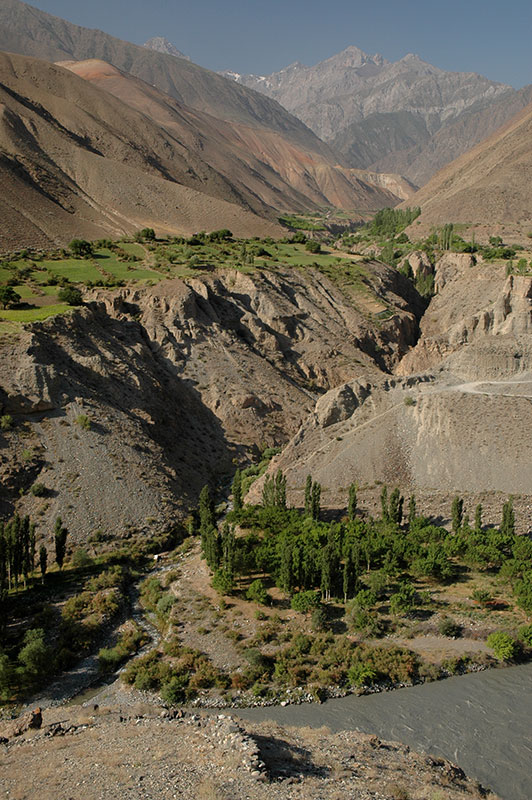
Zerafshan Valley, Sughd Region, Tajikistan
I retrace my route back down to the road, which formerly would have led west to Samarkand, however Karimov’s dislike of Tajikistan has seen him close the border for no reason other than spite, stifling tourism and communication in this beautiful region of Tajikistan, which now lies isolated between the mountain passes which separate it from both Khujand and Dushanbe. Rejoining the main M34 Highway towards Dushanbe, I soon have a rather unpleasant experience. A car driven by a wild-looking young man passes me very close, grazing my bull-bars. There is no damage to the truck, but a crease in the bodywork of the other car, which stops, and whose driver demands payment, which I of course refuse. After perhaps half an hour of threatening and at times abusive behaviour, the driver’s father arrives in another car. Although he is a revolting, volatile, self-adoring fool with a squeaky voice, his son’s behaviour suddenly improves, and we drive to a police post some distance down the road.
The road winds up the green slopes of the Zarafshan Range, plunging through the infamous Anzob Tunnel, a botched Iranian engineering project whose unlit five-and-a-half kilometre interior is almost perpetually flooded, with holes in the road surface large enough to founder cars in waist-deep water. Reaching the police checkpoint, arguments continue, though I refuse to do anything without informing my embassy. By now in a rush, both the driver and his father agree to meet me at the British Embassy the following day in Dushanbe, telling me that the police will hold my driving license until the matter is resolved with the Dushanbe Traffic Inspectorate. However, once everyone else has departed, the police officer, perhaps sensing that I am not at fault, or perhaps not wanting the burden of starting an investigation, hands me back my license, and I leave.

Soviet Border Marker, Surxondaryo Region, Uzbekistan
Beyond the checkpoint the road winds down the Mediterranean-like foothills, dotted by the holiday homes of the capital’s rich, into the sweltering heat of Dushanbe. I had planned on spending a couple of days here but, having found the city rather dull on my first visit in 2007, and not wanting to run into my accusers, I bypass the city and head straight for the Uzbekistan border at Dusti. I leave Tajikistan without an issue, and am even given a melon by a customs officer who is a frustrated piano player, and asks me to invite him to the UK. However, here I am once again subject to the bad relations between the two countries, as vehicular traffic is reduced to a trickle through the Uzbek customs yard, with thorough and time-consuming searches. I have to spend the night in no-man’s land, under an old Soviet monument to fraternal relations between Soviet nations; something which seems in short supply here. I do make friends with the only other car driver here, Nazim, a Tajik who is driving to Almaty. When we are finally admitted to the customs yard mid-morning the following day, Nazim is first in, though I need to lend him some tools to start dismantling parts of his engine so that the Uzbek guards can read his engine number. After my own thorough search, I’m through ahead of Nazim and wait for him a short way down the road, taking a very refreshing dip in the cool waters of an irrigation channel. Before long Nazim arrives and we have a great late lunch together, which he insists on paying for, before we go our separate ways.

Hissar Range, Surxondaryo Region, Uzbekistan
After passing the city of Denov I turn off the M41 Highway, heading west on small roads, bypassing Termez down on the Amu Darya where I had crossed in and out of the country from Afghanistan almost two years earlier. The road climbs through small villages of mud-brick houses, decorated sometimes with floral motifs and far more modern than the hovels I had seen in the Fann Mountains. Shepherds on donkeys move their herds across the landscape which is a near uniform brown but for the occasional low limestone outcrop; the air is thick with dusty haze and the heat torrid, giving these low southerly outliers of the Hissar Range the look of the Judaean Hills of Palestine. I stop in the early evening in the pleasantly green hill town of Boysun which is somewhat different from the typical lowland cotton-farming towns which dot most of the country, then move on to find a wonderful camping spot just out of town, overlooking the road which heads west towards Samarkand and Bukhara in this Biblical landscape, where I enjoy a pleasantly warm night under the stars, relieved to be out of Tajikistan.

Friday Mosque, Katta Langar, Qashqadaryo Region, Uzbekistan
In the morning I soon join the M39 Highway, which climbs gently to the ‘Iron Gates’ a natural defile in the Hissar Mountains through which traffic must pass; rather like the Khyber Pass, this transport bottleneck has a long history, linking Balkh and Samarkand, and has long-witnessed the passage of the armies, trade caravans and pilgrims which define the region’s history and culture. Today the traveller is delayed here by traffic jams caused by the authorities checking vehicles and passengers arriving from the Afghanistan border region, though I manage to pass without significant delay, turning north in Guzar towards Shahrisabz, hometown of Tamerlane (Timur).
After around thirty kilometres however I turn east, back into the foothills of the Hissars, winding up a narrow valley of powdery orange-brown rocks and scattered mud-brick houses to the large village of Katta Langar, where on a flat-topped hill sits the red-brick mausoleum of the sixteenth century Sheikh Muhammad Sadik. Said to be an adherent of a minor Sufi sect which was pushed into this small valley by the Naqshabandi Order (who spread from Transoxiana to the Indian Subcontinent at around this time), the mausoleum is restrained, lacking the dazzling faïence of the country’s most famous shrines, but of very elegant, Timurid proportions and set amidst a delightful cemetery of pistachio trees and ancient gravestones with Arabic inscriptions. Across the valley, where the bulk of the village houses lie along winding, unpaved alleys, is the Friday Mosque which, while plain on the outside, has a dazzling interior; a floor covered in aged carpets, walls of blue, geometric and floral tiles and a beautiful faïence frieze of Arabic below a decorated wood-beam ceiling supported by finely carved oak pillars. The mosque is said also to date from the sixteenth century – though I wonder how much of what survives is original – and is unusual for reversing the typical combination of exuberant exterior and plain interior.
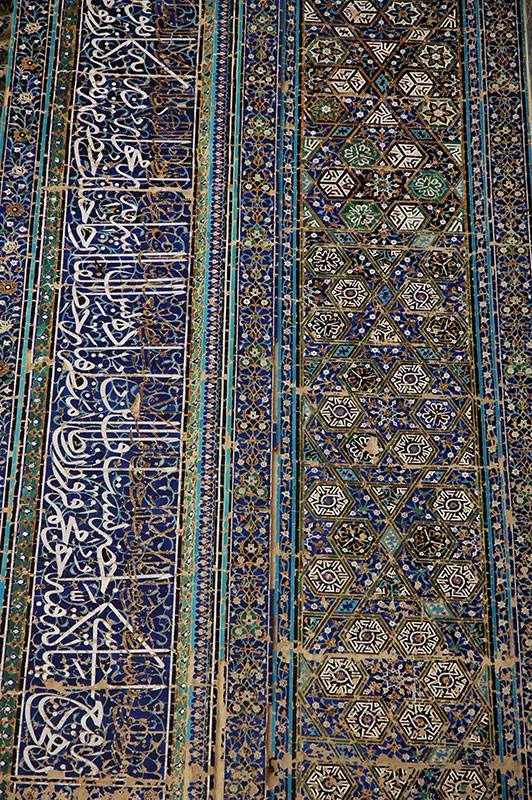
Tilework, Ak-Saray Palace, Shahrisabz, Qashqadaryo Region, Uzbekistan
Back on the main road I stop in Shahrisabz to admire again the crumbling ruin of Timur’s fourteenth century Ak Saray Palace, whose impossibly vast proportions surpassed the technologies of its time and soon crumbled, leaving evocative ruins which have thankfully thus far been spared the insensitive ‘restoration’ of many of the country’s other great architectural monuments. Only the soaring remains of the palace’s huge fallen arches remain, with great swathes of the never-finished exterior tilework, some of the most magnificent in the entire region. Elsewhere in town are beautiful mausolea containing members of Timur’s family, and a simple tomb thought to have been intended for Timur himself, though none have the same air of decaying and derelict megalomania as his fallen palace. Shahrisabz is otherwise a pleasant, bustling market town relatively unspoiled by tour groups and stopping at a tyre repair shop on my way out to get a puncture repaired, I am invited for lunch by the friendly Uzbek family who run the shop, and am not even charged for the repair.
North of Shahrisabz the road climbs a rocky hillside to reach the cool Takhtaqaracha Pass where I am delighted to find a spring whose cool, clean water is invigorating after days of driving through the torrid heat of the plains. The road descends gently to the north, through charming villages of ancient walnut trees and open water channels, dropping into the farming villages around Samarkand. The temperature is still noticeably cooler compared to the south side of the pass, and on a whim I decide to camp on a hill near the airport, overlooking Samarkand whose dusty skyline of low houses and mulberry trees is dotted by turquoise domes and huge portals; the heart of Transoxiana.

Petroglyphs, near Debaland, Navoiy Region, Uzbekistan
In the morning I check into Bahodir’s B&B in Samarkand, an old haunt from 2007 and 2009 where the family welcome me warmly, though are worried that I have been travelling for four continuous years rather than getting married. Bahodir’s is perhaps the greatest node for travellers in Central Asia, and I spend twelve days here relaxing, meeting other travellers and exchanging stories from the road, in a manner similar perhaps to the merchants who paused in caravanserais along the Silk Road centuries ago. The old centre of Samarkand seems to become ever more sanitised and charmless as the years advance, though the ensemble of medressas (seminaries) around the Registan (central marketplace) remain a magnificent sight; some of the the finest Islamic architecture on the planet. I make a few forays into Samarkand’s modern city, which is refreshingly down-to-earth and retains architectural traces of the Tsarist Russian Empire. Mostly however I spend days lounging in the courtyard at Bahodir’s, drinking cold Pulsar lager whilst chatting with fellow travellers.

Central Square, Zarafshan, Navoiy Region, Uzbekistan
Eventually I extricate myself from the amiable torpor of Bahodir’s and start my final journey towards Russia and Europe. I drive north-west from Samarkand towards the city of Navoiy and the fearsome heat of the Kyzyl Kum (Red Sand) Desert. I divert north-east briefly towards the Kazakhstan border, in order to find some petroglyphs on the desert-varnished rocks which lie in the hillsides above the road, then turn back and begin my journey into the heart of the desert. Away from the country’s main transport artery, this road exists to serve the remote mining towns of the Kyzyl Kum, and my first stop is in the gold mining town of Zarafshan. A modern, planned town founded in the late 1960s, I’m surprised to find that perhaps half the population are Russian, and Russian language is found on signs and shop-fronts, as if it were a preserved bubble of the USSR. As I drive out of town in the late afternoon, I am again surprised to see occasional yurts (nomad tents) dotted in the desert, inhabited presumably by once nomadic Karakalpaks, an ethnic group closely related to the Kazakhs to the north. As the sun approaches the horizon, and the heat finally starts to subside, I pull off into the sandy desert and make camp, spending a glorious night under a star-filled sky, lying on the back of the truck in nothing but my underpants.

Kyzyl Kum Desert, Karakalpakstan Republic, Uzbekistan
I reach the uranium-mining city of Uchkuduk in the morning, and need to find diesel. As in most parts of the country, the fuel pumps here are dry and diesel must be sought out on the black market; in this instance I befriend a minibus driver who leads me back to his home, where he pumps forty litres of diesel for me from an unseen source below a trapdoor in his garage. At a checkpoint on the edge of Uchkuduk the police stop and advise me to carry plenty of water and extra fuel, and then I am off into the depths of the Kyzyl Kum Desert on a road which I have long wanted to drive. I enter a landscape of endless, undulating desert, usually sandy, though always vegetated, and it is more than an hour before I pass another vehicle. Only once do I pass a remote settlement near an old irrigation canal, and as I enter into the autonomous republic of Karakalpakstan the landscape starts to alternate between sand and the wasteland of muddy plains which typify this blighted republic. By mid-afternoon I reach an unexpected roundabout in the middle of nowhere, where I turn south towards the Khorezm Oasis on the Amu Darya River, briefly rejoining the main road and then heading to the ancient city of Khiva.

Chilpyk Dakhma, Karakalpakstan Republic, Uzbekistan
Khiva, which I had previously visited in 2007, was the capital of the Khorezmian State, and later the Khanate of Khiva, famed for its trading of Russian slaves in the eighteenth and nineteenth centuries. Modern-day Khiva is visited by hordes of tourists and feels like a large open-air museum, but it’s my last glimpse of Central Asia and I’m content to spend a nostalgic morning wondering the streets of the Itchan Kala; the much restored, walled old-city, before taking to the road once more. I drive north-west through the Khorezm Oasis, crossing the muddy Amu Darya on a heavily patched steel pontoon bridge as the sun lowers towards the horizon. Not far from here I leave the highway and drive into the desert, to camp at the foot of the beautiful Chilpyk Dakhma, a Zoroastrian ‘Tower of Silence’ where the deceased were laid out to have their bones picked clean by vultures, thought to be more than two thousand years old and with views over the Amu Darya as it makes its way through the utterly barren landscape, with the irrigated fields of Khorezm in the distance.
In the morning I make my way to the city of Nukus, which feels more than ever (on my fourth visit) to be at the edge of the world. There is no fuel for sale, no ATMs, the city’s only internet cafe is closed, the tap water is undrinkable, and I fail even to find a place to eat anything more than limp, warm, fried matter. It’s this extreme isolation however which gives Nukus its character, as capital of the once fertile, but now desperate Karakalpakstan Republic, which feels the full effect of the Aral Sea Disaster. It was here that artist Igor Savitsky managed to secrete an astounding collection of paintings from zealous Soviet censors, and the modern Savitsky Museum is an astounding collection of non-conformist twentieth century Russian realism and impressionism which has been preserved in this far flung outpost of a city.
I leave Nukus in the afternoon, passing through an increasingly desolate landscape of dying irrigation canals and salinified fields, until I reach the twenty-five metre high cliffs of the Ustyurt Plateau; a stony, desert wasteland which stretches to the Caspian Sea. Here I break my journey, camping next to the Davit-Ota Necropolis on the edge of the plateau, spending another warm night under the stars in a starkly beautiful and rueful environment. From here it’s a three hundred kilometre drive following railway tracks to the border post, passing utter desolation, at most times with nothing whatsoever to catch the eye. Occasional, impossibly isolated, sun-beaten, fly-blown settlements loom on the horizon to the left; small railway staging-posts of oblivion, where life must be near unbearable. Around one hundred kilometres short of the border a camel which has been killed by a truck lies sprawled at the roadside, where in the 45º C midday heat its poor owners are scooping its insides out in a swarm of dust and flies. Karakalpakstan is certainly one of the most desperate and stricken regions of Eurasia which I have seen.

Freight Wagons, near Beyneu, Mangystau Region, Kazakhstan
I have an arduous three-hour wait at the border crossing which is shadeless and plagued by flies and dust-storms, though when I am waved through in the late afternoon I am conscious that the crowds of friendly Uzbek migrant workers on their way to Russia have been waiting far longer than I have. On the Kazakhstani side the road is an appalling washboard, but in the first town of Beyneu I am re-acquainted with the delights of civilisation; a well-stocked supermarket, a simple restaurant and an ATM. I leave Beyneu well after dark, deciding in view of the terrible heat and some noises from the truck’s front axle against heading south towards Aktau and the pilgrimage sites of the Ustyurt Plateau (which I would visit in 2014) and heading instead north towards Atyrau, camping next to the railway tracks and reaching the unlovable city of Atyrau late the following morning. I spend five comfortable days with Akmaral in Atyrau, contemplating my return to Europe. My plan is to drive to Ukraine; however I have no visa for Russia, and after being unable to obtain a visa in either Bishkek or Tashkent, I have only one last chance at the consulate in Oral, five hundred kilometres to the north, close to the Russian border.
Whilst in Atyrau I meet a group of Slovakians who have been robbed at gunpoint during daylight hours in the middle of the city, and James, an American cyclist who is also staying with Akmaral is knocked off his bicycle in a hit-and-run accident by a local driver. This seals my impression of Atyrau as perhaps the most unpleasant city I have visited on the entire trip, and I am glad to leave, heading north parallel to the Ural River across featureless steppe, which fades gently from semi-desert to sub-Siberian rangeland as I approach Oral. If I cannot obtain a Russian visa here, then I will need to make a very long detour through Turkmenistan, Iran and Turkey in order to reach Europe, and will need to double back to Almaty immediately to start obtaining visas. It is to my great relief then that I am able to get a ten day transit visa same-day, and in the late afternoon I am driving north-east, crossing the border on the Ural River at midnight and heading towards Orenburg.
And so concluded my 2011 journey through Central Asia, which had shown me so many more parts of Kazakhstan and Tajikistan, and some new places in Kyrgyzstan and Uzbekistan; meaning now that I had seen almost every part of Central Asia. This region, still relatively recently opened up to the outside world, with an alluring mixture of magnificent history, crumbling, atmospheric monuments, gorgeous scenery and welcoming people roughly book-ended the beginning and the end of the initial four-and-a-half year section of the Odyssey, and remains perhaps my favourite region of the world. Ahead of me now was the final drive back through Russia, Ukraine and Moldova, to finally return to the UK at the end of the year, after fifty-five months away.
Stage 29 – Kyrgyzstan, Tajikistan, Uzbekistan & Kazakhstan: Transoxiana [1/2]
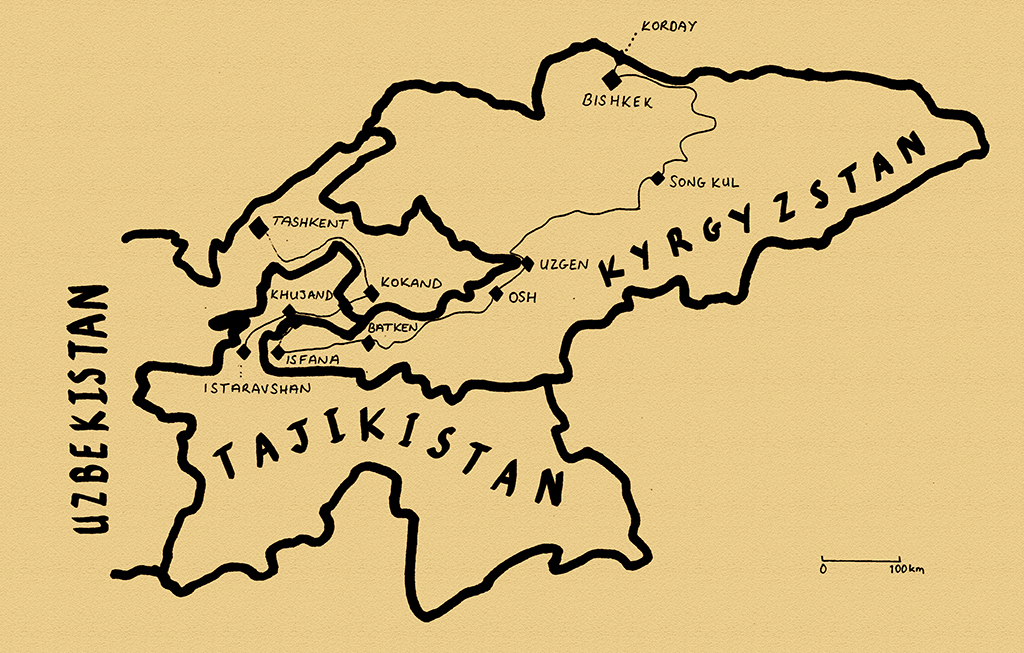
Transoxiana, literally meaning ‘Land beyond the Oxus’ is a swathe of long-settled territory at the heart of Central Asia, stretching from the Pamirs in the east to the Aral Sea in the west. It was this region which had initially drawn me towards Asia instead of Africa, and it was the first which I had explored in any real detail, on the outward leg of the trip more than four years earlier. For this reason I felt particularly attached to these fascinating and colourful cities and landscapes, and found myself on several occasions feeling quite nostalgic, considering all that I had learned and experienced in the intervening years of continuous travel, looking back on a journey of more than 120,000 kilometres around the continent. Perhaps it was rather ironic, or perhaps quite logical, that it was here that I finally decided to conclude the trip. I had plenty of money remaining, the truck was still in fairly good condition and I was still fit and healthy, but I had almost run out of places to visit, and my seemingly endless curiosity was finally being (temporarily) sated. The thought of returning to the dull mundanity of Western Europe, after years of exhilarating freedom held no appeal whatsoever, but it seemed a logical choice. So, as I toured the backroads of Transoxiana which I had missed in 2007, in the sweltering summer heat, I was both physically and mentally beginning a return journey, to somewhere I could scarcely call home. Far from being melancholic however, this five thousand kilometre journey from the Tien Shan Mountains, down through the lowlands and jigsaw-borders of the Fergana Valley, through the barren wastes of the Kyzyl Kum Desert and on to the Caspian Sea, would give me one last, lingering view of the Kyrgyz, Tajik, Uzbek, Russian and Kazakh societies of modern-day Transoxiana.

Ala Too Square, Bishkek, Kyrgyzstan
On the 8th June 2007 I enter Kyrgyzstan from Kazakhstan at the cross-border town of Korday, and head straight to Bishkek. The Kyrgyz capital was where I had made my first real rest stop of the trip, and now, years later I would repeat this. Modern Bishkek was established as a Russian garrison in 1865 and is certainly not one of the region’s great historical cities, but it makes for a pleasant place to relax. Despite last year’s revolution, which unlike the ‘Tulip Revolution’ of 2005 descended briefly into violence and anarchy, the city seems not to have changed and retains, by day at least, a pleasant and friendly atmosphere. Tree-lined avenues separate long urban parks and are filled with pretty girls and street food stalls giving a strong hint of Asia; unsurprising given that China is just a few hour’s drive away. In slight contrast to this free market atmosphere stand some polished examples of Soviet architecture, such as the genuinely impressive Parliament Building, or the 1980s modernist National (formerly Lenin) Museum. All streets slope gently upwards towards the magnificent mountainous backdrop in the south, a reminder that one is close to the heart of the ruggedly beautiful Tien Shan Mountains. A touch faded, and shabby at the edges, Bishkek is something like a poor, country cousin of Almaty, though far less pretentious and no less pleasant to spend time in; something I do thanks to the hospitality of a Simon, an ebullient Frenchman who works for an environmental NGO.
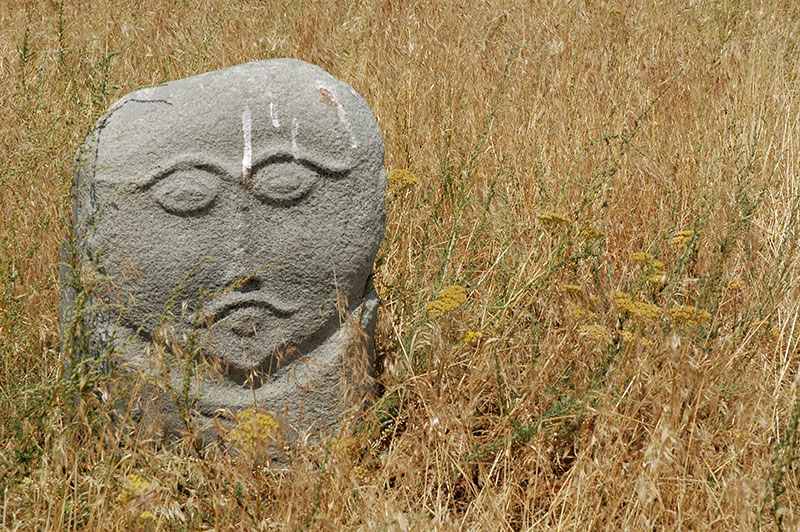
Balbal, Balasagun, Chuy Region, Kyrgyzstan
Leaving the comforts of Simon’s downtown apartment after two-and-a-half weeks, I leave the city, following the Chu River upstream towards Issyk Kul, stopping off at the village of Balasagun. Originally a Sogdian city, then one of the capitals of the Kara-Khanid Khanate, a pre-Mongol, Turkic tribal chiefdom, the scant remainder of the city, which consists of just a lone, truncated and heavily restored red-brick minaret, is one of very few pieces of historical architecture in Kyrgyzstan. Balasagun was, like so many others, attacked by the Mongols, after which it fades from history. Much more interesting however is a collection of balbals, anthropomorphic stone stelae which were carved as some sort of tribute to the dead by a succession of steppe cultures of Central Asia, Siberia and Eastern Europe. Here, the balbals have been rescued from around the country, and make up a fantastic array of different humanoid proportions, with different qualities of posture and expression.
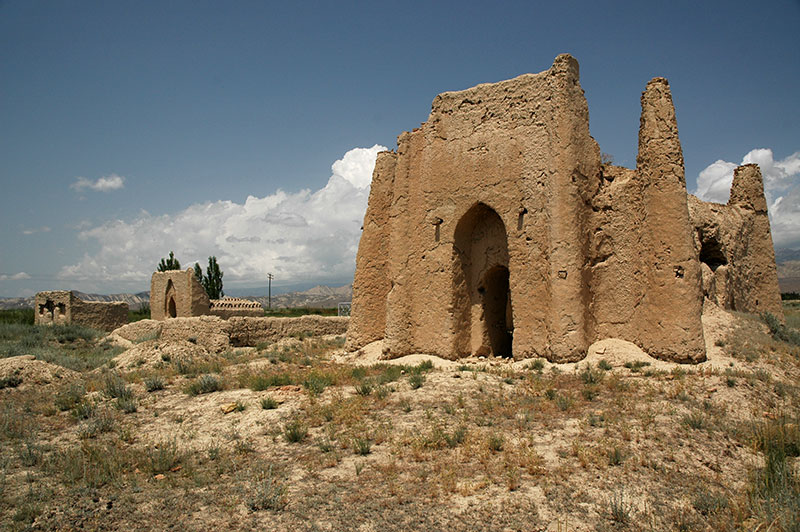
Taylik Batyr Mausoleum, Ak-Tal, Naryn Region, Kyrgyzstan
From Balasagun I continue east, turning off the highway just short of the toll gates at Balykchy, where a swingeing toll charge is extracted from foreign motorists; instead crossing on gravel tracks through a mine to emerge on the lumpy highway which heads through the centre of the country on its way to the Chinese border. As dusk approaches I turn west onto a dirt track and wind up and over a 3450-metre pass as darkness falls and a dramatic thunderstorm breaks, dropping down to the shores of Song Kul, a magnificently beautiful, jewel-blue lake at the very centre of the country. In the morning light the views are immense; of the even bowl of yellow-green grass which sits, ringed by mountains and dotted with distant white yurts and herders on horseback corralling sheep and horses. Memories of the days spent here in 2007 with Oliver come flooding back as I drive towards the south-western edge of the bowl, climbing briefly to a ridge where the land falls away to the south in a dramatic, cloud-filled canyon, its steep and inaccessible sides still dotted with dark conifers. The track descends this spectacular chasm in nine long, vertiginous switchbacks which drop seven hundred metres into the canyon floor, then descends further to parallel a river, which brings me to an area dotted with crumbling mud-brick mausolea. Like the Kazakhs to the north, the Kyrgyz are are traditionally nomads and mausolea such as these are the only lasting mark they leave on the landscape. Here however, I am slightly surprised to find mausolea somewhat more elaborate than those which dot the Kazakh Steppe; often built in the form of a small citadel, with corner towers, crenelated walls, domes and basic Islamic ornamentation picked out in the brickwork.

Fergana Mountains, Jalalabad Region, Kyrgyzstan
Just beyond the mausolea, the track crosses the Naryn River and turns east again, winding slowly over another mountain pass into sparsely populated country of badlands and irrigated fields, through the bleak and unloved mining town of Kazarman, then slowly ascending over hills of powdery loess covered in a thin, velvety carpet of grass. As the grassy ridges start to gather into mountains, the track begins the steep and at times rough climb up the 3000-metre Kaldama Pass over the Fergana Mountains, whose western slopes are covered in lush, tall grass and shrubs. In the late afternoon, the sun is just descending over the snowcapped peaks to the north-west, picking out sharp ridges of emerald-green in a spectacular mountain vista. Stretching away below me into the haze to the south-west lies the region at the very heart of Transoxiana; the Fergana Valley.
More than two-and-a-half millennia of history are contained within this broad, mountain-ringed lowland at the western edge of the Tien Shan, where the Naryn and Kara Darya Rivers join to form the Syr Darya. It was along this river that Herodotus’ knowledge of the world ended; the edge of civilisation. It was here that Alexander the Great established his most far-flung city, and where the Chinese first encountered the Indo-European civilisations to west, establishing the Silk Road in the first century BCE, and later making Fergana a centre for silk production in a tradition which endures today. This was the stomping ground of Genghis (Chinggis) Khan and Timur (Tamerlane) and Fergana’s most famous scion, Babur, patron of Kabul, who went on to found the Mogul Empire in India.

Kara-Khanid Minaret, Uzgen, Osh Region, Kyrgyzstan
I descend into the sweltering Fergana Valley the next morning, stopping briefly in the uninteresting city of Jalalabad, where I join the M41 Highway and continue south to the smaller town of Uzgen. Like Balasagun, Uzgen was for a period a capital of the Kara-Khanid Khanate, which lasted from 999 to 1218, and it is here that I find Kyrgyzstan’s greatest architectural ensemble. Next to the Kara Darya River sit three fine, conjoined, red-brick mausolea, one of which features an exquisite frieze of terracotta inlay around its arched entrance portal, said to be the precursor of the dazzling turquoise and lapis-tiled mausoleum complex of Shah-i Zindah in Samarkand. Next to the mausolea is an eleventh century minaret in the same red-brick, finer and taller than that at Balasagun with attractive, alternating bands of geometric brickwork. These buildings are some of the few architectural remnants of the Kara-Khanids; a dynasty who oversaw an important cultural syncretism during which Transoxiana becoming linguistically Turkic, but when simultaneously its Turkic inhabitants became more influenced and assimilated into settled, Persian and Arabian-Islamic culture. The Kara-Khanids were eventually weakened successively by the Seljuks, Kara-Khitans and Khorezmians, until the Mongols came in 1218 and swept away all that had preceded them. Nevertheless, the Kara-Khanids left an important cultural legacy, which can still be felt today.
Transoxiana was incorporated into the Russian Empire in the late nineteenth century, and following the Bolshevik Revolution, the region became subject to Stalin’s hand when, as Commissar of Nationalities, he was responsible for drawing borders to delimit the titular republics of the Fergana Valley’s Uzbek, Tajik and Kyrgyz inhabitants. What resulted was a hideous jigsaw of meandering boundaries and enclaves which paid no regard to topography, infrastructure or indeed ethnic considerations. Whether this was simply a botched attempt, conducted with the contempt for common sense beloved by totalitarian bureaucrats, at an admittedly difficult task; namely to segregate the inherently mixed inhabitants of the Fergana Valley, or, as in the case of the British drawing up the boundaries of the Middle East, a deliberate construct to foster ethnic strife and failure of nation states, is unknown. However, following independence in 1991, the Fergana Valley was divided between three sovereign states, whose absurdly impractical borders, coupled with mutual mistrust has seriously hampered regional economic development.
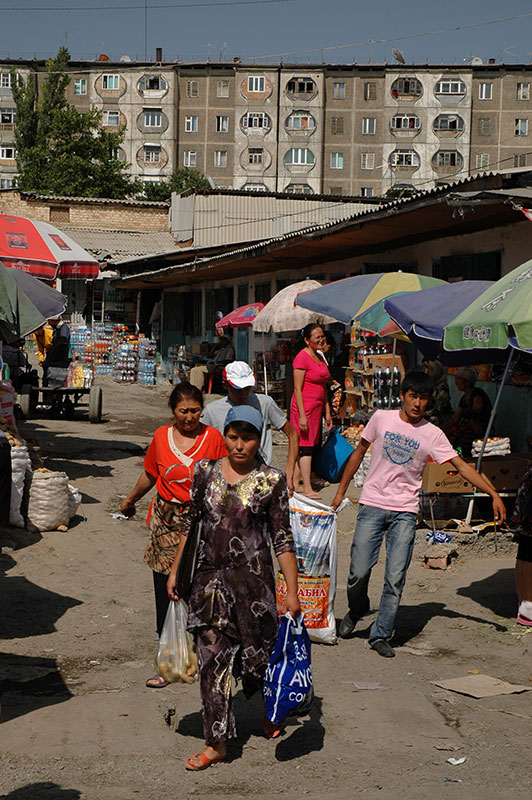
Bazaar, Osh, Kyrgyzstan
Perhaps worse than the impractical national borders however, is the legacy of the Soviet Union’s divide-and-rule policy, which saw all the region’s settled Turks labelled as Uzbeks, and all nomads and herders labelled Kyrgyz, leading to the Fergana Valley becoming an Uzbek ‘heartland’. Following the Soviet Union’s progression into economic stagnation under Brezhnev, Gorbachev’s perestroika (economic reforms) favoured liberalisation of trade, which benefited the settled, trading Uzbek population of the Fergana Valley far more than the Kyrgyz, who were typically herders. At the same time, Uzbeks were (and still are) severely under-represented in Kyrgyzstan’s government. A dispute over the division of land from a state collective farm was the spark which, as in so many other parts of the Soviet Union in its dying days, ignited ugly inter-ethnic violence and riots in the summer of 1990, which left a figure of between several hundred and a thousand people dead in the cities of Osh, Uzgen and Jalalabad. The riots recurred last year in Kyrgyzstan’s portion of the Fergana Valley, when civil order broke down during the 2010 Revolution resulting in perhaps two thousand people, mostly Uzbeks, being killed and up to one hundred thousand fleeing into Uzbekistan.
It was with this as a backdrop that I made my first visit to Osh, Kyrgyzstan’s second city, a very ancient settlement poised between nomadic and settled worlds, a city which grew with the ancient Silk Road and is still renowned today for having one of the largest bazaars in Central Asia. Babur described Osh with fondness, though I find little reason to favour it. My first impressions are of a city with strong, almost South Asian squalor; chaotic traffic, stalls encroaching onto the streets, taxis stopped at the roadside obstructing traffic, pedestrians walking without regard to traffic, roadside gulleys stinking of sewage-tainted stagnant water, filled with decomposing rubbish and plastic garbage (here mostly beer bottles) and feral street children in tattered clothes holding their hands out hopefully to passers-by. Everywhere is broken, crumbling concrete, peeling paint and plaster, wild flowerbeds and lawns, and parks gone to seed, amidst some semblance of old Soviet order in the ranks of grey, ill-maintained apartment blocks and other architectural remnants of this epoch which sit rather awkwardly amongst the chaos. The city must have been far nicer in Soviet times.

Rooftops, Osh, Kyrgyzstan
I check into a flophouse popular with backpackers near the city centre, run by a Kyrgyz who wears flowing Islamic garb and a long beard, but who has a rather false air of piety about him. On the communal noticeboard is a doleful, recent message of warning from a Belgian male tourist, who was out alone in the city at night and beaten-up by a group of locals. Out on the streets, the evidence of last year’s orgy of ethnic hatred is still abundant, with burnt-out buildings in the area around Osh’s dirty and frankly disappointing bazaar. It’s slightly chilling to think that some of the Kyrgyz of the city so eagerly slaughtered their Uzbek neighbours just a year earlier. In comparison to Jalalabad and Uzgen, I see few obviously Uzbek faces here, and the atmosphere is more tense. Groups of young, cocksure Kyrgyz adolescents roam the streets and I fancy that I detect a slight hint of barbarian gloating on their faces. Perhaps I am inflating things somewhat in my mind, but it is a long time since I have come across a place of this size which has such a raw and lawless atmosphere. I don’t venture far after dark, and ensure that the car is in a locked, secure parking lot.
Osh’s only real attraction is the striking, barren hill which rises above the dusty plains immediately to the west of the city, known as Suleyman Mountain, for legend has it that the Islamic prophet Suleyman (Solomon) was buried here. For millennia the mountain has been considered holy, and together with James, a very intelligent, affable and well-travelled British Army Officer who I meet in town, ascend the ancient rock-cut steps up the mountainside. On the summit are the familiar signs of pagan-influenced Central Asian Islam, with colourful votive prayer rags tied to tree branches and local women crawling through an opening over a holy rock in hope of giving birth to healthy offspring. Babur is said to have built a small mosque on the summit, though what remains today is rather plain and modern. The cooling breeze and views in the lengthening evening light are wonderful however, giving a beautiful view over the edges of Osh, which fade away in a rabble of disorderly, pitched-roof houses and mulberry trees into a dusty horizon, a typical and rather timeless Fergana scene which Babur might have recognised.

Turkestan Range, near Korgon, Batken Region, Kyrgyzstan
Beyond Osh, the road takes me to the far west of Kyrgyzstan, along the southern margin of the Fergana Valley, here delineated by the Turkestan Range, part of the greater Alay Mountains which drop down to the west from the central Pamir Knot in eastern Tajikistan. Leaving the environs of Osh, the country soon reverts to gentle, rural lassitude, and as I push further west, the settlements become increasingly sparse. It is here that Stalin’s irrational gerrymandering of the borders of the three republics reaches its zenith, and the road on which I am driving must negotiate around the meandering Uzbekistani border, passing the the exclave of Shakhimardan, then making a long detour around the exclave of Sokh. The landscape becomes increasingly pretty, a classical scene of lowland, rural Central Asia, with irrigated villages nestling between barren low hills, a swathe of green fields and streets lined by dry stone walls and tall poplars. I stop in the early evening in the provincial capital of Batken, which is little more than a large village, the result of the creation of Batken Region in 1999 to increase security and law enforcement in this far-flung arm of the country, in face of a threat of Islamic extremism and drug trafficking crossing the mountains from Tajikistan in the south.

Road to Isfana, Batken Region, Kyrgyzstan
Batken has a far more pleasant and tranquil atmosphere than Osh and I enjoy a good laghman (Central Asian noodle soup) in an outdoor chaikhana (tea house) under what is perhaps the largest apricot tree I have ever seen. The Kyrgyz here seem a touch softer and more refined than their up-country cousins, mellowed perhaps by settled life in such a splendidly fertile valley. Beyond Batken the road climbs, and the scenery becomes spectacular, with glimpses of snowcapped mountains. I pass the Tajikistani exclave of Vorukh, a mountainous redoubt accessible only by a single cleft in the surrounding wall of rock, then climb steadily to the west through a mountain paradise of green villages fed by crystal clear mountains streams, reminding me of the Hindukush of Pakistan and Afghanistan. Finally, the road drops down back into the Fergana Valley, to the slightly shabby town of Isfana, at the very far end of Kyrgyzstan, where I stop for another night. The following morning I follow the road out of town which roughly parallels the jagged border with Tajikistan through sleepy, forgotten kolkhozes (collective farms). At times I am genuinely unsure which country I am in, but after one false turn, I make it to the town of Kulundu and cross into Tajikistan. As per my first visit to the country, I leave Kyrgyzstan with rather mixed feelings; a country which seems to lack much spirit of nation building or ethnic identity, though is a mostly pleasant and laid back place to visit. Stunningly beautiful in parts, yet depressing, squalid and even rather hostile in others, Kyrgyzstan is not a country which I feel any great sadness in leaving.

Syr Darya River, Khujand, Sughd Region, Tajikistan
Both sides of the border crossing are friendly and painless, though the guards are unused to seeing a foreign vehicle. On the Tajikistani side, where the immigration and customs buildings are part of the main street in the small town of Ovchi-Kalacha, Boburjan, one of the Tajik immigration officials learns of my interest in Asian history and points to a defile in the distant, rust-coloured mountains which lie to the north, beyond the city of Khujand. He tells me that it was from that the armies of Chinggis Khan arrived and laid siege to the city, until certain of its traitorous populace opened the city gates and allowed the great Khan to enter, only to immediately be dispatched for their treachery. To this day, despite a period of almost eight hundred years having passed, and despite the destruction he wrought, the legend of Chinggis Khan is massive in Asia, and he seems to be universally respected.
It’s a short drive to Khujand, Tajikistan’s second city and western gateway to the Fergana Valley. Attractively positioned astride the gleaming turquoise waters of the Syr Darya, Khujand is an ancient city, which might either have been founded as Cyropolis, the city of the Persian empire-builder Cyrus II (Cyrus the Great) on his expedition against the Saka, on the very edge of his empire, or as Alexandria Eschate or ‘Alexandria The Furthermost’ by Alexander the Great, as the most far-flung of his Macedonian settlements. Modern Khujand does not quite live up to such romantic, edge-of-the-world notions, but is nevertheless a very pleasant place, noticeably more refined than the cities of Kazakhstan and Kyrgyzstan through which I have been travelling for the past few months. I enter the city on a visually striking six lane Soviet triumphal avenue, with immaculate flowerbeds in the central reservation, lovingly irrigated in the forty degree summer heat. This is however a neat trick; a Potemkin facade that post-Soviet autocrats like to put on to impress visitors and natives alike. A quick look beyond the polish however soon reveals considerable poverty in Khujand, and this sleek avenue is where the civic spending seems to end. Indeed Khujand, which might be thought of as the country’s cultural and intellectual capital, lost its power during Tajikistan’s bitter civil war of the 1990s and remains opposed to the current regime, which naturally marginalises the city, and the province of Sughd (named for the earlier Sogdian Empire) of which it is the capital.

Uzbek Clothseller, Khujand, Sughd Region, Tajikistan
Khujand is a lively market town and activity, as in much of Asia, revolves around the city’s central Panjshanbe (Thursday) Bazaar, which is a marvellous edifice of bright, pastel Stalinist architecture with colourful touches of Qajar-era Persia. Inside is a kaleidoscope of faces; Persian, Aryan, Turkic, Mongol and Gypsy, reflecting the full spectrum of Transoxianian humanity. After weeks of guttural Turkic, it’s also pleasing to hear the soft tones of Persian, albeit with the strange Tajik accent, and people here seem far gentler and more culturally secure than their historically nomadic neighbours to the north. I spend my days in the city slowly making my way round the bazaar, the scant remains of the ancient nearby citadel, and along the river banks, frequently stopping in chaikhanas to drink hot green tea, to fend off dehydration from the terrible heat.
My personal highlight in the city is my host Javohir, who graciously accommodates me in his apartment, where he lives with his wife and two young sons. I get on immediately with Javohir, who is educated and intelligent, fluent in English and has experience of living abroad, yet who lacks the connections required in this country to secure well-paid employment and exists on a very meagre salary, with which he struggles to support his family. Javohir is a Tajik, and a Muslim, but a man who is less concerned with petty ritual than with the true social message of his faith. We spend afternoons swimming in the warm, clear waters of the Syr Darya with his kids, and have long discussions into the night, bemoaning the corrupt and useless government which does nothing for common folk, and discussing the state of the greater outside world.

Dome Of Abdul Latif Medressa, Istaravshan, Sughd Region, Tajikistan
I make a side trip into the hills to the south of Khujand, to the provincial town of Istaravshan, which takes me slightly by surprise, for it is perhaps the nicest town I have seen in the country. Like Khujand, Istaravshan has a long history, and legend has it that it was near here that Alexander won his bride Roxanne by conquering the seemingly impenetrable citadel of a local ruler. Beyond a rather drab modern city, Istaravshan has a marvellous Old Town with wonderful, winding kuchei (alleys) with central, open sewer troughs, and traditional Central Asian family houses whose open gates and doorways reveal large walled courtyards with fruit and vegetable plantations. The people here are a real highlight; some of the friendliest and most welcoming whom I have met in the region, and I receive numerous invitations to tea, or to just to come inside and view their beautiful houses, some of which have century-old, colourfully painted wooden interior beams and columns. It’s a real treat to walk the backstreets and encounter people who seem genuinely interested to meet a foreigner.

Tajik Mullah, Istaravshan, Sughd Region, Tajikistan
Aside from the wandering lanes and rural ambience of the Old Town, Istaravshan has some specific points of interest. There are fine, Bukharan-style open-fronted mosques with carved wooden pillars, and the beautifully tranquil Sar-i Mazar ensemble, set amongst pools of open water and huge six- and eight hundred year old chinar (plane) trees. Two separate mausolea, their portals covered in tile mosaics and whitewashed stucco cover the main graves, in addition to a fine open-fronted mosque with the peculiar, colourfully painted ceiling beams which seem to be characteristic of the region. People are curious to see me, and take the time to show me specific details, and explain a little about them. The town’s jewel however is the Abdul Latif Medressa with its magnificent Timurid kok gumbaz (blue dome) of turquoise and lapis, every bit as fine as the domes of Samarkand or Bukhara, if slightly more restrained. Inside the buff brick of the medressa (seminary), a class of young boys study the scriptures on this peaceful Sunday afternoon, making the building all the more alluring for not being simply a polished but lifeless museum-piece. I later make my way back back to Khujand in the cooling evening, feeling quite serene and rather impressed with Tajikistan as a country.
After three thoroughly enjoyable days in northern Tajikistan, I drive east again out of town, past the turquoise water of the Kairokum Reservoir, towards the centre of the Fergana Valley. Once again however, a national boundary blocks my path, and I arrive mid-morning at the far end of the sprawling market town of Konibodom, where the road reaches the border crossing into Uzbekistan. Relations between the two countries are highly volatile, and cross-border traffic is a mere trickle, another example of Stalin’s foul legacy in Central Asia. Formalities on the Tajikistani side are fairly brief, though not without an (unsuccessful) request for a bribe, but I am met by a locked gate when reaching the Uzbekistani customs post. Here I am eventually let in, the only traveller save for an old Uzbek lady. The Uzbek border staff are very friendly and welcoming however, and intrigued to see a foreign vehicle crossing at this nearly deserted post. Unusually for Uzbekistan, where customs officers typically all but take apart vehicles in search of narcotics, not so much as a glance is made inside the truck.

Friday Mosque, Kokand, Fergana Region, Uzbekistan
It’s shortly after mid-day by the time I’m through the border, and drive to the city of Kokand in the sweltering heat. Soon after arriving, I set about acquiring one hundred US Dollar’s worth of Uzbekistan’s farcical currency, the Som; a transaction which is best carried out on the black market, in a country with a serious cash shortage and where ATMs are almost useless. A friendly bread seller whom I ask about this slightly shady deal immediately leaves his business and walks me down to the roguish street money-changers, making sure I am not ripped off, with no intention of personal reward. I acquire 246,000 Uzbek Som in 1000 Som notes, which approach the size of a small loaf of bread. Compared to Tajikistan however, I see immediately that Uzbekistan, despite its crippled monetary economy (run by a President who claims to have an education as an economist) is comparatively quite advanced; Kokand looks prosperous and organised, with better roads and traffic consisting almost entirely of new-looking, locally made cars. It’s also a reminder that, although Kazakhstan is certainly the economic leader in today’s Central Asia, in Soviet times this title very much went to Uzbekistan.
Kokand lies at the heart of the Fergana Valley and has a long history as a trading centre on the Silk Road. It is most famous however as the former capital of the Khanate of Kokand, an Shaybanid Uzbek tribal chiefdom which was an offshoot of the Khanate of Bukhara, established in 1709. The Khanate of Kokand, under the ruthless leadership of Alim Beg came to dominate the Fergana Valley in the early eighteenth century, becoming a pawn in the Great Game, a period when Imperial Russia and Imperial Britain vied for dominance in Transoxiana, with Russia eventually taking the last Kokand Khan’s territorial possessions and sending him into exile. The last Khan’s palace still stands today, a rather gaudy and crassly restored edifice which well defines the excesses of Asian wastrel leaders through the ages. More restrained attractions in town include a sprawling necropolis in which I spend an hour or so looking at the various graves and mausolea, and the beautiful nineteenth century Friday Mosque, with a simple, tapering, turquoise-domed, free-standing minaret set on a beautiful green lawn dotted with tall chinars and surrounded on four sides by open prayer galleries.
With this brief re-introduction to Uzbekistan complete, I head for the mountains to the north-west, leaving the Fergana Valley and making the long climb up to the Kamchik Tunnel which, at 2150-metres above sea level, links the Fergana Valley to the rest of Uzbekistan. I drop down through the sprawling towns of Angren and Almalyk as darkness falls, heading north east to what is undoubtedly my favourite city in the region: Tashkent.
 EurasiaOverland