
Stage 23 – Russia & Mongolia: Baikal And Beyond [2/2]
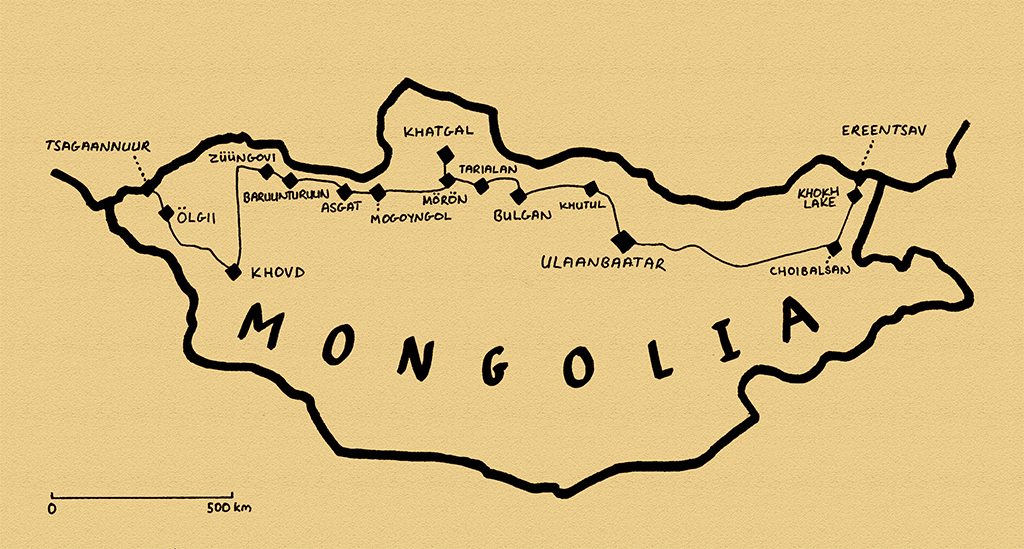
It’s the 10th October 2010 and I have just crossed the remote border crossing from Russia into Mongolia at Ereentsav, immediately followed by Finns Toni and Marjo in their ancient green Lada Niva. We face no problems in initially entering Mongolia at this crossing, despite the quarantine measures in response to a foot-and-mouth disease outbreak still being in effect here in Dornod Province, the easternmost of Mongolia. However, due to the Mongolian consul in Ulan-Ude having misspelled my middle name on my visa, the Mongolian immigration officer initially refuses me entry, and it takes some patience and persistence to convey to him that I am not making a 2250 kilometre round trip journey due to someone else’s incompetence. We are delayed even further by the customs office who upon learning of the Finns’ intention to sell the Niva in Mongolia, spend so long calculating import duty that by closing time the car is still not cleared into the country and has to stay at the border, with the three of us staying in the house of the customs officer a few hundred metres from the border, which turns out to be quite a pleasant and relaxing evening. The following day, upon hearing of an exorbitant import duty amounting to more than the car is worth, Toni abandons his aim to sell the it in Mongolia and begins to plan a return journey through Russia, allowing us to begin our journey.
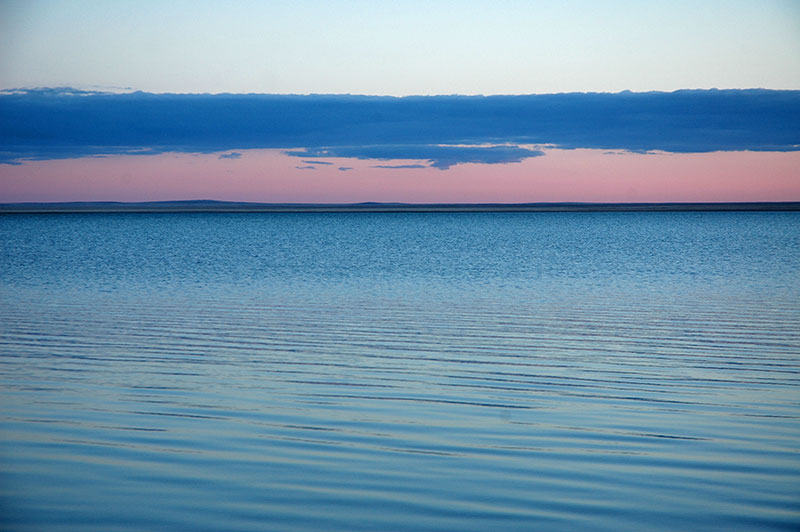
Khokh Lake, Dornod Province, Mongolia
We only get two kilometres along the track to the sum (district) centre of Chuluunkhoroot, nothing more then a few buildings from a former collective farm, before our progress is halted again, this time because of the quarantine. We spend several hours obtaining special quarantine permits to allow us to proceed south, and it’s early afternoon before we leave. The route should be a simple straight-line following the old railway line built during the Second World War to facilitate the war with Japan, but we take a diversion due to quarantine measures which significantly slows our progress (and during which another leaf breaks on the front right spring). In the late afternoon we stop and camp by the limpid waters of Khokh Lake, the lowest point in Mongolia, watching a pink sunset sky falling over the very gentle undulations of the steppe towards the Chinese border to the east. Without any shelter or a roaring fire the night is long and cold, immediately making us miss the thick, cosy forests of Siberia.

Gazelle, Dornod Mongol Steppe, Dornod Province, Mongolia
Moving south from the lake, we parallel the railway line through magnificent rolling grasslands known as the Dornod Mongol Steppe, which is subtly different from any other landscape I have seen in Mongolia, and forms one of the very few intact grassland ecosystems in Asia. We pass a small abandoned village on the railway, a few concrete skeletons in which at least one family is squatting, then continue into the pristine wilderness, a sea of waving dry grass under deep-blue skies. As we make our slow progress south through the grassland, we startle several herds of wild Mongolian gazelle up to around one-hundred strong, whose white haunches flash against the brown steppe as they race past us and turn towards the north. This magnificent sight, perhaps unique in modern Eurasia, is of the largest ungulate herds in the continent; an unexpected experience that can perhaps only be rivalled in Africa. More encouraging still is that despite local poaching of gazelle, the population here in Mongolia (as opposed to that in China) is thriving in this sparsely populated area.
In the early-afternoon we come to a couple of gers (yurts) set-up by the roadside; not as a home for local herders, but as a disinfection station. What follows is another bizarre and unique Mongolian experience. A large tent has been set up and covered in plastic sheeting, which is used as a fumigation chamber for vehicles. We park the cars inside the chamber which is sealed and then filled with an unknown agent. After they are deemed to have been sufficiently gassed, we are handed gas-masks which we don in order to retrieve our vehicles, an act which has us all in fits of laughter, and is conducted in good spirits by the officers of the Ministry of Emergency Situations. A few hours later we reach the northern edge of the city of Choibalsan where we are hosted by Trinh, a Peace Corps Volunteer who very kindly lets the three of us invade his small apartment.

Communist Mural, Choibalsan, Dornod Province, Mongolia
Choibalsan, the capital of Dornod Province and the fourth largest city in Mongolia, is named after Khorloogiin Choibalsan, an illegitimate son of a herder who was born nearby, and came to be the only autocratic ruler in modern Mongolian history. Choibalsan was nicknamed the ‘Stalin of Mongolia’, for his ruthless purges of the Buddhist clergy, intelligentsia and dissidents on the orders of Stalin, and was responsible for making Mongolia the first satellite state of the USSR. Like its namesake, Choibalsan the city has a strong Soviet influence, having become the economic centre of eastern Mongolia in the twentieth century. Today the city hosts plenty of crumbling and rusting industrial areas and has certainly seen better days, but the centre is remarkably pleasant and vibrant. Through Trinh, we meet many of the city’s Peace Corps and VSO volunteers and spend days drinking heavily and gorging ourselves on Chinese food; I am particularly gluttonous in the knowledge of the weeks of eating mutton which are likely to follow.
We visit the lively bazaar, where we meet a few rogues; life-long drinkers who seem to have degenerated to a state of dementia from drinking toxic substances; toothless, red-skinned and having seemingly lost the ability to even speak, they beg and sleep among piles of rubbish like stray dogs. Amidst such squalor I tend to a couple of pressing maintenance issues on the truck; three leaves have now broken on the left-hand front spring, and while no suitable spares are available, I manage to jury-rig a couple of leaves from a Korean light-truck, and have the crack in the mother-leaf welded to make a very satisfactory repair. Far less successful is a ‘repair’ attempted on my radiator by a local which if anything makes the leak (which has been intermittent since the start of the journey) worse.
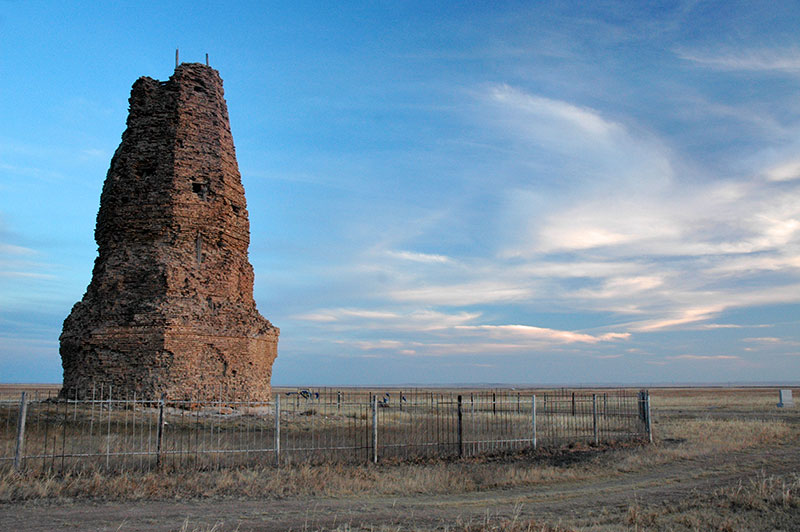
Stupa, Kherlen Bars, Dornod Province, Mongolia
On the morning we wish to depart, we must join a scrum of people outside the Ministry of Emergency Situations (near the displeasing sight of a new Mormon Temple) to obtain yet more quarantine permits, and it is not until late afternoon that we finally head out of town on the track across the steppe to the west. We follow the Kherlen River, the farthest tributary of the Amur, here almost five thousand kilometres upstream from the point where it enters the Pacific. Just before dark, with the Finns trailing behind I reach the ruins known as Kherlen Bars which are little more than the remains of a twelfth century Buddhist stupa; a rare ancient structure in Mongolia, and one of very few traces of the Kara-Khitan Khanate. The Kitans were the last of Mongolia’s pre-Mongol states, known as the Liao Dynasty in China, the remnants of which set-up the Kara-Khitan Khanate, a Central Asian state which lasted less than a century before being overrun by the Mongols. The stupa at Kherlen Bars is indeed the first and only structure I see in Mongolia which pre-dates the eighteenth century.
Well after dark we stop in the sum centre of Bayan-Ovoo and have dinner, then continue along the Kherlen, leaving it finally in Öndörkhaan where Jacob and I had split ways last month. Here we reach blessed asphalt and drive on into the night, though we separate and upon entering a cold Ulaanbaatar the next morning I receive a message that the Niva has had a small breakdown during the night, but that the Finns will arrive in the evening. We spend a somewhat debauched six days in Ulaanbaatar, during which time I come to like the city even less, particularly at the point when I am pickpocketed (for the first time in my life) by a group of feral-looking men in the notorious ‘Black Market’. I am however delighted when Maciej, whom I travelled with for more than two weeks in Iran in 2009, flies in and joins us (also bringing my -40ºC sleeping bag and winter parka). Resisting alcoholic dissipation, the four of us leave one morning, ready to cross the Northern Route towards Ölgii in the far west of the country.
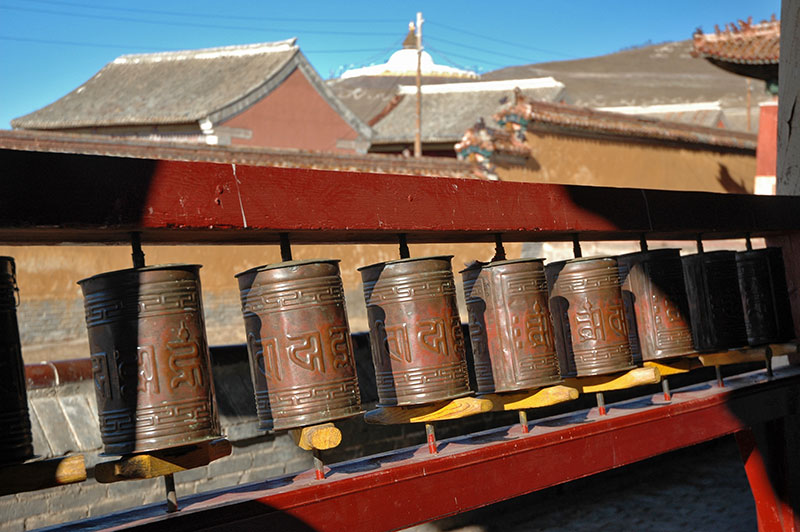
Prayer Wheels, Amarbayasgalant Monastery, Selenge Province, Mongolia
Leaving the city’s western outskirts we head north on the road to Russia, turning west just before Darkhan and camping near the sum centre of Khutul. The night is cold, below freezing and we are of course out in the open, drinking vodka ostensibly to keep warm. I get to try out my cold weather gear and am pleased to find that despite being well below zero, I am still too warm in my sleeping bag, lying out in the open on a thin mattress without a tent.
In the morning we reach the historical Orkhon River, flowing north from the traditional heartland of the country. We join the Orkhon briefly and head north, leaving the asphalt and then turning north-west away from the river, reaching the isolated Amarbayasgalant Monastery which sits in a wide grassy valley dotted with patches of recent snow and backed by bare hills. Amarbayasgalant is one of just three major monasteries to have (partially) survived Stalin’s purges, with 28 of 40 temples surviving. Whilst lacking the significant location of Erdene Zuu in Kharkhorin or the vibrance of Gandantegchinlen in Ulaanbaatar, eighteenth century Amarbayasgalant has a genuine feeling of age (even slight neglect) and a graceful harmony of architecture which sets it apart. We enter the walled compound, walking among the light crimson Manchu-style temples with glazed terracotta tiled pagoda roofs and intricately carves beams and lattice panel doors. Visibly we are alone at the monastery, but from within one of the temples in the west of the complex we hear the rueful chanting of monks reciting the centuries-old mantras of the Mahayana rite of Buddhism, continuing an ancient tradition which was very nearly wiped out by Stalin with his ruthless murder and incarceration of the clergy.
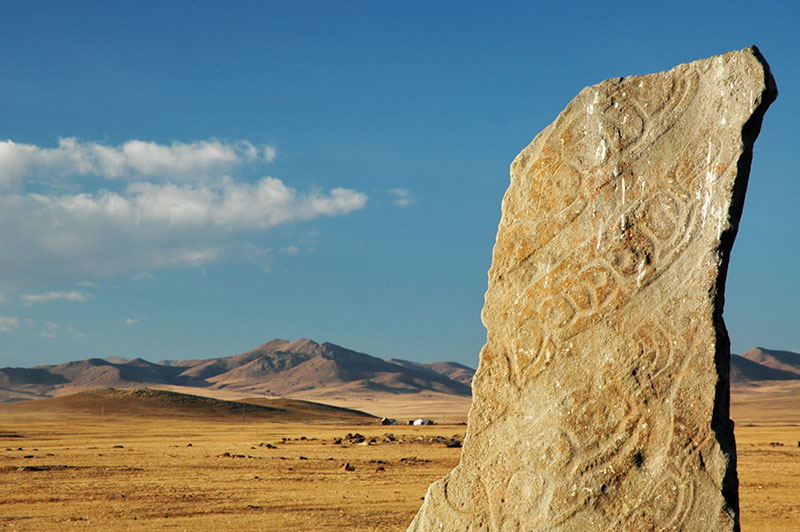
Deer Stone, Near Orkhon, Bulgan Province, Mongolia
Returning to the highway we continue west to Erdenet, Mongolia’s second largest city, built in 1974 to exploit the nearby deposits of copper ore and contributing a significant proportion to the country’s export earnings. Just an hour beyond Erdenet, continuing on smooth new asphalt we reach the town of Bulgan, capital of the province of the same name. Here we stay for three nights with another Peace Corps volunteer, Eric, from Wisconsin. Despite Eric’s wit and erudite conversation, we fall back into drinking and general debauchery, and the days and nights pass with just snapshots of vodka drinking, a karaoke bar, and an odd encounter with an openly (in fact optimistically) bisexual Mongol. We do manage to make one fairly lucid excursion, twenty kilometres south of Bulgan and back to the Orkhon River, to a group of Deer Stones (megaliths carved with stylised reindeer) in a landscape of grassy hills which must have been grazed for millennia by successive nomadic civilisations. It’s a beautiful spot and reminds me of the wilderness of ‘true’ Mongolia which we are about to enter, away from the asphalt roads and cities. Winter is impending and it is with a slight sense of foreboding that I imagine our journey east over the plains and highlands of the north.
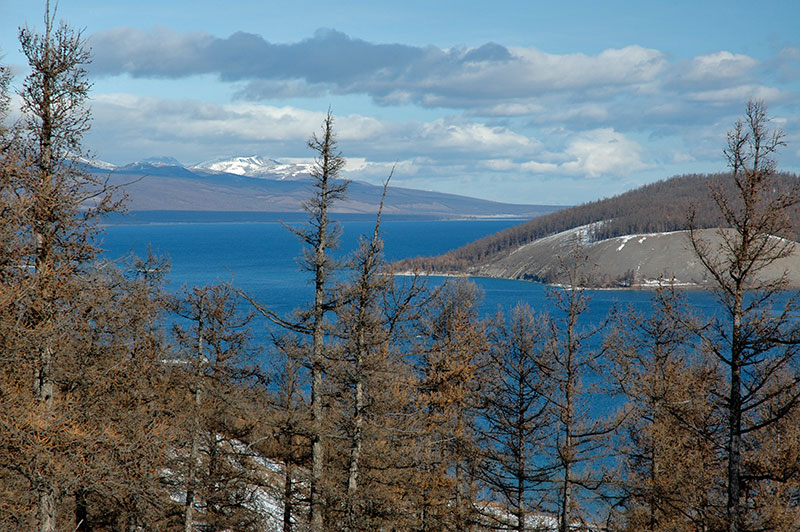
Khövsgöl Lake, Khatgal, Khövsgöl Province, Mongolia
The following day our journey into the wild begins, leaving a freezing Bulgan and returning to the dirt tracks which weave their way across the entire country. We move west and then north through a brown landscape of dry grassy hills with drifts of snow and patches of golden-brown larch trees, joining the Selenge River late in the morning and then crossing into the province of Khövsgöl, the most northerly in Mongolia. We see small wooden huts on the landscape alongside the ubiquitous white gers, and there are unexpected patches of wheat cultivation on the plains, now with only stubble remaining on which flocks of sheep are being grazed by shepherds on horseback. We spend a cold night camping near the sum centre of Tarialan, climbing the following day through barren mountains and dropping down to the provincial capital of Mörön for lunch, then continuing north to the sum centre of Khatgal where we reach the small wooden house of our Peace Corps host Patrick well after dark.
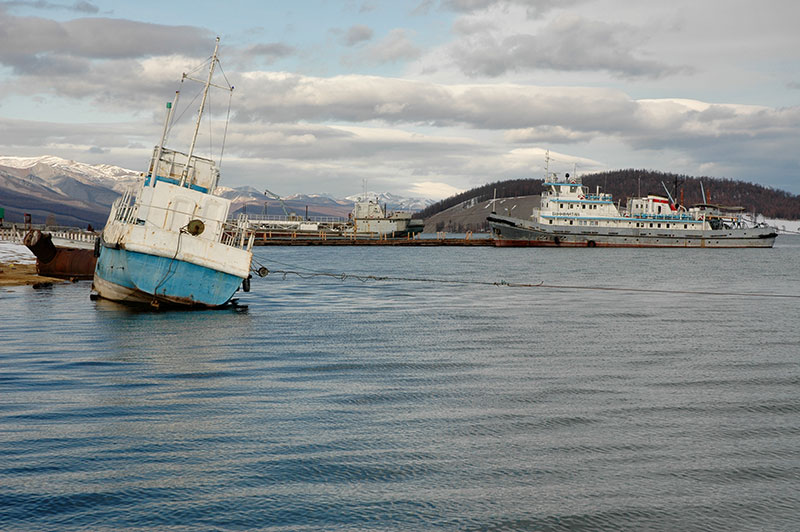
Boats, Khatgal, Khövsgöl Province, Mongolia
Khatgal is a small lakeside settlement with some attractive wooden houses, located at the southern tip of Lake Khövsgöl, the so-called ‘Little Sister of Baikal’ which is also one of the world’s oldest lakes and reputedly the cleanest with ultra-clear, unpolluted water. We make a short walk up into the hills of bare larch trees near town which offer spectacular views across the sapphire-blue water towards a snow-peak to the north. This region of Mongolia is renowned for its shamanistic traditions and in the forest we see signs of this; an old horse’s skull hung on a tree, and votive prayer flags wrapped around a tall, solitary larch in a small forest clearing. We drop down a snow-covered hillside to the lake shore where boats are moored around a small jetty awaiting the thick winter ice which in previous years has pushed a few of them almost completely onto the spongy lake-side grass, which is dotted with bleached tree stumps washed ashore over the years.
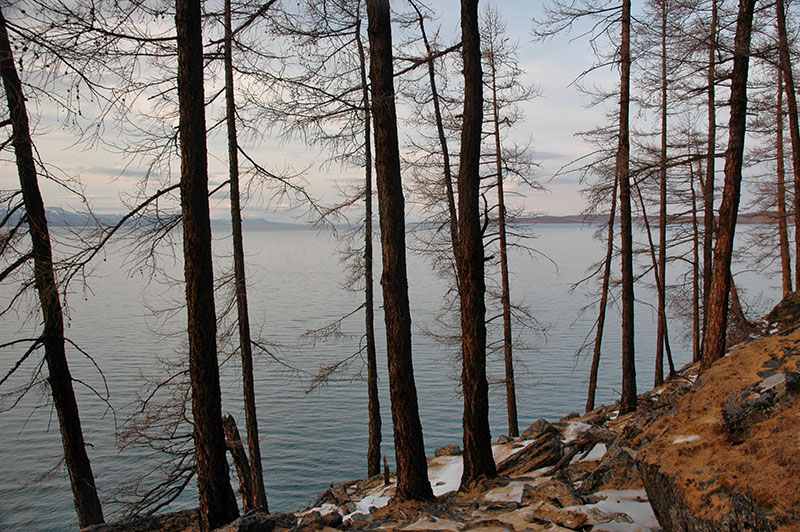
Khövsgöl Lake, Khövsgöl Province, Mongolia
Returning to Patrick’s house the drinking starts once more and the evening is lost in a blur of beer, vodka and peach-flavoured ice tea, leading to a rather hideous awakening in the morning. Despite this melancholy we manage to make it out and drive around the southern shore of the lake on a snowy and very rough track through the hills, reaching a patch of wintry forest on the far side of an inlet. We set-up camp and walk amongst the bare larch trees which grow amongst broken, lichen-covered granite boulders, looking over the steely-blue lake to the snowcaps on the far shore. It’s an austerely beautiful spot, utterly still, quiet and with no trace of other human presence. After dark however, the forest is full of night-terrors; Maciej lays awake in his sleeping bag wet with sweat and I, further away from camp in my sleeping bag on the forest floor, am gripped by terror each time I close my eyes, at one point forcibly holding them open to prevent myself from falling asleep and being dragged into the dark depths of the forest in my sleep.
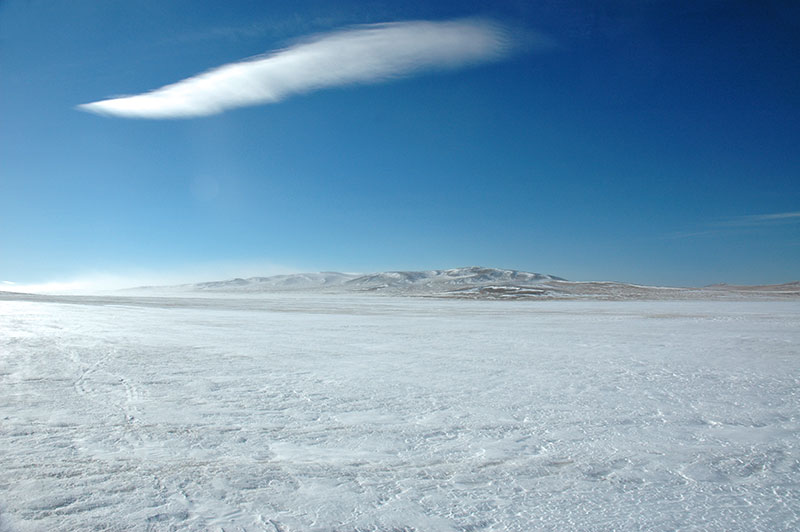
Landscape, near Tsagaan-Uul, Khövsgöl Province, Mongolia
The morning is cold and grey with clouds arriving from the northwest, and we spend the day uneventfully retracing our steps to first Khatgal and then Mörön where we have dinner and a shower, then continue west out of town after dark to camp out in the open near the Delgermörön River. This is our coldest night so far at -12ºC, and sleeping out in the open in my sleeping bag, I awaken with ice in my facial hair. We drive west out of the Delgermörön Valley, climbing from the sum centre of Bürentogtokh over a 1650 metre pass, on top of which is a large ovoo (shamanistic cairn of votive stones) whose prayer rags are thrashing in a bitter westerly wind. On the far side of the pass, we descend and then climb steadily to almost two-thousand metres, soon reaching what looks almost like a different world; a vast and empty plain covered in fresh, blindingly-white snow. A few vehicles have recently passed and we follow their tracks, but in places the wind has already scoured away the snow from the surface and obscured them, leaving us with the menacing prospect of being lost in this featureless white desert. Thankfully however there are telegraph lines which we follow, once blindly plunging into a dry, snow-filled gulley, but eventually reaching the sum centre of Tsagaan-Uul. The Finns arrive after some delay, reporting difficulties in climbing the pass in their ailing Niva, now reduced to rear-wheel drive only.
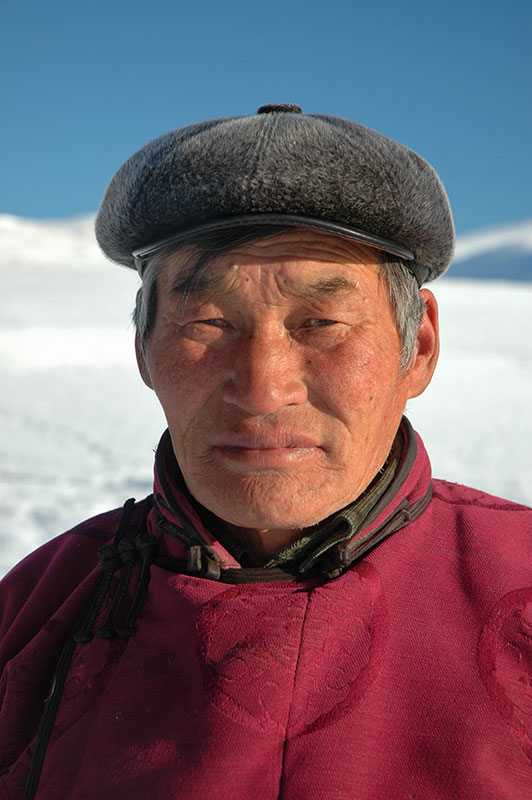
Mongol Man, Mogoyngol, Khövsgöl Province, Mongolia
After eating a good lunch and finding fuel for the Niva, we leave Tsagaan-Uul and re-enter the wilderness. The Northern Route, one of Mongolia’s principal east-west roads is here at best an ill-defined set of tracks, but with the fresh snow cover it is almost impossible to find our way and inevitably we become lost. I drive up a small ridge and stop to sight a distant track; after waiting quite some time, and with the Finns approaching in the Niva and the sun getting lower, I make the mistake of pressing on before they have reached our position, anxious to find the main track before dark. It would be the last time we saw the Niva, or the Finns.
As Maciej and I drive over the snowy highlands and the sun sets, a brooding pink fills the sky, and in the last light of day we see the storm coming straight for us; an indistinct grey blizzard of snow. We push on, now well off-course to reach the next sum centre of Tsetserleg, but with little choice but to follow the single track. We cross a small wooden bridge, heading south-west and eventually coming to a small mine where we get some directions. We push on a few kilometres hoping to find a track to take us back on course and even finding a lone ger at the edge of some low mountains, in a spot called Mogoyngol. We get some vague directions from the occupant who is more than surprised to have two foreigners appear in a car out of the darkness, but I rashly choose to try to reach Tsetserleg rather than accept his instantaneous invitation to spend the night in the ger. Within minutes we are mired in the snow and disoriented, but manage to retrace our path to the ger using the GPS and belatedly accept hospitality.
Inside the ger is a world removed from the bitter cold and snow of the huge landscape which surrounds it. Whilst we have been battling with the most extreme conditions we have ever encountered, our hosts, a young Mongolian man and his rather attractive wife, are perfectly at ease in their native environment. The ger, perfectly honed to its function over many centuries (and basically unchanged from the time of Chinggis Khan) is fantastically warm inside and totally insulated from the howling winds, heated by a stove fuelled by animal dung to the point where our (male) host happily sits bare-chested. We experience a kind of raw hospitality driven more by necessity and the harshness of the environment than by politeness or etiquette; we are accepted in without a moment’s discussion, fed and given a place to sleep in the male section of the ger, on the left as one enters from the front door.

Camel Caravan, near Tsetserleg, Khövsgöl Province, Mongolia
In the morning we emerge into a world of ice; the temperature is somewhat below -20ºC though the sky is clear and the sun pleasantly warming. Large crystals of rime have grown on exposed objects such as the nearby hitching post or the front of the truck, which splutters into life, running roughly on fuel which I worry has started to thicken due to the cold. After breakfast we thank our hosts profusely, leaving them a bag of groceries and heading north through the mountains on a path which we can barely recognise now, and would have been impossible in the dark. After a couple of rather tense hours we are relieved to drop down into Tsetserleg, but there is no sign of the Finns. We send them a message but receiving no immediate answer, decide to continue west through a vast, two-toned landscape of white snow and deep blue sky.
We follow the track west through a frozen world; trees are not just covered in snow, but beautifully coated with ice, forming into bare, white skeletons. Horses graze, shifting the snow with their muzzles, and the landscape seems more beautiful and less hostile, so long as we have tracks to follow. Shortly after noon we come across a marvellous, timeless sight; a man leading a train of four Bactrian camels loaded with the components of a ger, totally unfazed by the trackless, snowy wastes around us. Here the Mongols are really in their element, away from the squalor and materialistic trappings of the cities, strong, vital and confident. Here I start to see the kind of endurance and resilience which must have driven these people ever west and south in the thirteenth century to form the largest contiguous land empire the world has ever seen.
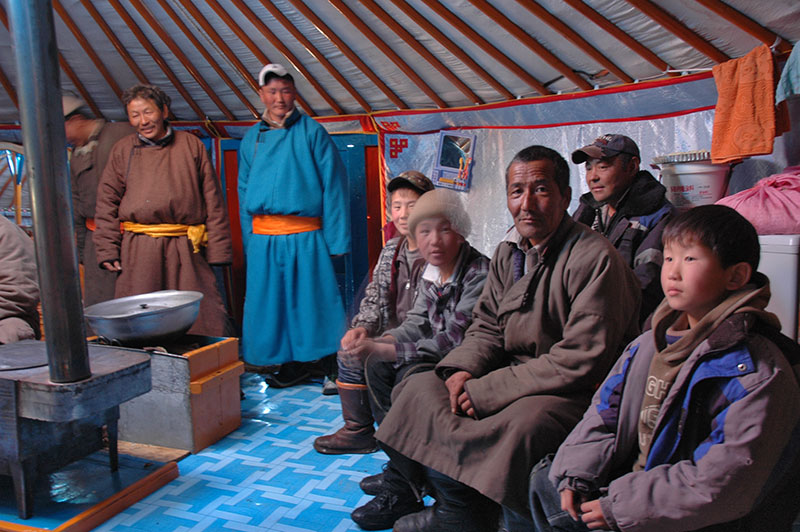
Mongol Family, near Asgat, Zavkhan Province, Mongolia
Near this point, and despite asking directions, we seem to get tracked off-course, somehow losing the main track and continuing through mountains as we cross into Zavkhan Province, following what eventually becomes just a single set of tyre-tracks. We begin to worry about fuel; too long a detour, or having to backtrack could see us close to running out. Happily, the tracks eventually lead to a group of gers on a snowy hillside belonging to a very friendly extended family who have just moved to their winter home (though quite what possesses them to chose a bleak hillside in the coldest part of the country is rather baffling). We are invited in to have some celebratory vodka, take hits of very pleasant snuff from an elegant carved-bone snuff box, but turn down their offer of further hospitality to continue to the nearby sum centre of Asgat. We are driving through an initially trackless expanse of fresh snow, but the directions given to us by the family are good and in time we find some tracks in a glorious landscape of distant snow-covered hills. In the afternoon we reach Asgat, finding a small motel where we have dinner and sleep in a communal room, awoken late at night by a group of Tuvans coming from the south and heading to the nearby Republic of Tuva in Russia. We are just fifty kilometres from Tudevtei, where Jacob and I had camped in a warm, sunny landscape of wildflowers just three months earlier.
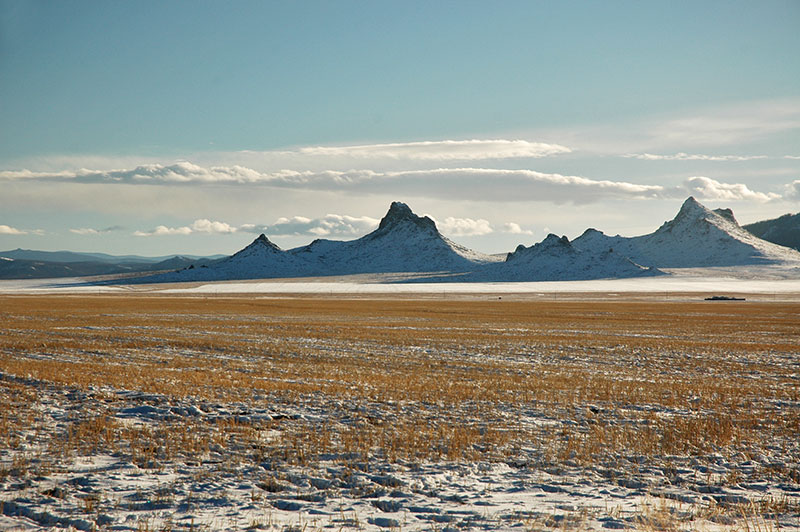
Landscape, near Baruunturuun, Uvs Province, Mongolia
From Asgat we drive north towards the sum centre of Tes, where we urgently refuel and rejoin the Northern Route once again after our second unplanned deviation. We also receive a message from the Finns; the Niva had given out completely on the night we got separated, and they were rescued in the morning by some locals travelling to Ulaanbaatar, from where they are now planning on continuing their journey south on the Trans-Mongolian Railway to China. West from Tes the land drops and opens up, and to our great relief the snow-cover starts to thin as we enter the province of Uvs. We cross a flat plateau dissected by low but sharp fins of mountains, grazed by herds of horses. The track is good and we press on into the evening, arriving in the sum centre of Baruunturuun well after dark. Through asking a local who is driving back from a shop, we find a homestay with a family in their concrete house, far more comfortable than our motel in Asgat.
West of Baruunturuun we stop in Züüngovi for one of the better meals we have in Mongolia; fresh, hand-made buuz (meat-filled dumplings), then decide to make a short side-trip to Bayan Lake; a deep-blue oval of still unfrozen water surrounded by the very unusual sight of sand dunes covered in snow. Maciej and I stop and have a beer here for an hour or so, admiring the fantastic view and feeling quite satisfied at having made it through two rather tough days in the wilderness. Ironically, just west of Züüngovi we have another brush with disaster as we once again lose the track, and I foolishly drive onto a frozen stream, only for the front left wheel of the truck to break through the ice and leave us stranded. After a couple of hours of futile attempts at extracting the car, a local arrives in a Mitsubishi, the same man who had led us to the homestay in Baruunturuun, and pulls us straight out. We’re glad to be free but his asking for money leaves a bitter taste, contravening an unwritten law of the road and being something he would not have asked from a fellow Mongolian. It’s getting late and we have no chance of reaching the provincial capital of Ulaangom the same day, so having safely crossed the frozen stream on the nearby bridge, we continue into the night for a short distance, encountering another small snow-storm and then camp by the roadside; a particularly cold night for Maciej.
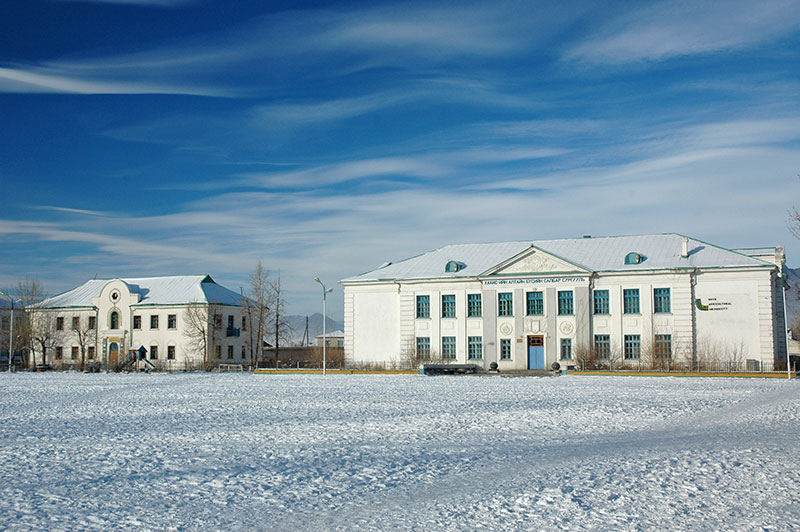
Ard Ayush Square, Khovd, Khovd Province, Mongolia
After driving for a couple of hours west the snow disappears finally and we reach Uvs Lake, in terms of area the largest in Mongolia, running all the way to touch the Russian border. Beyond the dull, peppermint saline waters of Uvs are a formidable range of mountains and beyond that lies my goal: the western border to Russia. Early in the afternoon we reach Ulaangom, which is attractively located but otherwise rather charmless and serves only as a lunch-stop. Instead of driving straight to the border however, I wish to make a final diversion to Khovd which lies almost 250 kilometres to the south. By Mongolian standards this is a huge distance to cover in an afternoon, but we are spurred-on by promises of asphalt and cans of Borgio lager. Progress is fairly slow and we drive into the night; despite the complete darkness we manage to stay on course, though the asphalt does not materialise until we reach the Khovd River, two hundred kilometres from Ulaangom. Our host Cameron, a Peace Corps volunteer from Detroit graciously receives us just after 23:00 and we collapse into our beds, exhausted after days of tough travelling.
Maciej has to leave after two days to get back to his native Gdańsk via Novosibirsk and Kaliningrad in Russia, while I settle down to join the clique of volunteers who live in Khovd, a small slice of Middle America out in deepest Mongolia. There is of course lots of drinking and partying, but I also witness some more wholesome American activities such as celebrating Thanksgiving with members of the local English-learning club, and organising a basketball game in the local primary school where many of the volunteers work. Generally however it is a time for me to relax, away from the rigours of travelling, and organise my forthcoming journey west across Russia.
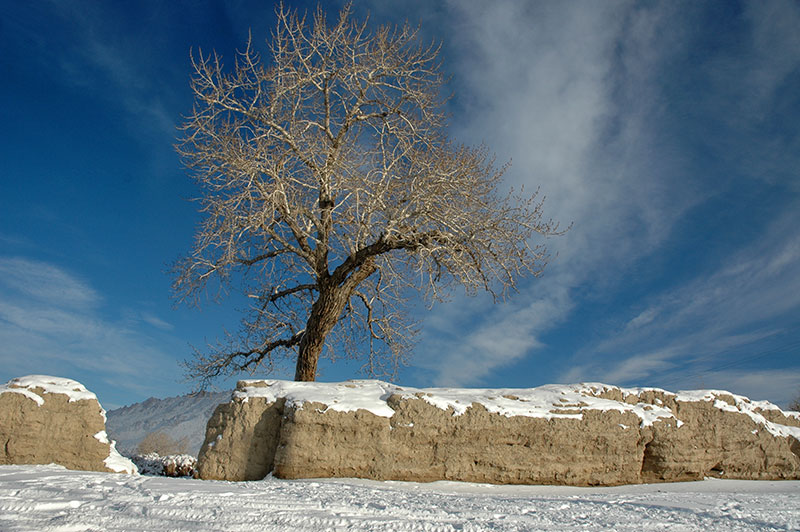
Sangiin Kherem, Khovd, Khovd Province, Mongolia
Khovd, like nearby Uliastai is a Manchu-era city and amongst the oldest in the country, dating from the time when the Qing Dynasty linked present-day China and Mongolia on important trade routes. Although much of the city is the usual sprawl of style-less concrete boxes and ger suburbs, there are a few hints of a long-gone elegance on the northern edge of the city where the heavily weathered remnants of the eighteenth century Sangiin Kherem, a Manchu fortress occupied by the Khovd amban (high official of the Qing Government) until 1912 can be seen, alongside the occasional street lined by tall, aged poplars.
After nine days however I must begin a final drive to the Russian border before the worst of the winter arrives. The road heads north from Khovd through more fresh snow, this time thankfully marked by plenty of vehicle tracks and crossing a bitterly cold mountain pass where I ask some directions from a very hardy Kazakh family in their winter house. It’s so cold here that the truck engine is starting to miss occasionally, due I imagine to the diesel starting to wax in the fuel lines. I descend to Lake Tolbo; in July a glorious turquoise but now a grey-blue expanse of ice, and reach Ölgii in the afternoon. The following day I drive the final strip of asphalt out of the city, then over the harsh ranges of mountains, with the leak in the radiator worse than ever, to the border post at Tsagaannuur where the temperature is frigid. An exit stamp is made in my passport ’32-11-2010′ and then I am at the Russian border gate with just one other vehicle, a Russian fuel tanker. My three-and-a-half month trip through Mongolia has come to an end, at exactly the same point at which it started.
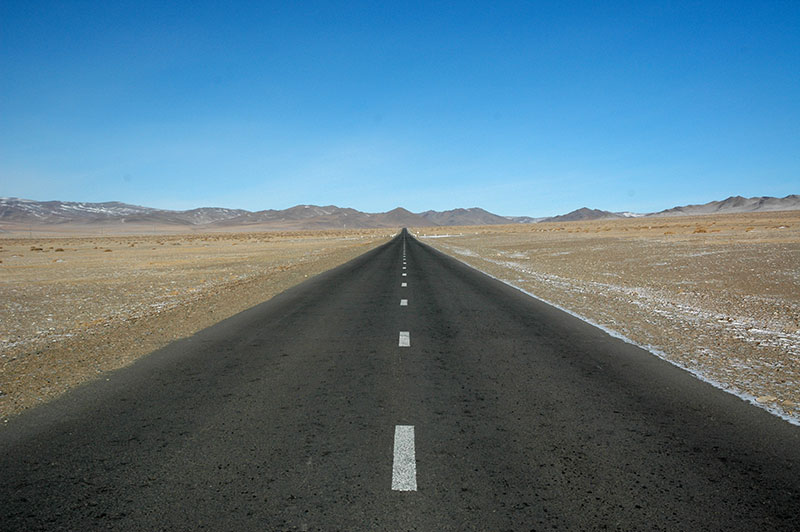
Road to Tsagaannuur, Bayan-Ölgii Province, Mongolia
Mongolia has been utterly enthralling, a country unlike any other I have visited. Travel has often been tough, with communication and navigation constant problems, fickle weather, bitter cold, terrible food, insects, drunks and a host of tribulations that make travel wearisome on an almost daily basis. However, the chance to experience the kind of freedom which comes with travel in Mongolia, to adapt to the wilderness around and to meet people who in the modern age continue to live in real harmony with their surroundings, as our ancestors must have done for thousands of years, far outweighs these annoyances. With the friends who joined me on this journey; Jacob, Toni, Marjo and Maciej, I shared a kind of camaraderie (despite losing the Finns) which would be hard to imagine in most other places. I leave Mongolia with a great sense of satisfaction, having intimately glimpsed a country, culture and way of life which is surely set to change as the ugly, faceless bureaucratic forces of conformism to modernity seek to undermine the freedom and individuality of the Mongols, forcing them into a mould of settled, registered tax-paying citizens whose lives may be neatly entered into spreadsheets, along with all the others. I hope, perhaps as I do for myself, that the Mongols may show sufficient resilience to subvert this awful process.
Stage 23 – Russia & Mongolia: Baikal And Beyond [1/2]
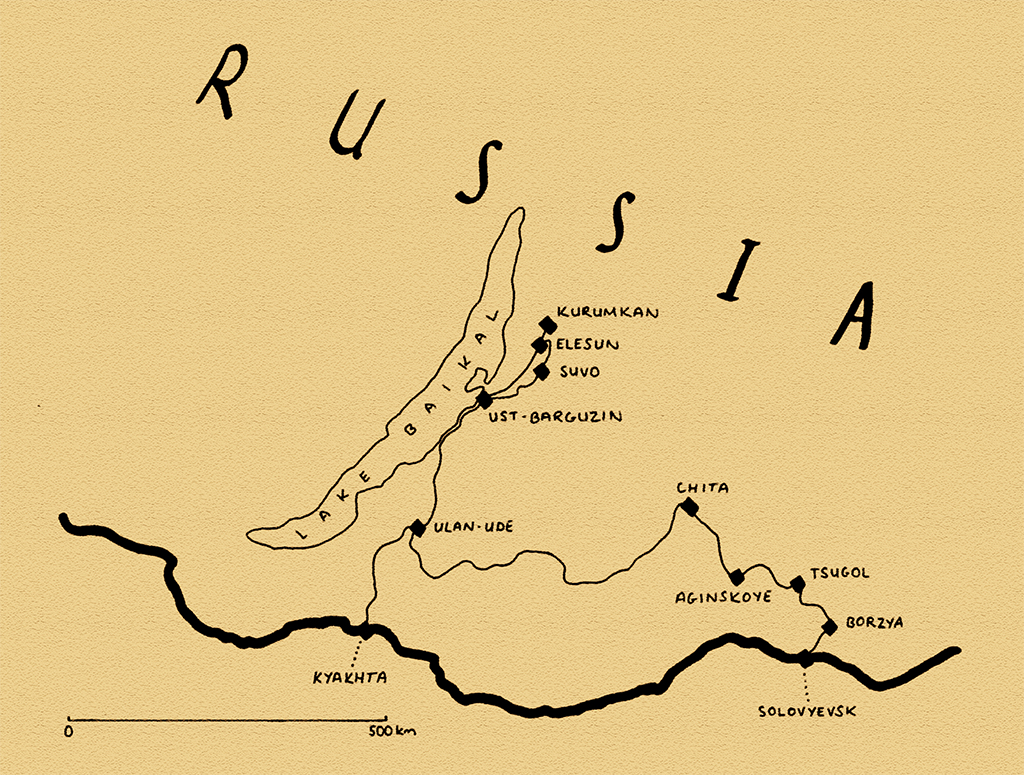
The north of Mongolia fades gradually into the huge expanse of Siberia, an immense wilderness which occupies three-quarters of Russia and much of the Eurasian landmass. Lake Baikal, by far the largest, deepest and most likely oldest freshwater lake in the world, the ‘Pearl of Siberia’, marks the centre of perhaps the most beautiful part of the region where the endless taiga meets the northern steppes and hardy Russian settlers (and exiles and prisoners) have for generations lived among the native Siberian tribes. East of here, beyond Baikal and many thousands of kilometres from the Russian capital, this very sparsely-populated transition zone fades into the great grasslands of China and the region Russians simply call the ‘Farthest East’. In the more than two months which I would spend looping through this region on my way back west to Europe, I would encounter both the stunning beauty and fierce harshness of this environment as the brutal winter abruptly began. Most of all however, I would enjoy the camaraderie of the friends who accompanied me, wilderness camping in what were at times quite harsh conditions.
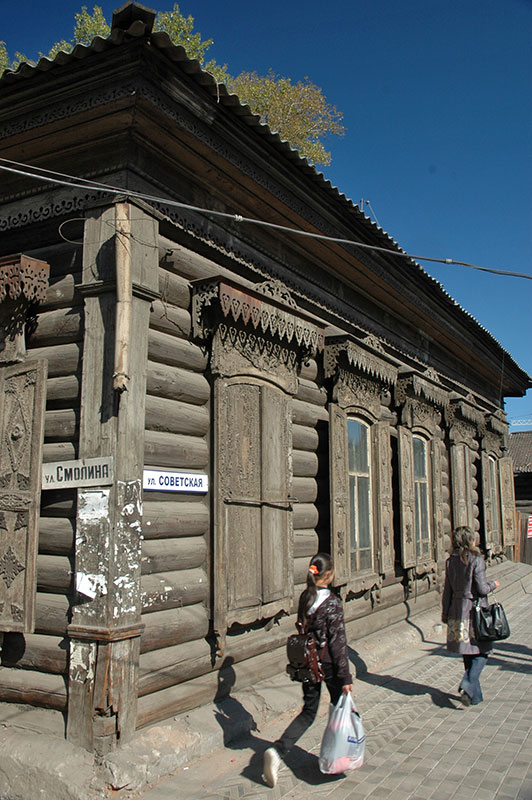
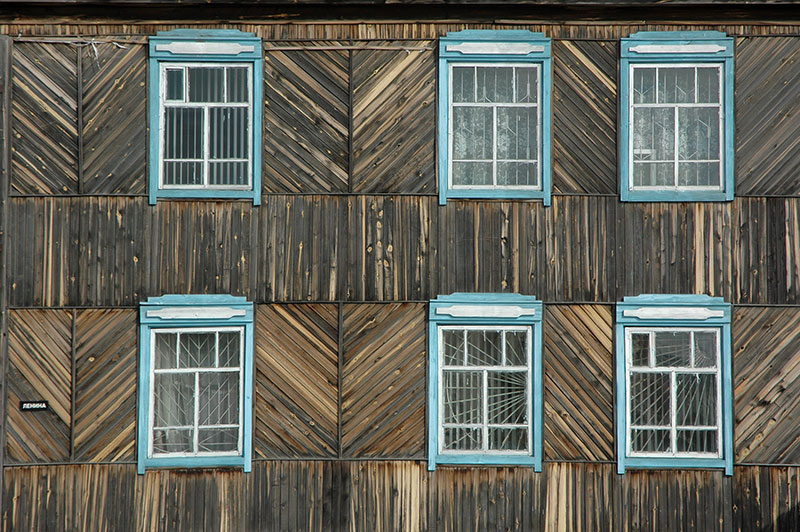
Wooden House, Ulan-Ude, Buryatia Republic, Russia
On the evening of the 16th September 2010 I am the last to leave the Russian customs post at Kyakhta. I’m unable to buy car insurance, so being very cautious I decide to park the truck in a grassy clearing a few hundred metres from the post and sleep the night there. In the morning I walk to a nearby shop where a friendly lady directs me to the town centre, which I reach by minibus. After weeks in the wilderness of Mongolia, the Russian town of Kyakhta is a stark change in environment. Pastel-coloured Tsarist- and Soviet-era buildings form an orderly, if distinctly faded centre, including a ruined cathedral with two roofless octagonal towers and the rather charming trading arches, which have disappeared from many larger Russian cities. It’s a cool autumn morning and light rain falls from a grey sky. Puddles form on the old asphalt of the main street and I am struck by the familiarity of a grey, mundane European scene, despite the fact that I am in deepest Asia, almost six thousand kilometres by road from Moscow.
Though looking quite forlorn today, Kyakhta is in fact quite a historic place; following the signing of the Treaty of Kyakhta in 1727, the border between Russia and Qing-Dynasty (Manchu) China was formalised and the town set up as a trading post on the ‘Siberian Route’, also known as the Tea Road. For almost two centuries goods passed through this trading post; with tea, silk and cotton heading west and furs, hides and textiles heading south towards China, until the completion of the Trans-Siberian Railway which bypassed the town. I buy a month’s car insurance in the post office, and then drive north out of town, soon finding myself back in the familiar wilderness of rolling hills dotted with stands of pine trees; but there is a difference from Mongolia. Here is a country with modern infrastructure; a road network, signposts and towns with strong hints of European culture and architecture. I no longer need to continually read the landscape in order to decide which way to proceed, or search for locals to quiz for directions, nor do I need to keep an eye on the weather and hope for kindly conditions for camping. It would take a few days to switch-off from the rigours of travel in Mongolia, and re-familiarise myself with the comforts of civilisation.
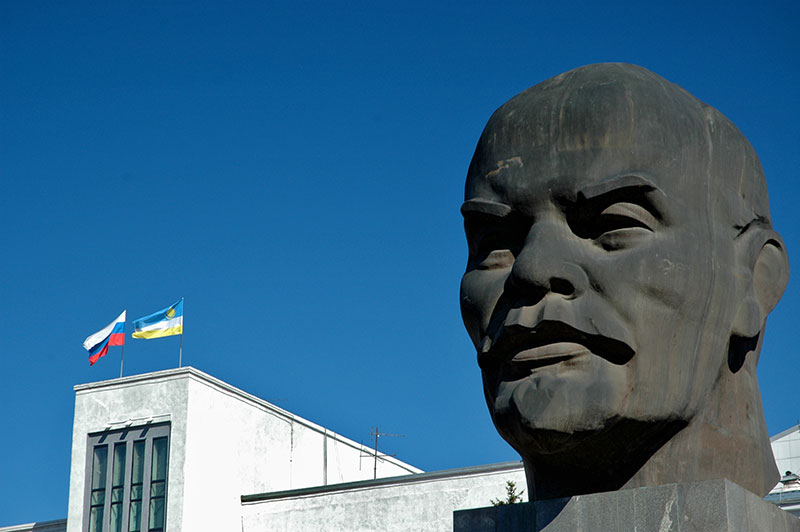
Head of V.I. Lenin, Ulan-Ude, Buryatia Republic, Russia
I arrive in the afternoon in the city of Ulan-Ude where I am hosted by Vladimir, who lives in a quaint and typically Siberian wooden house of dark-stained wood with light-blue window frames and roof gables, and a kitchen-garden with a simple outhouse and banya (Russian sauna). Ulan-Ude came to prominence as a major stop on the Trans-Siberian mainline which reached it in 1900 when it was still known as Verkhneudinsk, but like many Siberian cities is of little obvious historic interest. The city centre is nevertheless quite charming; a neat grid of late-nineteenth and early-twentieth century wooden buildings, only occasionally marred by modern glass-fronted structures. Ulan-Ude is also the capital of the Republic of Buryatia, and the republic’s flag flies along the Russian tricolour on the roof of the Republican Council building. Immediately in front of this, in Soviet Square sits a forty-two tonne head of Lenin, the largest in the world (who here has slightly narrow, Asiatic eyes), built in 1971 to commemorate the centennial of the man’s birth.
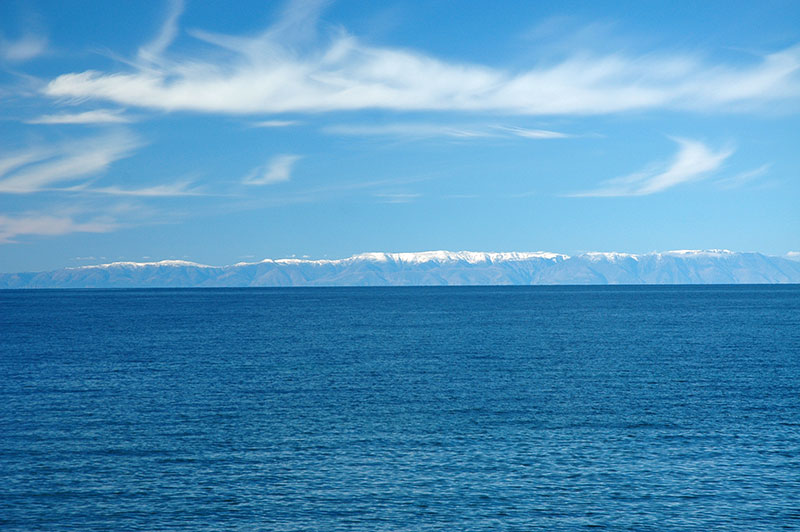
Lake Baikal, Buryatia Republic, Russia
Ulan-Ude is a pleasant place to unwind for a few days and between wandering around the back streets, watching the fishermen wading into the Selenga River from the overgrown naberezhnaya (embankment), and drinking beers in small cafés, I get a new Mongolian visa (on which my middle name is spelt incorrectly) and meet a few other travellers who are passing through town on the Trans-Siberian. After ten days however, seeing a break in the recently rainy weather, I head north on a crisp autumn morning to the real jewel of the region; Lake Baikal. The road heads north from the city’s suburbs, plunging straight into dark spruce forest as it winds over successive ridges before dropping into a rolling, wide valley and passing isolated settlements such as Baturino where the gleaming whitewashed Holy Candlemas Nunnery sits amongst tumble-down wooden village-houses. In Gremyachinsk the road reaches the lake shore and suddenly reveals a truly stunning vista of inky-blue water beyond a clean and pebbly shore dotted with larch trees whose needles are now striking shades of yellow and vivid orange. On the lake’s far shore, under crystal-clear skies of deep blue filled only by the occasional wisp of cirrus clouds is a long range of distant mountains whose upper peaks are dusted with fresh snow.

Barguzin River, Ust-Barguzin, Buryatia Republic, Russia
The road runs along the lake shore for one hundred beautiful kilometres, through dense forests, along sandy coves and past small, wild peninsulas before climbing briefly into the hills once more on a rough unsurfaced pass, emerging in the small town of Ust-Barguzin on the mouth of the Barguzin River. It is on this short stretch that I pass a green Lada Niva travelling very slowly, with foreign licence plates that are too dirty to identify. I have supper in a simple stolovaya (canteen) in Ust-Barguzin, with traditionally frosty service and as I am driving out of town to find a campsite I spot the same Niva parked at the side of the road and stop to offer assistance to the two rather lost-looking occupants. They are Toni and Marjo, two Finns who were total strangers before jointly buying an old Russian 4×4 and driving east from Finland with the aim to reach Mongolia. After a few minutes’ talking we decide to camp together and so begins almost six weeks of travelling and wild-camping together.
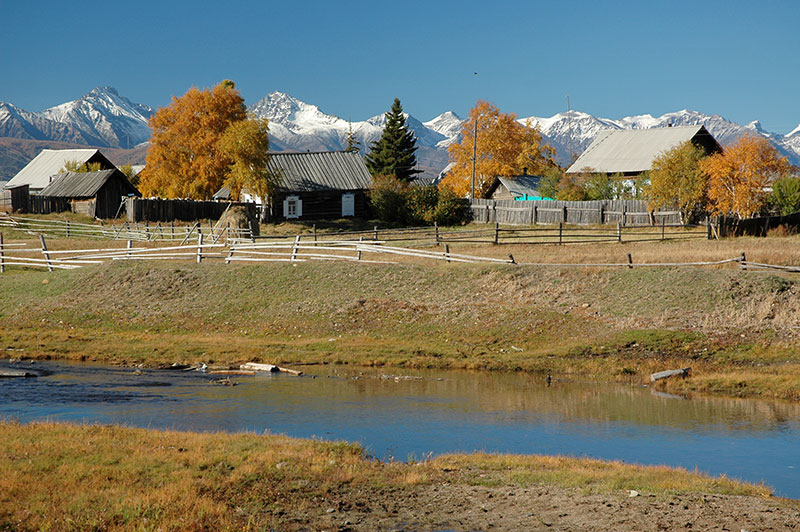
Suvo, Buryatia Republic, Russia
We find a clearing in the forest from which locals are emerging pushing bicycles with hoes and other implements attached. We make a small fire and enjoy a night of fireside drinking; a pleasant contrast to camping in the barren and often windswept Mongolian landscape, though the nights here are already becoming cold with the temperature dipping below freezing. In the morning we continue east, away from Baikal, crossing birch-lined streams of dark, tannin-rich water towards the wide and glorious Barguzin Valley, an idyllic slice of rural Siberia, far from the main rail and road axis to the south. We stop in the village of Chitkan first, with its rustic Tsarist-era church, patchily whitewashed and sprouting grass from the cupola on its bell-tower. Later in the afternoon, a little further north we reach the very bucolic village of Suvo, a picture-perfect scene of tidy wooden cottages among dazzling golden birch trees on a green riverbank lined with leaning wooden fences, overlooked by the jagged, snow-dusted peaks of the Barguzin Mountains which separate the valley from Baikal.
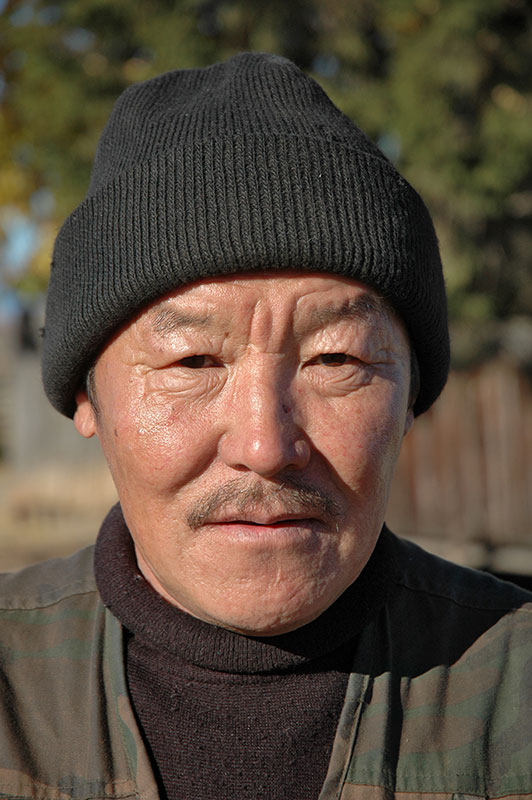
Buryat Man, Suvo, Buryatia Republic, Russia
These small villages have the feeling of a timeless Russia; outposts in the Siberian frontier almost untouched by the trauma of Bolshevism or the unchecked capitalism and consumerism which has followed. In spite the formidable isolation and harsh climate (or perhaps because of it) the locals are especially friendly, such as the old gentleman in Chitkan who animatedly tells us about the village and shows us his coin collection, or another in Suvo who greets us with genuine interest, asks for his photo to be taken, then presses two roubles into my hand. This, together with the sublime autumn scenery makes the Barguzin Valley immediately one of the most beautiful and enchanting destinations I have come across in Russia, and by far the most friendly and charming of Siberia’s mountainous republics.
We camp near Suvo in the evening, establishing a routine which we would follow across the forested wilderness of Siberia all the way to the Mongolian border. We are somewhat out of season, having escaped the insects and tourists of the summer, but the nights are becoming long, with temperatures dipping below freezing. After arriving at our chosen site, we collect perhaps ten to twelve fallen trees and drag them towards the cars, which we park at right-angles for some form of shelter. We dig a pit and then burn several of the tree-trunks at a time over the pit, building up a large, hot fire which warms us all night. The night is divided into three shifts to keep the fire going; 11:00-02:00, 02:00-05:00, and 05:00-08:00 when we get up and prepare to leave. Temperatures dip to -10ºC but with the continuous fire we can sleep on the ground in summer sleeping bags, and burn several hundred kilos of wood each night.
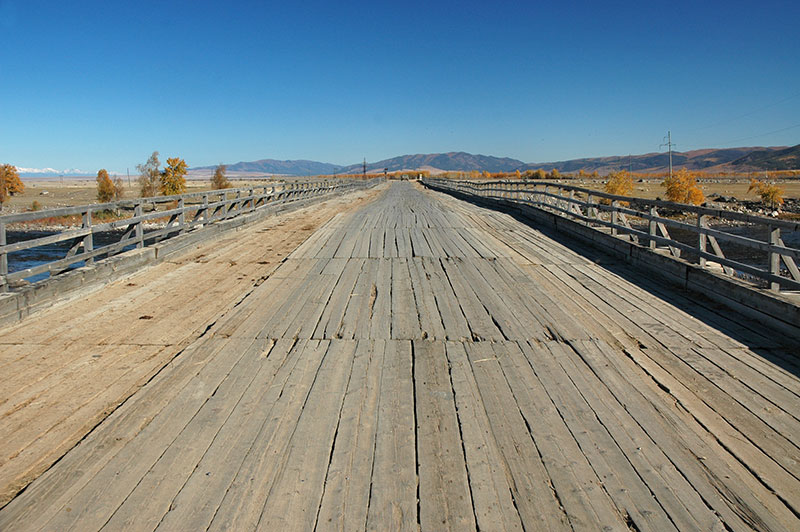
Ina River Bridge, Buryatia Republic, Russia
In the morning as we leave Suvo, we pass one of the few clear traces of Buryat culture which I have seen; a roadside animist shrine consisting of a sacred rock surrounded by a small wooden fence which is tied with sky-blue votive prayer rags identical to those seen at holy sites across Mongolia. Buryats are a northern tribe of the Mongols, linguistically and culturally very close though having both Turkic and Siberian roots and traditionally living in the forested valleys around Lake Baikal. Highly integrated into Russian society, as seen by the mixed populations across the republic from the capital to small villages such as Suvo, the Buryat language is classed as severely endangered with Russian very much the lingua franca. Next to the shrine is a stack of discarded vodka bottles and near that, a friendly village drunk sits slightly dazed-looking waiting for a lift, and when I drop him at his house a couple of kilometres along the road, he thanks me as if I’d rescued him from certain death.
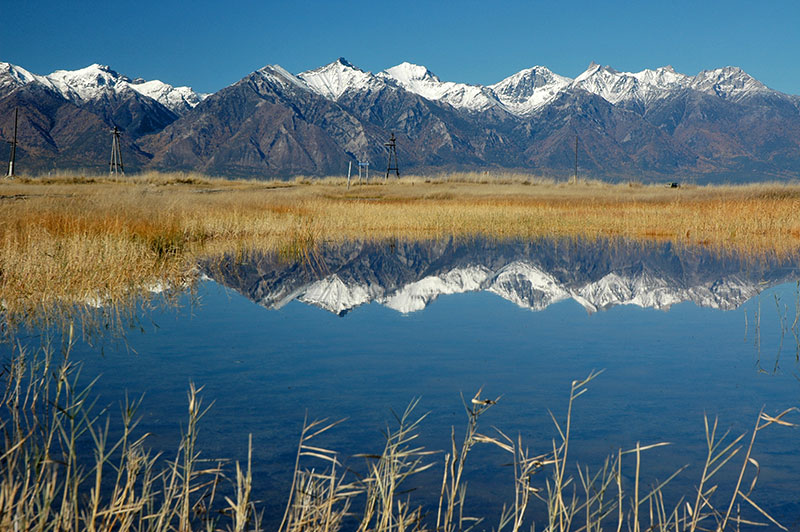
Barguzin Valley, Buryatia Republic, Russia
To the north-east of Suvo the road, now an unsurfaced track, crosses the Ina River on a beautiful wooden bridge, then enters a large plain of golden grass dotted with rivers and small lakes, an area of truly exquisite beauty. All around, wooded hills are textured by the contrasting yellows of larch trees with the green of pine, spruce and fir, overshadowed in the north by a range of gleaming snow-peaks which lie beyond the northern tip of Baikal, on the edge of the trackless taiga. Our northward progress is eventually stopped by the Argada River which we chose not to cross, instead turning west back towards the Barguzin River and the string of villages which lie on the far side of it. However, by mid-afternoon we end up on a long wooden bridge which has recently collapsed just short of the river’s western bank, and so camp for the night in a patch of pine forest near the village of Elesun, enjoying a relatively warm evening after a very pleasant day.
Town Hall, Barguzin, Buryat Republic, Russia
In the morning, we find a bridge slightly further south and cross the Barguzin River, then head north on the asphalted road through large villages of neat Siberian houses largely untouched by modernity, to the small town of Kurumkan. Here we spend the afternoon employing three Russian mechanics to replace the front wheel bearings on the Niva, then camp in thick forest a few kilometres north of town. We drive back down the valley the following day, stopping in the quaint town of Barguzin with its beautiful two-storey wooden town hall, then crossing the Barguzin River once again on an old ferry and driving through some unexpected sand dunes to camp on the eastern shore of Lake Baikal. Clouds begin to form in the sky to the west, but the afternoon and evening are glorious; we are alone on a long, sandy beach dotted with pine trees and logs of washed-up driftwood. It’s a beautiful setting and a nice ending to our time in the area, though by morning clouds have rolled in and the spell of perfect autumn weather comes to an end, making us yet more grateful for the enchanting few days we have spent in the Barguzin Valley.
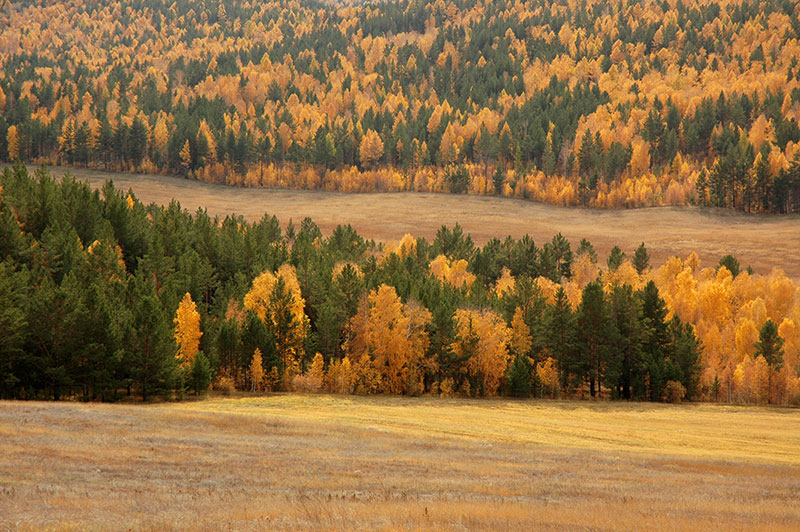
Taiga, near Petrovsk-Zabaikalsky, Zabaikal Territory, Russia
After returning to Ulan-Ude for a night, we set-off east on the Trans-Siberian Highway, on the M55 which runs to Chita. The road winds south and then east, crossing low passes and driving through patches of multicoloured taiga, soon leaving the Republic of Buryatia and entering Zabaikal (literally ‘beyond Baikal’) Territory. As we leave the surroundings of the lake, the country starts to feel wilder, the traffic thins and the villages go from being very attractive, with ornately decorated and colourful wooden houses, to being run-down, depopulated and forgotten, causing one to wonder just how, and why European Russians came to live in such a harsh and fantastically isolated area. Although the Trans-Siberian Highway (and Railway) are the modern conduits of Siberia, along which nearly all the population now live, Russian settlers have been in the region since the sixteenth century when Cossacks (a militaristic Eastern Slavic people from southern Russia and Ukraine, formerly loyal to the Tsarist authorities) rapidly subjugated various native Siberian tribes and established Russian control all the way to the Pacific by the mid-sixteenth century, using a series of small west-to-east river routes connected by short portages.
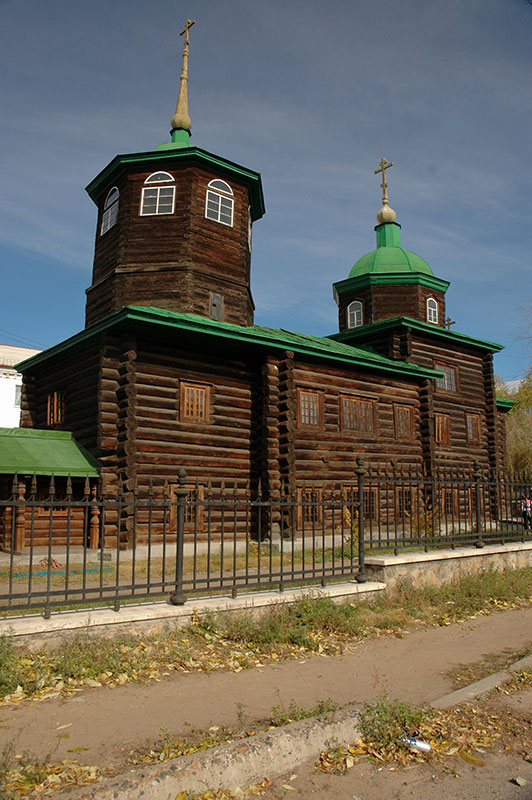
Decembrist Church, Chita, Zabaikal Territory, Russia
We spend a night camping in a forest clearing, following a long valley north-east the next day to the capital of Zabaikal Territory, the city of Chita. Historically overshadowed by nearby Nerchinsk, a centre for trade with China, the opening of the Trans-Siberian Railway marked a decline in the latter’s fortunes, and importance shifted to Chita, a large garrison strategically close to China and starting point of the Trans-Manchurian Railway. The three of us are hosted here by Anatoly, a generous local businessman who shows us around his native Chita; to the beautiful cream-coloured wooden post-office, the bustling market full of Chinese traders where one hears Mandarin as much as Russian, to the colourful and elegant Neoclassical building of the intelligence services, and the striking all-wood eighteenth century Decembrists’ Church which now functions as a museum.
Chita, like all of Siberia, has a modern history synonymous with exile, imprisonment and hard labour in brutal prison camps, culminating under Stalin in the infamous Gulags of the USSR to which millions were sent, and where many hundreds of thousands perished under unimaginable hardship. This dark tradition in fact goes back much further in time, to the mid-eighteenth century when the Tsarist government disposed of petty criminals and political opponents in this harsh and far-flung end of the empire. Later, this exile was used alongside forced migration as a method to settle and develop this territory which lay thousands of kilometres from the capital, far closer to Peking than to Moscow. Perhaps the most famous group of Tsarist-era exiles were those convicted of supporting the Decembrist Revolt of December 1825, when a group of Army officers and soldiers failed to pledge allegiance to Tsar Nicholas I following the abdication of his brother Constantine. Consisting of many formerly high-standing members of society (often followed by their wives), the largest group of Decembrists were settled initially in Chita, and had a gentrifying influence in Siberia, in some cases becoming landowners, embarking upon philanthropic vetures and later pressing for reforms in the Russia such as the abolition of serfdom. This new Siberian intelligentsia came to be widely respected by natives, and even glorified in the anti-Tsarist rhetoric of the USSR.
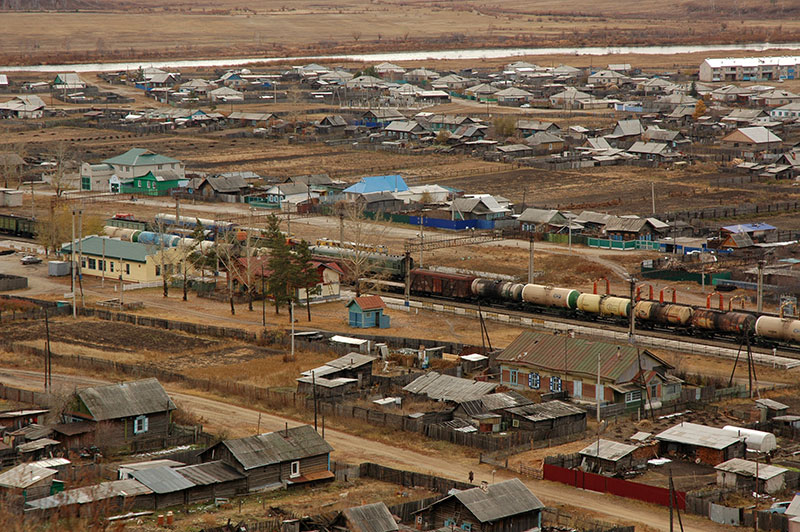
Novokruchinsky, Zabaikal Territory, Russia
After three nights in the very pleasant company of Anatoly, his wife and daughter, we pull ourselves from the comforts of the family apartment and resume our journey. To the east of Chita is the M58, leading to the Pacific at Vladivostok, via Khabarovsk, and at Magadan via Skovrodino and Yakutsk; all destinations I would love to visit, but which I sadly have to postpone to a future journey (currently planned for 2017-18). Instead, the three of us head south, leaving the Trans-Siberian Highway and following the road towards the Chinese border. We cross more forested ridges, leaving the edge of the taiga and entering a more bleak and windswept landscape of grassy valleys dotted with occasional trees, where we see our first real accumulations of snow. We pass through sleepy small towns, reaching the district capital of Aginskoye in the afternoon where we camp in a patch of birch trees on the edge of town and drink Toni’s expensive and coveted bottle of Russki Standart Platinum vodka.
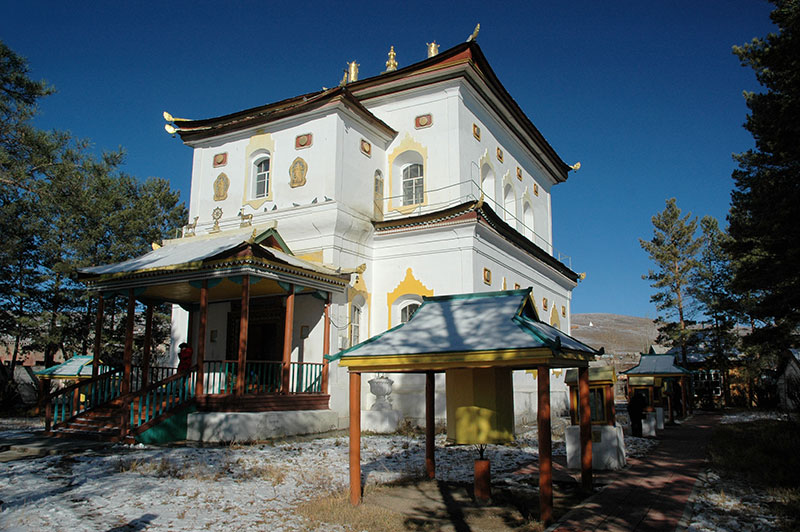
Dechen Lhudubling Datsan, Amitkhasha, Zabaikal Territory, Russia
In the village of Amitkhasha, a few kilometres west of Aginskoye is the Dechen Lhudubling Datsan, a Buryat Buddhist monastery of the Tibetan tradition, functioning as a centre of education similar to those in Tibet or Mongolia. We visit the datsan in the morning; a surprisingly well-maintained and vibrant complex of temples, stupas and service buildings dating from 1811 which, though closed during much of the Soviet Period, managed to survive Stalin’s religious purges and is now the oldest datsan in Russia, older and more impressive than the completely rebuilt Ivolgin Datsan near Ulan-Ude which is considered to be the more important. The new main temple is a large and imposing structure of brick with a wooden balcony and pale green roof; a very rare example of a graceful modern construction. Other, older buildings in the complex show a more charming architectural syncretism; a two-storey whitewashed temple with strong Tsarist echoes below a yellow pagoda-roof, and a quaint yellow classroom building similar to a typical Siberian cottage, but with a simple tip-tilted roof. Pilgrims and monks mill around the buildings making for an unexpectedly vibrant atmosphere in this otherwise quite austere and neglected region.
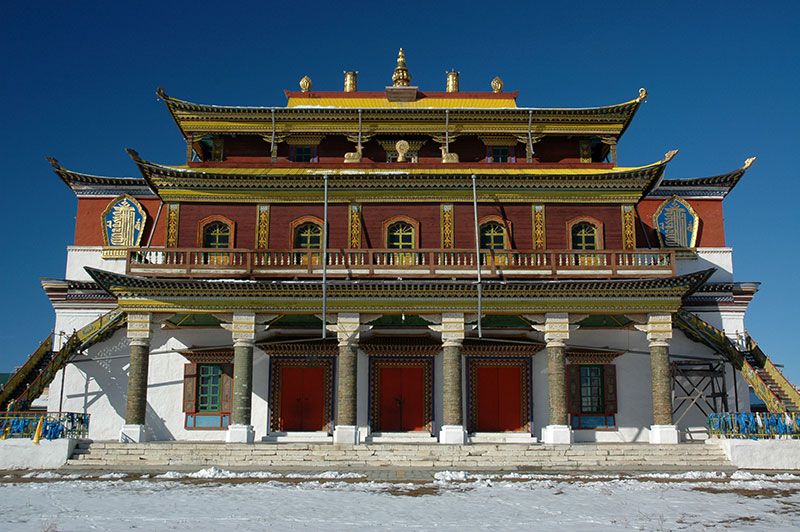
Tsogchen Dugan, Dashi Choypelling Datsan, Tsugol, Zabaikal Territory, Russia
Just over one hundred kilometres from Aginskoye, in the village of Tsugol lies the Dashi Choypelling Datsan whose main temple, the Tsogchen Dugan comes unexpectedly into view as we drive up on a muddy track from the highway. The sight is rather compelling; more picturesque by far than anything at Amitkhasha, the authentic nineteenth century shrine has panels of Mongolian script, preserved glazed-green brick columns and a beautifully intricate external staircase leading to the upper levels of the temple. There is fresh snow on the ground and the yellow, three-tiered pagoda-roof contrasts sharply with the deep-blue of the late-afternoon sky, making me think that after the gompas of Spiti and Ladakh in India, this is the most beautiful Buddhist structure I have ever seen.
Just south of Tsugol, we cross the Onon River, a distant tributary of the Amur River which delineates much of the Russia – China border on its course to the Pacific more than 3500 kilometres from here. The landscape becomes increasingly snowy, but we are glad to find a small patch of forest on the final ridge of mountains before the road descends onto steppe. The snow is about fifteen centimetres deep, but the Finns are in their element here collecting birch trees while I dig a fire-pit, and we have a comfortable final night in Russia around a raging birch fire.
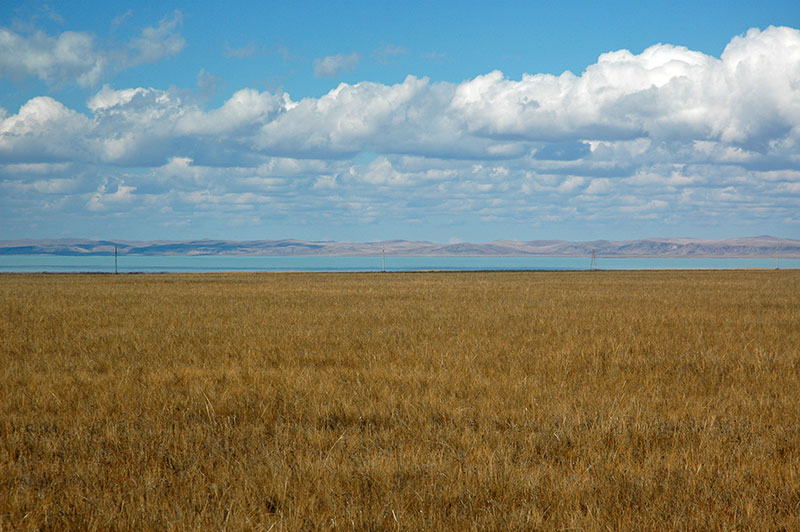
Zun-Torey Lake, Zabaikal Territory, Russia
South of our campsite we roll down onto the edge of the steppe. The snow soon disappears and we drive across a undulating landscape of dry grass. During Soviet times, this region was heavily militarised, particularly after the Sino-Soviet split of the early 1960s. We drive past the crumbling remains of military-industrial complexes aside the Trans-Manchurian Railway, even passing a small ghost town. These decaying concrete skeletons of buildings seem to add to the barren terrain to give a feeling of remoteness and desolation, though trade and traffic is these days thriving with China at the nearby border crossing. Our goal however is a remote and very seldom-used border crossing into the far east of Mongolia, into a region I had been unable to access last month due to a quarantine following an outbreak of foot-and-mouth disease, which I suspect to still be in force. We nevertheless choose to attempt to cross the border here.
In the small junction town of Borzya, at 116.5º east of Greenwich, I reach the easternmost point of my journey, nearly one third of the way around the world from the UK, on roughly the same line of longitude as Beijing. We have lunch in Borzya and stock up on supplies, then drive the final eighty-five kilometres on an arrow-straight gravel track to the isolated border post at Solovyevsk. Here we enter the true steppe; a flat expanse of waving yellow grass, the northern fringes of one of Asia’s most ecologically important grassland areas. Puffy cumulus clouds rack up in the huge sky, and turquoise Zun-Torey Lake appears on the horizon. At the tiny barracks of Solovyevsk, we surprise the Russian border guards, though they are friendly and by mid afternoon we have left Russia, ready to begin the crossing of northern Mongolia.
Stage 22 – Russia & Mongolia: Altai To The Gobi Desert [3/3]
It’s the evening of the 12th August 2010 when Jacob and I, driving from Kharkhorin on the only continuously paved road I have encountered since entering Mongolia more than two weeks ago, reach the outskirts of Ulaanbaatar. The suburbs are predictably rather squalid, a mass of chaotic traffic, large areas of seemingly moribund industry, mindless, aggressive drivers and a stench of raw sewage and animal muck. We stop in the pouring rain to have another late lunch, here consisting of buuz (meat-filled dumplings) rather than the dreaded tsuivan (greasy mutton lumps and noodles). The city gradually smartens as the traffic careens headlong towards the centre, and we see used Japanese cars, flashy new SUVs and beat-up Korean saloons instead of the ubiquitous Russian 4x4s of the countryside. We start to pass a succession of shopping malls and seedy karaoke bars advertising ‘VIP Rooms’, eventually finding ourselves in a tidy, smart and superficially modern and very westernised city-centre. By the time we reach our host Elena, a Russian Buryat who lives in a modern high-rise in the centre, the transition we have made today from the pre-modern countryside to the neon lights of the capital seems positively surreal.

Choijin Lama Temple and Blue Sky Building, Ulaanbaatar, Mongolia
Ulaanbaatar is not an old city, the site having been chosen in 1778 to be the permanent location of a previously nomadic, roaming monastery-city. It was not until the communist era that the city was modernised, and apart from a few temples which survived Stalin’s purge, and the glut of new buildings in the flashy centre, the city is architecturally purely Soviet in style. Indeed, the city’s name, which means ‘red hero’ is clearly of Bolshevik / Soviet origins. Almost half of the Mongolian population of three million live in Ulaanbaatar, with the population ever increasing. This urban drift may have something to do with the country’s recent mining boom, but is largely the result of poverty, exacerbated by harsh winters knows as zuds where thick snow and extreme temperatures devastate livestock and can leave families totally destitute. The previous winter of 2009/10 counted as a zud. Away from the orderly centre, the city is a mess of unplanned building, broken streets and general neglect which reminds me of Kathmandu, and in the farthest western slums one can almost watch the process of urbanisation. Migrants arrive with their gers (yurts), find a patch of land at the city’s edge and set up home, erecting a simple picket fence around their claim. A latrine pit and small outhouse are made, then an electricity hook-up and ultimately a fixed house. Following the slums towards the centre, the gers, unsuited to being continually erected in one spot, slowly vanish, and thus the urbanisation is complete, with nomad turned into city-dweller. Many of these unskilled migrants live in abject poverty and the city has a noticeable underbelly of petty crime, alcoholism and domestic violence.
At the same time however, there is a truly modern, urban Mongolian society, a well-dressed, attractive, educated and sometimes well-moneyed class. While Mongolian society in the countryside is undoubtedly traditional, these are not people who are restricted by the backward mores of a medieval social system, and the urban young of Ulaanbaatar live a life not much different from their contemporaries in Almaty or Moscow, though a world away from their countryside cousins. To me this is more evidence of the great adaptability of Mongolians, and while the urban class owes much to the communist era, there are also clearly parallels with the air of religious tolerance and pragmatic secularity for which the vanished ancient Mongol capital of Karakorum was famed.
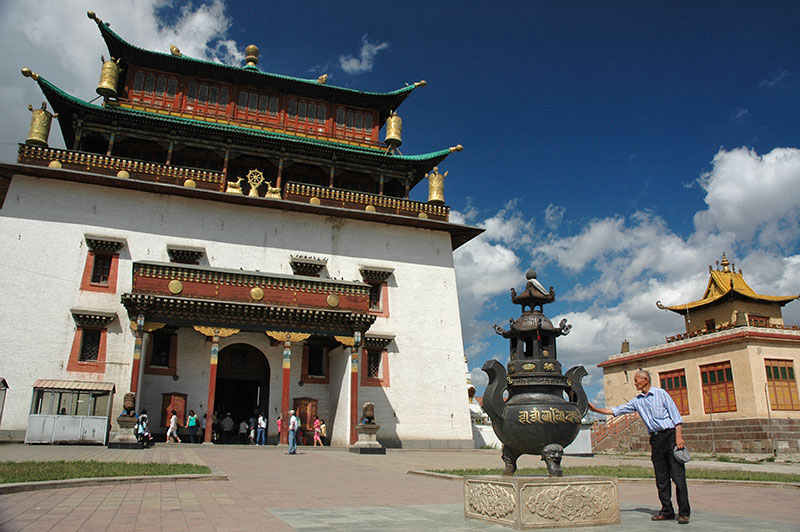
Gandantegchinlen Monastery, Ulaanbaatar, Mongolia
Jacob and I enjoy ourselves in the capital; eating good food, not constantly at the whim of the landscape and elements, and living an easy sedentary life. Ulaanbaatar’s sights are very modest; a few surviving old monasteries such as the large, whitewashed Tibetan-style Gandantegchinlen and otherwise just the Soviet and post-independence monuments and squares, though the National Museum is surprisingly good. One night we visit a rather seedy night club, dancing with very attractive young women but narrowly escaping the violent intentions of young Mongolian men; not the only example of deep-rooted xenophobia in the urban population, in stark contrast to the genuine hospitality of the people we’d encountered on the steppe. I’m also surprised by just how many tourists there are here – in stark contrast to the remote steppe we’ve driven through to get here – and from their accounts of rather superficial encounters with Mongolia on the train between Russia and China, or on contrived jeep-tours, I yearn once more to be free, out on the steppe. I wonder how many of the Mongolian urban migrants soon come to feel the same way after spending time here. After spending a slightly shocking twelve days in this uninteresting and rather unlovable city, Jacob and I depart, aiming for the Gobi Desert.

Ikh Gazriin Chuluu, Dundgovi Province, Mongolia
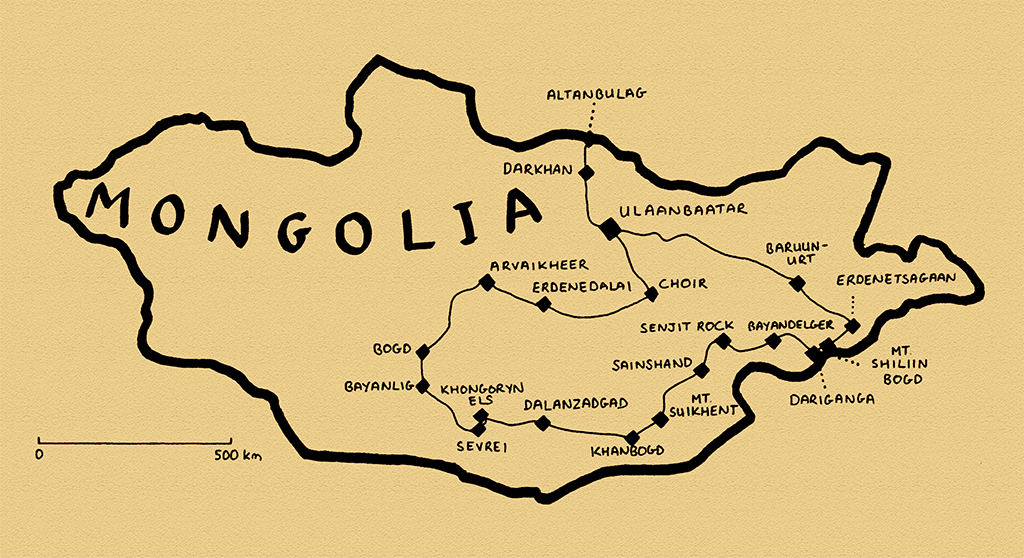
We leave the sprawl of Ulaanbaatar and head initially south-east, loosely following the Trans-Mongolian Railway which links the Russian city of Ulan-Ude (close to Lake Baikal), with (Chinese) Inner Mongolia and Beijing. Soon after leaving the capital, the low, green-brown hills flatten and after forty kilometres we are on empty steppe. We enjoy an asphalt road for much of the day, and in the late afternoon reach the small town of Choir. Once a Soviet military cantonment, Choir is the capital ‘city’ of its own small province, Govisümber, though is today little more than a large village and a near-deserted station on the Trans-Mongolian. We buy cold beers and ice creams and then head west a few kilometres and camp on the flat steppe. The temperature is pleasant and as the sun sets and a brilliant full moon rises against the day’s small drifting cumulus clouds, we revel once more in the wonderful feeling of freedom we have out on the steppe.
In the morning we continue westwards, aiming in the next few days to skirt the northern fringes of the Gobi Desert before plunging south to the sandy wilderness close to the Chinese border, from where we aim to move steadily eastwards to the easternmost part of Mongolia. While we have left the asphalt road and are back on more familiar dirt-tracks, the land here is flat and usually dry with very little traffic, meaning that our progress is relatively steady. Far more than the rocky west, this is the Mongolia I had imagined before coming here; rolling green plains dotted with yurts and cattle under huge, deep-blue skies with sparse ranks of clouds. Soon enough however, the land changes dramatically as we enter an area of red-basalt outcrops known as Ikh Gazriin Chuluu, a first taster of the Gobi Desert. We scramble around the dramatic, isolated piles of rock for a few hours before stopping for a meal and provisions in the provincial capital Mandalgovi on our way further west.
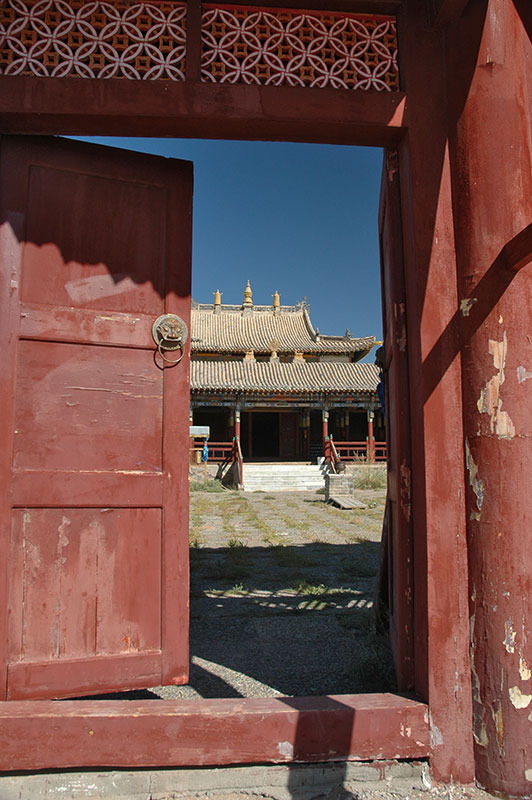
Gimpil Darjaalan Monastery, Erdenedalai, Dundgovi Province, Mongolia
Our destination the next day is Erdenedalai, a small, nondescript sum (district) centre which would be wholly unremarkable were it not for the beautiful late-eighteenth century Gimpil Darjaalan Monastery. The monastery consists of a single, surprisingly large Manchu-style temple which combines an outer perimeter gallery colonnaded with ornately painted wooden beams, with a large central hall, topped by a very elegant two-tier, meticulously tiled pagoda roof. The monastery somehow escaped Stalin’s purge, serving as a storage area until independence in 1990. Its presence is rather baffling on this otherwise totally featureless plain.
West of Erdenedalai, the landscape becomes drier, subtly more desolate and hostile. We pass some ancient stone-topped kurgans (burial mounds) marked out with a square of perimeter stones, lying totally anonymously in the semi-desert, traces of a long-forgotten culture. We lose the main track and, while Jacob snoozes, I drive through low, almost trackless valleys, past isolated gers and shepherds for several hours before reaching the tiny sum centre of Sant, from where we find a small track due west. Shortly after, we come upon the abandoned settlement of Dolgon, a small, communist-era agro-industrial complex now heavily looted for scrap and building materials. We wander into what must once have been an administrative building, a lone two-storey structure amongst the Mongolian wilderness investigating old office records, rather puzzled as to what the purpose of this factory might have been, and why it is situated away from any town or road.
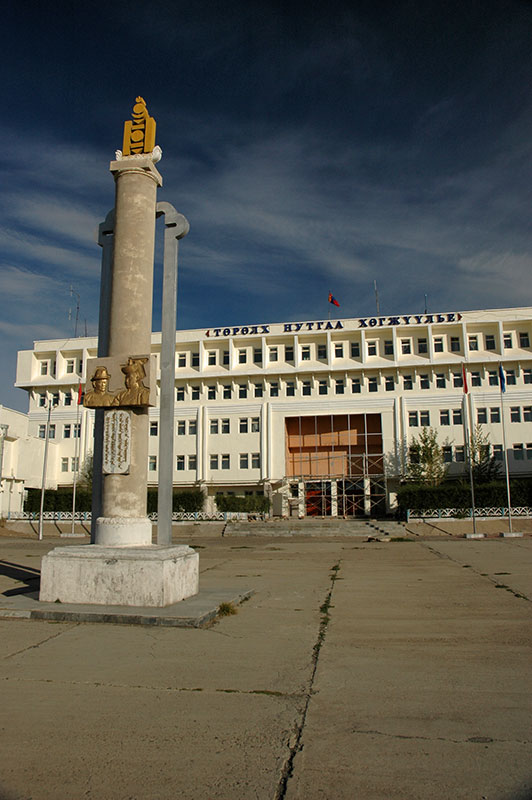
Central Square, Arvaikheer, Övörkhangai Province, Mongolia
Later we come to the Ongi River and have a very welcome bath, then fording the river to join the asphalt of the ‘Southern Route’, Mongolia’s main east-west highway. In the morning we explore Arvaikheer, the capital of Övörkhangai Province which is a little smarter than most Mongolian provincial capitals. Rather than the usual crumbling communist-era concrete, here the provincial administration building has been smartened up and is positively elegant, sat behind a concrete slab-paved square with a stele bearing the Mongolian coat of arms. There is even a patinated bronze sculpture of what I assume to be a miner, though his features are clearly, and rather patronisingly Caucasian.
West of Arvaikheer, the asphalt soon ends and the highway reverts to a heavily wash-boarded dirt track, making for rather unpleasant driving. I’m looking for a decent-sized track heading south which will take us deep into the Gobi Desert. The philosophy of driving and navigating in Mongolia is quite different from anywhere else in Eurasia. Aside from perhaps two highways worthy of the name, there is no single defined route between any two places, and certainly no signposts. Instead, one relies on bearings, finding a set of wheel tracks heading in one’s chosen direction, and following them, switching to others when necessary to maintain an approximate course. This method can be rather trying in the wetter and more mountainous areas of the country, where deep rivers, cliffs or steep mountains may put an end to one’s progress, but out here in the dry, wide-open plains, it becomes a very pleasant way to travel, almost like navigating across an ocean.

Gobi Road, Bayankhongor Province, Mongolia
Around one-hundred kilometres from Arvaikheer we leave the Southern Route for good (I break a leaf in the truck’s front-right spring coming down a steep bank too quickly) and proceed south-west, passing Bayanteeg shortly after. Quite quickly the landscape changes again, to the Gobi proper. The Mongolian term gobi literally refers to land which is too poor to support sheep, but on which camels may be grazed. In practice however, the Gobi Desert occupies a vast tract of inner Asia, stretching from here to the Tibetan Plateau and occupying much of northern and western China, encountering a wide range of environments. Beyond Bayanteeg the vistas become huge; we can clearly see Ikh Bogd Mountain on the horizon, despite it being sixty-five kilometres away. Occasional gers can be seen next to dry, ephemeral riverbeds, and we wonder what must draw (or force) people to live in such areas. The land becomes a hard-baked undulating plain, and we course at full speed along a winding gravel track, leaving a huge dust plume in our wake.
In the late afternoon we arrive in the small sum centre of Bogd, and find a very pleasant campsite in the small valley of the Tüin River. Now being late summer, the river, one of many which runs from the north and dissipates into the desert, is more like a warm pond but we join the camels who are (downstream) taking a dip after a long, dusty day. Some local children find us and are delighted when we teach them to line up empty vodka bottles and take aim at them with stones; a hobby which Jacob and I have taken up in order to break up long, monotonous drives and break down some of the innumerable vodka bottles which are ubiquitous in the Mongolian landscape.
Progress the next day is slow as we must navigate around the boggy land adjacent to Orog Lake and then cross Ikh Bogd Mountain in an area with no vehicle tracks. After tracking a gulley to the point where it no longer becomes drivable we have to turn around, but find a local to ask and finally make it up onto the southern ridge of the mountain. Here we drive east a little to Tsagaan Agui (White Cave), whose walls are lined with sometimes very large, glistening multicoloured quartz crystals and gemstones, and which was inhabited by Stone Age humans. Late in the afternoon we make it to the sum centre of Bayanlig which sits on the edge of a vast expanse of flat, utterly featureless desert into which we will drive tomorrow. The highlight of the day however is finding that the local guanz (canteen) has the best buuz we would find in Mongolia, and it is with full stomachs that we find a campsite just outside of town.

Bayangiin Nuruu Petroglyphs, Bayankhongor Province, Mongolia
In the morning, before heading into the true desert, Jacob and I drive on a bearing south-west to a range of low, black hills of desert-varnished basalt rock. Our target is Bayangiin Nuruu, a complex of petroglyphs tucked deep in the ephemerally watered valleys which dissect these dark volcanic stands. As so often happens, we lose the track and just two kilometres from target the truck is in a plain of large stones. Jacob scouts ahead, soon finding the right track and I slowly crawl around a small cliff and over to his position, from where we are soon at the mouth of a small valley. We walk up passing boulders, some with single, crude petroglyphs, wholly unprepared for the amazing prehistoric gallery which we find after half an hour or so; a cliffside of fissured black basalt, with multiple panes of several square metres filled with bright orange petroglyphs. Dated at around 3000 BCE, they are younger than the petroglyph complexes I had earlier seen in the Altai Mountains, but here the concentration in such a small area is overwhelming. There are depictions of wild sheep, aurochs, gazelle, reindeer with elaborate, stylised horns, camels, snakes, asses, large cats and boars. Human hunters are shown with longbows, either mounted on horseback or free-standing, and it is theorised that such petroglyphs are some kind of tribute to the spirits of the animals which were the hunter’s prey. There are fantastical, mythical beasts, and depictions of hunters in congress with women, even one of a male figure in posing in tumescence, suggesting a link with early fertility cults. Such petroglyph sites, almost always found in remote outcrops of volcanic rock always raise the question of whether these places specifically were sacred in some way, or if it was simply that the art of such early cults is only preserved in places such as these.
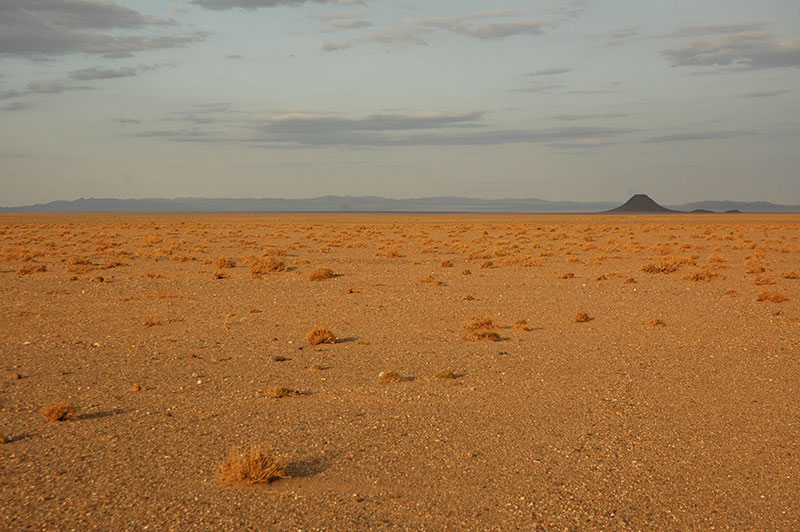
Khatan Suudal Volcano, Bayankhongor Province, Mongolia
We return to Bayanlig in the afternoon to eat more buuz, then head east into a vast, flat, sandy plain. The sand is not deep and it makes for very pleasant driving, though there are well over one-hundred kilometres of almost trackless desert between us and our next destination, making us somewhat anxious not to lose the track we are following. Soon the tracks start to diverge off into the nothingness, but far ahead we spot the small, extinct black volcano of Khatan Suudal, and reasoning that most people will naturally be drawn to this visually striking feature, we simply drive straight over the desert, disregarding the tracks of others. Such driving gives me a sense of absolute freedom, something simply impossible within the narrow confines of Western Europe, and strikes me as being one of the essences of my endless motivation to travel. We camp at the very bottom of the volcano and are of course totally alone in this glorious desert. We climb the volcano the next morning; I half expect to find some petroglyphs on the summit, but there is only a large slate cairn. However, despite being just one-hundred metres above the desert floor, the view is nonetheless spectacular; below us the truck is but a speck, and alongside a single dusty track, is the only sign of human existence we can see in any direction.
Our next target is known as Khongoryn Els, a small sand-sea in the neighbouring province of Ömnögovi, in the driest but most spectacular region of the Mongolian Gobi. We follow tracks for several hours, crossing flat gravelly plains, sparsely-vegetated sands, red yardangs and desiccated mud-flats dotted with saxaul plants. In the early afternoon however, the track we’ve been following leads to the edge of the els (sand-sea). The truck soon bogs, and after one brief spell of digging it is clear that we need to find another way round. We must make a decision however; either to skirt the els to the north and go straight to the spot we intend to camp in, or to drive around the south, close to some nearby mountains and the small sum centre of Sevrei, then crossing the els at a point where the map indicates a track. We have enough fuel to go by either route, but we might not have enough to return and try an alternative if we find our chosen route impassable.

Bactrian Camels, near Sevrei, Ömnögovi Province, Mongolia
The northern option would be more direct, but the area is totally trackless and may therefore be impassable, making us choose the longer but safer southern route. After a few rather tense and rough kilometres tracking south amidst small dunes, we are relieved to find a track and even see another vehicle; the first since leaving Bayanlig the day before. By late afternoon we’re climbing up a rough wash towards Sevrei, but once again lose the track and end up cutting across tortuous goat paths, reaching the tiny settlement after dark.
In the morning we wish to buy some diesel but the laziness of the fuel station owner exceeds my patience and we descend back to the dunes, letting some air out of the tyres and driving over the sandy edges of the els where beautiful Bactrian camels are nonchalantly grazing in the sparse shrubbery. We find something of a cleft in the els, a narrow, silty wadi which to our amazement is filled with thick, muddy floodwater from recent rain. After walking around on the nearby dunes and confirming that there is no alternative route, we have no option but to wait for the water to recede and the ground to become firm enough to drive over. This only takes a couple of hours however, and with Jacob once again scouting ahead, I carefully drive over the riverbed, which has been eroded into deep gulleys in places, then power through a long section of deep sand until I reach a firm area clear of the far edge of the els, and wait for Jacob to walk over.
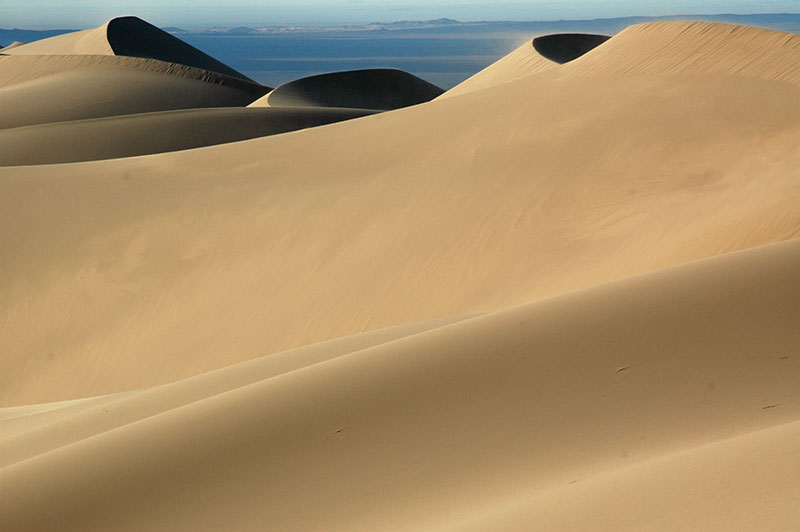
Khongoryn Els, Ömnögovi Province, Mongolia
It’s a joyous moment when we get the truck through; we’re relieved not to have got stuck or worse, and thrilled at having finally almost reached our destination after a particularly strenuous journey from Bayanlig. We’re also noticed by a van full of Mongolian men who stop and of course start drinking vodka, inviting us over to join them. They’re a rough but good-spirited and generous bunch, but after a few bowls we manage to excuse ourselves before things get too wild, and drive south to our camping spot at the foot of Mongolia’s highest dunes, hoping to be far enough from the tourist jeeps and ger camps to have the desert to ourselves. In the late afternoon we haul ourselves up to a high ridge in the els, lying on our backs against the steep slipface of a dune in a rather blissful state. We are sitting atop a beautifully sculpted sea of yellow sand which extends around fifteen kilometres to the north-west, behind which, in the very far distance are black ridges of desert mountains close to the area we passed yesterday. The temperature is perfect, and watching the sun set from here is one of my absolute favourite moments of the trip, one that I will never forget.

Khongoryn Els, Ömnögovi Province, Mongolia
The Gobi Desert is the world’s fifth largest and also one of its coldest, and it is therefore on a warm September morning particularly pleasant to walk among the dunes, in the absence of blazing sun or scorching heat. We spend the whole day at the els, though sadly a storm passes in the afternoon, covering us with wind-blown sand and ruining any chances for another beautiful sunset view of the dunes. On our second and final morning I walk east along the els, reaching a small area of lush green grassland on which happy Bactrians graze below small mountains of golden sand. On my walk back I’m so deep in thought that I overshoot our campsite by more than a kilometre, and finding myself slightly disoriented, only recognise our campsite from the profile of the large dunes which I know to be right behind it.
We continue our journey east, travelling on a good solid track past the els and on to an evening stop near the sum centre of Bayandalay, then passing the following morning close to the ‘Flaming Cliffs’ where American palaeontologist Roy Chapman Andrews famously discovered the first dinosaur eggs in the mid-1920’s alongside many other dinosaur remains, and where of course there are no bones for the casual visitor to see today. We stop in the provincial capital of Dalanzadgad and make use of the bathhouse, guanz, well-stocked shops and fuel station, then press ever further east. Here the land starts to revert to true gobi as the desolate sands and black mountains of the south start to blend into lightly vegetated plains.
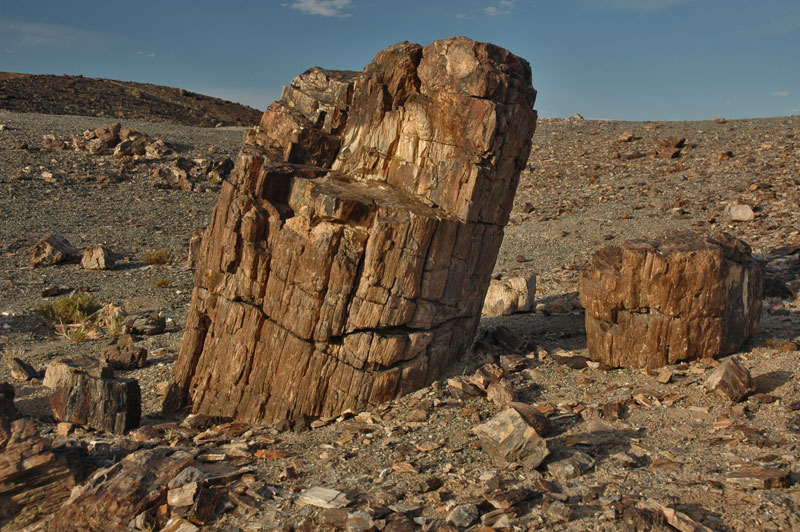
Petrified Tree, Mt Suikhent, Dornogovi Province, Mongolia
The tracks are very sparse and we are relieved to reach the coal-mining town of Tsogttsetseii in the evening, where we camp. Here we see the incredible scale of mining operations in the country; throughout the night we can hear a steady drone of mine machinery and there is an extraordinary, never-ending convoy of trucks carrying coal – at a rate of several trucks per minute – along a dusty desert track, straight to the border crossing with energy-hungry China, around two-hundred kilometres away. We have lunch in a guanz full of noisy Chinese mine engineers in the sum centre of Khanbogd, the nearest town to the huge Oyu Tolgoi Mine. This controversial mine is the largest investment ever made in Mongolia; a joint venture between Rio Tinto and the Mongolia Government, a boon to the Mongolian economy and a potential disaster for the delicate Gobi environment, it’s flora, fauna and water resources. While mining is set to potentially transform the Mongolian economy into one of Asia’s most dynamic, many Mongolians feel understandably resentful towards such projects; spelling and end to the traditional nomadic way of life and a threat to the beautiful, pristine landscape of Mongolia to which they are deeply and spiritually attached.
In the late afternoon we finally leave Ömnögovi Province and reach our target, a small black outcrop of basalt known as Suikhent Mountain. Millions of years ago the area was a boggy forest, and the trees which fell in this bog have been preserved and mineralised into petrified wood; rocks with the original form, texture and internal structure of trees. We camp in a small valley filled with intriguing petrified logs and tree stumps. It’s the warmest evening we’ve yet had and we sit out wearing only shorts, late into the evening drinking tea and savouring the setting, for there is hardly a trace of human presence in the entire area.
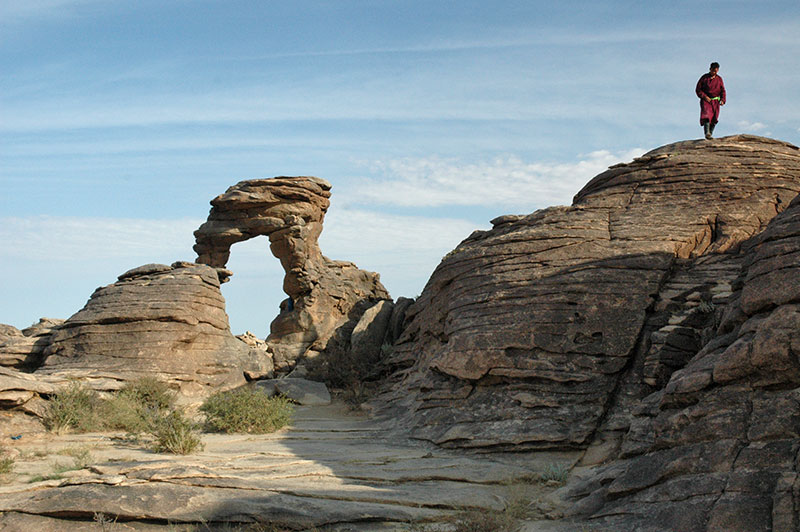
Senjit Rock, Dornogovi Province, Mongolia
It’s a long drive the next day, passing the huge, eerily ruined complex of Ölgii Monastery, then heading north-east through almost totally unpopulated, largely flat territory as we aim for the tracks of the Trans-Mongolian once again. We camp just short of the town of Sainshand and are met shortly after stopping by a pair of curious Mongols who arrive on an ancient Soviet motorcycle. After making a few gestures to each other, our visitors retreat a few steps and calmly watch us for an hour or so as we cook some pasta and make tea, before slipping away into the night. We reach the railway town of Sainshand in the morning, capital of Dornogovi Province, and by evening we are in a large area of odd volcanic outcrops. Darkness and a howling storm close in on us before we can reach our intended camping spot, and it is not until the following morning that we reach the striking and locally famous natural rock arch known as Senjit Rock.
As we continue ever east into Sükhbaatar Province, the landscape changes very slowly as we leave the desert and enter the grasslands of the Mongolian East, passing sum centres such as Delgerekh, Bayandelger and Ongon; places which even by Mongolian standards feel isolated and forlorn, though the people are friendly and welcoming, if extremely surprised to see two outsiders arrive. Turning south-west towards the Chinese border we must employ some subterfuge, for we are in a restricted border zone for which permits are required. Having tried but failed to obtain them in the capital, we instead resolve to avoid settlements and be totally self-reliant in fuel, food and water for the next few days. Our first stop is in the sum of Dariganga, where the extinct volcano known as Altan Ovoo is considered a holy mountain. In a fenced enclosure near the deeply weathered volcano are three Mongol-era balbals (anthropomorphic megaliths), two of which are decapitated. All three are swaddled in long, sky-blue votive cloths, and offerings are made at their bases; sweets, vodka, trinkets such as miniature boots and most bizarrely, a tea set consisting of three porcelain pigs straddling a sugar bowl. Pilgrims leave such offerings here before climbing the mountain and circumambulating its simple white-washed ovoo (shamanistic totem or altar).

Altan Ovoo, Dariganga, Sükhbaatar Province, Mongolia
We spend the evening camping amid small trees on the very edge of Moltsog Els, a small and vegetated sand-sea just to the east of Dariganga. We’re discovered by some locals on horseback, but they soon disappear and we slip away in the morning unnoticed. East of town begins the Dariganga Volcanic Field, consisting of over two-hundred Quaternary lava and cinder cones, a flat area of grassy steppe now yellowed from the long, dry summer and dotted by sculpted volcanic mounds. Entering a very subtle, open valley known as Khurgiin Khundii, we spot an odd, basalt balbal of a gaunt and naked man sitting on a rock, his right hand holding a votive cup, his left on his genitals. Equally striking is the totally unannounced cave of Taliin Agui; rather than a conventional cave in a mountainside, this cave consists of a void-space in a lava flow and is accessed from the table-flat steppe through a small hole in the ground. Despite being late summer, temperatures in the cave remain sub-zero; the cave roof is a sea of white filigree ice crystals, while the floor is dotted with smooth ice-stalagmites.

Dariganga Volcanic Field, Sükhbaatar Province, Mongolia
Our destination for the day is the highest of the volcanic cones; Mt. Shiliin Bogd, a sensual, crescent-shaped eroded cinder cone, long-dormant and covered in long grass. The mountain is just five kilometres from the Chinese border and considered amongst the most sacred in Mongolia. The soul of a man (and only a man; women are not allowed) who walks anti-clockwise around the mountain’s summit (especially at dawn) is said to be restored. We drive part-way up the side of the mountain, where we strike camp and then set off around the crater rim. The view from the top is utterly magnificent; a true moonscape of craters and ridges extending to an indeterminate horizon, particularly beautiful in the low-light of sunset.
In the night we are rather startled by a lone pair of headlights jolting across the steppe, aiming straight for us; we kill our lights and keep a close eye on the approaching vehicle, worried that it might be the local border patrol coming to apprehend us. The vehicle stops some distance away at the foot of the mountain, and we discover in the morning that a group of Mongolian businessmen from the capital have come to on a pilgrimage to the holy mountain to restore themselves spiritually. We walk up together, the Mongolian men (one of whom speaks good English) wearing expensive traditional deels (coats) and offering us a nip from their snuff bottles. At the summit, the men circumambulate around the huge ovoo which is covered in offerings such as sweets, hard bread and alcohol and tied with long blue prayer pennants which are thrashing in the stiff morning breeze. We drink bowls of vodka together and marvel at the sublime view as the rising sun catches the profiles of the long-dead volcanoes. I’m impressed that these men, like me, seem genuinely enchanted by their surroundings, more so that despite being wealthy and urbane, they have made the long and arduous drive down from the capital just to perform this ritual. Clearly despite money and a modern life, the age-old shamanism of the steppes endures in them.
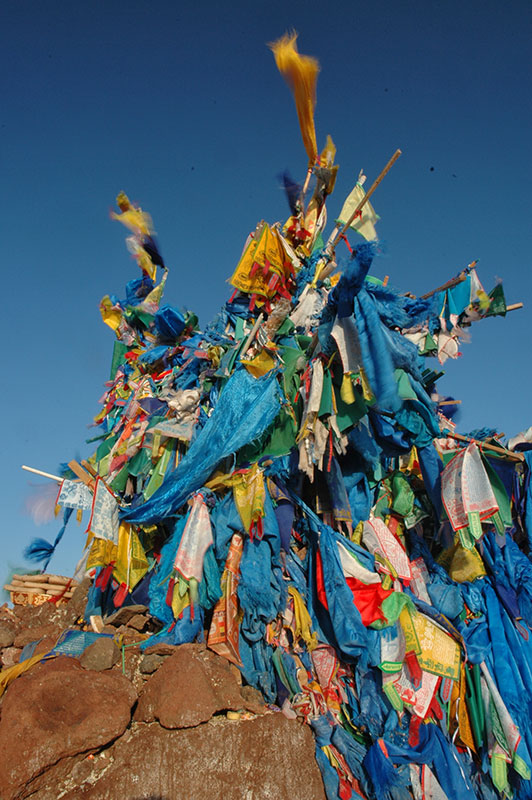
Ovoo, Mt. Shiliin Bogd, Sükhbaatar Province, Mongolia
We leave Shiliin Bogd feeling spiritually revitalised, and as we pull away from the border and leave what we imagine to be the border zone, we are rather pleased with ourselves; we’ve sneaked through and seen what we came to see, which turned out to be more beautiful and interesting than we had imagined. All this comes abruptly to end however as we reach the sum centre of Erdenetsagaan and are immediately apprehended my a man on a motorcycle who takes our passports and brings us to the local police station. Here we are ordered not to move the car, though we are not technically under arrest it seems, as we are free to move around in the small town. One man speaks some English and keeps repeating the word ‘animation’ to us. Slowly it becomes clear that we are not in trouble for being foreigners in a border zone, but rather that there is for whatever reason a total ban on travel in the region, which I suspect might be an outbreak of livestock disease.
The man who speaks some English turns out not to be a police officer, but is also in custody. Balykcha and his young assistant are eagle-hunters from the north of the country who sell the birds on to the Gulf States where eagle hunting is a popular pastime amongst the oil sheikhs. The four of us slip out of the police station on the first evening to the local bar-come-nightclub where we get blind-drunk; Balykcha has to depart the premises on all-fours, the rest of us later staggering back to the Police station rather late without even settling the bar-tab.
It’s not a bad life at the police station; Balykcha cooks good meals for us with the contents of a huge food parcel he has received from ‘his’ sheikh in Bahrain, there is a comfortable and warm place to sleep, a village bathhouse and of course the bar, but on the third day (Sunday) I manage to speak to someone in the British Foreign Office, explaining that I am being held and am not even sure for what reason. Our plans to visit the very furthest eastern reaches of the country (and sneak through another border zone) are of course scuppered, but my visa is due to expire in a few days, and it is clear that my only option is to get up to the capital and then move straight on to Russia.
On Monday morning the police officer gets a call from the British Embassy; his manner visibly changes whilst on the phone and a member of the embassy staff explains to me that there has been an outbreak of foot-and-mouth disease. Soon after this the police arrange special travel permits to allow us to escape the province-wide curfew, and by late afternoon we say farewell to Balykcha, the Policeman and Erdenetsagaan as we are escorted out by the provincial head of customs, who is driving from the customs post on the Chinese border to the provincial capital Baruun-Urt with his attractive assistant Bayarmaa. We stop at the edge of town and have several rounds of baijiu, (lethal Chinese fire-water) before heading off. The Chief soon speeds ahead and leaves us to find our own way, though we have to stop and disinfect the tyres a couple of times at make-shift decontamination points.
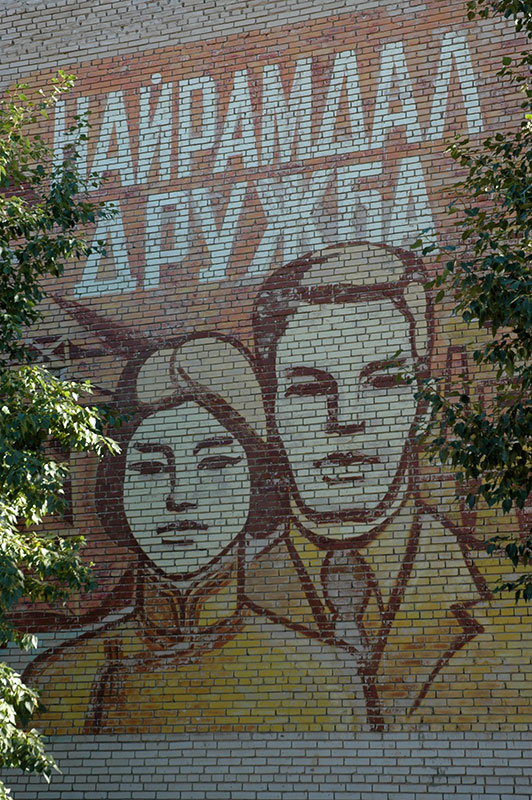
Communist Mural, Darkhan, Darkhan-Uul Province, Mongolia
We reach Baruun-Urt after midnight and camp in a patch of open ground in the centre. In the morning Bayarmaa, who is very apologetic for the predicament we have found ourselves in, helps us get our permits to drive to the capital, then even buys us lunch and introduces us to her family. The road out of town starts off as a dirt-track, but after a few hours becomes the asphalted main highway which will one day run right across the country. Jacob and I drive on into the night and have a final dinner together before stopping in the town of Öndörkhaan, capital of the province of Khentii from which Chinggis Khan is said to hail, where we part. Jacob has been a fantastic travel partner and I’m truly glad to have had him along for the seven weeks we’ve spent touring nearly the entire country. It’s a sad parting but my time in Mongolia is up (for now), while Jacob will continue to explore the north of the country before heading on to China and Pakistan.
I drive right through the night, during which I see my first frost of the year, pausing in Ulaanbaatar at dawn to refuel, then taking the road north to the Russian border. Soon after the road forks north at the westernmost edge of the capital, the landscape changes to one far more reminiscent of Siberia than anything I have yet seen in Mongolia; stands of yellowing larch trees stand on the grassy hilltops, farmers cut and gather grass from fields and birch trees, tied with colourful votive rags, line the roadsides. Occasionally a marvellous golden carpet of wheat covers the hillsides, and I see mechanised farming for the first time. The air is crisp and the sun’s rays long; autumn has begun here already. It’s a world away from the austere but magnificent plains of the Gobi, which I immediately miss.
By early afternoon I reach the small city of Darkhan, built from scratch by the USSR in 1961 as a second centre of manufacturing in Mongolia. It’s a nicer place than much of the capital though of no real interest, and after having a good meal I continue north. I camp alone near the roadside in a field; it feels rather odd without Jacob and I realise that without company, my experience in Mongolia would have been rather lonely – not a word I use very often at all.

Landscape, near Sükhbaatar, Selenge Province, Mongolia
In the morning I continue my journey north through the rolling, almost bucolic landscape of Selenge Province, named for the river which flows north into Lake Baikal. Approaching the capital, Sükhbaatar, I lose my patience behind a crawling Mongolian driver and pass him on a railway crossing right in front of a traffic cop. The fine is just a few dollars and I have no grounds to argue it, and it thus becomes the first and last traffic infraction I would pay for on the entire journey. I’m actually laughing to myself about this as I drive out of town, only for a shepherd boy who is sitting by the roadside to notice this and, perhaps feeling self-conscious for a moment, raises his middle finger; not the nicest finale to my first trip across Mongolia.
The border at Altanbulag is busy and Mongolian Customs are so slow that there is a considerable jam of traffic. I am on the last day of my visa and so make another call to the British Embassy, and am soon waved to jump the queue. I have been very pleasantly surprised by how useful the Embassy has been in the last few days and finally feel I’ve recouped some of the swingeing embassy fees I paid for my passport in Islamabad two years earlier.
And so with just an hour left, I slip out of Mongolia. Fascinatingly different from any other country I have visited, stunningly beautiful but continually challenging and frustrating, travel in Mongolia is an almost addictive experience, and my first goal when entering Russia will be to obtain another Mongolian visa, and make a second pass across the country.
 EurasiaOverland