
Stage 3 – Kyrgyzstan: The Tien Shan
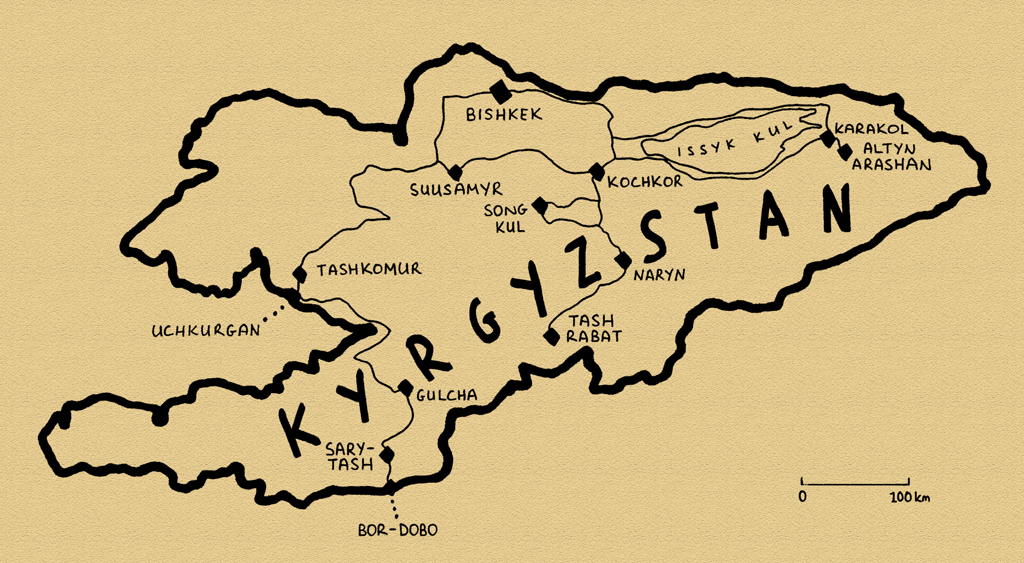 The small, mountainous state of Kyrgyzstan is something of a strange entity as in independent country. Physically, the country has three regions; the fertile northern plains close to the Chuy River where Kyrgyz have settled alongside many Slavic (Russian and Ukrainian) immigrants; the eastern edge of the Fergana Valley, where the Kyrgyz have settled the fertile, low-lying farmland amidst ethnic Uzbeks (and where the two nations occasionally indulge in some ugly ethnic violence); and finally the western Tien Shan mountains (the eastern parts being in Xinjiang). It is in the high, grassy meadows, or jailoos, of this range, nestled between the Pamirs and Lake Issyk Kul, that the Kyrgyz still practice their traditional nomadic ways. Yet only a small proportion of the country’s population live in such a manner, with the majority living settled lives alongside the Slavs and the Uzbeks. Perhaps because of this, the country seems to lack a particularly clear identity when compared to its neighbours. Lacking also the natural resources of Kazakhstan, or the infrastructure of Uzbekistan, it is a poor and isolated place. Tourism has been promoted as a key industry, and in a bid to attract foreign tourists, the Kyrgyz authorities have simplified visa procedures and abolished the old Soviet requirement of registration. As well as being less bureaucratic (from a foreigner’s point of view at least) it’s also more democratic than its neighbours. In 2005, there was the fairly peaceful ‘Tulip Revolution’, and three years after my 2007 visit another, less peaceful revolution which coincided with more deadly ethnic violence in those regions of Kyrgyzstan which lie in the ethnic jigsaw of the Fergana Valley. This troubled mountains state does however provide easy access to the knot of mountains in Central Asia, which were the main attraction for visiting.
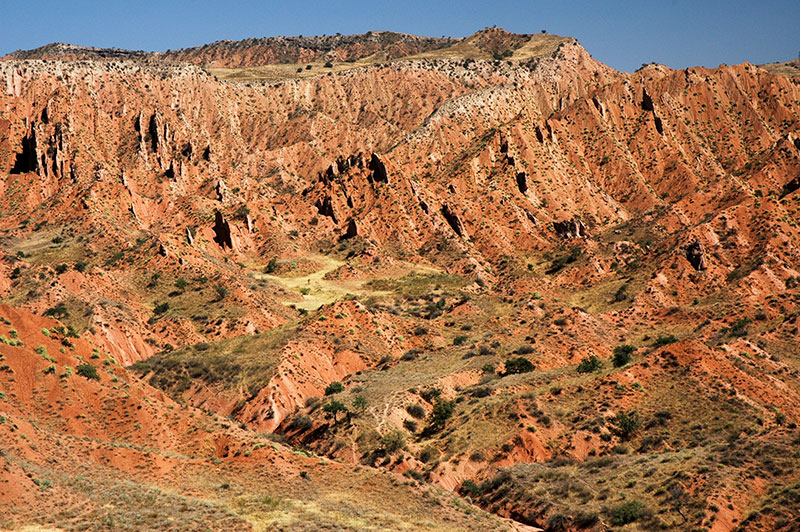
Landscape, near Tashkömür, Jalal-Abad Region, Kyrgyzstan
I enter Kyrgyzstan on the 12th August 2007. Leaving Uzbekistani customs, I drive a few hundred metres through a field, until I reach a simple road junction on the main M41 highway which leads to the capital, Bishkek. There is no official looking building of any sort, and the border guard is sitting at a desk in the back of an old Russian Kamaz army truck with deflated tyres. He glances at my passport, writes my name and licence plate in a tattered ledger, and waves me through. Dismayed – it had taken hours to enter Russia and Uzbekistan – I prepare to drive off but stop immediately when I realise he’s not stamped my passport. Imagining all sorts of trouble for having no proof of legally entering the country, I stop and ask the officer to place a stamp on my visa. He shakes his head and dismisses the idea with a wave. I ask again, then indicate that I shan’t move until the stamp has been made. Finally, he tells me that he doesn’t have a stamp, smiles, and says: “Kyrgyzstan. Tourist. I love you”. This experience speaks volumes about the country.

Kara Balta Valley, Chuy Region, Kyrgyzstan
Heading out of the Fergana Valley, onto the winding M41 which crosses the mountains to the capital, the contrasts with Uzbekistan are immediately apparent; rough, desolate but beautiful mountains in shades of red, brown and grey replace the cotton fields of Uzbekistan’s monotonous plains. Absent are the crowds of people and the almost continuous string of small towns and villages. Here only the occasional grimy roadside café breaks the distances between the tumbledown villages along the road. After spending the night on the freezing 3184-metre Ala Bel pass, I descend slowly in the early morning into the wide, beautiful Suusamyr valley as the sun starts to rise, colouring the surrounding grasslands golden-green in the cold morning air. The descent is gentle and continuous, through beautiful jailoos dotted with Kyrgyz yurts which sell kymyz (fermented mare’s milk). After an hour or so, the road climbs steeply once again, plunging through a steep mountainside in the dark, smoky Too Ashuu tunnel at 3200 metres. North of the tunnel the road descends in long switchbacks to the broad, fertile Chuy valley, from where it’s a short drive to the capital, Bishkek.

White House, Bishkek, Kyrgyzstan
Bishkek, formerly Frunze (after the Red Army commander) is like a smaller, slightly shabbier and less ostentatious version of Almaty, with oak-lined streets arranged in a grid plan, all set against a gorgeous backdrop of soaring, snow-capped peaks to the south. The city is full of remnant Soviet architecture, but doesn’t have the slightly oppressive, authoritarian atmosphere of Tashkent; rather, there is a worldly, free-market atmosphere, despite the apparent poverty. Days are stingingly hot, but the nights cool and convivial and I while away a relaxing week in the Nomad’s Home Guesthouse, meeting other travellers and swapping stories. One traveller I meet is Oliver, an Austrian who is travelling with his dog Socks, and has driven his Hiace from India through Afghanistan to get here. Having just given up my dream of driving into Afghanistan due to a recent deterioration in security, it’s tantalising to meet someone who has had the courage to do it.
Oliver and I drive east out of Bishkek, in search of the iconic Central Asia of nomads on high grasslands. Just before reaching Issyk Kul Lake, we turn south and then off the road, onto a dirt track which climbs high into the mountains, to one of Kyrgyzstan’s most idyllic spots. Song Kul is a freshwater lake at 3000 metres in a broad bowl of 4000-metre mountains, surrounded on its shores by wonderful green jailoos; lush green grasslands dotted with Kyrgyz yurts and grazed by sheep, cattle and horses. Away from the immediate shore the land starts to rise into grassy ridges which stretch up to a horizon of low, distant mountains. The water is an enticing deep blue, with dappled horses drinking from one of the pebbled beaches; an absolutely magical scene.
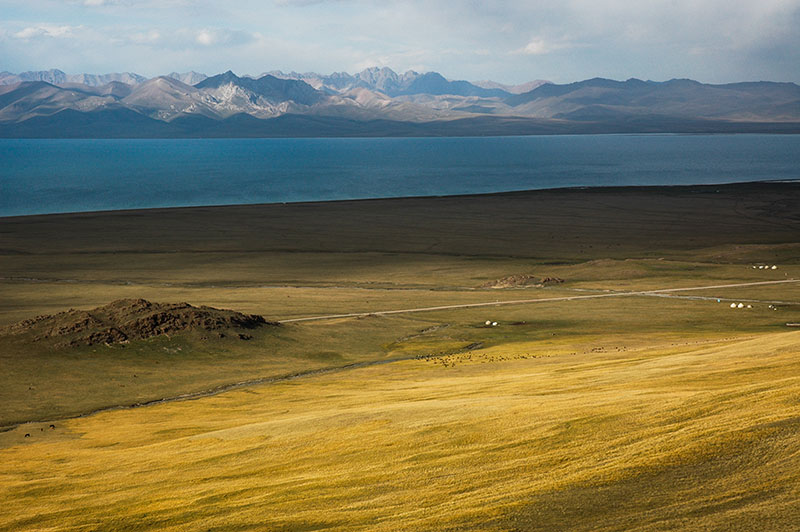
Song Kol, Naryn Region, Kyrgyzstan
Here the Kyrgyz come up from winter residences in towns at lower elevations to graze animals during the short summer, in a way which remains largely unchanged since the time of Chinggis Khan, and which has survived the horror of collectivisation which has all but wiped it out in neighbouring Kazakhstan. For the first time I feel the full measure of independence the cars give us; we circle the lake on rough tracks at our own pace, stopping to cook meals and sleep wherever we want in this quintessential Central Asian landscape. After two days, we descend from the southeast side of the lake through territory which seems absolutely uninhabited, through soft, rounded hills whose sparse cover of vegetation give them the appearance of velvet from afar. In the rather rough and grim town of Naryn we split, and I head towards the Chinese border.
The road south crosses another dusty mountain pass, which is pounded by huge Chinese-made lorries ferrying goods either way across the border, a modern-day remnant of the ancient Siilk Road. Beyond the pass, the road draws up alongside the At Bashy range, a line of sharp, snowcapped peaks which run roughly parallel to the Chinese border. This is true big-sky country, with banks of windswept cloud creeping over the peaks from the east. Sadly, the Chinese government do not permit foreigners to freely drive around China, but it’s tantalising to be so close to Xinjiang, Chinese Turkestan, the place where I first encountered Central Asia in 2003.
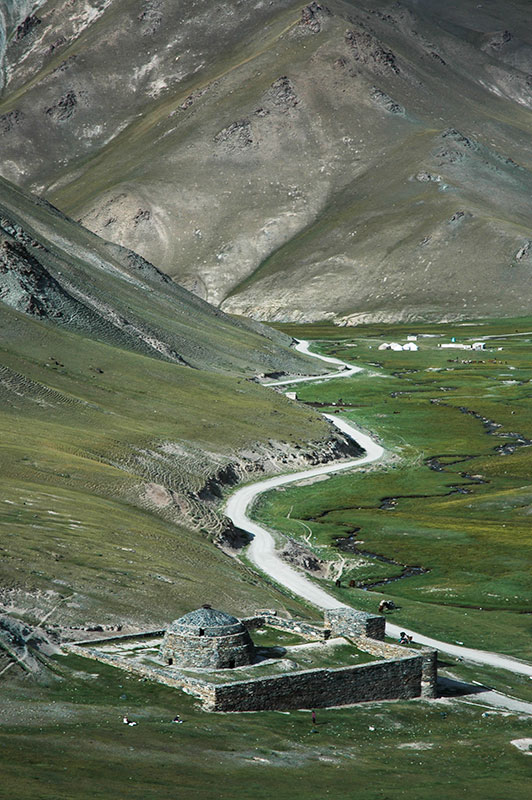
Tash Rabat Caravanserai, Naryn Region, Kyrgyzstan
Kyrgyzstan is largely devoid of noteworthy architecture – nomads don’t build temples or palaces – but nestled in the green hills in the southeast of the country, not far from the Chinese border, lies an intriguing relic of the Silk Road. As merchants plodded along these braided trade arteries which passed through vast tracts of desolate and unpopulated terrain, they naturally needed places to rest. These medieval motels, known as caravanserais served that purpose, and can be seen from the Levant all the way to China. Tash Rabat caravanserai is a neat, stone-walled structure built into a hillside, with a cavernous interior chamber topped by a simple stone dome. While the building doesn’t have the architectural merit of those in Samarkand, or Bukhara, its location at 3100 metres in a remote valley surrounded by peaks is what impresses. How harsh conditions must have been in those days, the days when Marco Polo made his voyage along this route, to Cathay (China).
Backtracking to the north, I reach Issyk Kul (‘warm lake’, thus named as it never freezes), a large, deep alpine lake which sits between two ranges of the Tien Shan. I drive east along the southern shore of the lake, which is dotted with small villages, some Kyrgyz, and some Slavic. The Slavic villages have an almost Germanic air, with shuttered, pastel-coloured wooden cottages and prim kitchen gardens. It’s strange to see quaint European villages of blond-haired, blue-eyed farmers here, so deep inside Asia.
At the far eastern end of the lake, I reach the town of Karakol, where I camp in the garden of a guesthouse run by a friendly Ukrainian family, where I am re-introduced to the delights of Ukrainian cuisine each evening, when meals are served in the kitchen, which looks to be straight out of a Bavarian Gasthaus. A long-standing Slavic community is evidenced here by the large, wooden Russian Orthodox Trinity Cathedral; a large, ornate and entirely wooden structure. Dungans, Han Chinese Muslims (known in China as Hui) have also settled in Karakol (fleeing persecution in China in the 1880s) and their highly stylised mosque is one of the most striking I’ve ever seen. Built by Chinese artisans in the early 20th Century, the wooden mosque is a fusion of Arab and Chinese architecture, with an up-swept, pagoda-style roof and wooden pillars running all around the building. Like the Cathedral, the Dungan mosque is said to be made entirely without the use of nails.

Animal Market, Karkol, Issyk Kul Region, Kyrgyzstan
Karakol is notable for its Sunday animal market, which is second in size in Central Asia perhaps only to that of Kashgar. As well as a place of commerce, it’s a meeting point for the semi-nomadic Kyrgyz, and a fascinating place to people-watch. Over two large fields, thousands of sheep, goats, cows, horses and donkeys are being groped at and eyed-up by prospective buyers; mostly tough-looking Kyrgyz from the surrounding mountain villages, though the odd soft, Slavic face mixes into the crowd. Though it’s not much past 08:00, many people are already swigging beer, and there is lively banter and deep, gold-toothed laughs. The sky, which has been getting darker, then breaks into gentle but steady rain, and the market becomes a quagmire of mud and manure. On my way out of the market I see the day’s purchases being led off; sheep bleating from the half-closed boots of old Zhigulis and Volgas, their legs bound in string.
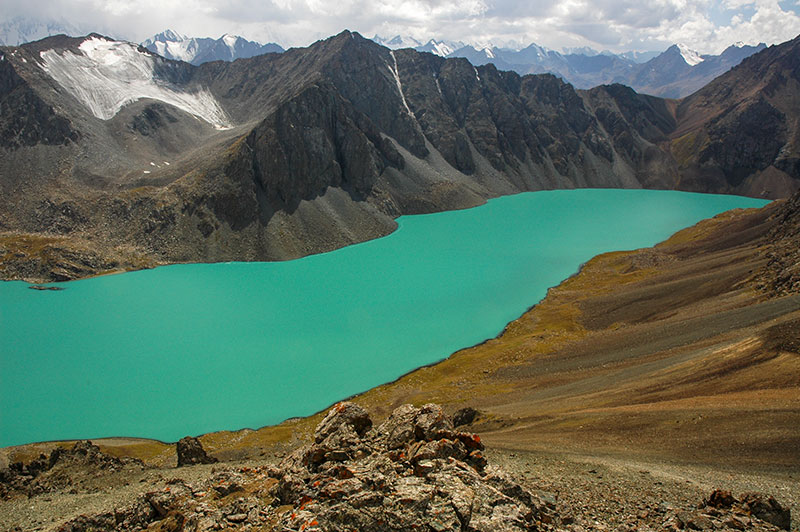
Ala Kul, Issyk Kul Region, Kyrgyzstan
I leave town one afternoon, heading south on a track which climbs up into the mountains to an area of hot springs set in a gorgeous alpine valley known as Altyn Arashan. The low evening sun casts a soft, golden glow along the pine-clad flanks of the valley, illuminating the brilliant white triangle of Mt. Palatka, a 4500-metre peak which presides over the end of the valley. It’s a fairytale scene without so much as a telephone line or a car horn to spoil the views and therapeutic tranquillity. In the morning I set out with seven others for a short day-trek. We head up the Arashan valley and separate as we find our own pace to walk at. The forest makes a wonderful change from the endless plains, deserts and barren mountains of Central Asia, with its wonderful fragrant pines and damp spongy, moss-covered ground, tranquil but for the burbling of mountain streams. I start to climb too early however, and end up having to wade through two leg-numbing roaring mountain streams before finding the right track which leads above the treeline to a large, barren amphitheatre. I move past the others in the group who are uncertain of how to proceed, as we are at the foot of near-vertical 200-metre high scree-slope. The ascent is arduous, treading gravel for an eternity, at times on all-fours, but at the summit of the 3900-metre ridge I am rewarded with a mind-bending view of Ala Kul, a milky, turquoise lake which sits in a rent in the Earth almost 400 metres below me, fed by deeply incised glacial streams. To the south is a 180º panorama of twisting, interlocking peaks of the Tien Shan, the western edge of a great range of mountains which run far into China.

Dungan Mosque, Karakol, Issyk Kul Region, Kyrgyzstan
I return to Karakol, and then to Bishkek via the northern shore of Issyk Kul, settling back in the Nomad’s Home Guesthouse. I need to collect a few visas and plan the next leg of the journey into Tajikistan and then on through Uzbekistan and Turkmenistan to Iran. I spend three weeks in the capital attending to these tasks, and enjoying a rest from travelling, as well as the company of the many travellers who pass through the guesthouse. One such character is Miguel, perhaps the most eccentric of all the people I met on the entire trip. A Catalan from Barcelona, Miguel is 32, well-built, and has the full, glossy black beard of a Greek Orthodox priest. Having studied Kabballic Judaism in Jerusalem as part of a PhD in philosophy, he set out on a journey from his native Barcelona in 2002, and has been on the road ever since. Despite being a Roman Catholic, Miguel wears a black handkerchief over his clean-shaven head, a kippah (Jewish skullcap), and tops it off with a splendid €300 Hungarian-made black Jewish Hat. The hat was given to him for protection by his professor in Israel, and is only taken off when he sleeps, and on days that he travels. One might be tempted scoff at this, though considering that he has travelled through some of the most unsettled and lawless places in the world, such as Mogadishu in anarchic and war-torn Somalia, or Taliban-held Kandahar in southern Afghanistan, the fact that he has never been robbed, kidnapped, killed, or even fallen seriously ill in five years might cause one to consider more than mere chance was involved.
Miguel is also a self-confessed alcoholic; having fallen for cheap spirits in China and the former Soviet Republics, he claims to drink two to three bottles of vodka per day. As for his five years of travel, he has plenty of wild and outrageous stories, which fished from the muddiness of his vodka-addled memory and related in his hard-clipped Iberian accent, reduce me to fits of uncontrollable laughter. Miguel was arrested and imprisoned for being drunk in Georgia and Moldova (in his own words, he “fell down in the garden”, a term which actually meant he passed out inebriated in a public park). In China, whilst drunk, he climbed into an unmanned police shack at a traffic intersection, and began directing the traffic with his whistle and umbrella. Also in China, where people would “stare at me like I come from Plutonia”, Miguel would hit staring Chinese with his umbrella, and part crowds of unruly passengers at train station ticket kiosks using the same whistle. Miguel and I passed a lot of time in Bishkek, where I would build up my tolerance to his favourite Ukrainian vodka and laugh at his quirky behaviour; patting random strangers on the head as we walked round the city, and fondling the ladies’ underwear hung out to dry at the grotty brothel near the guesthouse. Miguel subsequently moved to Ukraine to be close to his favourite vodka, but has visited his native Spain several times since 2007.
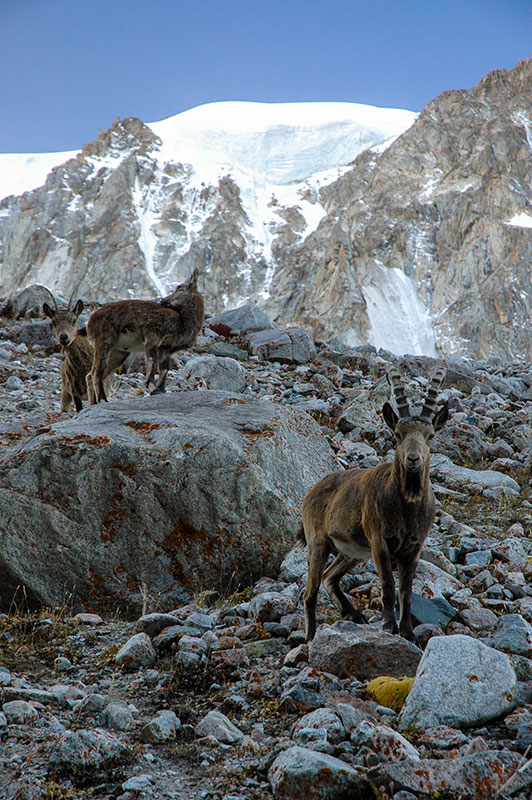
Ibex, Ala Archa National Park, Chuy Region, Kyrgyzstan
The guesthouse is situated at the east of town, in an insalubrious area just next to the East Bus Station, which is quite a seedy place; a couple of dirty cafés where the staff are drinking beer at 08:00 on a Monday monring, a grubby brothel with cackling, drunken six-dollar whores, and marijuana plants growing in bushes full of litter and the excrement of the numerous stray dogs which patrol the area. The centre of Bishkek is far smarter and more pleasant however, a gentle mix of modern and old Soviet. Uniquely in a Central Asian capital, Lenin is still present, though he now stands behind the National Museum rather than in front of it, with his back to the sun, perhaps emphasizing his place in the past, and his waning ideals. Now he faces some smart neo-classical government building, surrounded by perhaps the city’s densest conglomeration of luxury European limousines and black SUVs. It’s not quite what he’d envisaged. Still, he can be thankful to still be upright and in the city centre, albeit in a small, quiet park devoid of passers-by, but wonderfully fragrant with late-summer marigolds. Penniless old Russian babushkas shuffle past, the forgotten ones, pausing to pick-up and inspect pieces of litter, whilst Kyrgyz students, young and beautiful move past in pairs or trios; the new face of Kyrgyzstan. Both casually disregard Lenin; to one he represent the irretrievable, to the others the irrelevant. Next door to the government building is the American University of Central Asia, housed in what was once the residence of the Supreme Soviet; again, more irony and disillusionment for old Lenin on his plinth.
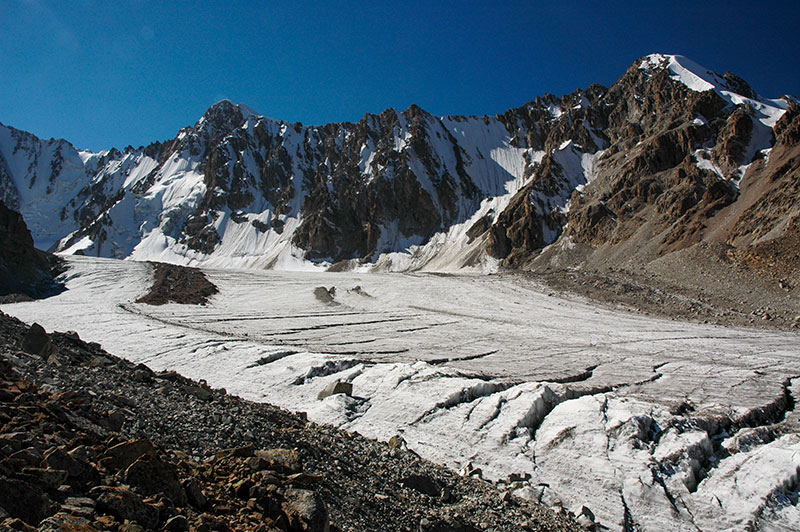
Ak Say Glacier, Ala Archa National Park, Chuy Region, Kyrgyzstan
As autumn draws close, the nights become colder and the air clearer, causing the mountains to the south of the city to glow even more enticingly. I team up with Andi, a German traveller who has come to Bishkek by motorcycle, and we set off into Ala Archa National Park, just beyond the southern limits of the city. Reaching the mountain hut at Ratseka, I feel the effects of having climbed to 3300 metres in one day, and spend a sleepless night on a wooden bench bed, aching from head to toe in what I assume is altitude sickness, whilst mice scurry around on the floor beneath. Nevertheless, I feel slightly better in the morning and we both summit Mt Uchitel, a 4550 metre peak from which there are fantastic views of tongues of glacial ice cascading down into the valley. A good finish for my time in the Tien Shan.
During my time in Bishkek, I start to become familiar and fond of the city; its shady, tree-lined streets, its bustling air of commerce and free-trade, its ageing fleet of Soviet trolleybuses, and the pretty girls and posing young men outside TSUM, the old Soviet state-run department store. The guesthouse is a marvellous place to kill time; vodka flows and an ever-changing cast of travellers pass through, contributing to a considerable degree of inertia. The mid-September nights are however already becoming cold, and with new visas in hand my thoughts turn to the next leg of the journey, driving Central Asia’s most beautiful road, the Pamir Highway, through the desolate high plateaus of Tajikistan all the way to the Afghan border.
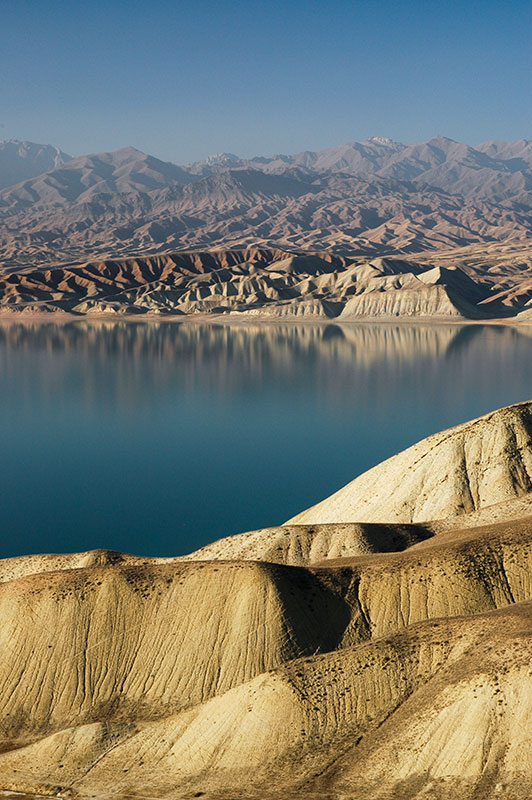
Toktogul Reservoir, Jalal-Abad Region, Kyrgyzstan
I finally leave Bishkek with Boštjan, a Slovenian whom I meet in the guesthouse. We drive west to Kara Balta, kilometre zero of the M41 which later becomes the Pamir Highway. I’m retracing the route which I took six weeks ago when I first entered the country, up the switchbacks and through the Too Ashuu tunnel, then down into the glorious Suusamyr valley where the trees have beautiful yellow-brown leaves, the yurts are gone, and the grass is a seared, dead-looking brown. We pass the stunning, mirror-like waters of Toktogul Reservoir, which is backed by heavily eroded, multicoloured barren hills which are reflected in the still, cerulean waters. Descending further, we enter Kyrgyzstan’s section of the Fergana valley, back to monotonous cotton fields and chaotic Uzbek towns. I’m suddenly struck by how divided the country is; there is little traffic on the road on which we’re driving, which is the only surfaced road to link this part of the country with Bishkek and the north, and I am in an area which feels culturally very different from the highlands.
Near the city of Osh, we turn east once more, onto a rough dirt road which is pounded by more Chinese lorries. The villages become poor and spaced-out as we leave the agricultural heartland of Fergana and climb back into the last ridges of the Tien Shan, crossing the 3615-metre Taldyk Pass, the highest of the trip so far, which takes us down into the broad Kyzyl Suu Valley. On the far side of the wide, grassy valley, where farmers are gathering hay, a huge wall of smoothed and sculpted glaciated rock looms; the Pamirs, looking very different from the Tien Shan, crowned here by the summit of 7134-metre Mt Lenin, which occasionally comes into view out of the swirling cloud.
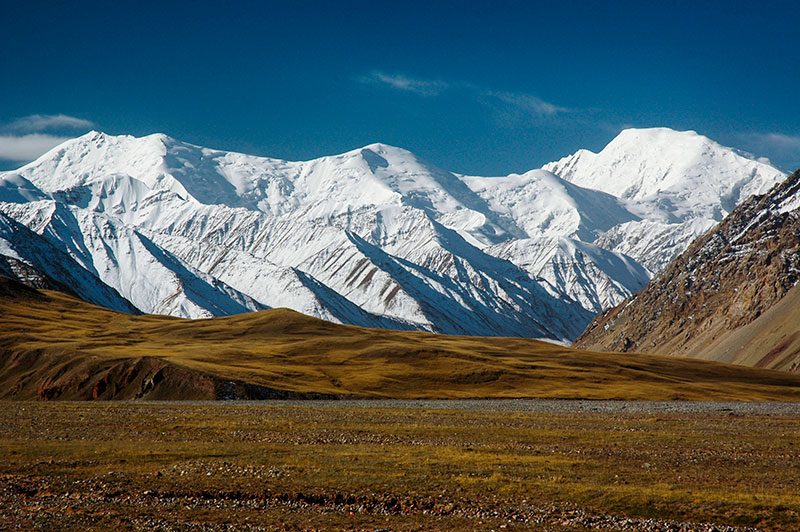
Pamir Mountains, Osh Region, Kyrgyzstan
We stay a final night in the rough and charmless town of Sary Tash, which is little more than a crossroads with roads leading both to China and Tajikistan. After a night which reaches -12ºC, I say goodbye to Boštjan (whom I’ll meet in India next year), and head for the towering mass of snow-covered rock. Somewhere in there is an international border crossing.
Kyrgyzstan represented a rewarding foray into the Tien Shan mountains, and a glimpse of the traditional transhumance of Central Asia. This young and divided country has yet to promote its own national identity, and is still filled with the physical baggage of the USSR, though free-market reforms and an open-doors policy to tourism give it a more welcoming atmosphere than other places in the region. Having been settled as recently as a century ago by the Soviets, Kyrgyz culture is still emerging and adjusting to new-found statehood, yet at the same time poverty fuels corruption, alcoholism and petty crime. Kyrgyzstan is certainly a destination I shall remember for its wonderful mountains, rather than for any settled culture.
Stage 2 – Kazakhstan & Uzbekistan: The Silk Road

From the time that this journey was first being planned in the summer of 2004, until late 2006 when another planned departure date slipped past, my goal was Africa, a continent I’d hardly set foot in. In the summer of 2003 I’d made an overland trip from Istanbul to Beijing (using public transport) and was deeply impressed by Asia; especially its ever-changing beauty and the warmth of the people. Yet Africa, especially the Sahara and wild rainforests of Central Africa, still had a stronger draw. It was the countries of Central Asia which finally drew my attentions east instead of south. In my mind were conjured romantic images of heart-stopping turquoise-domed shrines, two-humped Bactrian camels and the smooth, snow-clad peaks of the Pamirs.
On this first visit then to Central Asia in the summer of 2007, it was in my mind the main destination of the trip. If I made it further to Pakistan and India then all the better, but they were both countries I had previously visited. Central Asia was terra incognita for me. This first visit to the region would be a fascinating experience; a journey through the beautiful heart of the Eurasian continent, meeting locals and fellow travellers and witnessing the assertion of the nascent national identities of these newly-formed countries. In my months in Central Asia I would develop my confidence and experience as the Odyssey evolved from something like open-ended tourism into a lifestyle of perpetual travel. Whilst in many ways Central Asia was the focus of my journey; the summer of 2007 was merely an introduction to an Odyssey which, unknown to me at the time, would stretch more than four years into the future.
On this first leg of my travels in Central Asia through southern Kazakhstan and into Uzbekistan, I would attempt to chase my rather idealised, romantic expectations of what the ‘real’ Central Asia should look like, though would leave slightly disappointed and frustrated by the modern, post-Soviet reality. It would be two years until, in Afghanistan, I would convince myself that I was seeing the region almost as Marco Polo had seen it more than seven centuries earlier. Nevertheless, these were my first, memorable steps along Central Asia’s Silk Road.
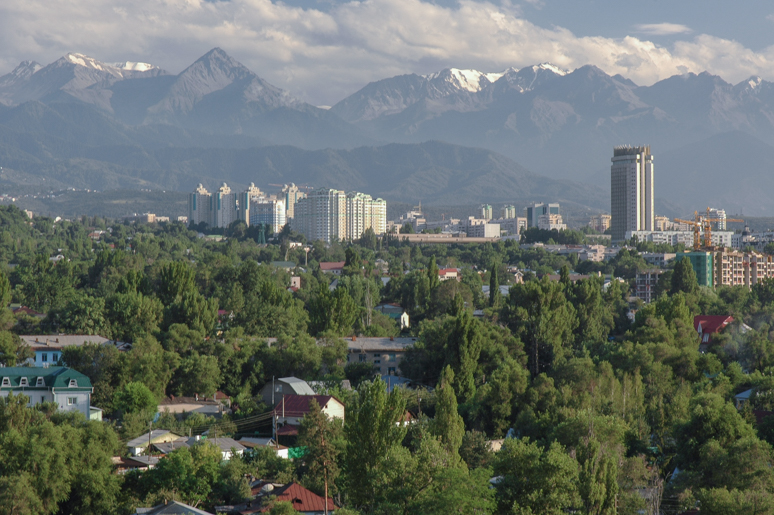
Almaty, Kazakhstan
It’s the 8th July 2007 and I roll into Kazakhstan’s largest city, Almaty. If my transition to this southern region of Kazakhstan marks my entry into the ‘real’ Central Asia, then Almaty is something of a false start. It lies deep inside the Eurasian continent, is one of the most remote cities in the world from the ocean, yet on first impression seems to be strongly European; far more like the cities of Siberia than what one would imagine a ‘real’ Central Asian city might look like. There are no turquoise domes, no mud-brick buildings and certainly no camels. Even the population seems to be as much European as Asian. The atmosphere is of rapid economic development and like Kiev, I see once again a huge inequality between the city and the unchanging countryside. The city’s air is even rather ostentatious; the Central Asian nouveau-riche are seemingly even more crass than those of Eastern Europe.
However questionable Almaty’s credentials as a ‘real’ Central Asian city are, it’s superficially a beautiful, well-ordered and clean city, with a centre laid out on shady, tree-lined avenues. Having been founded by the Russians in the mid-nineteenth century, Almaty is memorable more for its setting at the foot of the striking Ile Alatau Mountains, deep emerald-green on their lower slopes immediately behind the city and snow-capped in their higher reaches, than for any historical or cultural attractions. I’m hosted firstly by Amanda, a young American journalist, and then Inanç, a Turkish construction engineer. Between the three of us, we manage to get one of the truck’s broken rear leaf springs replaced; Amanda has a friend flying in without luggage from London who brings a new spring and Inanç introduces me to two welders from Uzbekistan who cut off the old, broken spring after I spend two days under the car, fuel tank removed, attempting to break a spring free from its mounting on the chassis. It’s a great moment when, at the dusty construction site at which Inanç works, we finally get the new spring on, giving me far more confidence on Kazakhstan’s terrible roads.

Zenkov Cathedral, Almaty, Kazakhstan
Aside from working on the truck, I spend a very enjoyable time with Amanda and Inanç, not least because they are the first people with whom I can speak English since Novosibirsk, two weeks earlier. Evenings spent with Inanç eating Turkish döner and sitting in Panfilov Park with a cold beer, or watching the city’s gorgeous young women from pedestrianised Zhibek Zholy (Silk Road) Avenue are particularly memorable. However, as comfortable and welcoming as my stay is, this isn’t quite the Central Asian experience I’d been dreaming of. So, after a very pleasant week, I reluctantly leave from the congenial, green surroundings of Almaty and drive west towards the Uzbekistani border, into an area which is the most traditional and most ethnically Kazakh in the country. Here the nomadic Kazakh culture meets that of the settled Uzbeks, creating a wholly different atmosphere to that pervading the more Russified north of the country.

Aisha Bibi Mausoleum, Aisha Bibi, Zhambyl Region, Kazakhstan
On the second day of my westward drive, involving a detour from the main road which cuts through a corner of Kyrgyzstan, I make my first stop in a village just west of the city of Taraz, named after the mausoleum of Aisha Bibi, the beautiful daughter of a Sufi mystic who died as a fiancée to a local notable. The twelfth century, Karakhanid-era mausoleum is an elegant cube with a sharp conical dome, all in the buff colour of native clay. On closer inspection however, the structure is covered in finely carved terracotta tiles, whose relief creates sensual and changing textures from natural sunlight instead of using the exuberant colour of faïence. This well proportioned mausoleum is, rather touchingly, a monument to love and faithfulness and appears to be a popular object of veneration for local women. From an architectural point of view this style represents the earliest one commonly encounters in Central Asia; a rare surviving piece of pre-Mongol architecture.
The mid-July heat is terrific as I press further west towards the Syr Darya river (the Jaxartes of the Ancients), beyond which lies the fearsome Kyzyl Kum Desert. Whilst in the north and centre of the country the temperature was in the low- to mid-thirties, the temperature here tops forty degrees and at one point I record 47°C inside the truck, with both windows fully open. Wind-chased tumble-weed and dust-devils pound the side of the truck from the parched, empty plains, causing me to drive momentarily with eyes closed against a blast of grit. In this heat, the mind is idle, the ceaseless urge of the body to consume fluids eclipsing any thought.
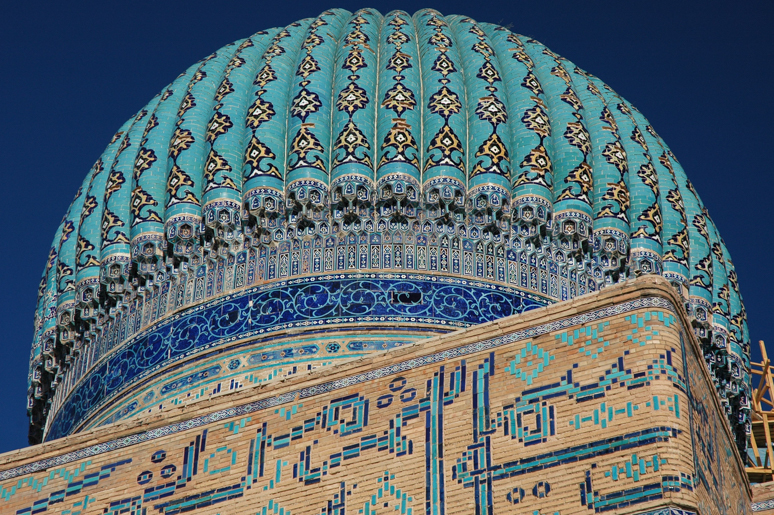
Khoja Ahmad Yassawi Mausoleum, Turkistan, South Kazakhstan Region, Kazakhstan
I make a detour however to see the greatest piece of historic architecture in the country: the mausoleum of Khoja (a pious honorific) Ahmad Yassawi in the pilgrim-town of Turkistan. Yassawi (named for Yassi, the ancient name of the city) was a Turkic Sufi mystic and the founder of the first tariqah (order) of mysticism in the Turkic world. Such shrines are common right across the Islamic world but in Kazakhstan, the pilgrim city of Turkistan is a centre of Islam and of religious piety. Kazakhs are not by nature particularly religious people; a nomadic lifestyle doesn’t lend itself to the trappings of settled religion, and in general are not particularly observant in visiting mosques or reading the Qur’an. Drinking vodka seems almost universal in men, and women as often as not dress according to the Russian rather than Islamic school. From the outside, Kazakh society seems largely secular.
However, in places such as Turkistan, one sees a different side to Kazakhs. Islam for them seems, perhaps after decades of public repression, to be more spiritual; rather than being obsessed with petty ritual and public posturing, there seems something a little deeper. I sit ruefully and watch pilgrims come and quietly pray to themselves whilst pressing a hand against the wall of the mausoleum, or circumambulate the shrine, always keeping a hand on its wall, which runs a path smoothed and darkened over the years. Touch seems an important part of the connection with the buried mystic through this physical edifice of his tomb. I watch one lone woman, dressed casually but for a white headscarf, lean her head back against a wall of one monumental portal, gazing up at the magnificent faïence tilework, praying and gently weeping in contemplation. This silent, private Islam impresses me, but I suspect it’s a mere glimpse into the secretive and spiritual Islam one occasionally encounters in the former Soviet states of Central Asia.

Khoja Ahmad Yassawi Mausoleum, Turkistan, South Kazakhstan Region, Kazakhstan
For myself, Turkistan is a dazzling and delightful introduction to Timurid (named after Timur, or Tamerlane) architecture; the iconic post-Mongol style of turquoise-domed shrines and madrasas (seminaries) of Central Asia. Yassawi’s mausoleum is characteristic in its great size, with a vast single arch framing a small entrance. The building’s exterior remains largely plain mud-brick, unfinished due to the death of Timur during construction, though the rear wall and portal are exquisitely tiled in mesmerising geometric patterns of turquoise and lapis. The mausoleum is literally crowned by a stunningly intricate, ribbed turquoise dome with flutes like the segments of a peeled mandarin, which glow magnificently in the late afternoon sun. On my way back to my airless hotel room, feeling quite parched, I spot, mirage-like, a young lady pouring draught beer into frosted half-litre glasses and gulp one down, barely pausing for air, followed near my hotel by a second beer and a plate of shashlik (kebabs). After dark I return to the mausoleum, sitting on the warm stones of the courtyard admiring the floodlit building; the end of a wonderful day.
I leave Kazakhstan the following day, doubling back from Turkistan via the far less impressive mausoleum of Arystan Baba, Yassawi’s murshid (spiritual guide), bypassing the city of Shymkent to reach the border crossing which is rather charmingly named Zhibek Zholy, or ‘Silk Road’. Kazakhstan has been my favourite country of the trip so far; its huge, empty, wild, pristine open spaces are the perfect antidote to the confined life I have just left in Western Europe. Based on what is in my guidebook, I imagine, quite wrongly, that the rest of the country is flat, dull and almost devoid of anything of interest.
Leaving Kazakhstan is fairly straightforward, but in the no man’s land before the Uzbekistani border gate, there is of course absolutely nothing in the way of information to assist a novice in crossing the border. Leaving the truck, I go forward on foot and, after finding an official, am told that I can’t enter Uzbekistan with a right-hand drive vehicle. I take this news with a touch of dismay, for I have no means to re-enter Kazakhstan, but also amusement. Given the amount of money changing hands here, I am quite sure that any problem might ultimately be solved with a little financial inducement. I of course elect to use persistence rather than bribery to get myself through and after a phone call by a customs agent, I’m given the all-clear. By this time however it’s after 18:00 and an unruly scrum of cars are bumper-to-bumper against the gate. I notice that there is at work an unwritten and unspoken order; money is changing hands and some people are advancing, while others are resigned to their places. I’m offered the chance to skip the queue for a bribe, but instead chose to spend a peaceful night in no man’s land. It’s an early encounter with the way things are done in Central Asia.

Siyab Bazaar, Samarkand, Samarkand Region, Uzbekistan
The following morning I manage to get into Uzbekistan and I’m immediately impressed with how different it looks. Gone is Kazakhstan’s atmosphere of impending prosperity and economic reform, replaced by a the inertia of timeless Asia. The roadsides are lined with piles of melons, chaikhanas (tea houses) where old men laze on elevated, carpeted takhts (platforms) sipping tea from wide bowls and playing cards or nard (backgammon) and old women selling sunflower seeds and single cigarettes from battered old suitcases perched on rusty prams. To look at, the Uzbeks seem far more heterogeneous than the population of Kazakhstan, as one would perhaps expect from a settled people in the centre of Eurasia. On the streets I see virtually no Russian faces and Uzbekistan straight away feels far more its own country than Kazakhstan did.
From the border compound I soon find myself on the Tashkent ring-road, though I decide to skip the city for the moment and head south-west, thrilled to be on the fabled road to Samarkand. Tashkent’s chaotic suburbs, which seem to be one giant market, fade into satellite towns, then into the dull countryside; hot, dusty monocultured cotton fields interspersed by bland, flyblown villages.
Once again, I must detour from the highway which now cuts a corner of Kazakhstan onto a provincial road along the Tajikistani border with frequent roadblocks manned by dim-witted but friendly conscripts. As the afternoon heat peaks, I peel off the highway and into Samarkand. Bland farmland turns into bland suburbs until, cresting a low hill, I get my first glimpse of the city proper; dotted with turquoise domes, soaring portals and minarets in the shimmering haze, a stirring, iconic skyline finer perhaps than that of any city I have seen, bar Istanbul. The very name Samarkand, more than any other in the region seems to carry its own romance; the celebrated, unreachable Silk Road city out in the barbaric steppes beyond the Oxus river. I take a circuitous route through a warren of lumpy back-streets, arriving at the guesthouse of the Bahodir family where for the first time on the trip I am surrounded by fellow travellers.
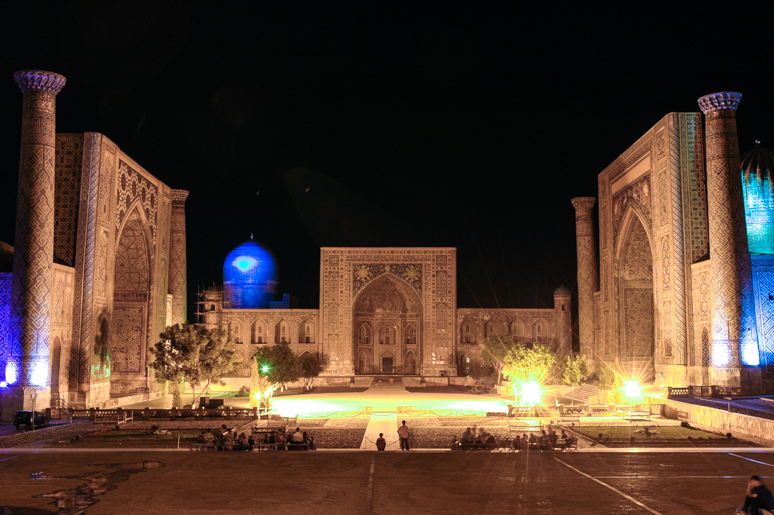
Registan, Samarkand, Samarkand Region, Uzbekistan
Samarkand is a truly ancient city whose origins are lost somewhere most likely in the first millennium BCE when it became a centre of the Sogdian civilisation. Strategically located on what would become the Silk Road, Samarkand passed variously through Iranian, Hellenic and Turkic empires, until its destruction by the Mongols in the thirteenth century. It was Timur who would bring Samarkand back to prominence, making it the capital of his Timurid Empire in 1370 and bequeathing the city a host of magnificent buildings, something of a high-water mark in Central Asian art and culture. Despite being weary from my protracted cross-border journey, I can’t resist heading out in the evening for a glimpse of the city’s dazzling architectural legacy. Samarkand’s centrepiece is the Registan (marketplace) which consists of three madrasas lining three sides of a central square. The architecture alone is stunning; a megalomaniac’s showpiece of minarets, sensuously curving domes, vast ornate portals and delicate arched galleries running in two tiers above the central court. This Timurid elegance is accentuated and made yet more exotic in being finished with a complete cloak of mosaic tiles of deep turquoise, lapis and gold, contrasting with the muted background of neutral buff; the intrinsic colour of the surrounding plains. Though in places the tilework is rather coarsely restored, the ensemble of the Registan is nevertheless in my mind the most impressive piece of Islamic architecture in the world for its sheer, exotic beauty.
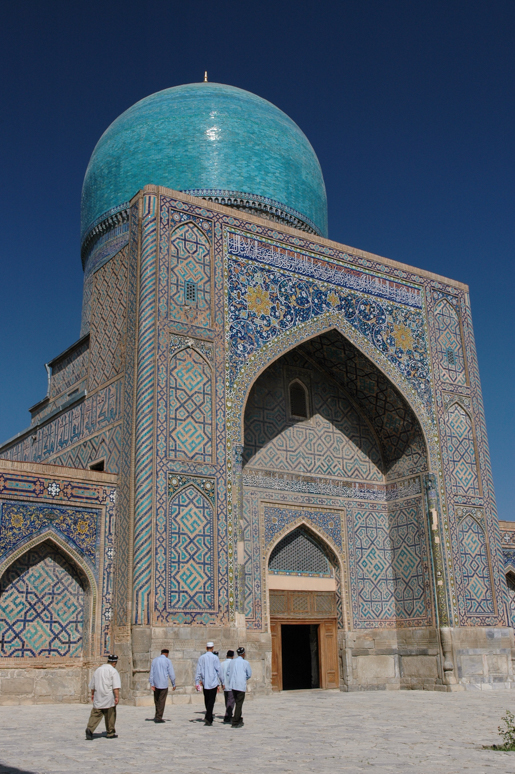
Tillia Kari Madrasa, Samarkand, Samarkand Region, Uzbekistan
Walking the next day northwards away from the Registan down Tashkent Street, which looks once to have been a major commercial thoroughfare, one reaches the deceptively large Bibi Khanym Mosque. Commissioned by Timur in the very last year of the fourteenth century, the remains of the mosque reveal its outlandish size, for whilst of normal proportions, the soaring, thirty-five metre tall iwan (portal) dwarfs the human figure. Herein however lies the structure’s downfall, for it simply exceeded the limitations of construction methods of the time and soon fell into ruin. Nearby are several other examples of Timur’s classical monumentalism and amidst these, the modern-day Siyab Bazaar with bustling, tree-lined market streets made colourful as much by the groups of ladies swathed in colourful dresses as by the piles of fruit, vegetables and spices which are heaped on neatly ordered rows of tables in small commercial units. Here however, Samarkand’s magic falters, for the atmosphere of the bazaar, and by extension the city itself, is rather restrained and insipid. There is no air of the Iranian or Levantine bazaar, where old, vaulted passageways bustle with trade and wind their way around very much still alive mosques and madrasas in a homogeneous complex of urban architecture which links the lives of the cleric, trader and common man.

Bibi Khanym Mosque, Samarkand, Samarkand Region, Uzbekistan
Indeed, while the city’s monuments are strikingly beautiful and recently restored (often rather hastily), they are exactly that: monuments; still, lifeless relics of a bygone age. Somehow the subdued local culture has little in common any longer with the magnificent buildings. Comprehensive Soviet modernisation over three or four generations has detached people’s lives from the mosques, shrines and seminaries which surround them and the locals approach the buildings in much the same way I do, as a curious visitor, rather than a component of the cultural landscape of the city. To compound this, the government, in looking to safeguard and increase the tourist industry is doing everything it can afford to do in order to further sterilise the atmosphere of ‘Old’ Samarkand and keep the locals and their activities well away from the places foreign tourists want to see.
The city’s intangible cultural fabric also seems to be under threat; having spent so long under the influence of Iranian and Persian-speaking empires, Samarkand’s population is majority Tajik-speaking (and presumably ethnically Tajik), but is being comprehensively ‘Uzbekised’ by the current government. Samarkand today certainly seems a far cry from the outpost of high culture and art it once so clearly was. It’s tragic, but in a country where opponents of the regime may find themselves boiled in oil, nobody is opposing anything.

Shah-i Zinda Necropolis, Samarkand, Samarkand Region, Uzbekistan
One place in Samarkand does however stir me, which is the Shah-i Zinda Necropolis, out to the north of the bazaar area, on the southern edge of the barren archaeological site of Afrasiyab, thought to have been the Sogdian capital of Marakanda (from which the name Samarkand is derived). I approach the site through a modern cemetery punctuated by elegant marble headstones, each adorned with a fine, skilful engraving of the deceased, climbing a shapeless mound of desiccated earth, once the city walls, then dropping into an avenue of mausoleums; pretty miniatures of the huge buildings found elsewhere in the city.
Inside the main mausoleum, thought to be that of Kusam ibn Abbas, a seventh century cousin of the prophet Mohammed, I feel an air of sanctity I’ve not felt anywhere else in the city and I watch locals silently make their way to the shrine, morose and thoughtful. From outside, a mullah sings beautiful Quranic verses in a soft but piercing voice which seems to hang timelessly in the cool, still air of the mausoleum. For this short moment I feel profuse Islamic piety, redolent with the power and mysticism of the Islamic world. Just as I experienced in Turkistan, Islam here seems to be intimate and personal to the individual rather than a part of mundane, public life. Many of the other mausoleums in the necropolis belong to members of Timur’s family and are, architecturally speaking, far finer than that of ibn Abbas. Indeed, here I find the most impressive faïence in Samarkand, with beautiful, raised white Kufic verse running vertically over intricate turquoise latticework and honeycomb tiles. It’s certainly my favourite spot in the city.
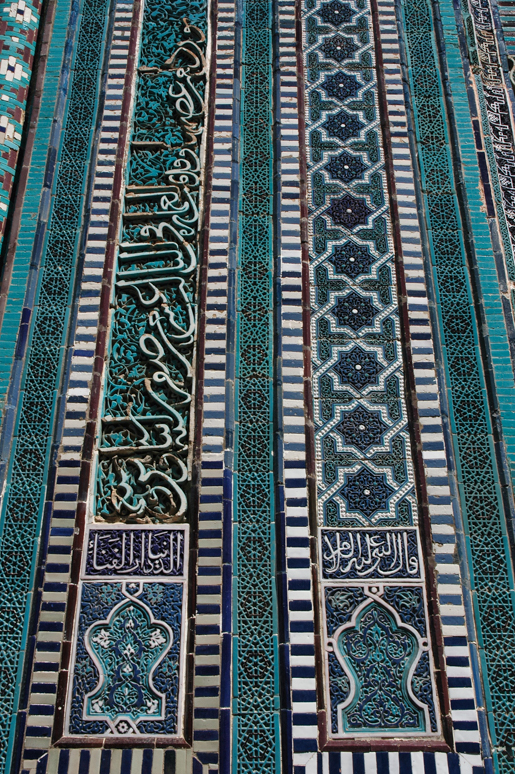
Tilework, Shah-i Zinda Necropolis, Samarkand, Samarkand Region, Uzbekistan
Evenings in Samarkand are very pleasant, spent in the large, shady courtyard of the guesthouse, swapping stories from the road with other travellers in the warm evening. I meet my first fellow drivers, Tania and Stephanie, a Swiss couple who have driven their Mercedes camper here via the Caucasus, a ferry across the Caspian and the featureless steppe western Kazakhstan. They tell me that travelling as two females has distinct advantages, saved by Central Asian male chivalry from flat tyres and breakdowns.
After three nights in Samarkand, I move on up-country to Bukhara, another ancient, Tajik-speaking irrigated Silk Road city, capital of the Iranian Samanid Empire and later the Emirate of Bukhara. Bukhara is notable as once having been the holiest city in Central Asia, a major intellectual centre of the Islamic world which was known to the Arabs as Bukhara-i Sharif (the noble). It was a native of Bukhara, Imam al-Bukhari who, after travelling in the ninth century Islamic world, returned to author the most highly regarded collection of hadiths (records of the life of the Prophet Mohammed). Bukhara was the birthplace of early Islamic polymaths such as Abu Ali ibn Sina (Avicenna) and was the home of Sufi mystics such as Jalaluddin Surkh-Posh Bukhari, who was instrumental in spreading Islam into the Indian Subcontinent, and Bahauddin Naqshband Bukhari, founder of the most popular, Naqshbandi, Sufi tariqah.
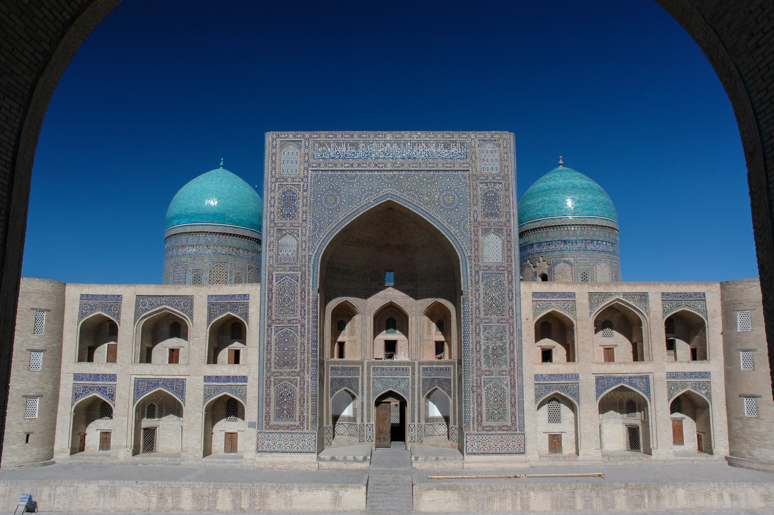
Mir-i Arab Madrasa, Bukhara, Bukhara Region, Uzbekistan
My first impression of Bukhara, upon arriving in the mid-afternoon, is of its warren of narrow, ancient back-streets in which I spend considerable time locating my chosen guesthouse. Bukhara is quite different from Samarkand with a more complete, medieval old city of madrasas, mosques, hauz (pools) and remnant stretches of a covered market, almost completely detached from the bland order of modern Bukhara. At the centre of the old city is the magnificent Po-i Kalon (grand foundation), a wide courtyard with the stout, plain brick Kalon Minaret, the only remainder of a Karakhanid-era mosque destroyed by Chinggis Khan. Facing each other across this square are two fine examples of Shaybanid (a rival, and then successor empire to the Timurids) architecture. To the west is the huge, sixteenth century Kalon Mosque, an enclosed courtyard mosque built in the early Iranian style, while on the east lies what in my opinion is the city’s finest building, the sixteenth century Mir-i Arab Madrasa with a soaring iwan of magnificently intricate tilework; finer, if more restrained, than that of Samarkand’s Registan and flanked by two gleaming turquoise domes.
A little further west is Bukhara’s Ark (citadel), dating from the time of the Emirate of Bukhara, which was only overthrown by the Red Army in 1920 and which encompasses the city’s oldest settlement mound. The Ark overlooks the beautiful, open-plan, eighteenth century Bolo-Hauz Mosque and a very pleasant modern park, where old chinar (plane) trees shade an open-air restaurant. Here I spend several evenings with Michel, a French teacher who has moved between postings in New Caledonia, French Guiana, Uruguay and France, eating shashlik and drinking good, cold draught beer.

Skyline, Bukhara, Bukhara Region, Uzbekistan
On first sight, I think this undeniably attractive old city might be where I find my ‘real’ Central Asia but, whilst more homogeneous than the old parts of Samarkand, the buildings are again monuments, detached from contemporary culture, with the old city feeling like something of a tourist trap awash with aged French and Japanese tour groups. However, away from the main sights of the old city, one can catch glimpses of Central Asian life through open doors, in the shady, vine-covered courtyards of traditional family compounds. Here children play while women wash clothes and clean enormous steel cooking dishes used for making plov (pilaf) whilst men sit in shady corners smoking and playing cards or nard. From these twisting mud-walled lanes with their stinking open sewers, one sometimes catches the city’s skyline, a maze of buff rooftops, facades and minarets, crowned by several large turquoise domes. One interesting cultural attraction I seek out in Bukhara’s back-streets is a synagogue belonging to the city’s dwindling, Persian-speaking community of Bukharan Jews. Michel and I are welcomed here to watch a Torah recital one evening, where a small congregation with an astonishing diversity of faces worship together, some the descendants perhaps of ancient Persian exiles and Silk Road traders.
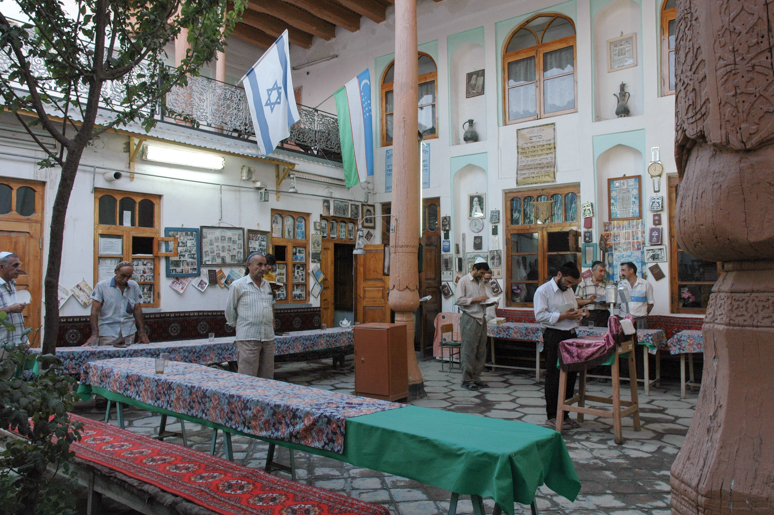
Bukhara Synagogue, Bukhara, Bukhara Region, Uzbekistan
So backward is Uzbekistan’s telecommunications infrastructure that it is a task of several hours to make a phone call to Tashkent and arrange for my second replacement spring to be received from an air freighter. I speak to the British embassy and after initial frustration speaking to an idiot at the front desk, get through to the very helpful deputy ambassador who puts me in contact with a shipping agent. Despite being so close to having the truck’s suspension fully repaired, I decide to leave the truck in Bukhara for a few days and join Michel, Tania and Stephanie (whom we meet one evening in the park) in sharing a taxi out into the desert, north-west to Khiva in the Khwarezm oasis. The journey is long, hot and cramped and with the driver blaring out repulsive Turkish pop music, spending more time shouting into his phone or fiddling with his collection of odious compact discs than watching the road, makes me swear never again to abandon the truck.

Bazaar, Khiva, Xorazm Region, Uzbekistan
Once out of Bukhara the land becomes sterile, rarely attractive desert, though we eventually catch a distant glimpse of the rather pallid looking Amu Darya (Oxus), here marking the border with Turkmenistan. The Khwarezm Oasis is a pocket of fertile farmland amidst the braids of this once-great river, which today is split between Uzbekistan and Turkmenistan. An ancient centre of initially Iranian civilisation, Khwarezm enters history as a distant part of the Achaemenid Empire, becoming more prominent as the base of the Turkic-speaking Khwarezmian Empire in the twelfth century, whose capital was Urgench, now Konye (old) Urgench in Turkmenistan. Later, after a change in the river’s course and the attentions of the Mongols, the city of Khiva became the focus of Khwarezm with the establishment of the Khanate of Khiva. Famed for its isolation, fierce hostility towards outsiders and salve trading, Khiva was only subdued by the Russian Empire in 1873.

Ichon Kala, Khiva, Xorazm Region, Uzbekistan
In this quite romantically remote location, Khiva’s compact Ichon Kala, or old city, is surrounded by tapering, seventeenth century mud-brick walls, containing a museum-like preserve of minarets, mausoleums and madrasas, some quite exuberant and unusual in form and colour, but lacking quite the grace of the finest buildings of Samarkand or Bukhara. Whilst not as filled with tour groups as Bukhara, after walking around Khiva’s manicured old streets and alleyways in 40°C heat for a few hours I am again struck by a lack of atmosphere and I realise that I won’t find the ‘real’ Central Asia of my imagination in modern Uzbekistan. Of course what I am seeing is the real Central Asia; the unreality lies solely in my mind’s expectations.
Having had more than my fill of slightly charmless cities and hastily restored faïence, I wish to see something very different. On the far side of the Amu Darya from Khiva, still part of the historical region of Khwarezm, lies the Karakalpakstan Republic, an autonomous republic of the Karakalpak people who are ethnically more closely related to Kazakhs than to Uzbeks. Here the Amu Darya historically reached its end-point in the Aral Sea, a large, endorheic, saline lake. However, beginning in the late 1950s, the Soviet Union diverted huge quantities of water from the Amu Darya and Syr Darya rivers to irrigate the barren desert and boost cotton production. The Aral Sea, whose water levels were sustained by these two rivers, soon started to shrink in the beginnings of an environmental catastrophe caused by trademark Soviet negligence and totalitarian incompetence. Today the Aral Sea, has all but disappeared from Uzbekistan.
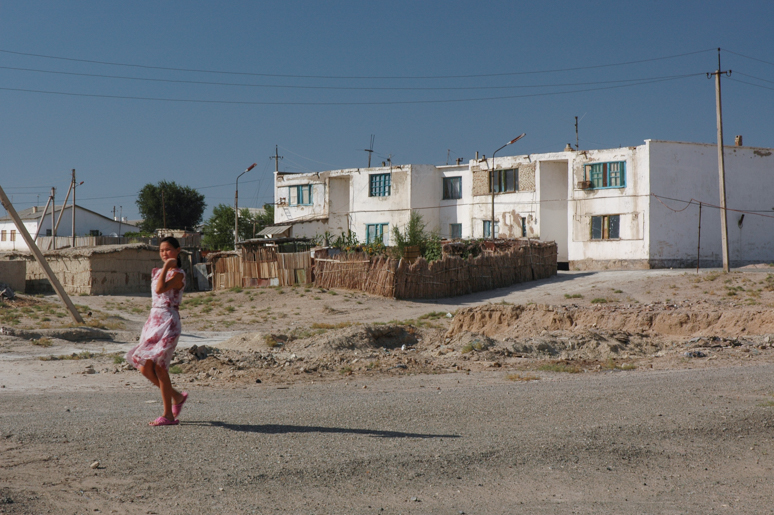
Moynaq, Karakalpakstan Republic, Uzbekistan
Michel and I take a taxi to the bleak and oven-like city of Nukus, the republic’s capital, and find a room in an old Soviet behemoth of a hotel with a dank bathroom missing a sink, two sagging old beds and a decrepit Soviet air conditioner which wheezes out the odd puff of warm air whilst making enough noise to rattle the window panes. The only saving grace of this pile is a dimly-lit and rather seedy bar, where a pretty waitress serves good cold beer and Russian fare, a welcome break after the monotonous Uzbek cuisine of greasy mutton in various forms. After a stuffy, mosquito-plagued night we board a bus to Moynaq, which takes us quickly beyond the reach of the waters of the Amu Darya (which now dissipate in this desert, far short of the Aral Sea), into a land of utter desolation. This once fertile land is now blighted by a lack of water, suffers hotter summers and colder winters without the Aral Sea’s climatic buffering, and its inhabitants are additionally afflicted with respiratory complaints due to wind-borne dust and aerosols of toxic pesticide run-off coming from the former sea-bed.

Former Aral Sea, Moynaq, Karakalpakstan Republic, Uzbekistan
The desperate, almost deserted town of Moynaq sits out upon an endless, blazing expanse of hard-baked clay. Photographs and paintings of Moynaq from before the 1980s show a quaint, happy seaside town set upon a wide, curving bay of the Aral Sea, which looked just like the ocean. It was a community based on fishing and on tourism. For citizens of Soviet Central Asia, the Aral Sea was the closest destination for a warm seaside holiday, despite being deep in the centre of the Eurasian landmass. Today Moynaq lies 120 kilometres from the nearest remnant scrap of the Aral Sea; a lifeless, hyper-saline body of water now far more like the Dead Sea than the ocean.

Fishing Boat, Moynaq, Karakalpakstan Republic, Uzbekistan
After finding a hotel amongst Moynaq’s collapsing buildings, Michel and I cross a field of sand dunes which thirty years ago might have been a pleasant beach dotted with Soviet families, and find ourselves walking on what used to be the bed of the Aral Sea. It’s profound enough to walk on a former seabed, still littered with shells, but truly iconic are the fleet of rusting hulks of old fishing boats wedged surreally into the desert. These beached sentinels are perhaps one of the most powerful images of mankind’s destruction of our natural habitat.
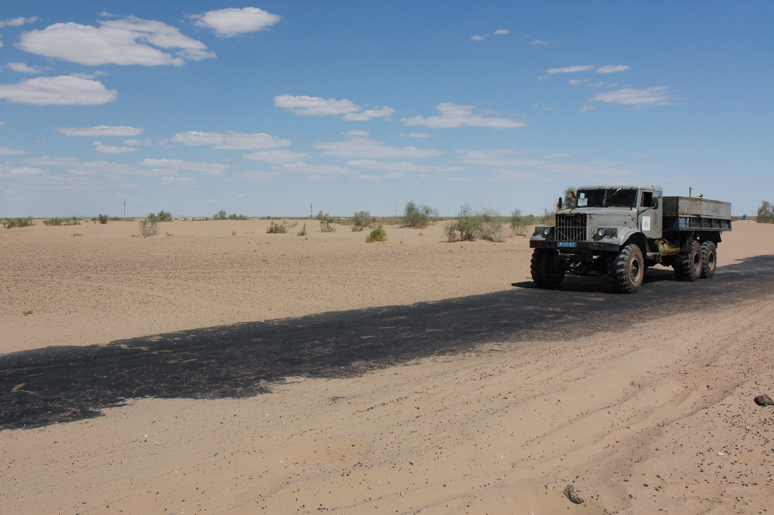
A380 Highway, Bukhara Region, Uzbekistan
Having reached almost the utter end of Uzbekistan, I re-trace my steps back down the length of the country, through Khiva to Bukhara where I’m glad to be reunited with the truck, then through Samarkand back to Tashkent. The capital of Uzbekistan is Central Asia’s largest city and was the fourth largest in the Soviet Union, causing me to approach it with the expectation of choked streets of manic traffic and chaotic, winding roads. To my surprise, I find a city set out on a huge scale with wide avenues of light traffic separating enormous, widely-spaced buildings. The city is in fact so spacious, that I drive almost completely across it, thinking I am in never-ending suburbs when I’ve gone right through the centre of it. After doubling back, I park with ease in the very centre of the Tashkent, next to a small park of old chinars on Amir Timur Square, and meet my contact Nail.

Independence Avenue, Tashkent, Uzbekistan
I’ve arranged to stay in the apartment of the Grachev Family, whom I stayed with in Novosibirsk last month. The Grachevs had lived in Tashkent until 1997 when, like many Russians, they decided that social and economic conditions in independent Uzbekistan were not favourable and moved to Russia. Nail, the son of the Grachevs’ former neighbours, currently lives in the apartment, and here I also meet Igor from Novosibirsk, a colleague of Yuri Grachev who is visiting on business. The next day, Nail helps me deal with customs at Tashkent Airport, haggling down the import duty for my new spring to an unofficial cash payment, and it’s a great relief to finally have the second new spring back at the apartment.
In the evening, as Nail and I are heading out to dinner, we run into Igor who invites us to join him, telling us he has a dinner invitation from a ‘Big Boss’. The man’s name is Kamil, an Uzbek from Jalalabad, just over the border in neighbouring Kyrgyzstan. We enter a flashy-looking restaurant packed with Tashkent’s upper social echelons and soon the food and vodka start flowing, though I pass on the vodka as I am still recovering from a bout of diarrhoea a few days ago. Kamil turns out to be quite a mover in Tashkent; he is the director of a construction firm and, conveniently, is also a police chief of some sort as well as a childhood friend of the brother of the president of Kyrgyzstan. He also turns out to be extremely helpful, offering firstly for his son to arrange for the second new spring to be fitted to the truck, and giving me the personal telephone number of some chief of Uzbekistan’s road police, stating that should I get into any trouble, I need only mention his name to get any irksome traffic officers off my back. Perfect.
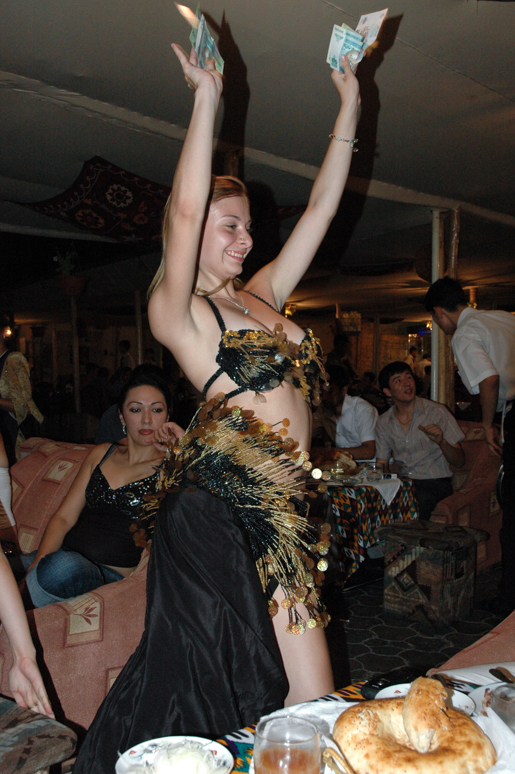
Dancing Girl, Tashkent, Uzbekistan
Live music begins and an array of dancing-girls, scantily clad in what are supposedly Russian, Ukrainian, Gypsy, Indian or Turkish dress, make their way round the tables. Kamil becomes very animated and hands out wads of notes to the girls and I narrowly sidestep his insistence that he pay for me to take one of them back to the apartment. As the evening winds to a close Kamil’s son Rauff joins us, bringing a car to take us home. As we make our way to the car it becomes clear that Kamil himself intends to drive us home, despite being drunk. He reverses the car out violently, very nearly mowing down the valet, and storms down Tashkent’s unlit boulevards. Seriously concerned, I suggest that I drive, which Kamil seems to find a novel idea, and we switch seats, much to the delight of Kamil who orders me to go faster and ignore red lights (as a police chief he, and therefore I, have carte blanche to flout any rules of the road). I cannot say how fast we’re going as someone has taken the speedometer out of the car, but I spend considerable time trying to engage fifth gear in a four-speed car, much the amusement of my passengers. Nail, who had no objection to being driven by someone so drunk that he could not walk straight, has suddenly become quiet and looks rather pale.
Next day Rauff, good to Kamil’s word, meets me, takes me to a workshop, gets the spring replaced and even fills my tank with diesel, absolutely refusing to accept any of my money, citing ‘eastern hospitality’ as the reason each time, with a smile. I’m left marvelling at how meeting the right people and making connections through connections is the way to get things done in the region. I spend a few more days relaxing in Tashkent, finding it oddly quiet, strongly policed and still seemingly Russian-dominated, in stark contrast to any other part of the country which I have seen. I imagine this atmosphere to be rather unchanged from the days of the Soviet Union, an opinion I share with a surprised Igor, who had come to the same opinion.
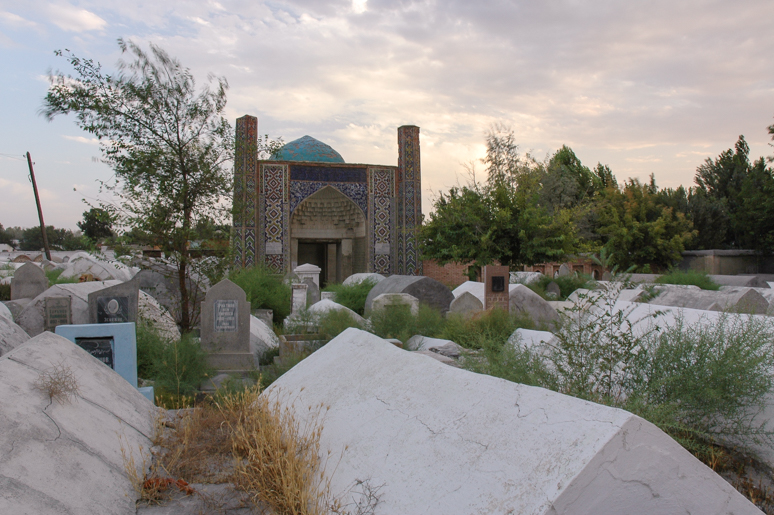
Shayhon Cemetery, Kokand, Fergana Region, Uzbekistan
After five days, I gather the energy to move on, heading east towards the Fergana Valley. Not long after leaving Tashkent’s urban refinement, I’m back in Uzbekistan’s familiar countryside, passing nondescript farming villages and towns, soon climbing into the western outliers of the Tien Shan. I pass the turquoise Akhangaran reservoir, then cross Kamchik pass and find myself descending into the Fergana Valley. More a broad, fertile plain than a true valley, Fergana has been occupied since pre-history and remains an intensively cultivated region, densely populated by Uzbek, Tajik and Kyrgyz farming communities, who occasionally erupt into inter-ethnic violence. But whilst the valley is historically notable; it is most likely the site of the first contact between China and the West, and the birthplace of Babur, founder of the Mughal Empire, it lacks (somewhat to my relief) any preserved old cities in the style of Samarkand or Bukhara. I stop briefly for an afternoon in Kokand, once the capital of the Khanate of Kokand, but find the Khan’s old palace to be rather gaudy and uninteresting. More atmospheric is Kokand’s large Shayhon cemetery, a quite fascinating collection of tombs and mausoleums, testifying to the city’s considerable age. What I most notice in the Fergana Valley however are the people, who seem be both more religiously observant, with women almost all covering their hair and men sometimes wearing topis (Muslim skullcaps), and rather less subdued, with pedestrians often waving spontaneously at me as I drive past and conversation coming more easily.

Bazaar, Andijan, Andijan Region, Uzbekistan
The next day is my last in Uzbekistan (on this visit) and I stop in the morning in the city of Andijan. Whilst having a lively bazaar, my interest here is a touch voyeuristic. In the newly independent republics of Central Asia, Islamic fundamentalism is seen as a serious threat, perhaps not surprising given the proximity to war-torn Afghanistan and to Tajikistan, which witnessed the region’s first post-Soviet civil war. This threat is also a convenient cover for general repression of civil rights, and Islam Karimov, Uzbekistan’s barbaric president, rather over-extended this cover two years ago in Andijan when the military opened fire on what was reportedly a popular protest against poor living conditions and corruption, massacring an unknown number of unarmed civilians (perhaps several hundred to over a thousand). The incident has not been openly investigated and saw a shift in Uzbekistan’s relations away from the West, and a banning of foreign journalists from the country.
There is of course nothing of this civil unrest to be seen today in Andijan, which seems to be one giant bazaar, teeming on a Sunday with people drawn in from surrounding towns and villages. I park the truck and walk off to find an internet connection, as usual in Uzbekistan, a futile exercise, and return to see three plain-clothed police carefully inspecting it. They question me for a while, look through my luggage, then leave. A little later on, I enter one of the bazaars which is frenetic and colourful, though filled mostly with Chinese crap, and take some pictures. Immediately, plain clothed police officers appear and lead me out forcefully to the street. They make some calls on their radios but after a few minutes I am sent off. This is clearly not tour-group territory. There might not be anything to see in Andijan, but the organs of the state lurk in camouflage at every corner. Its a slightly sad realisation that while the people here seem livelier and perhaps more worldly than in the rest of the country, they are just as powerless. I take my cue and leave, through the final cotton fields to the border town of Uchkurgan where I am the only vehicle using the crossing.
I leave Uzbekistan feeling slightly disappointed by the country; its rich culture and legacy seems to have been reduced to rather two-dimensional tourist attractions and its people blunted and repressed by successive governments, left utterly powerless and terribly naïve. There had been highlights; glimpses of age-old shrine worship and good times in the vibrant, cosmopolitan island of Tashkent, but my expectations of a vibrant, sophisticated Asian country were unfulfilled and I was leaving slightly disillusioned at what remains of the romantic Silk Road, glad to be heading for the beautiful mountains scenery and fresh air of Kyrgyzstan’s mountains.
Stage 1 – Ukraine, Russia & Kazakhstan: To The Altai Mountains [2/2]
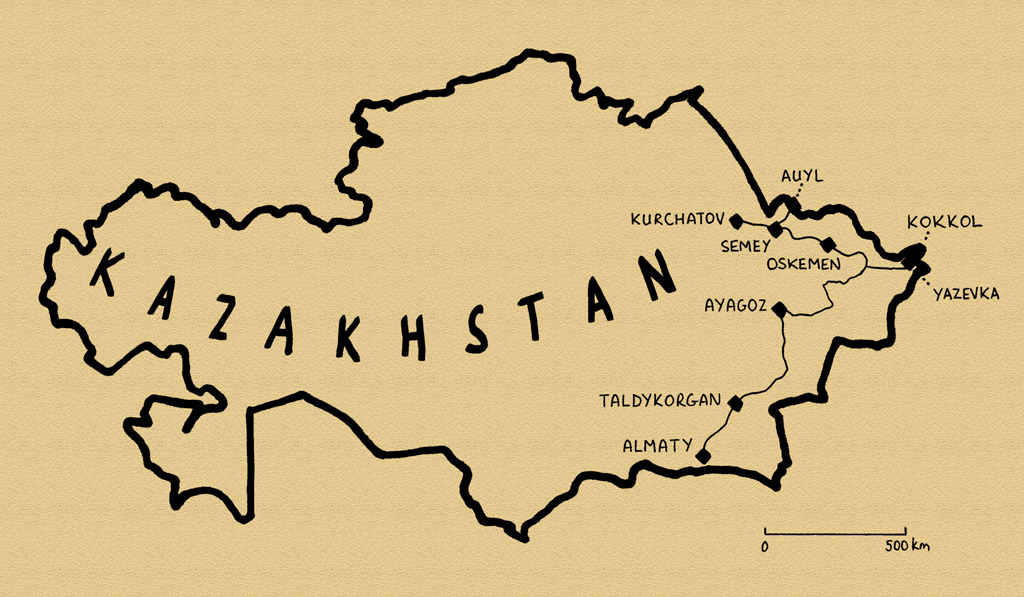
Kazakhstan. The world’s ninth largest country. Holder of a considerable proportion of the world’s known gas and oil reserves. Rich in minerals. Home of the apple, and quite possibly the tulip too. Sadly, Kazakhstan seems known in the western world more for a certain fictional character. To Russians its name also has often negative connotations; vast, uncivilised steppes, gulags, wasteland. Kazakhstan has turned out to be one of my favourite countries in the region. To date, I’ve made five visits. I love the solitude of steppe, the long days of driving across featureless wilderness. Delve a little deeper in this country however, and one finds many delights; ancient petroglyphs, testament to millennia of continuous inhabitation; ruined cities of the old Silk Road which hint at past glory and, in places, a budding cultural renaissance. The Soviets viewed Kazakhstan as a void in which to exile dissidents, test nuclear weapons, and operate vast industries and ill-conceived agricultural projects without regard for the local environment or population. The centuries-old nomadic culture of the Kazakhs was ruthlessly eliminated in the early twentieth century in favour of disastrous collectivisation. By the time of independence, which was something of a windfall for the country, Kazakhstan was a neglected backwater. Today Kazakhstan has by far the most dynamic economy in Central Asia and, led by the highly popular Nursultan Nazarbayev, is making an entry onto the world stage. The country is not exactly bursting with historical or cultural attractions, but in this modesty lies for me perhaps its greatest appeal. One certainly doesn’t run into too many other visitors here.
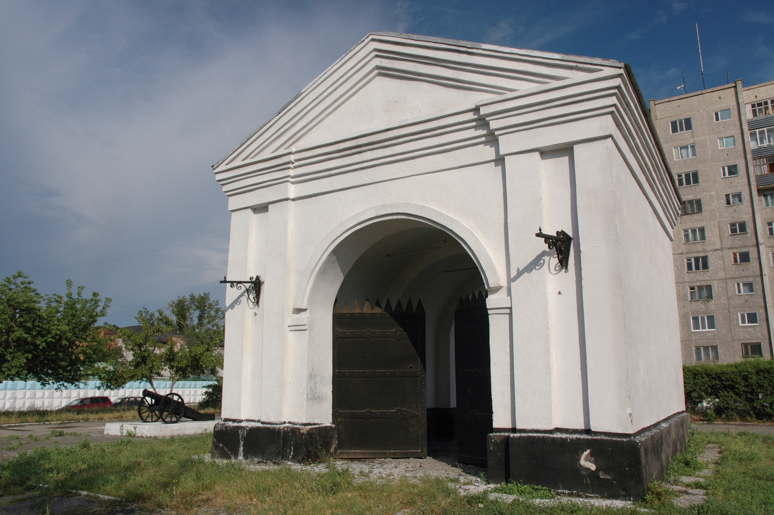
Yamyshevsky Gate, Semey, East Kazakhstan Region, Kazakhstan
On the 30th June 2007 I cross the border with surprisingly little fuss, and enter Kazakhstan for the first time. The soil immediately becomes thinner, sandier, far less productive, and one can see quite clearly here where the border would have been drawn between the Russian settlers on their fertile Siberian soils, and the Kazakh nomads herding livestock over the sparse grasses of the steppe. As a consequence, the settlements here are even more spread-out than in Russia’s sparsely populated Altai Territory immediately to the north. The land looks wilder, and the vistas longer. The marvellous desolation is broken only when I approach the first city, Semey. Formerly known as Semipalatinsk, the city was established as part of a line of fortresses during the southward expansion of the Russian Empire, with the lonely Yamyshevsky Gate the only surving part of the city’s eighteenth century fortress. The name Semipalatinsk is however synonymous with nuclear weapons testing, as it was at a site around 150 kilometres away that the Soviet Union conducted its test program from the 1940s to 1990s. The city also hosted Fyodor Dostoyevsky during his exile, and was most likely the setting for Raskolnikov’s exile in ‘Crime and Punishment’. It’s an interesting introduction to Central Asia; although in reality, it has culturally more in common with the Russian cities to the north than with cities of southern Kazakhstan such as Taraz or Shymkent, it does feel a step closer to the bustle and colour of Asia.
The city shows clear signs emerging from a long period of economic slumber, with new buildings popping up in the centre along roads which look like they have been bombed; a smorgasbord of large holes filled with muddy rainwater. The atmosphere seems to be optimistic however, and is far more relaxed than Russia. I spend my time exploring the bustling and colourful bazaar, which definitely brings me a step closer to the Orient than to Russia, and retire to my hotel room with delicious kebabs and cold beer. Life is pretty good.

Bazaar, Semey, East Kazakhstan Region, Kazakhstan
One thing which certainly catches my eye here are the young Kazakh women; often thin, elegant and pretty, with strong oriental features tempered only slightly by a refined Asian softness. In subsequent travels in Kazakhstan, I would start to notice that these women, in addition to being highly attractive, were often markedly more ambitious, worldly and industrious than the men, whose interests usually seem to lie more in drinking, cars and money. It was a pattern I would see repeated in Kyrgyzstan and Mongolia.
Two things have brought me to Eastern Kazakhstan; the glorious Altai Mountains (which sit on the four-border area of Russia, Kazakhstan, Mongolia and China), and the prospect of getting a look at the former Soviet nuclear weapons institute out in the wilderness, close to the actual test site. I had once read a newspaper article which described a rather gory museum in the nuclear institute which included among other things, a collection of jars containing various parts of unfortunate animals which were tethered close to nuclear explosions. From the moment I read the article, I was determined to visit. The town which hosts the institute is named after Soviet nuclear scientist Igor Kurchatov, and is reached by a road which follows the lazy Irtysh river, and passes through semi- and wholly abandoned villages where today the remaining inhabitants suffer from an unusually high incidence of genetic defects. The landscape is utterly desolate; to the southwest is a low range of hills where many of the actual tests were carried out. It rather looks like the kind of place one would test nuclear weapons.

Irtysh River, Pavlodar Region, Kazakhstan
Reaching Kurchatov I locate the institute after some initial communication difficulties. The guard in the entrance building where I turn up unannounced is naturally suspicious of my motives, but takes my passport in and returns after twenty minutes with a note, in English, inviting me for a private tour later that afternoon. I spend the intervening time looking around the numerous abandoned buildings; apartments, shops, schools, even scientific laboratories, where trees and waist-high grass sprout out of the broken concrete pavements and yards. Mature shrubs grow in the roofs of the apartment buildings, sad shells of what was once a busy town. It’s tempting to think that some terrible nuclear disaster wrought such widespread dereliction to the town, but it’s just another victim of the collapse of the USSR. Much of Kurchatov’s population (which shrank from around twenty-five thousand to eight thousand) were Russian Army personnel, who returned to Russia after 1991. In time, I would find a number of semi-abandoned cities, but Kurchatov was the most intriguing.
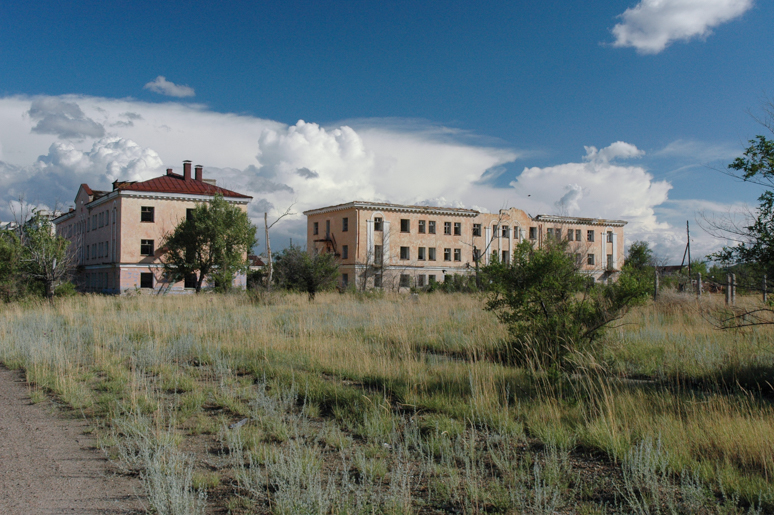
Abandoned Buildings, Kurchatov, Pavlodar Region, Kazakhstan
At the agreed time I return to the institute and begin my tour of the museum, conducted in Russian by a senior scientist, accompanied by a translator and another woman who keeps a very close eye on me lest I sneak a photograph, or perhaps pocket some of the exhibits. The museum turns out to be pretty good. There’s a macabre model of the first nuclear test site, with the bomb suspended in a gantry above the ground, surrounded by tanks, aeroplanes and other military hardware, simple buildings and a total of 1350 tethered animals; dogs, cows, pigs, horse and even a model camel sits on the diorama (though I feel the latter may be just to cater to local tastes). In glass jars of formaldehyde are the remains of some animals, with bluntly clinical labels such as ‘dog bladder-wall haemorrhage’, ‘third-degree burns of sheep head’, and my personal favourite, ‘multiple haemorrhage of dog thorax wall’. Among the less traumatising exhibits are a series of still images from a high-speed recording of some atmospheric tests, showing the development of an apocalyptic mushroom cloud, and a two centimetre thick cylindrical steel shroud which has been twisted in one of the tests like a piece of scrunched-up aluminium foil. At the end of the tour, the staff enquire after which organisation has sent me here to visit, and it takes a couple of attempts to explain that I am an independent visitor. The reaction is one of bewilderment however, rather than suspicion; that I would have driven all the way here from the UK to visit this forsaken and crumbling town in the middle of absolutely nowhere. My voyeuristic urges well and truly satisfied, I head out of town back towards Semey. A natural mushroom-cloud gathers silently beyond the broken rooftops, discharging occasional lances of pink lightning. It seems fitting for an area with such a violent history.
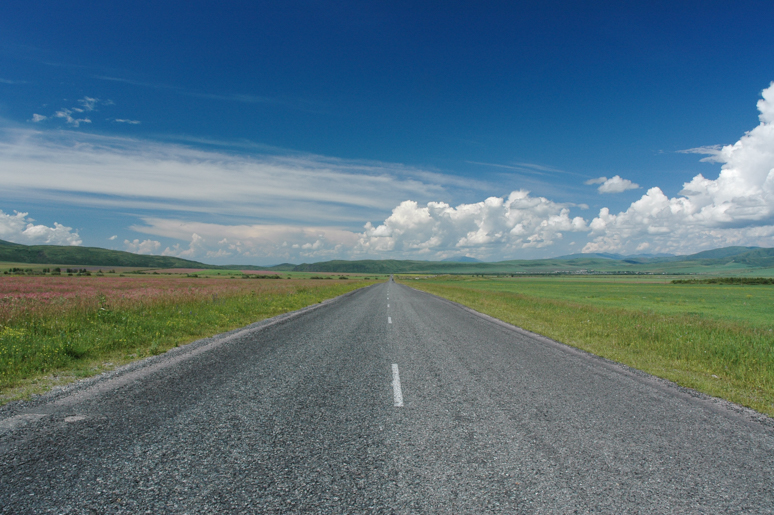
Altai Mountains, near Katon Karaghay, East Kazakhstan Region, Kazakhstan
There’s something rather special about the Altai Mountains, something I can’t quite put my finger on. It’s said to be one of the ‘world energy centres’ and possible location of Shangri-La, and while I’m no fan of new-age mysticism, I do agree that they have a quality which I’ve not found anywhere else. I personally attribute it more to their remote, highly continental location well away from any cities or industry, a rich animist history (there are still practising shamans in the region), and a kind of fairytale neatness to the landscape. The Kazakhstani section of the Altai Mountains, which lies on the southern side of the highest peaks, is one of the least-visited areas, requiring a border permit application to be made months in advance. I collect my permit in the town of Oskemen (Ust-Kamenogorsk), where I have a run-in with the authorities when I attempt to register. After a few hours of difficulties, which end with being escorted by a friendly and heart-stoppingly attractive young Uyghur woman to the appropriate authority, I have all my paperwork in order and may (somewhat reluctantly) proceed. The road out of Oskemen climbs gently into the foothills which have an extraordinary beauty of soft, green rolling hills strewn with wildflowers, clear rivers and idyllic Siberian villages of wooden homes. While the Russian Altai is somewhat stark and severe in its beauty, the land here is subtly different; benign and liveable and populated by Slavs and Kazakhs. In the town of Katon-Karaghay I stop in the early afternoon to make another registration at a national park office, where I meet Alia, a German-speaking entomologist gives me the details of a local family up in the mountains who hire horses.
Leaving town, the landscape gradually pulls in, with unspoilt ridges of dark green pine forest appearing either side of the road. An hour up a side track into the forest I reach the village of Yazevka, where I turn up wholly unannounced at the house of the Lupshchanov family, with nothing but a hand-written letter from the entomologist explaining what I wish to do. The family are very welcoming, and I’m soon being fed delicious smetana (sour cream) on fresh bread with wild-strawberry jam (easily the best I’ve ever tasted), all home-made.

Kokkol Waterfall, East Kazakhstan Region, Kazakhstan
The following morning I’m given a horse and a horse and a guide in order to reach the utter end of Kazakhstan; a salient of land sticking into Russia at the foot of Mount Belukha, the seldom-seen giant, perpetually snow-clad highest peak in Siberia. The horse trekking doesn’t start too well; the weather is cool, with low clouds pouring rain. This doesn’t however deter the swarms of midges, mosquitoes and horseflies, which are present in a volume I’d previously thought impossible. Never before (and never since) have I seen such biblical swarms of biting insects. My guide Farhat immediately begins drinking vodka when we leave the family home, though seems to be holding it well until he chooses to have a quick nap under a tree, while his horse runs off into Russia. Worst of all however is my Kazakh saddle; hard, unpadded leather which by the end of the day is cutting into me. After following a barely discernible path for several hours, which at one point veers into Russia, we stop for the night with some relatives of Farhat, the Bazhenovas who in traditional Kazakh-style are on summer pastures in their yurt (tent).
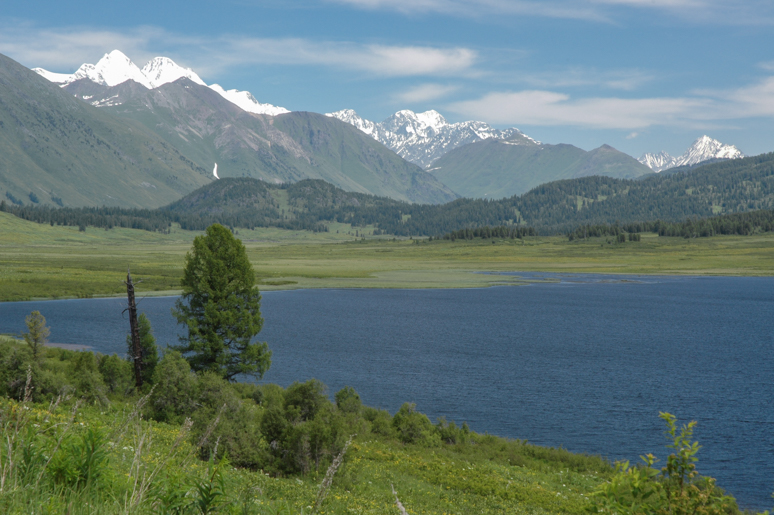
Lake Yazovoye, East Kazakhstan Region, Kazakhstan
Conditions of weather and insects improve the next day, but sadly the condition of my posterior remains grave. The scenery is astounding however, as we track up the milky Belaya Berel river and finally steeply up a hillside into the Kokkol valley, a gorgeous grassy amphitheatre filled with orange, purple and magenta wildflowers, perched above a pristine waterfall. Huge Siberian snowpeaks loom a few kilometres to the north on the Russian border, capped with views of the rarely-seen southern side of Belukha. It’s absolutely sublime, and has been worth all the effort of getting here. The area is pristine, untouched but for the few Kazakh families who herd animals nearby, and some tumbledown remains of an old Gulag; grizzly Soviet history overcome once more by stunning natural beauty. An old turbaza (mountain refuge) reveals that this was once a place people visited for recreation, evidenced by extensive Soviet-era graffiti, starting in the early 1970s but abruptly stopping in 1991. I leave an inscription, and wonder how many other visitors ever make it this far.
Retracing our steps back towards Yazevka, we pass the jewel-blue Lake Yazovoye, where Farhat and I get into an abandoned pedalo and are rewarded with an even finer view of Belukha from out on the lake. In the evening, after an early supper I say a fond farewell to a sober Farhat and his delightful family (his mother gives me a jar of fresh wild-strawberry), and start my journey towards the south.
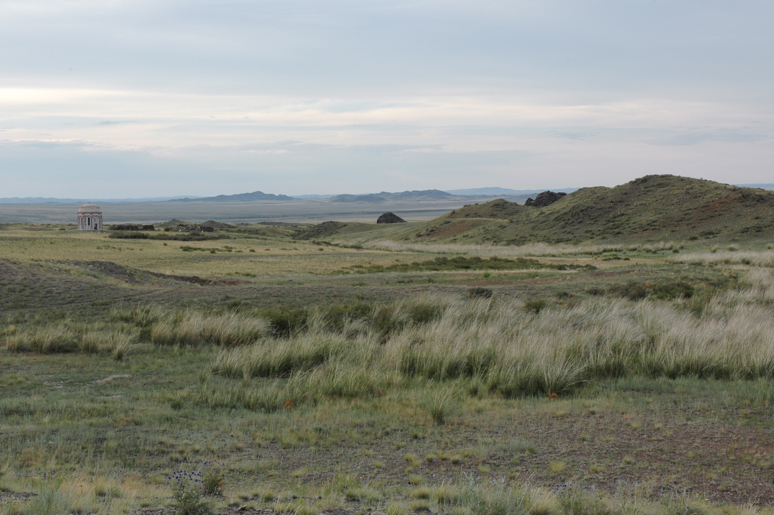
Tarbagatay Hills, East Kazakhstan Region, Kazakhstan
Initially, the route takes me back the way I came, through Katon Karaghay, but before reaching Oskemen I take a road to the south, which becomes increasingly quiet and isolated until it ends at a rusting ferry pontoon on the shore of the Irtysh, here a wide reservoir held up by the Bukhtarminskoye Dam. After ninety minutes an old ferry arrives, and about twenty cars cram on. It’s rather an odd sensation being on a ferry at one of the planet’s most continental points, which takes people from nowhere to nowhere, but any respite from the country’s atrocious roads is most welcome.
The road from the far side of the reservoir joins the M38, which runs to the north-western corner of China, but I turn off short of the border, heading southwest, into a vast open landscape, with the distannt Tarbagatay mountains to the south just visible through the cooling late-afternoon air. At the foot of these mountains, at an indeterminate distance is a wide lake which reflects the lengthening sunlight with a metallic sheen. Overhead a thin stratum of cloud is dissipating into the cooling air to reveal streaks of cirrus, adding to depth of the scene. This long-distance scenery, seen alone from an empty road is really quite stunning, and I soon stop to have a break, feeling deeply serene and humbled by an awesomely vast 360-degree panorama of muted natural beauty.
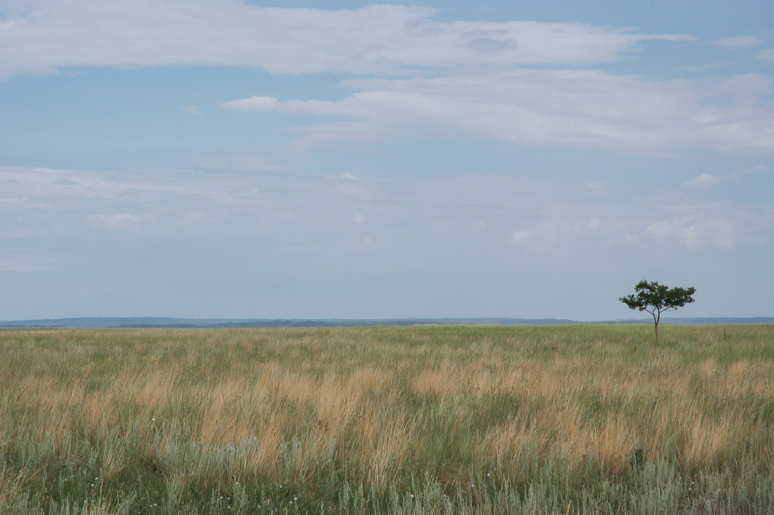
Steppe, near Aktogay, East Kazakhstan Region, Kazakhstan
The road runs for just over a thousand kilometres south-west to Almaty and as the hundreds of kilometres slowly pass (for the road condition is generally awful and my springs are still broken), one notices subtle changes in the landscape; distant mountain ranges shimmer on the Chinese border, the occasional small, squalid town or assortment of roadside shacks serving food pass by. The land flattens, then rises gently and starts to undulate. A herby, bittersweet scent fills the car as the shrubby sub-Siberian wilderness gives way to the wormwood steppes of central Kazakhstan. Wormwood has become one of the most evocative of scents for me; the merest hint of it transports my thoughts straight onto the sere steppes of High Asia.
A lone tree, or a car glinting far off in the distance are the only things which may catch the eye, and the journey once again has that soporific ocean-voyage like quality, the senses dull, and thoughts start to swell in the mind. Grassy hills draw level with the road and I start to see shepherds leading sheep to graze along the valley floors. Towns of size start to appear; not of chocolate-box Siberian cottages, but of shady streets lined by tall, elegant poplars and neat courtyard houses. The people in these small towns are almost entirely Kazakh, with elderly men wearing white topis (Muslim head caps) and sitting idle at the roadside. Hanging in the air is the omnipresent smell of woodsmoke rising from shashlik (kebab) braziers. I’m in Central Asia.
 EurasiaOverland