
Stage 1 – Ukraine, Russia & Kazakhstan: To The Altai Mountains [2/2]
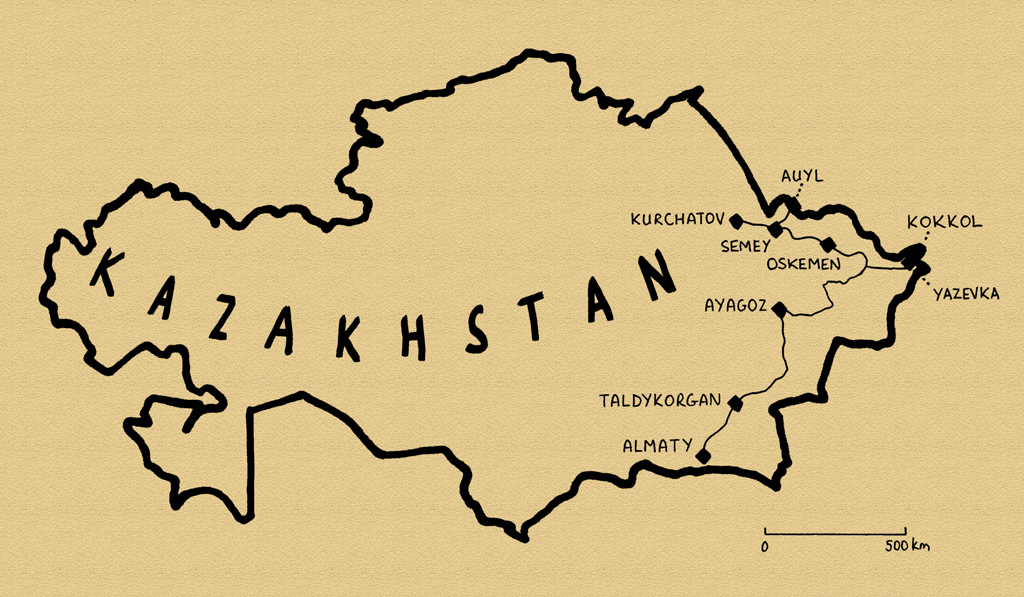
Kazakhstan. The world’s ninth largest country. Holder of a considerable proportion of the world’s known gas and oil reserves. Rich in minerals. Home of the apple, and quite possibly the tulip too. Sadly, Kazakhstan seems known in the western world more for a certain fictional character. To Russians its name also has often negative connotations; vast, uncivilised steppes, gulags, wasteland. Kazakhstan has turned out to be one of my favourite countries in the region. To date, I’ve made five visits. I love the solitude of steppe, the long days of driving across featureless wilderness. Delve a little deeper in this country however, and one finds many delights; ancient petroglyphs, testament to millennia of continuous inhabitation; ruined cities of the old Silk Road which hint at past glory and, in places, a budding cultural renaissance. The Soviets viewed Kazakhstan as a void in which to exile dissidents, test nuclear weapons, and operate vast industries and ill-conceived agricultural projects without regard for the local environment or population. The centuries-old nomadic culture of the Kazakhs was ruthlessly eliminated in the early twentieth century in favour of disastrous collectivisation. By the time of independence, which was something of a windfall for the country, Kazakhstan was a neglected backwater. Today Kazakhstan has by far the most dynamic economy in Central Asia and, led by the highly popular Nursultan Nazarbayev, is making an entry onto the world stage. The country is not exactly bursting with historical or cultural attractions, but in this modesty lies for me perhaps its greatest appeal. One certainly doesn’t run into too many other visitors here.
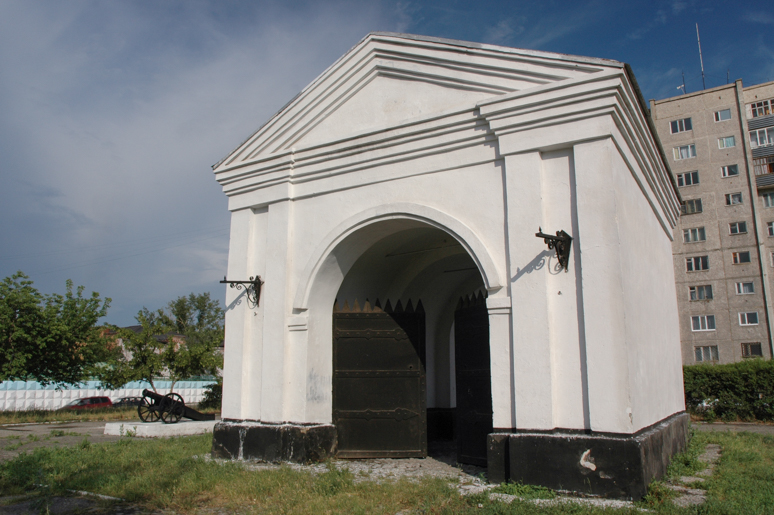
Yamyshevsky Gate, Semey, East Kazakhstan Region, Kazakhstan
On the 30th June 2007 I cross the border with surprisingly little fuss, and enter Kazakhstan for the first time. The soil immediately becomes thinner, sandier, far less productive, and one can see quite clearly here where the border would have been drawn between the Russian settlers on their fertile Siberian soils, and the Kazakh nomads herding livestock over the sparse grasses of the steppe. As a consequence, the settlements here are even more spread-out than in Russia’s sparsely populated Altai Territory immediately to the north. The land looks wilder, and the vistas longer. The marvellous desolation is broken only when I approach the first city, Semey. Formerly known as Semipalatinsk, the city was established as part of a line of fortresses during the southward expansion of the Russian Empire, with the lonely Yamyshevsky Gate the only surving part of the city’s eighteenth century fortress. The name Semipalatinsk is however synonymous with nuclear weapons testing, as it was at a site around 150 kilometres away that the Soviet Union conducted its test program from the 1940s to 1990s. The city also hosted Fyodor Dostoyevsky during his exile, and was most likely the setting for Raskolnikov’s exile in ‘Crime and Punishment’. It’s an interesting introduction to Central Asia; although in reality, it has culturally more in common with the Russian cities to the north than with cities of southern Kazakhstan such as Taraz or Shymkent, it does feel a step closer to the bustle and colour of Asia.
The city shows clear signs emerging from a long period of economic slumber, with new buildings popping up in the centre along roads which look like they have been bombed; a smorgasbord of large holes filled with muddy rainwater. The atmosphere seems to be optimistic however, and is far more relaxed than Russia. I spend my time exploring the bustling and colourful bazaar, which definitely brings me a step closer to the Orient than to Russia, and retire to my hotel room with delicious kebabs and cold beer. Life is pretty good.

Bazaar, Semey, East Kazakhstan Region, Kazakhstan
One thing which certainly catches my eye here are the young Kazakh women; often thin, elegant and pretty, with strong oriental features tempered only slightly by a refined Asian softness. In subsequent travels in Kazakhstan, I would start to notice that these women, in addition to being highly attractive, were often markedly more ambitious, worldly and industrious than the men, whose interests usually seem to lie more in drinking, cars and money. It was a pattern I would see repeated in Kyrgyzstan and Mongolia.
Two things have brought me to Eastern Kazakhstan; the glorious Altai Mountains (which sit on the four-border area of Russia, Kazakhstan, Mongolia and China), and the prospect of getting a look at the former Soviet nuclear weapons institute out in the wilderness, close to the actual test site. I had once read a newspaper article which described a rather gory museum in the nuclear institute which included among other things, a collection of jars containing various parts of unfortunate animals which were tethered close to nuclear explosions. From the moment I read the article, I was determined to visit. The town which hosts the institute is named after Soviet nuclear scientist Igor Kurchatov, and is reached by a road which follows the lazy Irtysh river, and passes through semi- and wholly abandoned villages where today the remaining inhabitants suffer from an unusually high incidence of genetic defects. The landscape is utterly desolate; to the southwest is a low range of hills where many of the actual tests were carried out. It rather looks like the kind of place one would test nuclear weapons.

Irtysh River, Pavlodar Region, Kazakhstan
Reaching Kurchatov I locate the institute after some initial communication difficulties. The guard in the entrance building where I turn up unannounced is naturally suspicious of my motives, but takes my passport in and returns after twenty minutes with a note, in English, inviting me for a private tour later that afternoon. I spend the intervening time looking around the numerous abandoned buildings; apartments, shops, schools, even scientific laboratories, where trees and waist-high grass sprout out of the broken concrete pavements and yards. Mature shrubs grow in the roofs of the apartment buildings, sad shells of what was once a busy town. It’s tempting to think that some terrible nuclear disaster wrought such widespread dereliction to the town, but it’s just another victim of the collapse of the USSR. Much of Kurchatov’s population (which shrank from around twenty-five thousand to eight thousand) were Russian Army personnel, who returned to Russia after 1991. In time, I would find a number of semi-abandoned cities, but Kurchatov was the most intriguing.
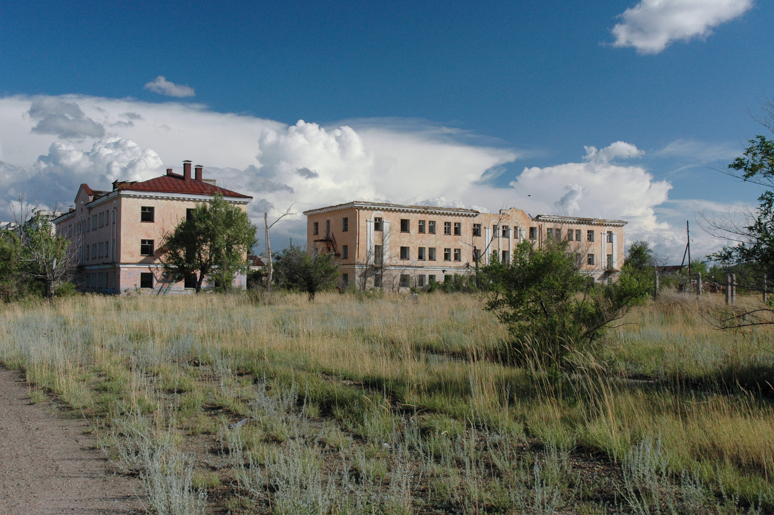
Abandoned Buildings, Kurchatov, Pavlodar Region, Kazakhstan
At the agreed time I return to the institute and begin my tour of the museum, conducted in Russian by a senior scientist, accompanied by a translator and another woman who keeps a very close eye on me lest I sneak a photograph, or perhaps pocket some of the exhibits. The museum turns out to be pretty good. There’s a macabre model of the first nuclear test site, with the bomb suspended in a gantry above the ground, surrounded by tanks, aeroplanes and other military hardware, simple buildings and a total of 1350 tethered animals; dogs, cows, pigs, horse and even a model camel sits on the diorama (though I feel the latter may be just to cater to local tastes). In glass jars of formaldehyde are the remains of some animals, with bluntly clinical labels such as ‘dog bladder-wall haemorrhage’, ‘third-degree burns of sheep head’, and my personal favourite, ‘multiple haemorrhage of dog thorax wall’. Among the less traumatising exhibits are a series of still images from a high-speed recording of some atmospheric tests, showing the development of an apocalyptic mushroom cloud, and a two centimetre thick cylindrical steel shroud which has been twisted in one of the tests like a piece of scrunched-up aluminium foil. At the end of the tour, the staff enquire after which organisation has sent me here to visit, and it takes a couple of attempts to explain that I am an independent visitor. The reaction is one of bewilderment however, rather than suspicion; that I would have driven all the way here from the UK to visit this forsaken and crumbling town in the middle of absolutely nowhere. My voyeuristic urges well and truly satisfied, I head out of town back towards Semey. A natural mushroom-cloud gathers silently beyond the broken rooftops, discharging occasional lances of pink lightning. It seems fitting for an area with such a violent history.
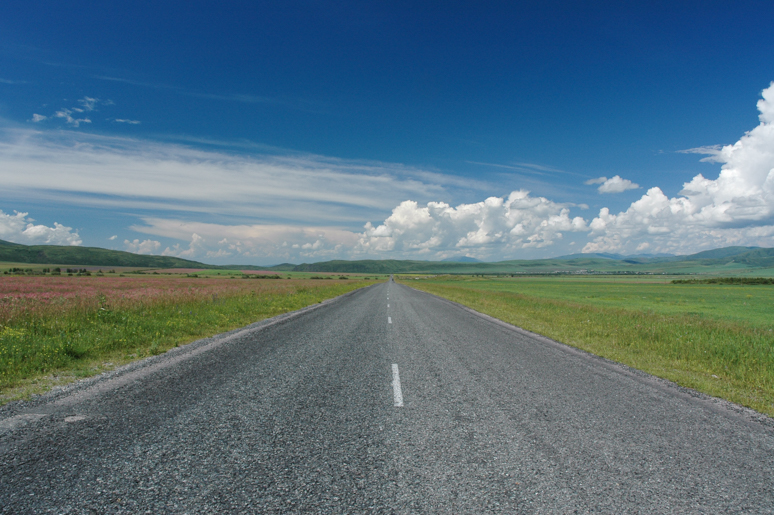
Altai Mountains, near Katon Karaghay, East Kazakhstan Region, Kazakhstan
There’s something rather special about the Altai Mountains, something I can’t quite put my finger on. It’s said to be one of the ‘world energy centres’ and possible location of Shangri-La, and while I’m no fan of new-age mysticism, I do agree that they have a quality which I’ve not found anywhere else. I personally attribute it more to their remote, highly continental location well away from any cities or industry, a rich animist history (there are still practising shamans in the region), and a kind of fairytale neatness to the landscape. The Kazakhstani section of the Altai Mountains, which lies on the southern side of the highest peaks, is one of the least-visited areas, requiring a border permit application to be made months in advance. I collect my permit in the town of Oskemen (Ust-Kamenogorsk), where I have a run-in with the authorities when I attempt to register. After a few hours of difficulties, which end with being escorted by a friendly and heart-stoppingly attractive young Uyghur woman to the appropriate authority, I have all my paperwork in order and may (somewhat reluctantly) proceed. The road out of Oskemen climbs gently into the foothills which have an extraordinary beauty of soft, green rolling hills strewn with wildflowers, clear rivers and idyllic Siberian villages of wooden homes. While the Russian Altai is somewhat stark and severe in its beauty, the land here is subtly different; benign and liveable and populated by Slavs and Kazakhs. In the town of Katon-Karaghay I stop in the early afternoon to make another registration at a national park office, where I meet Alia, a German-speaking entomologist gives me the details of a local family up in the mountains who hire horses.
Leaving town, the landscape gradually pulls in, with unspoilt ridges of dark green pine forest appearing either side of the road. An hour up a side track into the forest I reach the village of Yazevka, where I turn up wholly unannounced at the house of the Lupshchanov family, with nothing but a hand-written letter from the entomologist explaining what I wish to do. The family are very welcoming, and I’m soon being fed delicious smetana (sour cream) on fresh bread with wild-strawberry jam (easily the best I’ve ever tasted), all home-made.

Kokkol Waterfall, East Kazakhstan Region, Kazakhstan
The following morning I’m given a horse and a horse and a guide in order to reach the utter end of Kazakhstan; a salient of land sticking into Russia at the foot of Mount Belukha, the seldom-seen giant, perpetually snow-clad highest peak in Siberia. The horse trekking doesn’t start too well; the weather is cool, with low clouds pouring rain. This doesn’t however deter the swarms of midges, mosquitoes and horseflies, which are present in a volume I’d previously thought impossible. Never before (and never since) have I seen such biblical swarms of biting insects. My guide Farhat immediately begins drinking vodka when we leave the family home, though seems to be holding it well until he chooses to have a quick nap under a tree, while his horse runs off into Russia. Worst of all however is my Kazakh saddle; hard, unpadded leather which by the end of the day is cutting into me. After following a barely discernible path for several hours, which at one point veers into Russia, we stop for the night with some relatives of Farhat, the Bazhenovas who in traditional Kazakh-style are on summer pastures in their yurt (tent).
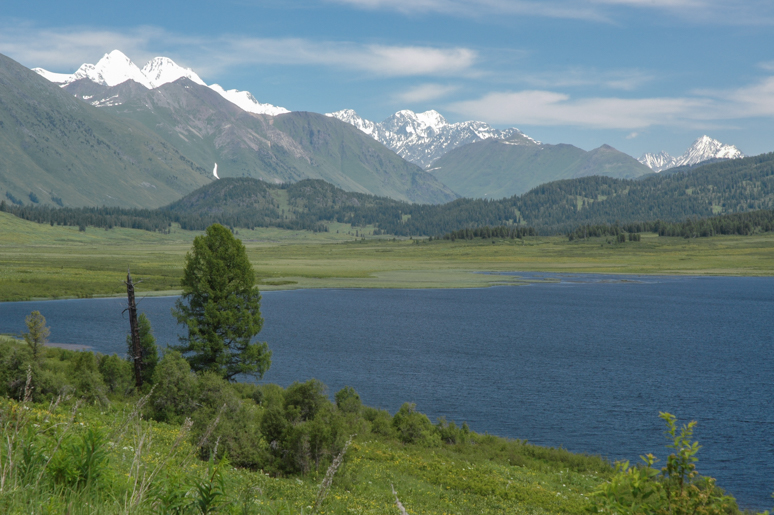
Lake Yazovoye, East Kazakhstan Region, Kazakhstan
Conditions of weather and insects improve the next day, but sadly the condition of my posterior remains grave. The scenery is astounding however, as we track up the milky Belaya Berel river and finally steeply up a hillside into the Kokkol valley, a gorgeous grassy amphitheatre filled with orange, purple and magenta wildflowers, perched above a pristine waterfall. Huge Siberian snowpeaks loom a few kilometres to the north on the Russian border, capped with views of the rarely-seen southern side of Belukha. It’s absolutely sublime, and has been worth all the effort of getting here. The area is pristine, untouched but for the few Kazakh families who herd animals nearby, and some tumbledown remains of an old Gulag; grizzly Soviet history overcome once more by stunning natural beauty. An old turbaza (mountain refuge) reveals that this was once a place people visited for recreation, evidenced by extensive Soviet-era graffiti, starting in the early 1970s but abruptly stopping in 1991. I leave an inscription, and wonder how many other visitors ever make it this far.
Retracing our steps back towards Yazevka, we pass the jewel-blue Lake Yazovoye, where Farhat and I get into an abandoned pedalo and are rewarded with an even finer view of Belukha from out on the lake. In the evening, after an early supper I say a fond farewell to a sober Farhat and his delightful family (his mother gives me a jar of fresh wild-strawberry), and start my journey towards the south.
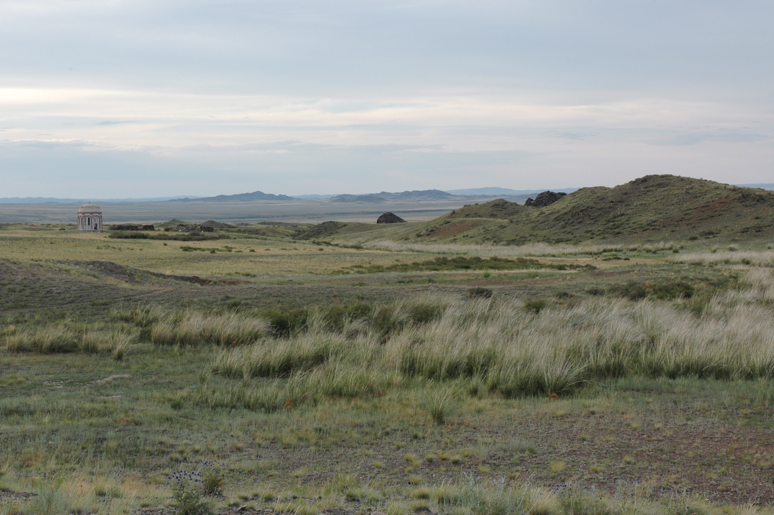
Tarbagatay Hills, East Kazakhstan Region, Kazakhstan
Initially, the route takes me back the way I came, through Katon Karaghay, but before reaching Oskemen I take a road to the south, which becomes increasingly quiet and isolated until it ends at a rusting ferry pontoon on the shore of the Irtysh, here a wide reservoir held up by the Bukhtarminskoye Dam. After ninety minutes an old ferry arrives, and about twenty cars cram on. It’s rather an odd sensation being on a ferry at one of the planet’s most continental points, which takes people from nowhere to nowhere, but any respite from the country’s atrocious roads is most welcome.
The road from the far side of the reservoir joins the M38, which runs to the north-western corner of China, but I turn off short of the border, heading southwest, into a vast open landscape, with the distannt Tarbagatay mountains to the south just visible through the cooling late-afternoon air. At the foot of these mountains, at an indeterminate distance is a wide lake which reflects the lengthening sunlight with a metallic sheen. Overhead a thin stratum of cloud is dissipating into the cooling air to reveal streaks of cirrus, adding to depth of the scene. This long-distance scenery, seen alone from an empty road is really quite stunning, and I soon stop to have a break, feeling deeply serene and humbled by an awesomely vast 360-degree panorama of muted natural beauty.
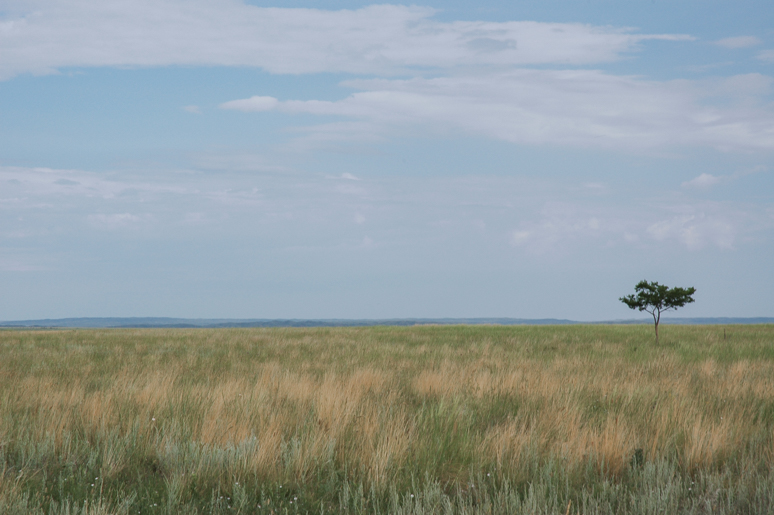
Steppe, near Aktogay, East Kazakhstan Region, Kazakhstan
The road runs for just over a thousand kilometres south-west to Almaty and as the hundreds of kilometres slowly pass (for the road condition is generally awful and my springs are still broken), one notices subtle changes in the landscape; distant mountain ranges shimmer on the Chinese border, the occasional small, squalid town or assortment of roadside shacks serving food pass by. The land flattens, then rises gently and starts to undulate. A herby, bittersweet scent fills the car as the shrubby sub-Siberian wilderness gives way to the wormwood steppes of central Kazakhstan. Wormwood has become one of the most evocative of scents for me; the merest hint of it transports my thoughts straight onto the sere steppes of High Asia.
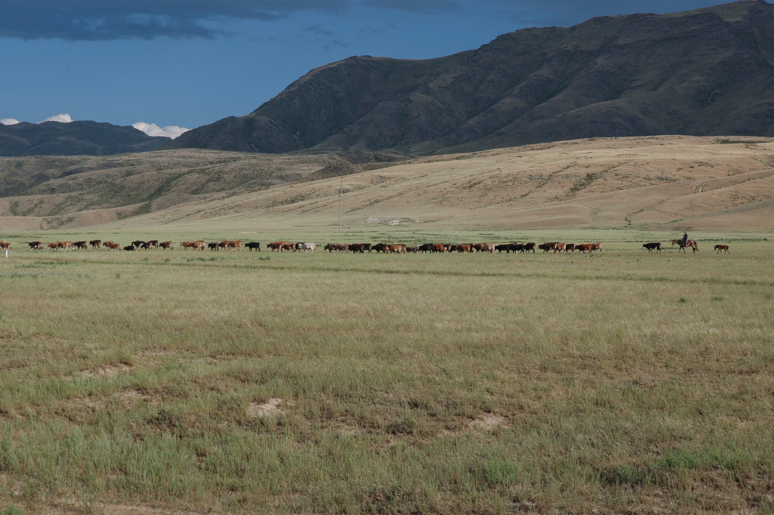
Cattle Herder, Almaty Region, Kazakhstan
A lone tree, or a car glinting far off in the distance are the only things which may catch the eye, and the journey once again has that soporific ocean-voyage like quality, the senses dull, and thoughts start to swell in the mind. Grassy hills draw level with the road and I start to see shepherds leading sheep to graze along the valley floors. Towns of size start to appear; not of chocolate-box Siberian cottages, but of shady streets lined by tall, elegant poplars and neat courtyard houses. The people in these small towns are almost entirely Kazakh, with elderly men wearing white topis (Muslim head caps) and sitting idle at the roadside. Hanging in the air is the omnipresent smell of woodsmoke rising from shashlik (kebab) braziers. I’m in Central Asia.
Stage 1 – Ukraine, Russia & Kazakhstan: To The Altai Mountains [1/2]
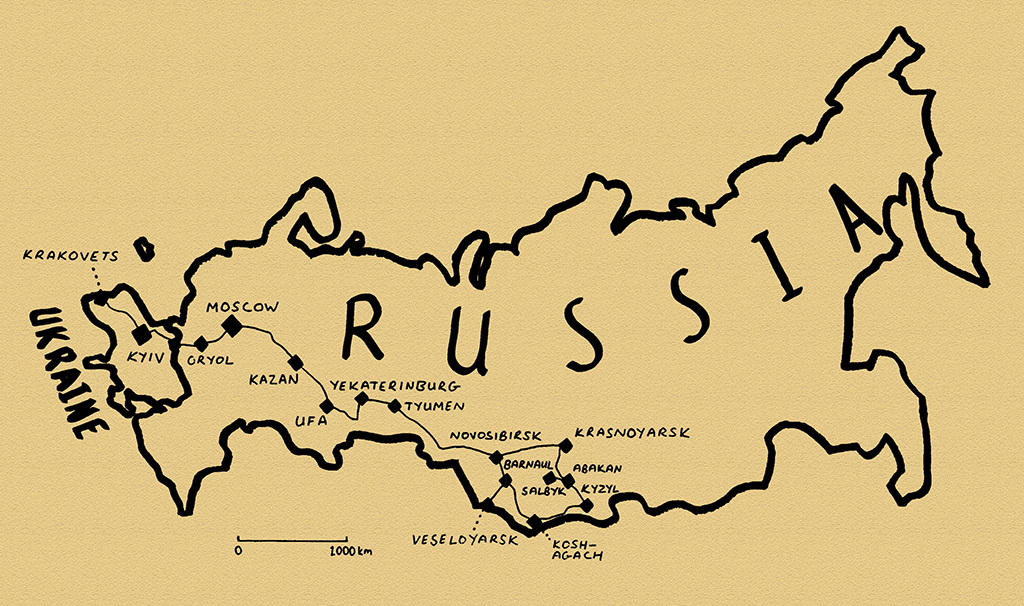
It transpired that I would cross into the Former USSR, and thus begin the Odyssey proper, on the 6th June 2007. I had no idea of the immensity of the adventure I was embarking upon.
After a delayed start to my journey due to being robbed in Romania, my aim was to quickly leave Europe and drive into Siberia, heading for the beautiful Altai Mountains which I had first visited in China, four years ago. From Russian Altai I would cross into Kazakhstan and explore the southern side of the mountain range, before heading firmly south into Central Asia.
These initial weeks in Russia would be filled with experiences good and bad, but the problems I would face with corrupt authorities, my own lack of language skills, Russian bureaucracy, an ill-prepared vehicle, violently aggressive Tuvans and even a minor accident would be offset by the endless wild beauty of Russia, the warmth of the Russian people, and the immense feeling of freedom as I drove myself halfway across the world’s largest country.
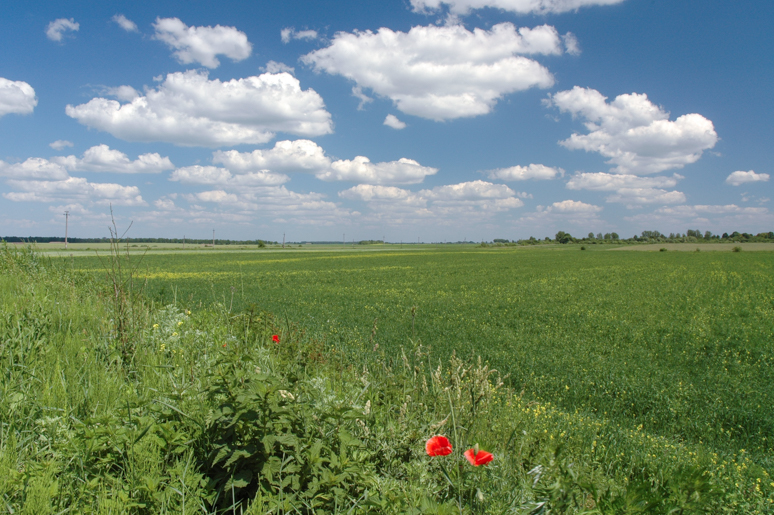
Fields, near Zhytomyr, Zhytomyr Region, Ukraine
It’s a sunny morning as I slip out of the east of Poland and into Ukraine. My first impression is of the contrast with Central Europe; bad roads, sprawling, idle farmland and cities of rusting moribund industry and doleful concrete apartment blocks. A general scene of dormancy and lassitude. I bypass the concrete suburbs of Lviv (which today I regard as one of the most beautiful cities of the Former USSR) and meander across the beautiful, though unexciting Ukrainian countryside, getting lost a couple of times on roads which are decent for a while, then degrade into a morass of broken asphalt and gravel. With nothing but a large-scale paper map I bumble rather cluelessly across the country, eventually near Zhytomyr finding a decent road which plunges in and out of clumps of pine forest as it courses its way east, ending up in Kiev.
Kiev comes as something of a shock; whilst the villages I have passed through during the day were shabby places of idle farmers, horsecarts and manure-heaps, the capital is modern, dynamic and outwardly prosperous. The traffic-choked streets are filled with a quantity of expensive, late-model SUVs which I have not seen anywhere else, aggressively driven by gangster-looking types. It takes me ninety minutes to reach my hostel in the district of Podil, and I spend the evening briefly looking around the city, impressed by its grandiose boulevards and (perhaps superficial) wealth. I would return to Kiev in 2011 to make a more thorough exploration of the city.
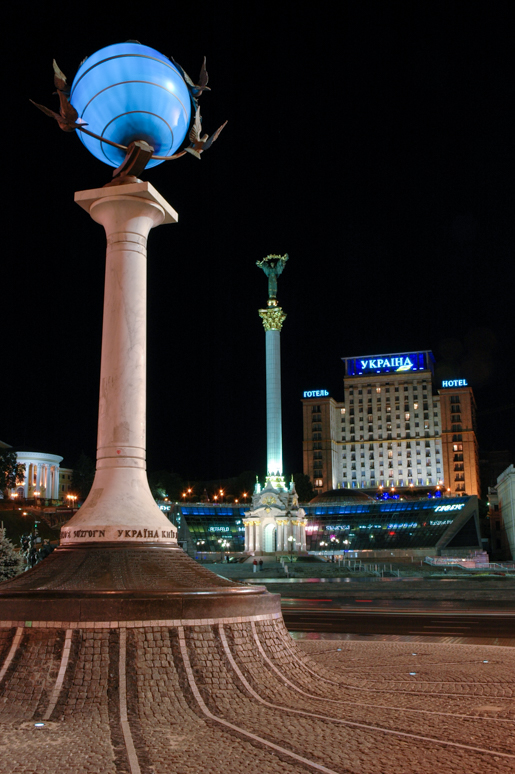
Independence Square, Kiev, Ukraine
I leave Kiev in the morning, keen to enter Russia and cross the Urals into Siberia. The road leaves the outskirts of Kiev, heading north-east past mostly unseen towns, slowly deteriorating as it nears the Russia border. The Ukrainian side of the border crossing is a mess; at first I find myself handing over $30 to a policeman after being found not to have Ukrainian motor insurance. Then I’m told that I’m missing a customs document by a beaming, gold-toothed customs officer, though I refuse to pay any bribe in this instance and eventually get through without a problem.
The Russian side of the border seems more efficient, and one of the customs officers even speaks some German, but I’m soon given a list of various official payments, followed by an unofficial one in order to keep the truck in Russia for more than fourteen days. I’m exhausted and feeling rather violated by the time I leave the border at around 22:00 in the twilight, only to be stopped on an empty road by two traffic police on the trumped-up charge of illegally overtaking. Forty minutes later I am sent away having paid nothing but the loose coins in my pocket.

Lenin Square, Oryol, Oryol Region, Russia
I reach Oryol, my first city in Russia, after midnight, trying to find a hotel in which to register myself (a legal requirement for foreigners in Russia). I ask several people on the streets for directions, all of whom seem to be drunk, until eventually two friendly men, also drunk, jump into the truck to guide me. Driving slowly, I’m soon flagged by a furious police officer who, upon smelling alcohol in the car (from my passengers) screams at me to hand over my documents and orders me out of the car to have a breath-alcohol test, which to his surprise and perhaps disappointment I pass. When I finally reach the hotel, the receptionist, who obviously regards me as an idiot for not speaking Russian indicates that it is absolutely impossible to register and then sits silently waiting for me to leave.
At the end of this ordeal I am in a state of utter desolation. Just how is it possible for a country to be so thoroughly awful? Its citizens seem universally corrupt, greedy, unpleasant, dishonest, drunk and unhelpful. Even the city itself feels faintly threatening, with its over-sized streets and intimidating architecture, seemingly designed with some Orwellian prerogative to reduce the individual to insignificance. I retire for the night into a petrol station forecourt and prepare to sleep in the car. I contemplate leaving Russia. Enviously, I watch a stray dog gnawing a bone. Dogs don’t need to register, cross borders, pay bribes or get breathalysed.
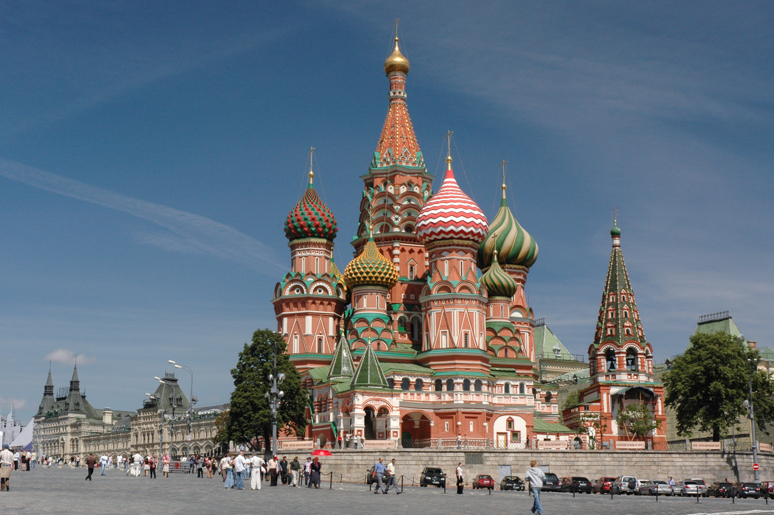
Saint Basil’s Cathedral, Moscow, Russia
Of course, this is a common experience for the newcomer to Russia, and one which Russians themselves sardonically name ‘Welcome to Russia’. My initial impressions would very quickly evaporate as I met kind, welcoming and spirited Russian people. I would learn how to deal with police (and never again pay a bribe on the entire trip) and indeed Russia has since become a country I really love, and is the country which I have revisited most often.
I drive north to Moscow the following afternoon, entering the wild, furious traffic on the MKAD, the main Moscow ring road; five lanes of speeding vehicles where expensive Japanese and German cars, old Soviet marques and wheezing trucks all weave around various accidents and breakdowns, cutting across lanes at the last moment to reach an exit. Finding my exit, I plunge into the city centre and eventually manage to meet my host Masha, who invites me to a party at a friend’s apartment where I have a wonderful introduction to Russian hospitality; eating okroshka (a cold Russian soup), drinking beer and meeting various locals and travellers who are passing through. In the morning I jump on the Metro to take a quick look at the centre of Moscow; Red Square, Saint Basil’s Cathedral, Lenin’s Tomb and GUM, the State Department Store; all huge, imposing but magnificently beautiful buildings. I walk up over the Moskvoretskiy Bridge, turning west onto the right bank of the Moscow River from where there are fantastic views of the Kremlin, looking down to the elegant, gold-domed Church of Christ the Saviour, a modern reconstruction of the original which was dynamited by Stalin in 1931.

Kremlin and Moskva River, Moscow, Russia
I’m caught in traffic for several hours trying to leave Moscow in the afternoon, and contemplate the distances ahead. It will be around eighteen hundred kilometres from here to the Urals, the notional Europe-Asia border, making me realise that countries such as Poland or Slovakia, often referred to as being in Eastern Europe, are very much in the centre. Novosibirsk, where I will drop down into the mountainous south of Siberia, is 3700 kilometres away, yet this is much less than half way across Russia; Magadan, the farthest city reachable by road is more than ten thousand kilometres away. Russia is an almost unimaginably large country.
Once past the traffic, Moscow’s sprawl soon merges into satellite towns, then transitions to rural Russia; villages amid mostly fallow fields and clumps of remnant birch or occasionally pine forest; a landscape unspectacular though subtly beautiful in its gentle variation. I pass Nizhny Novgorod at around sunset, continuing east into land which has been totally cleared of forest but today lies largely idle.

Kremlin, Kazan, Tatarstan Republic, Russia
I reach Kazan the next day, capital of the Republic of Tatarstan, a beautiful city centred (like many of Russia’s oldest cities) on a kremlin (fortress), built symbolically by a victorious Ivan the Terrible on the site of a former fortress of the Tatar Khanate of Kazan, whom he defeated in 1552. Today Kazan’s kremlin is dominated by the striking white and blue Kul-Sharif Mosque; modernist and slightly incongruous, and also one of Europe’s largest, though there is naturally also a reconstruction of Ivan’s Annunciation Cathedral, the original of which was destroyed by Stalin in 1930. Nearby in a steep side-street I enter the beautiful Saints Peter and Paul Cathedral to witness my first Russian Orthodox ceremony; a swarthy priest in fine vestments and acolytes swinging thuribles of incense in front of a congregation of colourfully dressed old Russian women. In the side streets of the city centre, across the Volga River, I notice chaotic bazaars which together with the city’s partly Islamic identity give an air of being closer to Asia already.
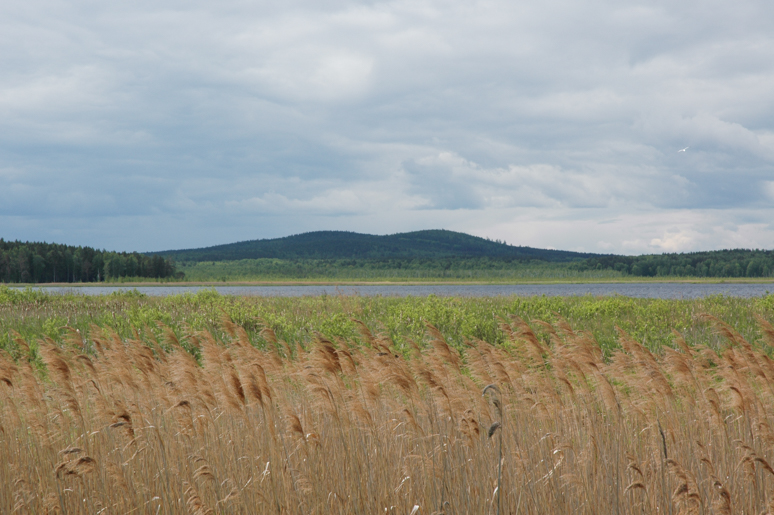
Lake Boyevskoye, Sverdlov Region, Russia
The following day, driving ever east on the M5 Highway, I enter the Republic of Bashkortostan and see the land change slightly as I near the very first undulations of the Urals; ploughed fields of black earth, stands of birch forest and villages of colourful wooden houses. I reach the capital, Ufa at around midday and find the city to be fairly bland, though enjoy a peaceful moment in the city’s oldest mosque, which looks out onto the forest on the far side of the Belaya River. East of Ufa I climb into the Urals, crossing a pass of about seven hundred metres and unceremoniously entering Asia, the continent I will not leave for more than two and a half years. After a cold night sleeping in the truck, I pass the city of Chelyabinsk early in the morning, then turn north through a beautiful upland of reed-fringed lakes, reaching the city of Yekaterinburg in the afternoon. Yekaterinburg is a likeable place, notable for being the place where the last of the Russian Royal Family were murdered in 1917, and for being home to Boris Yeltsin; thus having played a crucial role both in the formation and destruction of the Soviet Union.

City Administration Building, Yekaterinburg, Sverdlov Region, Russia
Setting off from Yekaterinburg I enter Siberia proper. Somehow I’d imagined that Siberia would be an endless expanse of pine forest, but here at least, on the Trans-Siberian Highway, the taiga (continuous, boreal forest) is nowhere to be seen. Indeed, the landscape of endless fallow fields with the occasional stand of birch trees is rather similar to European Russia; only the distances between cities goes from roughly three hundred to around five hundred kilometres, and the swarms of insects are even thicker and more voracious. I finally leave behind the cold-spell which has followed me since Kazan, and stop briefly in the city of Tyumen late in the evening. Tyumen is one of Siberia’s oldest cities and of great economic importance as an energy-industry hub, but it’s not long before the lure of the road sends me out again, on into a night which never gets fully dark. I sleep for just a few hours in the truck, then push on again, driving the whole day through the featureless, swampy Siberian lowlands, straight past the city of Omsk and on, then another few hours of sleep in the semi-darkness, windows wound up against the infuriating insect swarms, and finally, at around 15:00 the next day arriving in Novosibirsk, more than two full days since leaving Yekaterinburg and six days after leaving Moscow.

Chemskoye District, Novosibirsk, Novosibirsk Region, Russia
Novosibirsk is the largest city in Siberia and the third largest in Russia. Founded in the nineteenth century at the future site of a bridge across the Ob River on the Trans-Siberian Railway, the city is an island of civilisation amidst the endless lowlands of southern Siberia. I park freely on a main street in the very centre of the city, a revelation for someone coming from Western Europe, and soon meet my host, Pasha. Pasha and his wonderful parents are my first real introduction to the warmth and generosity of the Russian soul, and of wonderful Russian home-cooked food; the memory of the pork plov, (a Central Asian dish of meat, vegetables and rice) made by Pasha’s mother stays with me to this day. Pasha lives in a district known as Chemskoye, one of the ubiquitous, identical-looking concrete suburbs of rather imposing apartment blocks which one finds in every Russian city. Already however, I can begin to see the real beauty of these buildings; here is a warm and cosy apartment stuck out in the wastes of Siberia, with all modern conveniences. Soviet architecture is a triumph of human ambition and achievement over nature’s adversity.
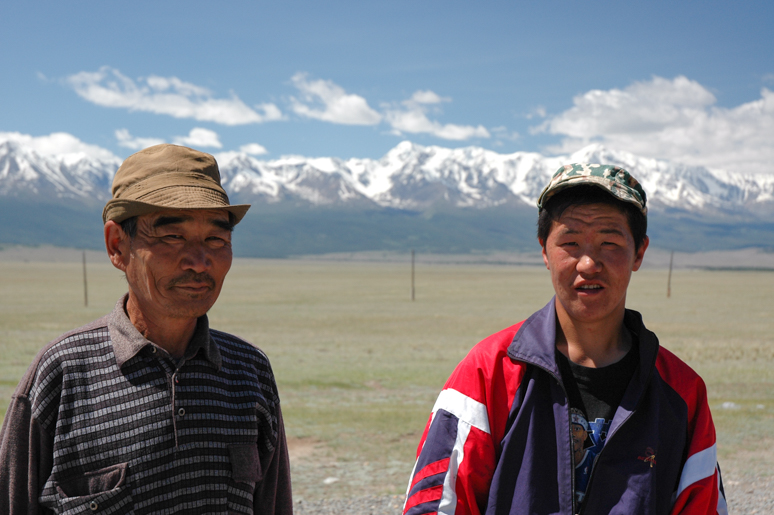
Altai Men, Kuray, Altai Republic, Russia
I drive south out of Novosibirsk in the morning on the M52, stopping for a night in Barnaul and driving on to beautiful, mountain-flanked Lake Teletskoye, then doubling back to Gorno-Altaisk, the rather charmless capital of the Altai Republic. Here I struggle for more than a day with ridiculous Russian bureaucracy; first chasing my visa sponsor in Moscow for an introduction letter, then a local travel agent, all in order simply to register my presence here in the Altai Republic. South of Gorno-Altaisk the M52 becomes known as the Chuya Highway and winds up towards the Mongolian border through some of Russia’s most glorious scenery, making it in my opinion one of the world’s most beautiful roads. Green hills packed with Russian holiday-makers become low, craggy mountains interspersed by grassy, wild-flower-filled clearings as I progress southwards. Crossing the Semninsky Pass, the tourists disappear and the land starts to open up, with picturesque wooden villages of mostly Altai People, with stout, blocky, Mongolian-looking faces. At the top of the beautiful Chike Taman Pass, I stop and am soon joined by a minibus full of Altai People who rip strips of cloth from a rag and tie them onto an already heavily decorated birch bush, which they then circumambulate, gesturing towards the air. A couple of the men notice me and invite me to join them in eating hard sheep’s cheese and drinking toasts of vodka, but I gesture that I am driving and politely decline.
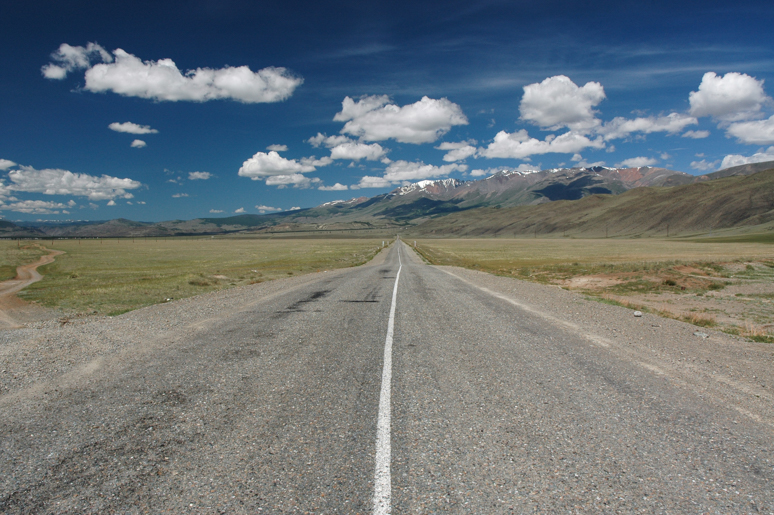
Kuray Steppe, Altai Republic, Russia
Beyond the pass the landscape becomes extremely beautiful; pristine and sparsely populated, dotted with ancient kurgans (barrows), menhirs (standing stones), and vaguely anthropomorphic balbals. Passing the ramshackle village of Kuray I enter the magnificent Kuray Steppe; a huge landscape of green grasslands backed by dark forests on the lower slopes of a range of snow-covered three-thousand metre sawtooth peaks; the archetypal Central Asian landscape I have been dreaming of seeing for years; one which makes all the ardours of the trip so far worthwhile. Still climbing, the road abruptly reaches drier, dark-red mountains and leaves behind the forests, entering the dry Chuya Steppe and soon after the wind-blown town of Kosh-Agach, the last of any size before the Mongolian border. In Kosh-Agach I must surmount more bureaucracy at the KPP, the Russian border patrol, where after a trip back down the M52 to the garrison at Aktash and dire warnings of lawlessness in western Tuva, I finally have the necessary border permit to allow me to make the rugged trip across the Western Sayan Mountains into the Republic of Tuva.
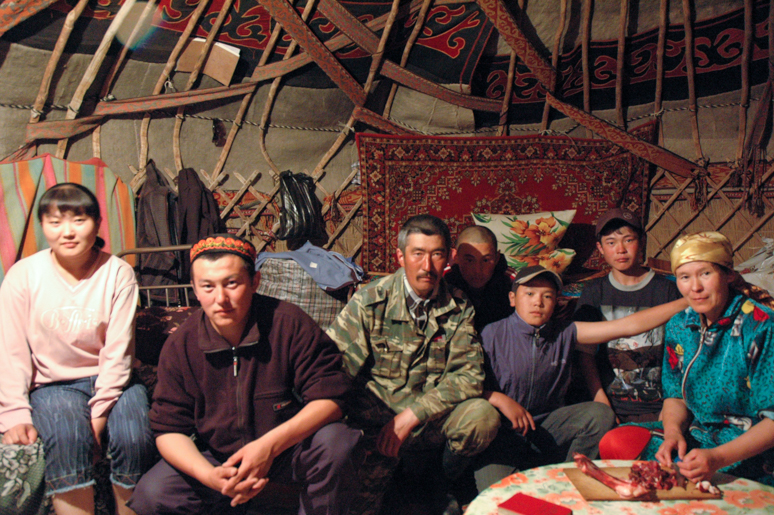
Kazakh Family, near Kokorya, Altai Republic, Russia
It’s early evening by the time I leave Kosh-Agach, having been told to follow a local driving a Russian UAZ minibus along the same route into Tuva. I’m a little apprehensive; not only of the warnings from the border patrol, but of those in my guidebook, and also of Vadim, a Russian hitch-hiker I had met in Barnaul. All tell of unpredictable violence from drunks in western Tuva. Once out of Kosh-Agach and into the border zone, the UAZ soon rushes off along the rough tracks, out of sight, while I slowly take in the magnificent scenery as I leave Kokorya, the last settlement before the border with Tuva. A distant storm moves in from the south and as the sun is setting, a huge white cumulonimbus spreads across the deep blue sky. Darkness slowly approaches and I head for a clump of trees, hoping to keep a low profile. Not long after, a white Zhiguli car comes bumping along the track, and stops right next to me. Out of the car comes a family of people with kind, oriental features. The daughter, whom I reckon to be a little younger than myself even speaks a few words of English. They invite me to drive across a river and stay with them in their home.

Buguzun Valley, Altai Republic, Russia
The Svatov Family are Kazakhs, who live in the town in winter (when temperatures can drop below -40° C in these high, continental plateaus), and are currently on summer grazing grounds with their herd of several hundred sheep (and a few cows), living in a yurt, the ubiquitous Central Asian nomad’s tent whose design remains unchanged since the days of Chinggis Khan. Inside the yurt are carpets and distinctivly Kazakh felt textiles, and the unmistakable smell of nomadic life; of humans and animals, dairy products and meat. At first the smell is rather acrid, but I soon find myself adjusting to it, and would later consider it quite homely and reassuring. The family share dinner with me, which we eat together from a communal dish, and insist that I take one of only three beds in the yurt, which is wonderfully warm. Outside, the home is guarded by a ferocious wolf-killing dog which barks a warning when the occasional UAZ passes during the night. I couldn’t feel safer. It remains perhaps my greatest experience of spontaneous hospitality.

Buguzun Pass, Tuva Republic, Russia
After a heartfelt farewell, I set off in the morning towards the the Buguzun Pass, which marks the Tuvan border. The scenery becomes ever-more spectacular as I climb; around me is fairytale mountain scenery with emerald grasslands, smoothly rounded hills, pristine, dark green pine forest and gleaming snowcapped mountains. The track is rough and I’m impressed by the truck as it clambers easily over rocks and through rivers. It is on this slow ascent that I meet my first Tuvan, a rough and dishevelled-looking man on horseback with wild, distant, emotionless eyes. After following me for a while he asks for a lift, suggesting that I tie his horse to the back of the truck. Obviously this is a ridiculous idea, and I decline and continue on my way. The view into Tuva from the Buguzun Pass is breathtaking; a huge, rippling plain of yellow grass backed by jagged, snow-flecked mountains extends as far as the eye can see towards the east. The track improves slightly after the pass, descending and passing a few small lakes. I stop at every opportunity to ask directions from the locals; at a grubby yurt where the children run away in panic at my approach and a mistrustful man simply points eastwards, and from three drunks who overtake me and jump out of their UAZ, one of whom urinates right next to me, while the others asks me for vodka.

Western Sayan Mountains, near Sagly, Tuva Republic, Russia
My lasting impression of Tuvan people comes however from a UAZ which I stop near the town of Kyzyl-Khaya in order to ask directions. The driver is quite civil, but out jump three burly Tuvan youths with rough, barbaric faces. They grab me, demanding money and vodka. I manage to escape their grips and get in the car; one of them stands in front of the truck to stop me moving, but I push past. From the mirror I can see the driver attempting in vain to reign in the youths, just as one hurls a apple-sized rock, which strikes the truck on the front right wing.
On the swampy edge of Kyzyl-Khaya I wave at a man and woman out picking flowers and receive a smile and a returned wave; the only civil human interaction I would have with Tuvans. I drive straight through the town and up into the dry mountains where a thunderstorm strikes the nearby hills with pink bolts of lightning, then cross two passes with stunning views south into Mongolia. At times the washboarded track runs right along the barbed-wire fence marking the Mongolian border (which I stick a foot through in order to tread on Mongolian soil); beyond I can see patches of green grass dotted with white gers (nomad’s tents) and huge flocks of sheep.

Kizhi Kozhe Menhir, near Kyzyl Mazhylak, Tuva Republic, Russia
I’m still on this bone-shaking road the next day when I hear a hissing sound coming from the truck. Worried that a slow radiator leak has worsened, I stop to walk around the car, relieved to find that it’s just a puncture. As I change the wheel however, I make a startling discovery; both my rear springs have broken leaves and the right-hand rear spring shackle is almost disconnected, with the shackle bolt loose and just a few turns from dropping off. I work swiftly, changing the wheel, then jacking up the truck and tightening the shackle back into place, terrified that Tuvans will arrive and see what they can get from me. Whilst doing this I can see a UAZ approaching, but mercifully it does not stop. Back on the road, I pass two crashed vehicles and one drunken Tuvan, his face slightly bloodied perhaps from the accident, or perhaps from subsequent fighting, leers into the truck cab asking for a lift back towards the last town. He has the now familiar cold, vacant eyes and look of malevolence and, despite his situation, I choose to drive on for my own safety.

Yenisei Steppe, near Chadan, Tuva Republic, Russia
By mid morning, with a sense of relief, I reach the asphalt of the Khandagayty to Chadan highway, which runs away from the Mongolian border region towards Tuva’s main west-east highway. In the junction town of Chadan I turn left towards Ak Dovurak, home to the world’s largest asbestos mine, in order to see a particularly fine nearby balbal, a moustachioed man-stone rising from the flat steppe, surrounded by votive offerings of food and alcohol, his head daubed with guano. Doubling back, I drive through glorious steppe, under huge, deep-blue skies streaked with cirrus cloud, passing Chadan and joining the deep-blue Yenisei shortly before reaching the small and slightly shabby Tuvan capital of Kyzyl.
I stop and visit a shop and am followed by a drunk asking for money; outside, I am followed down the street back to the truck by a different drunk. I try waving at a few Tuvans as I drive past them, but always I get the same vacant, emotionless stare. By this time however, I am indifferent: Tuva is a wretched place and I want nothing but to leave it. I have never been anywhere like this. On the edge of Kyzyl I get into a minor car accident, though the drunk Russian driver and his two friends are perfectly civil and friendly, and we resolve the matter quickly with a modest cash payment. On my third day in Tuva, I leave, feeling hugely relieved. Tuva is a stunningly beautiful place. I am sure there are plenty of decent, friendly Tuvans. I am sure Tuvans are largely the victims of circumstance, of Russian colonisation, collectivisation, economic marginalisation. Alcohol and poverty have clearly had a devastating effect on the Tuvan people. But they are by no means alone in this, and I can’t help feeling that, as much as I don’t like to use the term, I have come across perhaps the closest there is in this age to uncivilised people.
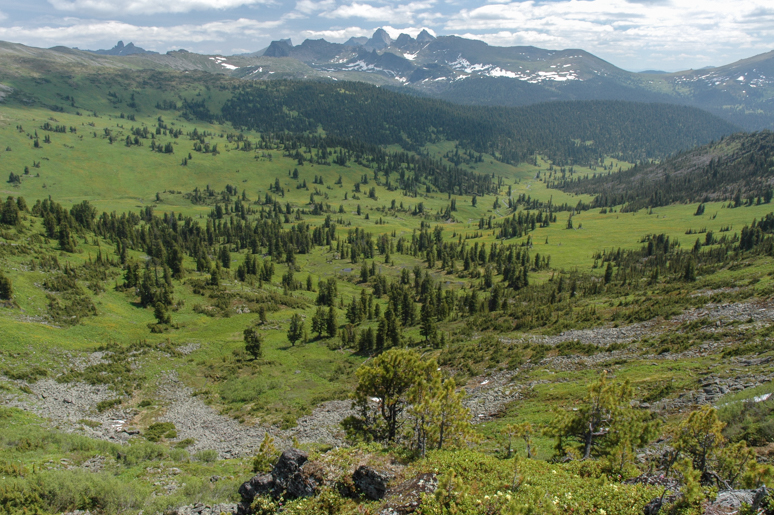
Ergaki Mountains, Krasnoyarsk Territory, Russia
North of the Tuvan border I enter Krasnoyarsk Territory on the M54, the Usinsky Highway, and almost immediately the landscape changes from dry, rolling Central Asian steppe to thickly forested mountains and crystal-clear rivers. At one particularly scenic spot I walk up onto a hill next to the road, onto fragrant tundra and dwarf rhododendrons for a magnificent view of the sharp, horny peaks of the Ergaki Mountains, seen across a yawning emerald-green valley. Dropping down, the road enters more populated terrain, with villages of quaint, chocolate-box Siberian cottages, and by mid afternoon I enter Abakan, capital of the Republic of Khakassia. Unlike Tuva, Khakassia is heavily Russified, (which right now is no disappointment), and a wonderfully peaceful and relaxing place which I immediately enjoy. After some essential shopping, as I’m driving out of the city, I catch sight of the Yenisei River. It’s a warm summer evening and locals are sitting at the riverside grilling shahslik (skewered meat) and drinking beer. I pull up on the riverbank and after cooking some dinner, I walk into the river in only my underpants with a bar of soap and a loofah, and scrub off eight days of grime from the mountains. This moment reminds me of two things which I love about Russia and Russian people; firstly that simple pleasures such as sitting outside with friends around a fire in a beautiful setting on a warm evening can be freely enjoyed (a freedom unknown to most Western Europeans), and secondly that a gangly foreigner can bathe in the river right alongside someone’s barbecue, and not attract anything more than the odd glance. This is the Russia I love.

Salbyk Kurgan, Khakassia Republic, Russia
Refreshed bodily and spiritually, I head out onto the Khakass grasslands north of Abakan, turning onto a small side-road towards the mining town of Sorsk. At a given kilometre marker I pull off the highway, though as it is now dark, I decide to stop and camp for the night. Early the next morning I drive the last few kilometres to the magnificent site of Salbyk, a Scythian temple consisting of a square array of pink granite boulders, many elongate and placed upright, measuring up to eight metres in height arranged around a central, excavated kurgan. I’m deeply impressed that this structure has remained out here on this vast, remote plain since roughly the fourth century BCE, and am intrigued by the Scythians: people Herodotus was vaguely aware of, but who occupied the hinterlands of central Eurasia to a point many thousands of kilometres beyond what classical civilisation marked as the edge of the world. After walking alone around the ancient stones for perhaps an hour, I return to the M54, heading north towards Krasnoyarsk on a beautifully undulating road through the green grasslands of Khakassia, with the wide Yenisei River a few kilometres away to the east. On these empty grassy plains are hundreds of menhirs, barrows and numerous burial sites, suggesting that this was once a rich and highly cultured area.

Menhirs, near Saragash, Khakassia Republic, Russia
Leaving Khakassia the road towards Krasnoyarsk finally enters the taiga, at last matching my pre-conceived notions of Siberia. In Krasnoyarsk I reach the easternmost point on this Russian trip, then drive west on the Trans-Siberian Highway through the mining cities of Kemerovo and Achinsk, reaching Novosibirsk the following afternoon. I stay three days with Pasha’s family, relaxing and eating good food, servicing the truck and ordering two new springs back in the UK. Then, the day before my Russian visa runs out, I make the final journey south, back on the M52 through Barnaul, then further to Rubtsovsk near the Kazakhstan border. After finding an ATM, I get lost on the city’s dark and potholed streets, and soon get flashed by the police. I expect a shakedown but instead they actually help me, kindly escorting me to the correct road out of town. Crossing the border beyond the village of Veseloyarsk the next day is simple, if lengthy, and thus ends my first encounter with Russia.
These first three weeks of the Odyssey were some of the most memorable of the entire trip, as I came up against the steep learning curve of travel in the Former USSR and began to really enjoy the amazing journey I had embarked upon, settling into my nomadic existence until, several months later, it would become my everyday lifestyle. For the following two-and-a-half years I would concentrate on Central and South Asia, a journey which would culminate in a long dreamed-of crossing of Afghanistan. After this, in early 2010 I would set my sights firmly on Russia again. For the moment however, the southern side of the Altai Mountains, and the huge, open steps of Kazakhstan lay ahead.

