
Stage 13 – Pakistan & Iran: Thar Desert And The Makran Coast [2/2]
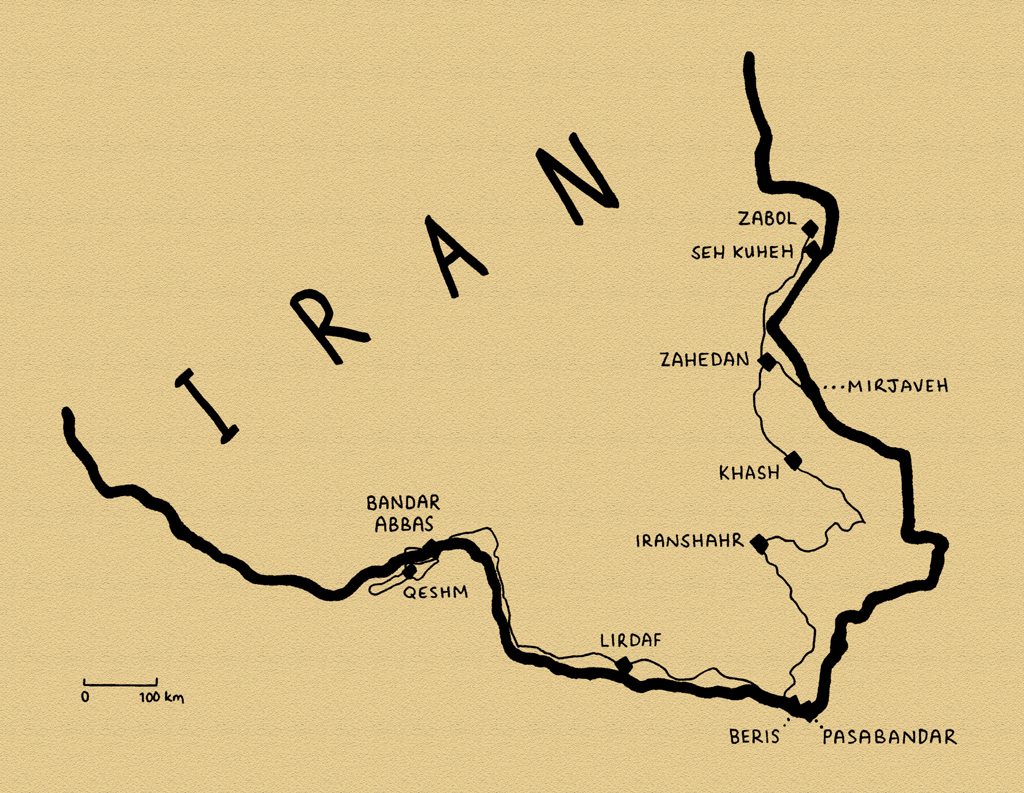
Having driven much of the length of Pakistan’s spectacular Makran Coast, only to find that there was no way for me to cross the Iranian border anywhere near the coast, I had made a long detour through Balochistan, onto the northern route from Quetta to Taftan, which since the outbreak of war in Afghanistan, has been part of the Asian Overland Route from Europe to India. Ahead of me now lay the Iranian province of Sistan and Baluchestan, and the desolate, sometimes insecure stretch of road from the border town of Mirjaveh to Kerman. Despite the region’s reputation for insecurity, I was intrigued by what lay off this route, and my onward journey would now take me through areas far beyond the desolation of the main highway, back to the Makran Coast all the way to the Persian Gulf. Far from being a barren void, my journey would take me through spectacular, unforgettable scenery, experiencing the warmth and kindness of the Baloch People I met on the way.
I cross the border into Iran on the 22nd December 2008 and have a ‘guard’ forced upon me; an unarmed eighteen year old Turkmen conscript, who speaks no English but joins me until I reach the city of Zahedan, capital of the Iranian province of Sistan and Balochistan. I first came to Zahedan in 2003, when a bout of heat exhaustion kept me in a hotel room for an unplanned day with mild delirium. My second visit a year ago was nothing more than a brief restaurant stop well after dark. This time I wanted to have a proper look at this far flung Iranian city, almost universally maligned and overlooked. It would turn out to be a visit which etched itself permanently into my mind.
My host in the city is Ahmad, a dental technician who works with two cousins in the centre of the city in a large office in which I will stay. I arrive after dark, and after a fairly painless hand-over from my escort, I drive with Ahmad back to his office, unpack a little and settle in. After an hour or two, Ahmad enquires if I would like to ‘smoke something’. ‘Hashish?’ I ask. ‘No, something a little stronger…’ he replies.
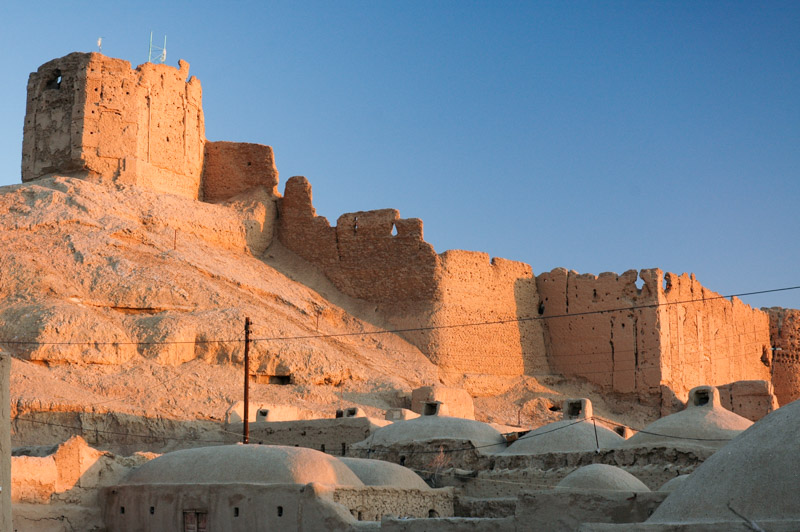
Castle, Seh Kuheh, Sistan And Baluchestan Province, Iran
I join Ahmad and his two cousins in the small office kitchen where I have my first taste of opium, known in Persian as tariak. Opium, which is the dried latex of the opium poppy Papaver somniferum has been used since the Stone Age for analgesic (and undoubtedly recreational) purposes. It normally has the colour of dark chocolate and the consistency of stiff plasticine. One does not smoke opium by burning it, but rather by heating it, causing the active alkaloid ingredients (most notably morphine, but also codeine and others) to vaporise, making them easy to inhale. Opium should not be confused with heroin, which is a chemically extracted drug with roughly fifteen times the potency of natural, raw opium. Its use is extremely widespread in Iran, perhaps similar to the recreational use of cannabis in western countries. There are many ways of smoking opium, but most commonly a centimetre-sized lump is warmed with a flame to soften it, allowing it be flattened into a disc and spread across an unfolded paper-clip. A separate metal rod is then heated in a gas flame and pressed against this flattened disc of opium and the resultant vapours inhaled through a rolled up paper tube (known in Persian as a lul).
My first encounter with opium is subtle; a mild, indefinable sensation of calm. Like many of life’s pleasures, it requires a little introduction, but after a few sessions I begin to appreciate the effect: one feels extremely comfortable, relaxed and at ease. The effect is not in any way debilitating or retarding, as with marijuana, but can only be described as absolutely pleasant. Ahmad and his cousins smoke three times a day, and I am glad to join them, spending the intervening time either in a state of perfect, fulfilling lassitude or, if the need arises, undertaking some errand such as money changing or shopping. So controllable are the effects of opium, that one of the few give-aways of a user is a temporary brown-staining of the front-teeth, by which I am caught out one evening by a filling-station attendant, much to my chagrin.
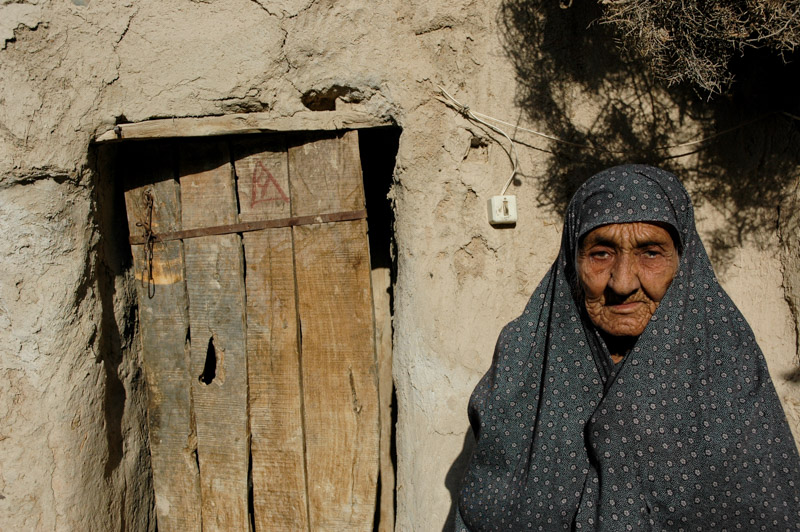
Perisan Woman, Seh Kuheh, Sistan And Baluchestan Province, Iran
After four days, on Friday, the Iranian weekend, Ahmad and I make a trip out of Zahedan towards Zabol, former capital of the region historically known as Sistan. Lying just to the north of modern Balochistan, and in stark contrast to it, Sistan is an ancient centre of civilisation encompassing the full history of Iran. Fed by the waters of numerous inland rivers, most importantly the Helmand, it was an area of early settlement by Aryan tribes and was incorporated into the Medean, Achaemenid, and Seleucid Empires successively. It was later a centre of Scythian culture known as Sakistan, from which the region’s modern name most likely derives. Sistan is littered with slowly-decaying monuments standing testament to this rich history and we stop off at the large Bronze Age Shahr-e Sukhteh, or ‘Burnt City’, site of the earliest known prosthetic eye, dice, and the earliest (though perhaps questionable) indications of neurosurgery.
Ahmad’s great aunt, a venerable lady of ninety-nine years (who is also an occasional opium user) lives in the spectacularly sited village of Seh Kuheh, thirty-five kilometres from Zabol, in a cave house hollowed from the side of a Qajar-era castle. She is delighted to see Ahmad and myself, and we barely manage to stop her from cooking a meal for us. Ahmad wastes little time in acquiring opium; sending out the mentally-retarded son of a neighbour with the equivalent of two dollars to acquire some. The young man returns with a cherry-sized lump of sukhteh, a jet-black extract of burnt opium which for reasons not clear to me, is particularly potent. Ahmad and I rather conspicuously take my gas cylinder and cooker to the local bathhouse, where we sit rather sordidly smoking the recent purchase, which is particularly pleasant: not surprising seeing that we are just twenty kilometres from Afghanistan, the source country.
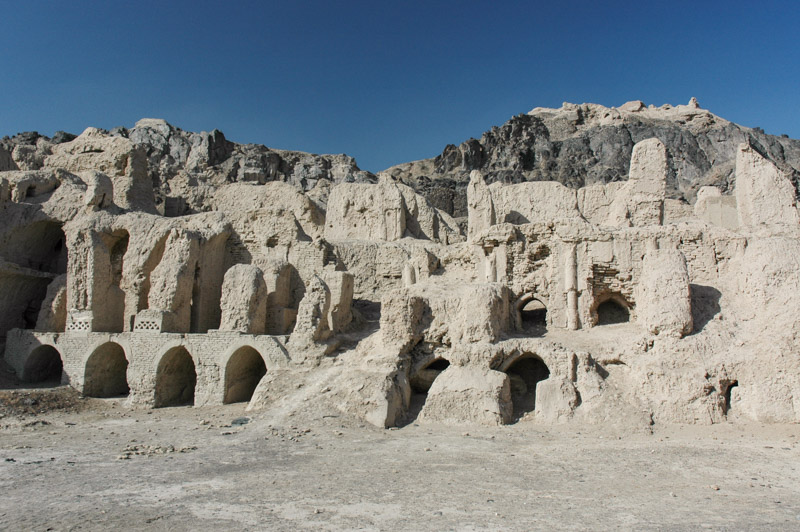
Chehel Dokhtaran Castle, Mount Khajeh, Sistan And Baluchestan Province, Iran
After smoking, we return to the cave and retire for the evening. Ahmad’s great aunt excuses herself to the house of her son who lives next door, and we enjoy the effects of our sukhteh. I lie in the centre of the troglodyte room on a thin woven mat, yet the sensation is of floating. There are no sharp edges to the world, no loud noises or bright lights. No pain, no irritation and no tension. I can evaporate into a meta-state of weightless bliss, which can only be compared to the sensation one gets when one finally rests after absolute exhaustion, multiplied by many orders of magnitude. Equally, I can pull myself from this effusive state into total, perfect, sharp awareness. It is nothing short of the most compelling bodily experience I have ever encountered, one of lasting pure and perfect bliss.
In the morning Ahmad and I leave to explore the nearby city of Zabol, which is rather mundane despite being just a few kilometres from Afghanistan; certainly not the den of ‘guns and drugs’ which a famous travel guidebook describes. Near to Zabol however is the intriguing Mount Khajeh which we visit in the afternoon. The mountain is a striking black volcanic outcrop which sits in the middle of the currently dry Lake Hamun, a shallow, ephemeral salt lake fed by the Helmand River. The naturally striking site has drawn people from the flat surroundings of Sistan for centuries, with striking Sassanian Zoroastrian ruins first investigated by Marc Auriel Stein, which pre-date the arrival of Islam in Persia. We arrive at the base of the mountain, stopping below the Sassanid ruins of the Chehel Dokhtaran Castle, which guards the entrance to the mountain. On the top of the volcanic outcrop, with views across the starkly barren plains of Sistan lies the more recent shrine of Khwaja Ali Mahdi, a descendent of Imam Ali, whose body is interred in a grave several metres long which local legend supposes to be continually growing.
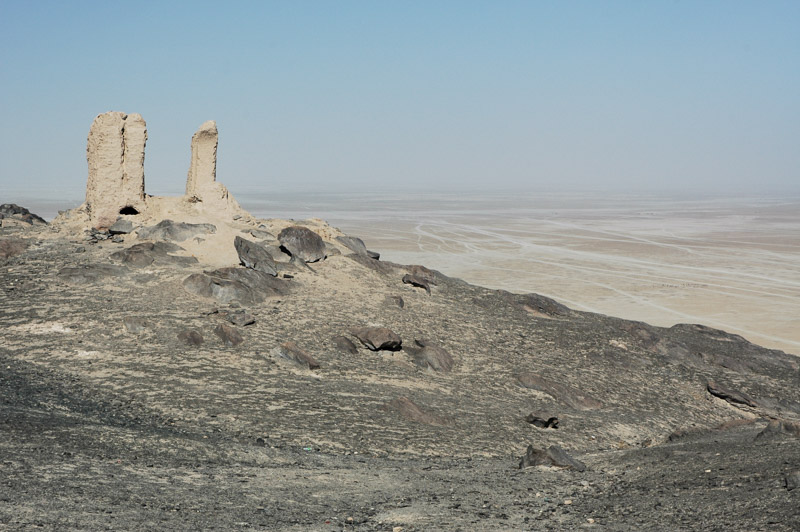
Mount Khajeh, Sistan And Baluchestan Province, Iran
In the afternoon, Ahmad seems to become anxious, slightly pale and clammy, and rather distracted; something I later realised was opium withdrawal. We drive back to Zahedan, stopping at the edge of town with a friend of Ahmad’s to smoke once more, this time from a home-made waterpipe known as a gholgholeh. I notice that all Ahmad’s worries and stresses vanish like the sickly sweet opium vapours once we start to smoke. I also notice that I am perfectly coordinated and capable of driving, even immediately after smoking. Opium is in fact used by lorry drivers in Iran to deal with boredom, and stay awake.
I stay with Ahmad for three more days, during which time I visit his home which is a few minutes walk away, where his wife stays. I am fed wonderful home-cooked khoresht (stew) with rice, an appealing Iranian dish of subtle flavours and textures. Ahmad’s home is a typical, comfortable modern Iranian home, heated by gas fires with large, uncluttered rooms. As in most Iranian households, a set of furniture used for ceremonial occasions sits at the back of the room, covered in plastic, and the thickly carpeted floor is instead used to sit on and take meals or relax with a pillow for an afternoon nap. It’s a nice re-introduction to the comforts of Iran, and I realise that Zahedan, far from the wild, dusty frontier town I remember from 2003 is a perfectly comfortable, if slightly dull Iranian city. Beyond however, lie vast, sparsely populated landscapes which I am keep to explore.
Just before leaving Ahmad, I have a slightly sour experience. Some money goes missing from my bag, and I know almost beyond doubt that it is one of his cousins. It’s a difficult position to be in, but somehow the money is returned to me by Ahmad. I wouldn’t normally accept, as I was certain Ahmad was not himself guilty, but took it more as tacit acceptance on his part that his cousin was the culprit. We part on good terms.
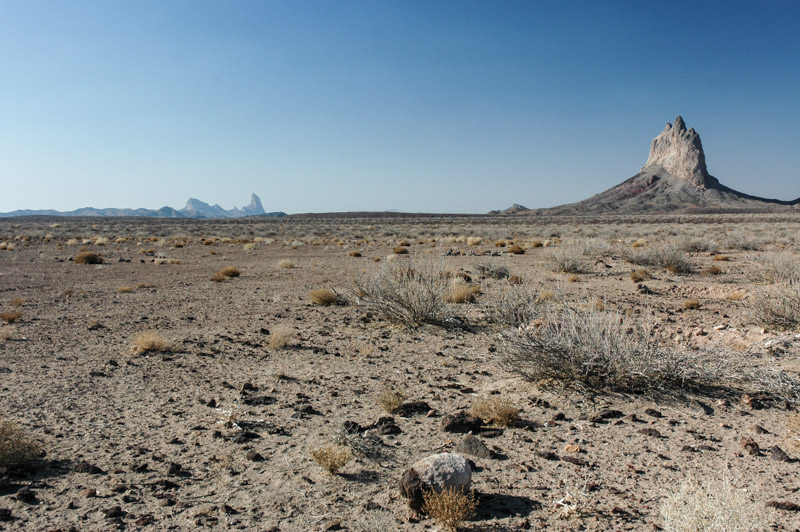
Mount Garash Khan, near Khash, Sistan And Baluchestan Province, Iran
After a week in Zahedan, I plunge south without attention from the police (who are luckily pre-occupied with the impending visit of President Ahmadinejad) into the interior of Balochistan once more. Shortly after leaving the city, I am in marvellous, radiant desert; a pure wilderness of blue sky and long vistas of mountains and high plains. From a huge gravelly plain, the striking rock fin of Mount Garash Khan protrudes, said to bear the facial profile of Reza Shah, whilst to the east lies the very prominent mass of Mt Taftan with active, sulphurous fumaroles steaming from its summit. I reach the Baloch town of Khash by mid-afternoon, by which time I’m beginning to feel mild symptoms of opiate withdrawal: aching joints and bowels and a touch of melancholy. After enquiring in a tailor shop as to the presence of a hotel in town, I am invited to stay at the home of one of the men, a rare insight into a traditional Baloch family; quite a different experience from the excesses of the past week.
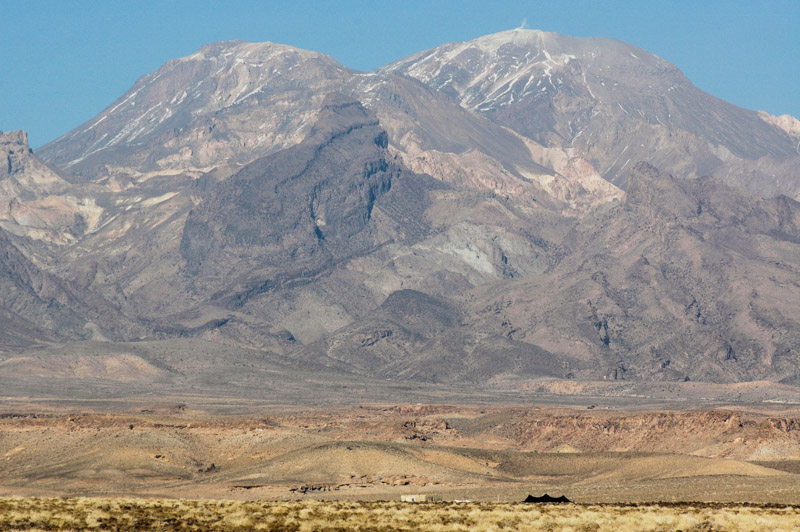
Mount Taftan, Sistan And Baluchestan Province, Iran
I set off next morning continuing my journey south towards the coast. I’m stopped at the edge of the town of Saravan by the police, who after fifteen minutes of waiting tell me I cannot enter the town. The same happens in the following two towns of Surkeh and Paskuh, until I am finally allowed to stop for lunch in the town of Zaboli, where sentinel gunmen patrol the streets from the town’s rooftops. I am clearly an object of suspicion to the local police and army, something I very quickly tire of. Mostly consisting of barely educated adolescents, whose limited intellect is fortified with heavy government brainwashing into a paranoic state of xenophobia, their reactions are usually contemptible, juvenile laughter and a fascination with any number of my possessions, such as a piece of coral, which are somehow construed to be the apparatus of espionage or narco-trafficking. I try continually to resolve this breed of cretin with the other Iranians I meet, who are very nearly all dignified and intelligent people. It is quite clear from which social echelons the country recruits its security forces. I later learn that there had been a very recent bomb attack at a police station in the town of Saravan, which may explain why I was denied access to a number of towns.
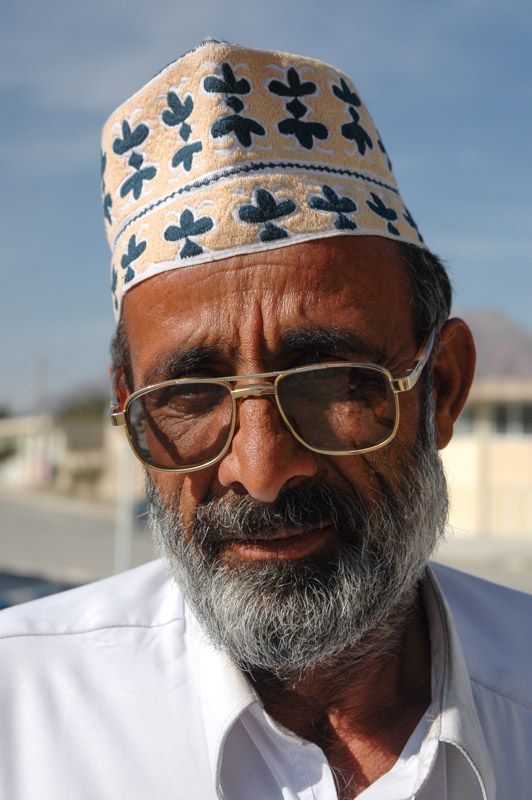
Baloch Man, Zaboli, Sistan And Baluchestan Province, Iran
Beyond Saravan, the land starts to fall gently and the temperature rises. Date palms and ephemeral watercourses appear, giving the land a North African look. Small mud-brick houses and even the occasional black nomads’ tent dot the landscape, and the air thickens as I near the coast. Failing to find a cheap hotel in the town of Iranshahr, I opt to camp next to the main road into town, opposite a police checkpoint. The huge and obvious police presence here is due to the insecurity of the region; its long, porous border with Pakistan makes it a prime conduit for smuggling. The police initially protest, advising me to find a hotel, and are staggered by my telling them that I do not wish to pay thirty dollars for the privilege of sleeping somewhere for one night. ‘But you are a foreigner, you must be full of money!’ says the incredulous police officer before telling me to move on. I drive forward one hundred metres and put my tent up, with no further protests. It’s New Year’s Eve 2008, and in my tent on the back of the truck, at a police checkpoint in the farthest flung reaches of Iran (which uses a different calendar), and with a dose of post-opiate depression, I actually feel a touch lonely for the first time I can remember.
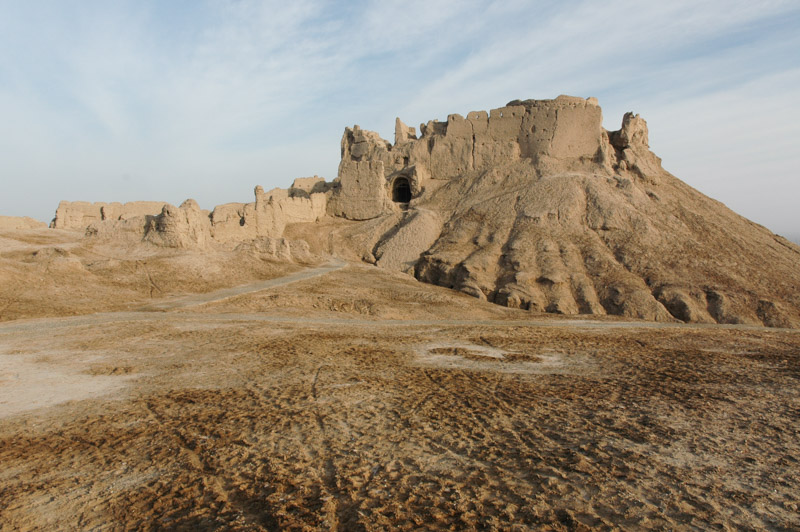
Castle, Bampur, Sistan And Baluchestan Province, Iran
Next morning I’m feeling back to normal and drive to the small nearby town of Bampur where I find a large, ruined castle which I have all to myself. Far more rewarding than nursing a New Year’s Day hangover. I drive further south, into the western reaches of the coastal Makran Range which I had left in Pakistan the previous month. Shortly before approaching the large city of Chabahar, I turn south-east off the main road, and drive down through spectacularly eroded hills to the sleepy coastal village of Beris. It’s getting late and I fancy staying here, so I find a suitable looking venue, some large commercial grounds, and ask to stay. Two local Baloch are in the office of what turns out to be a regional distributor of fish, and immediately allow me to drive in and put the tent up for the night. They even have a hot shower which I make use of. It’s a rather perfect camping ground, and I sleep comfortably in the cool, nocturnal sea air to the sound of chirping frogs who inhabit the bathroom.
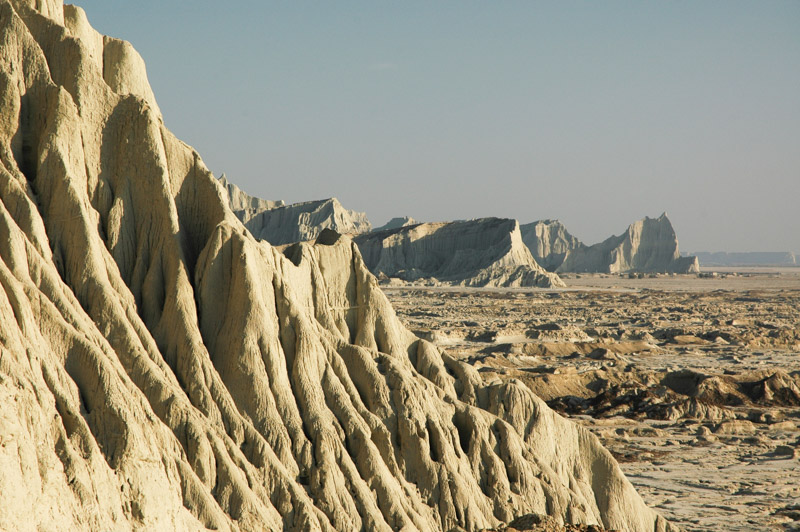
Makran Coastal Range, near Beris, Sistan And Baluchestan Province, Iran
In the morning I drive further east, to the end of the road in Iran, at Gvatar where a mangrove-lined estuary blocks any further progress. It’s as close to Pakistan as I can get. Turning round, I stop at the village of Pasabandar, where I enter the port for a look around. The harbour is full of exuberantly painted boats, which carry cargo along the Makran coast from Pakistan to Iran. Most of the crews are Pakistani, and seem genuinely pleased to meet me, flattered that I have taken an interest in what they are doing. They have tough lives, living in very basic conditions on the boats with only the very basic amenities of the port, which they may not leave as they lack visas for Iran. They come mostly from Karachi’s urban poor, and I wonder if any of them come from the slums I drove over, along the Lyari River. I am reminded of the genuine friendliness and kindness of Abdul Rehman, the fisherman whom I stayed with near Karachi the previous month. One of the sailors is so kind as to invite me to his wedding next month. Among their mixed, Makran-Baloch features, I notice a number of Sheedis, the pure-African descendants of slaves, who through numerous generations still retain absolutely African features; it is really very strange to meet a man who looks absolutely to be from the interior of Central Africa, but has the soft manner and accent of a Pakistani.
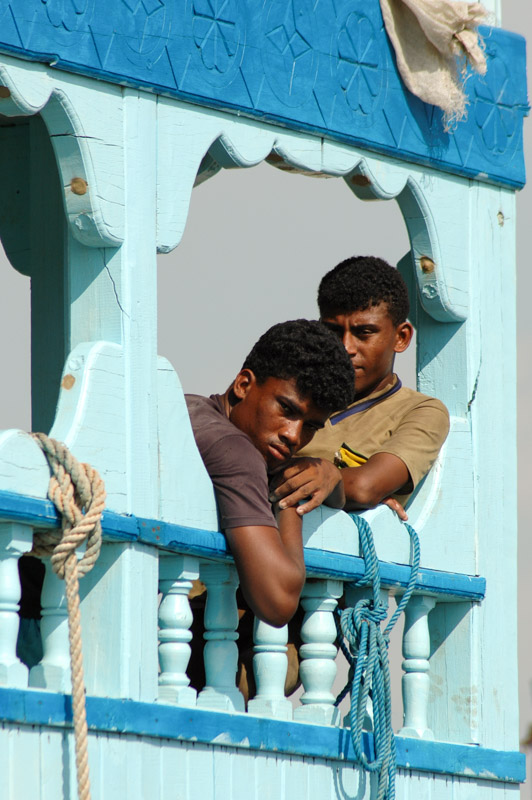
Sheedi Sailors, Pasabandar, Sistan And Baluchestan Province, Iran
Although I am delighted to be back in Iran for many reasons; decent, signposted roads free from crawling lorry traffic, cheap diesel, tap-water that doesn’t make one ill, continuous electricity, organised cities, people who don’t habitually spit on the ground and so on, meeting these sailors makes me realise just how much I miss Pakistan.
In the evening Hassan, the younger of the two Baloch who are hosting me takes me on his motorcycle to the edge of town, then across the barren clifftops to the edge, from where there is a stunning view of the Gulf of Oman; looking east towards Pakistan a magnificent beach of rust-coloured sand extends for several kilometres, contrasting with the perfect blue of the sea. It seems virtually untouched by man. This desolate corner of the world, so infamous for its treacherous terrain throughout history, and renowned today for lawlessness seems in truth like a hidden corner of spectacular beauty and thoroughly warm people. Why is it that in the places which people most warn one about, one so often finds the kindest people?
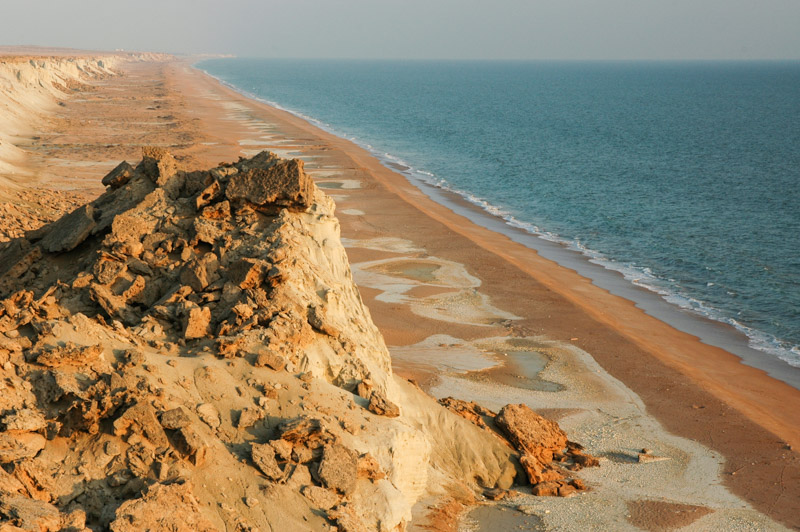
Makran Coast, Beris, Sistan And Baluchestan Province, Iran
The time comes however to move on from the tranquillity and beauty of Beris, and leave the Makran Region and Balochistan itself. I drive west along the coastal road, soon passing through the thriving port city of Chabahar, from where trucks drive goods into he rest of Iran and landlocked Afghanistan. Beyond the city’s sprawl, the road enters utter wilderness, but the fantastically eroded hills, so characteristic of the Makran, thin out and dissipate into a flat, featureless plain of hard-baked clay. Dust-storms crash across the road and the harsh, white light picks out only scrubby bushes and the occasional desperate settlement. At one point the large Tang Mud Volcano protrudes surreally from the plain a few kilometres south of the highway, but it is not until sunset, when I reach the border of Hormozgan Province, that the landscape improves at all.
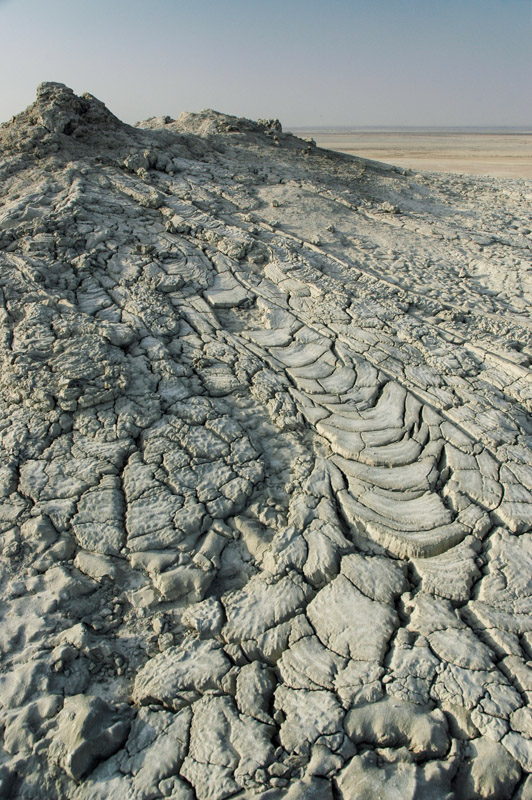
Tang Mud Volcano, Sistan And Baluchestan Province, Iran
Shortly after dark, in the small town of Lirdaf I am stopped by the police and it is suggested that I stop for the night. I’m not against the idea, and to my surprise the police bring me to a room full of people. They don’t look to be police, and I’m relieved to find that they are a group of students, some local, some from the city of Shiraz, whom the friendly police officer know. I am to stay the night with them, a wonderful re-introduction to Persian hospitality, and we have a hearty meal and wonderful conversation all evening. To the best of their knowledge, I’m the first foreigner to end up in this back-of-beyond town.
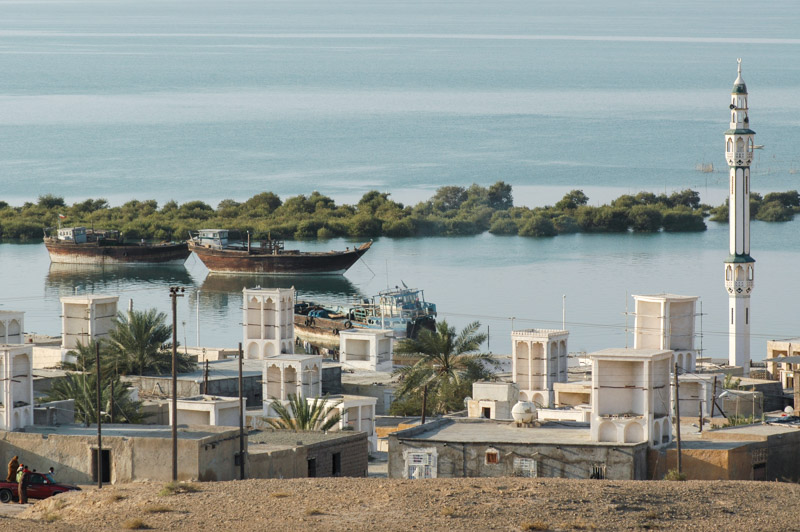
Bandar-e Laft, Hormozgan Province, Iran
The end of my journey along the coast comes the following evening when I reach the large city of Bandar Abbas, sitting on the Straits of Hormuz and marking the end of the Arabian Sea and Gulf of Oman. I notice my headlights dimming as I come into town after dark and realise that my alternator has failed. I rest for a few days in Bandar Abbas, get my alternator repaired and also meet David, a Taiwanese-American backpacker. David and I decide to travel together briefly, and so we drive a little further west to the port of Bandar Pol and take a car ferry to the Island of Qeshm.
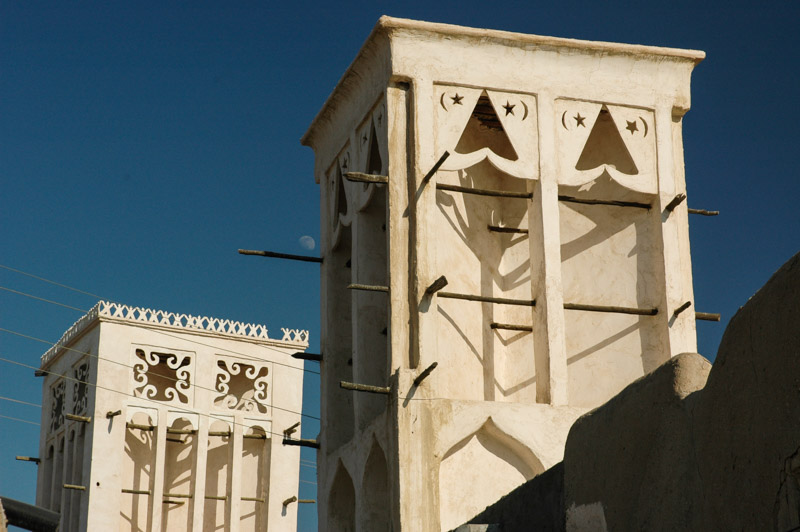
Badgirs, Bander-e Laft, Hormozgan Province, Iran
Qeshm is the largest island in the Persian Gulf, considerably larger than Bahrain and, uniquely in a region which very rapidly modernised in the twentieth century, retains in places authentic Gulf culture and architecture. David and I arrive near the Bandar-e Laft, which is a quaint, traditional Persian Gulf port. The skyline of Laft is dotted with occasional minaret, but far more prominently by wind-towers, or badgirs, which utilise the sea breeze to funnel hot air out of houses, and are often ornately decorated. Although it is pleasantly warm on this early-January day, the long summers here are almost unbearably hot and humid, and the badgirs act as an ancient form of air-conditioning. Beyond the town lies a short row of mangroves, which form something of a harbour at the waterfront where traditional wooden dhows come and go. It’s a charming place, and a rare glimpse of what the Persian Gulf must have looked like before the discovery of oil less than a century ago.
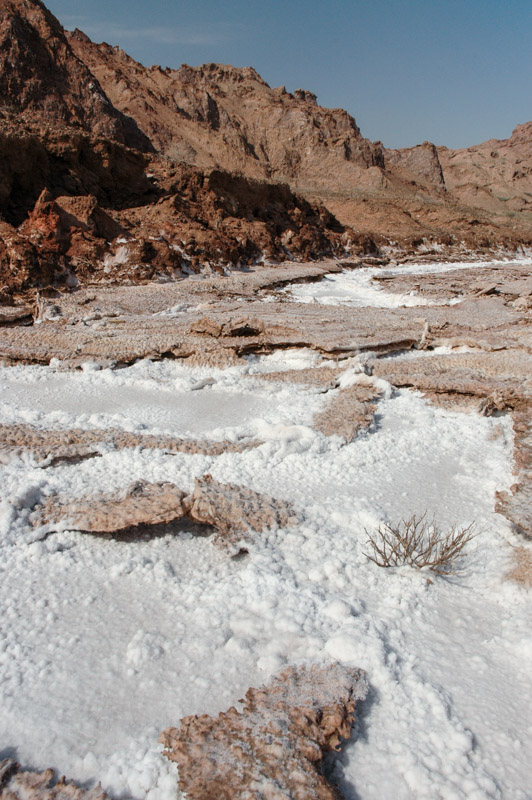
Mount Namakdan, Hormozgan Province, Iran
After the beauty of Laft, the eastern half of the island is far less picturesque and the its capital, Qeshm, appears to be little more than a large, bland duty-free market. David and I camp after dark on a rocky shore just south of the town, noticing a rather acrid smell in the air. It is not until morning that we realise the coastline is coated in oil, testament to the environmental impact of oil production and shipping in the Gulf. Continuing our journey around the island, we find the southern coast to be wild and rugged becoming and in a wilderness of eroded rock well beyond the last small fishing port, we find Mount Namakdan. The blood-red out crop of salt is in fact a salt dome piercing the rocky surface of the island. We walk up and enter a large salt cavern with walls of white and dark red salts, which open to the surface spewing what looks to be a glacier of white halite. The interior of this southern tail of the island hides another landscape; a desert of limestones and marls eroded into beautiful wind- and water-sculpted forms, not unlike parts of the Sahara. We end the day back near Laft, camping in a perfectly tranquil spot in the desert, deeply impressed by the diversity of the island’s beauty.
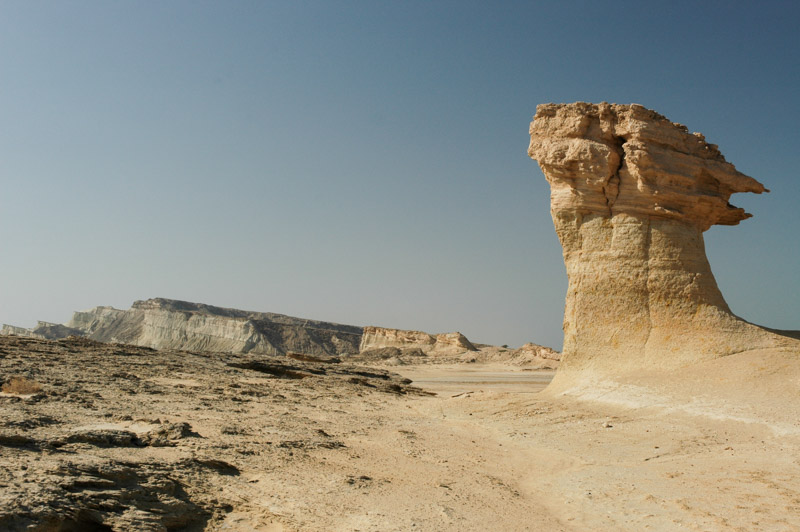
Yardang, near Tabl, Hormozgan Province, Iran
David and I leave Qeshm after two nights and return to Bandar Abbas. My plan had been to go from here on a ferry to the UAE, then progress to Africa via Oman and Yemen. Two things put doubts in my mind however, firstly the logistics of entering Oman with a right-hand drive car, and shipping a car across the Red Sea from Yemen to Djibouti, and secondly, perhaps more importantly, a deep feeling of not wishing to leave Asia. There seems much yet to see; parts of Iran and Pakistan and, of course Afghanistan, a country I have long dreamed of visiting. I resolve not to cross the Gulf at present, but to head north and spend more time in Iran, during which time I will have to make a decision as to how the Odyssey will continue.

