
Stage 7 – Pakistan: The Indus Valley [2/3]

‘The Interior’ as Karachiites call it, or the greater province of Sindh, is a world away from the cosmopolitanism of the big city. Unlike Karachi, Interior Sindh is overwhelmingly Sindhi; a place of shimmering, irrigated farmland, zamindars (feudal landowners), landless serfs and extravagant, colourful dargahs (shrines) dedicated to long-dead sages. My first visit to this overlooked corner of Pakistan would be a landmark in my journey, one which would come to dictate the future of The Odyssey as the experiences; surprising, enlightening and humbling, were etched indelibly into my memory.
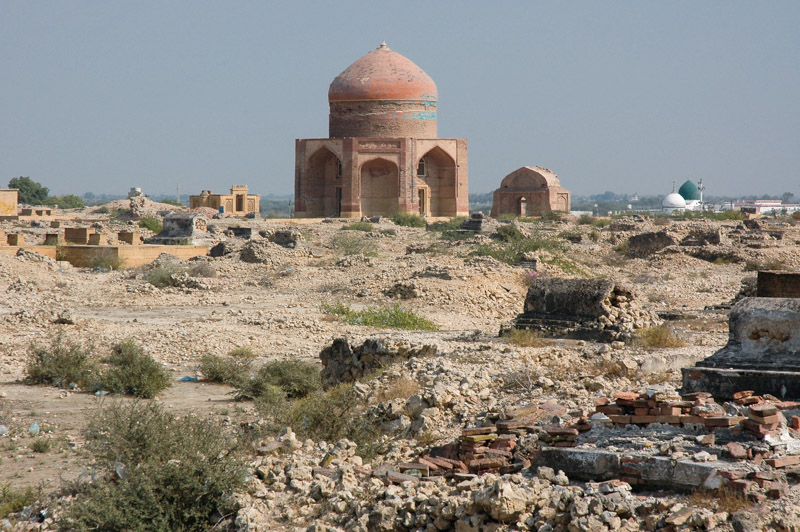
Makli Necropolis, Makli, Sindh, Pakistan
It’s the 28th January 2008, and I’m driving out of Karachi, finally extricating myself from the city’s chaotic traffic, onto National Highway 5, the country’s main road artery which runs along the course of the Indus Valley and then on to the Khyber Pass. The landscape is rather flat, nondescript, part of the mouth system of the Indus River. It was on these plains that the armies of the Arab general Muhammad bin Qasim arrived in the Indian Subcontinent in 711 CE, brining Islam to an area corresponding very roughly to that of modern-day Pakistan, incorporating it into the Umayyad Caliphate. Just under one hundred kilometres from Karachi I stop short of the Indus at a sprawling site of mud and broken coral on which are anything from five hundred thousand to a million graves, collectively known as Makli Necropolis. Said to have grown up around a khanaqah (meeting place of a Sufi brotherhood) established by a Sufi saint in the fourteenth century, the sprawling, countless graves span around four hundred years of burials. Amongst them are several large mausoleums which showcase distinctive, evolving architectural styles; the earliest made from golden sandstone, elaborate carved in the Gujarati style, which then blend into the more Mongol-Persian styles of the Mughals. My favourite is the seventeenth century tomb of the Mughal vassal Mir Sultan Ibrahim Tarkhan; a neat, octagonal shrine with a Mongol dome once covered in faïence, in whose crumbling brick arches men laze, smoking and chatting. There’s a slight air of iniquity about the place, but its decaying grandeur seems to fit well with Sindh’s backwater atmosphere.

Shah Jahan Mosque, Thatta, Sindh, Pakistan
Adjacent to Makli is the city of Thatta, which was the capital of Sindh well into Mughal times, until the Indus silted up and changed course in the late seventeenth century. Today little more than a junction town on the highway, Thatta is a good introduction to the settlements of The Interior; a dusty, pot-holed main street where colourfully painted autorickshaws and donkey carts compete with ancient, decorated Bedford lorries piled high with cut sugar cane, street stalls and simple eating holes in unfinished concrete boxes where men laze on charpays (rope beds), chewing betel nut and spitting out gobs of deep red liquid, which stain every wall and floor. A singular air of indolence and indifference to the passing of time. One thing however, very clearly marks Thatta out as more than an average Interior town; the stunning Shah Jahan Mosque. Commissioned by a grateful Shah Jahan (builder of the Taj Mahal) in 1647 after he was given refuge here from his father, the Mughal Emperor Aurangzeb, the mosque is one of the very finest buildings in the country. One enters a square park set with tall palms and a dry fountain, then passes through an entrance portal into wide courtyard of polished marble, surrounded on four sides by arcades of fine red-on-white brickwork. Walking through these arcades, one appreciates the perfection in architecture as the succession of vaulted chambers play parallax tricks with the eye, but it is the tilework of the mosque’s interior which is most impressive; intricately covering every surface, in mesmerising, geometric patterns of floral tiles. Stepping out of the mosque’s rarefied atmosphere I am back in the squalor of Thatta and escape a few desperate-looking beggars to continue on the highway, which now joins the Indus. By mid-afternoon, I pass Kotri, crossing the Indus on a British-made iron bridge, and drive into Hyderabad.
My host is a Mr Bossin, with whom I plan to stay for one night before continuing northwards. All I know about Mr Bossin is that he is French and lives in Hyderabad with two other people. I arrive expecting to find three French anthropologists, but instead I’m welcomed by a family; Aly, his Sindhi wife Shahana, and their five-year-old son Noé.
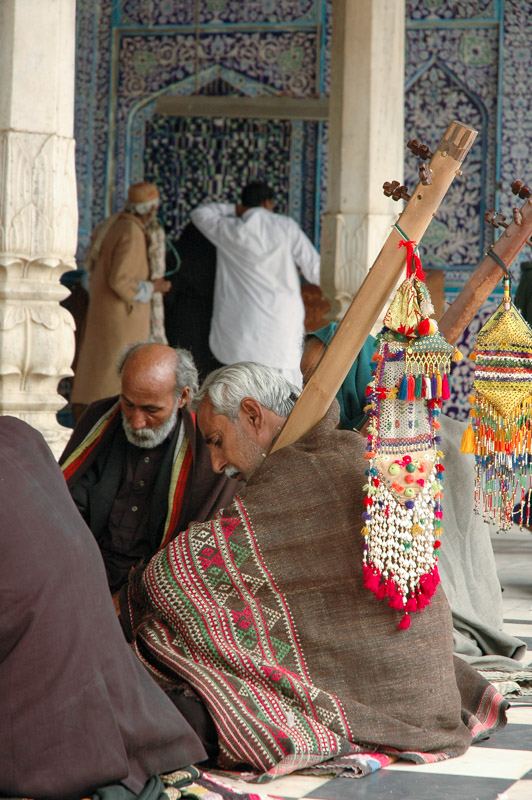
Musicians, Bhit Shah, Sindh, Pakistan
Aly and Shahana suggest a number of places in the surroundings of Hyderabad which I should visit, and so I decide to stay for a little longer. On the day after I arrive, I take a minibus up the left bank of the Indus, around seventy kilometres to the small pilgrim town of Bhit Shah. Sindh is a land of spirituality and mysticism, embodied in its countless dargahs which dot the landscape with their bright white domes; islands of cleanliness and calm in the surrounding sea of squalor and clamorous traffic. Bhit Shah hosts one of the most revered of Sindh’s many shrines; that of the eighteenth century Sindhi Sufi mystic, saint and poet Shah Abdul Latif Bhittai. Bhittai wandered the region’s landscapes, seeking out other mystics, and his poetry espouses tolerance and humanism attracting both Muslim and Hindu followers. Clearly influenced by Rumi, Bhittai’s mystical verses include much Sindhi folklore, and he may be regarded as the local spiritual emanation of the mysticism which has flowed into the subcontinent with waves of Turkic and Persian arrivals since the twelfth century.
Visiting Bhittai’s shrine is a joyful experience, a celebration of the great man’s death as a union with God. The building is riotously decorated with glazed tiles from nearby Hala (where Bhittai was born) and filled with the scents of rose petals and incense. In an ornately arcaded atrium, a group of musicians play wahi (devotional music), singing in powerful falsetto and strumming tall, five-stringed tanburs, which swing with tassels hung with bright pendants. It’s a truly beautiful scene; religious expression with no hint of politics or sectarianism (a great relief after Iran’s morose shrines) and I feel that I am glimpsing a timeless, organic scene of the Indian Subcontinent.

Sindhi Children, Bhit Shah, Sindh, Pakistan
Most interesting perhaps is the stream of people coming from The Interior; great crowds of serf families flood into the dargah, their women dressed in bright, multicoloured robes, carrying infants, accompanied by shrieking children whose eyes are highlighted with kohl (antimony). Fakirs (holy men who subsist on alms) squat or lie patiently about the place; one plays a recorder and flute simultaneously with a cloth spread in front of his feet. These people may have come from deep within the province, where a feudal system similar to that of medieval Europe remains in place. I imagine the majority, especially the women, are illiterate and so whatever they know of Shah Abdul Latif Bhittai and his mystic works must have been passed down by oral tradition. Looking through their billowing headscarves, I see some of the women are extremely beautiful; some have tribal facial tattoos, and many are wearing considerable amounts of jewellery. I suspect that for some of these people of The Interior, I am the first European they have set eyes upon, for many take as much interest in my appearance as I do in theirs.

Fakir, Bhit Shah, Sindh, Pakistan
I sit down in a contemplative mood near the group of musicians. It’s a beautifully warm, sunny, late January day and my thoughts drift off in tune with their passionate singing. It’s very nearly nine months since I left the UK. I’ve passed through the new republics of post-Soviet Central Asia, through the ancient relics of the distinct epochs of Persian history, crossed the desolate void of Balochistan and entered this most spiritual corner of Pakistan, fondly re-acquainting myself with my favourite country. I feel as if I have broken free from any pull of my previous life in Western Europe; my former job and girlfriend and my family all seem far removed in both space and time. I’m far, far out to sea, alone; not in a sea devoid of all life, but in a sea of people, places and experiences far beyond the limitations of my previous existence. I begin to feel that I am no longer a solitary observer, simply visiting the places of obvious touristic merit; no longer a tourist in fact, but that I have become a traveller, engaging with people whom I meet on my way, and enjoying the journey itself as much as the individual destinations. From this point on, I distance myself from making plans in too much detail, and become more open to taking things as they come; I begin from here to see my journey not as a finite trip away from my home, but as my own unfolding lifestyle, without a definite goal or end.
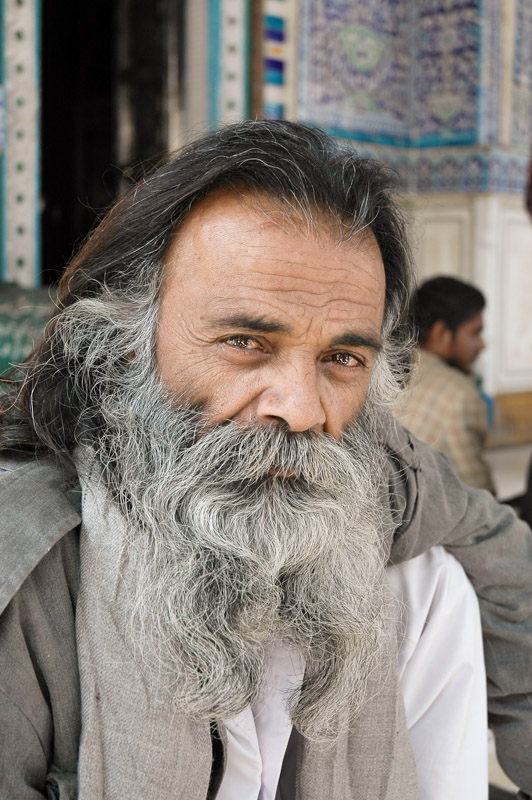
Sindhi Man, Bhit Shah, Sindh, Pakistan
I get chatting to some local men who are also watching the performance, slowly chewing dark lumps of charas (hashish). One man looks like the archetypal Indian sadhu, with a long, flowing beard and a look of inner peace and satisfaction which suggests he has found something in life that most others haven’t. They are part of the group of musicians, and towards lunchtime, as the performers wind up and pack away their instruments, they invite me to eat lunch with them. We walk to the edge of the shrine’s courtyard and retire to an uthak (guest-house) where visitors are accommodated in this traditional and gender-segregated society. The musicians divide-up the donations given by pilgrims and insist that I take a share. Soon after, a chillum, a traditional Indian type of hand-held pipe, used to smoke charas, is passed around. I take a couple of drags of their strong, coarse hashish, and am soon expending all my effort and concentration on avoiding what seems like an inevitable meeting of my limp body with the ground. A hot, spicy chicken curry arrives from a nearby kitchen, which does something to bring me round, much to the relief of my hosts. Before leaving, I’m given a rilly, a traditional patchwork quilt as a gift; one of the very few material souvenirs which I would keep from the journey. Sitting on the minibus on the way back to Hyderabad, I reflect upon what I’ve just experienced in my semi-stoned state; this is exactly the reason I had fallen in love with Pakistan five years ago, and it was experiences such as these that fundamentally motivated me to travel. When I reach home, in Hyderabad, Shahana immediately looks over my gift, commenting that it is of fine quality, and an especially honoured present, for, the more rillys one has, the more guests one can accommodate; to give one away is a sign of great respect.
The following day, on a tip from Shahana, I take a minibus further into The Interior, to the dargah of another Sufi; Shah Inayat Shaheed, in the small town of Jhok Sharif. The journey takes me through quintessentially Sindhi scenery; a land of camel, donkey and ox-drawn carts, herds of black water-buffalo, fields of corn, wheat, cotton, sugar cane, bananas, mangos, papayas and palm trees. I pass numerous small towns and villages of the most rudimentary homesteads; life here has changed little over the centuries. The people are brightly dressed and extremely friendly and laid-back, but I notice a high incidence of ill-health; adults with stunted growth, polio cripples, malnourished children and eye-diseases seem especially common here: the diseases of poverty.
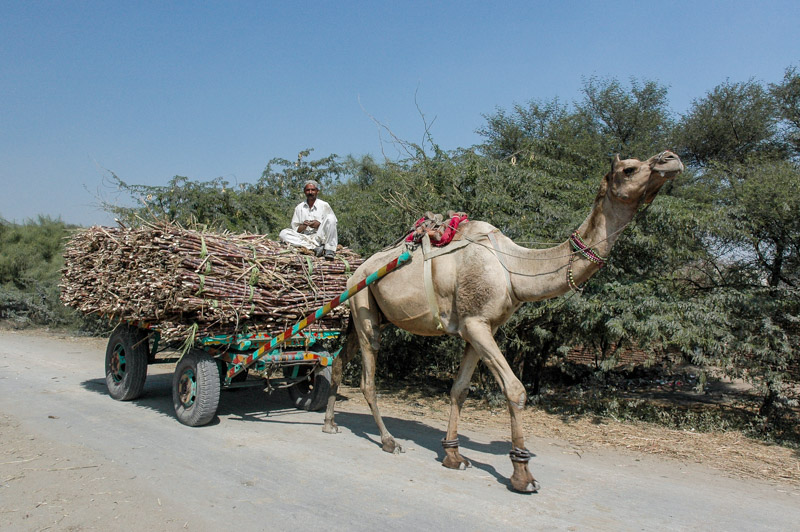
Camel Cart, Jhok Sharif, Sindh, Pakistan
When I reach Jhok Sharif, the dargah is visibly more low-key than that at Bhit Shah and seems almost deserted. As I approach the entrance to the mausoleum, a man emerges and with just a brief greeting leads me by the arm to an office at the rear of the shrine. My initial fears that I have breached some unwritten law of etiquette are soon dispelled when I meet Attaullah, the mureed, or present successor, of the interred holy man. He’s an ebullient, well-built Sindhi wearing a white shalwaar kameez and a baseball cap with a ‘Texas’ logo. He has recently returned from a few years of living in Texas and speaks with an accent that is an interesting mix of Pakistani and Texan. Despite being a massively revered man, a saint in local circles, there is about him no hint of pomp and he invites me to sit and share his lunch, sending his assistant out to fetch tea and water. His ancestor, the Sufi mystic known locally as Shah Shaheed, was born in Thatta in the seventeenth century and wandered across the Indian Subcontinent looking for knowledge and a mursheed (spiritual guide) in a tradition which is shared by Sufis, Hindus and Buddhists. Unlike most mystics however, Shah Shaheed’s teachings of tolerance and equality extended into social activism and revolution against the local zamindars, the ruling Kalhora Dynasty and ultimately the Mughal Emperor Farrukhsiyar, who had him executed in 1718 following the Battle of Jhok.

Sheedi Man, Bulri Shah Karim, Sindh, Pakistan
I mention to Attaullah my impressions of the expressive and free atmosphere in the dargahs here in Sindh, and what seems to be a far greater tolerance of different sects and religions than I’ve seen elsewhere in the Islamic world. He looks at me earnestly and tells me ‘God created Adam, that’s all. All these religions and these divisions, have been created by man. Religion just tells us to be good people. We Sufis believe in accepting all people; Hindus, Christians, Jews…’ He leads me outside to a dusty area where there are a number of low grave mounds each marked with a stick and an orange strip of cloth. ‘These are Hindu graves. Hindus come here to the dargah, they pray in the mosque, and some even wish to be buried here’. This takes me by surprise, but I realise that what I am seeing here is an almost syncretic mixture of Islam and the far more ancient mysticism of the subcontinent. This the local interpretation of Sufism, the mystical branch of Islam, whose ‘adherents’ often claim exceeds the sectarian divisions within Islam, the divisions between the three ‘Abrahamic’ religions, and perhaps unifies all human spirituality. It’s a doctrine which largely defies definition, though perhaps the simplest description of which I know, is to ‘find one’s own way to God’.
Attaullah summons his nephew and together they drive me a few kilometres north to the next town, Bulri Shah Karim, which clusters around another extravagantly tiled dargah of a mystic; Shah Karim, grandfather of Shah Abdul Latif Bhittai. After a brief visit to the shrine, Attaullah introduces me to an elder of the local Sheedi community, a handsome and distinguished-looking African. The gentleman is clearly of pure African descent; his face suggests he might be from the coast of East Africa, but his accent when he speaks is unmistakably Pakistani. The Sheedis are indeed a group of Afro-Pakistanis originally brought as slaves by Portuguese and Omani traders, and now have a rich culture in the lower reaches of Sindh and Balochistan. Attaullah drops me off at the bus stand where we wish each other farewell, and whilst I’m on the minibus heading back to Hyderabad, I reflect upon another fascinating, disarmingly humanistic experience in this most welcoming corner of Pakistan, all but unknown to outsiders.
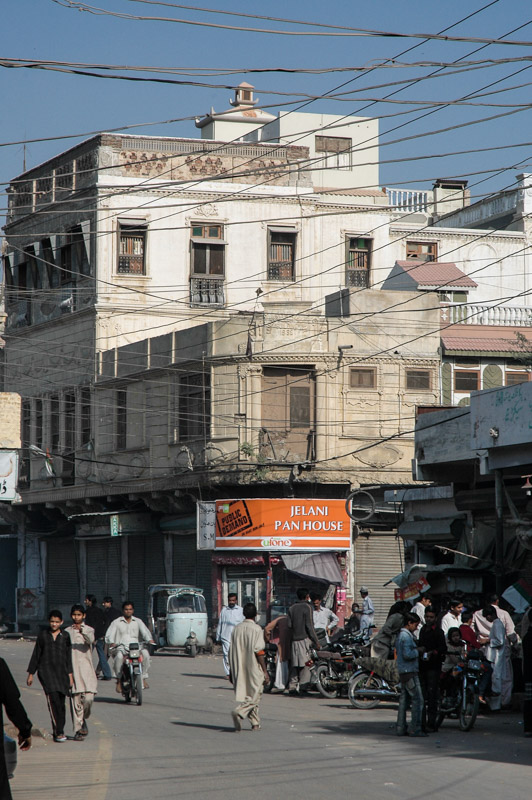
Hyderabad, Sindh, Pakistan
As the days pass, Aly and Shahana repeatedly encourage me to stay longer, to feel as if I were at home and to see more of the local area; something I am very glad to do. In the cool winter evenings we sit out in the fresh air talking to visiting family members and friends, and I am keen to learn Aly’s story. Philippe, to use Aly’s original name, arrived in Hyderabad in December 1974 as a lone traveller escaping his native France, built up a network of friends in the city and soon fell in love with the place. As I sit describing my journey so far and explain the impression which my experiences so far in Sindh have made on me, I feel that Aly can see his younger-self in me; a lone twenty-something discovering the wonders of Sindh for the first time. Aly made repeated, long visits to Hyderabad in the 1970s, then converted to Islam and in 1984 married Shahana, the daughter of an acquaintance he had made soon after he first arrived in the city. Shahana, who hails from the Saraiki-speaking Bhurgri Tribe, descendants of Baloch nomads, strikes me as a slightly unusual character. In a country where women are often absent in public life, or play at best a very discreet role, Shahana will lead conversations and debate heatedly with men without any sign of intimidation. As time passed, I would see that Shahana was an extraordinarily strong woman, who cared little for petty social conventions (marrying a European was a clear sign of this), yet at the same time is deeply spiritual and humanist. I soon feel extremely comfortable and at-home with Aly and his family, and what I had planned to be a stay of one night becomes a stay of one month.

Tomb of Mir Karam Ali Khan Talpur, Hyderabad, Sindh, Pakistan
Hyderabad is the second city of Sindh and was its capital under the ruling Kalhora and later Talpur Dynasties, until the British transferred the title to Karachi. Hyderabad’s ancient centre is marked by the Kalhora-era Pakka Qila, a crumbling eighteenth century mud-brick fortress and a number of slightly shabby though attractive tombs of the deceased rulers of both ruling dynasties. The central district of Heerabad is filled with once elegant, finely decorated mansions, which in the 1920s and 30s belonged to a wealthy Hindu merchant class. Many (though by no means all) of these Hindus left for India during the upheavals following Partition in 1947, with Muhajirs (Indian-born Muslims) coming to take their place. Despite these fading landmarks however, one’s strongest impression of Hyderabad is of sprawling, chaotic, shoddy new ‘developments’ and hellish traffic; narrow streets are brought to a standstill by deafening, smoke belching squads of autorickshaws and Chinese motorcycle taxis, who weave around encroaching market stalls, foetid open sewers and chaotic illegal electricity lines which sway and spark on their way from one overloaded transformer to its illegal hook-up. But within this bedlam lies a certain charm, and on a relatively quiet Friday afternoon, or during a strike or curfew when the streets are empty, one still gets strong echoes of Hyderabad’s glory days.

Dervish, Karam Ali Lavali, Sindh, Pakistan
As the warm days pass in Hyderabad, I begin to strike-up a good friendship with Shahana, an unusual experience for a foreign male visitor to Pakistan. One weekday, Shahana asks me to drive her and her Urdu-speaking friend Farah to visit a dervish, a holy man who has renounced the things of this life to seek the divine. We find Lalan Sain in the village of Karam Ali Lavali near Jhudo. He’s a dark-skinned, haggard, middle-aged man with a wispy beard and some missing teeth. His bare feet are caked in drying mud and he wears nothing except a worn dhoti, (a simple rectangular piece of cloth wrapped around the waist). He squats on his haunches on the edge of a rope-bed, rather like a giant bird, muttering the name of God as a mantra whilst rocking slightly and occasionally turning his head to bellow something unintelligible into a patch of acacias where goats are nibbling on the thorny bushes. Shahana and her friend sit some distance in front of him at a point which he indicates and chat in Sindhi about the spiritual and also the mundane; relationships, politics and so on. Aside from his occasional outbursts, he seems like a fairly ordinary man but I’m seeing another ancient tradition of the subcontinent: asceticism, a tradition which fits naturally into Sufism.
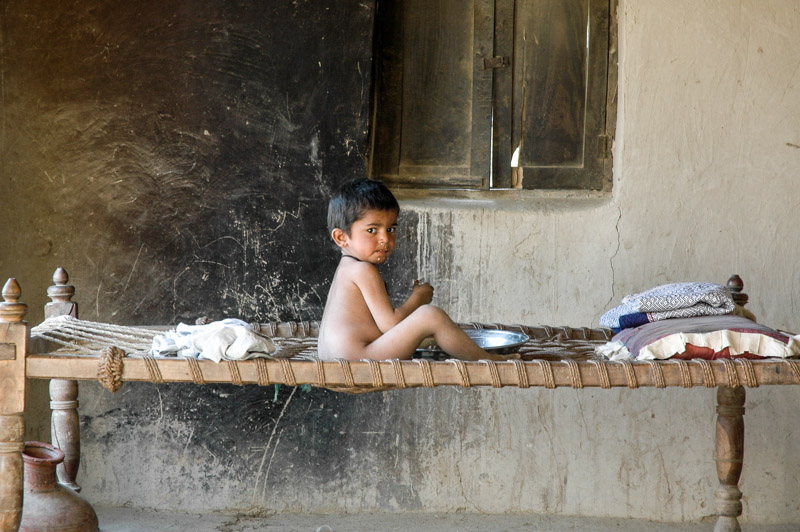
Child, Goth Kurban Ali Rind, Sindh, Pakistan
Despite being far from wealthy, Aly and Shahana run a number of social and humanitarian projects, primarily a school in Hyderabad (of which we will learn more in future stages of the trip), but also out in the The Interior, in the irrigated hinterland which spreads south-east of the city, a place which feels deeply neglected by the authorities. This, together with Shahana’s great charisma, gives them a chance to penetrate into the private life of the communities here and I am very glad to join them. The land of The Interior is divided between rich and powerful zamindars whose guarded mansions and fleets of late-model Land Cruisers stand out starkly in the harsh and impoverished landscape. Around these estates are the village compounds of the landless serfs, isolated behind high mud-brick walls, the interior of which is strictly of limits to outsiders. We however, are invited to visit, not simply the uthak where visitors are normally received, but to enter the inner compound where family life takes place, and I have a rare glimpse of everyday family life.
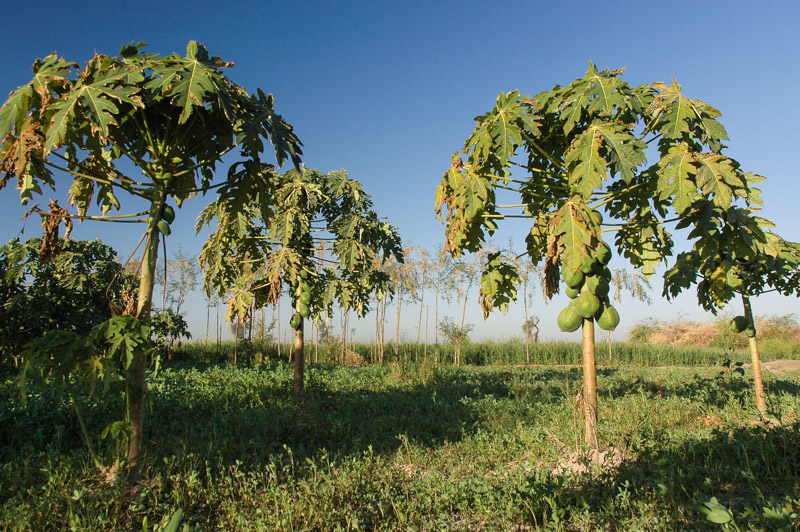
Papaya Trees, Fazal Bhambhro, Sindh, Pakistan
The compound, which constitutes a village, is known as Goth Qurban Ali Rind. Inside it live six brothers, who between them have dozens of children. The family is Rind, a tribe descended from Baloch herders who moved into the area around three-hundred years ago. Here one sees the age-old rhythms of life, unchanged for centuries, hidden from the outside world in this almost medieval feudal village. This is the private face of Interior Sindhi society, and well illustrates the difference between a village, as a place where people live, and a town of the interior where one goes to shop, and in the case of the men, lie around on charpays drinking tea.
We spend the night in the village of Shahana’s maid, Husni, whose family live in a single-roomed shack made from sticks, hand-plastered with mud, out amongst a field of papaya trees and sugar cane. These people, who own very nearly nothing and have no claim to the land they work, invite us to sleep in their only beds, out under the stars, in the most rudimentary of homes I’ve ever seen. Yet another unforgettable experience.

Hindu Woman, Nabisar Road, Sindh, Pakistan
In the morning we continue, following the abandoned metre-gauge railway line northwards through poor, patchy farmland. We stop at some abandoned British-built railways buildings, one dated to 1925, and notice a slight demographic shift, with the appearance of a noticeable Hindu population; very colourfully dressed women with facial tattoos and arms covered in bangles. In 1947, during the ugly process of partition, communities were violently torn apart with the deaths of hundreds of thousands to the north in Punjab, and far to the east in Bengal. Here in Interior Sindh however, the process was largely peaceful and in the timeless communities of The Interior, the pre-Partition balance remains largely intact, with some districts further east in the Thar Desert being majority Hindu.
Leaving the old railway line, we drive towards Nabisar where we leave the irrigated fields and drive into a landscape of undulating, settled dunes dotted occasionally by white, cubic dargahs. We are heading for another holy man who lives in a simple hut near Cheelh on the edge of the Thar Desert. Sain Khair Mahmad Shah lies nonchalantly on a rope bed with his back to us, and refuses even to look towards his visitors, staring instead vacantly into the distance. A cup of tea and a biscuit seems to stir him slightly, though he simply puts the biscuit on the floor, blesses it with a bit of tea and then watches a crow pick it up and fly off with it. Aly and I look at each other, somewhat bemused. Shahana suggests that we return another day when he may be more responsive, and we leave without even having spoken to him.
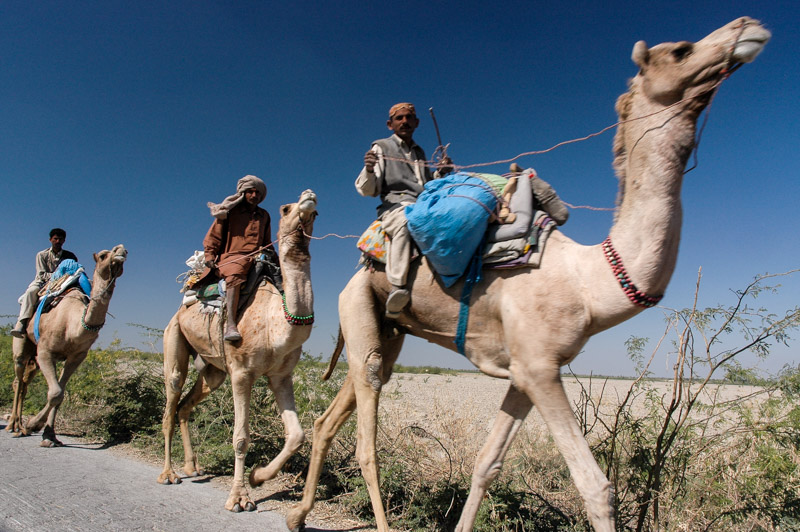
Camel Riders, near Kunri, Sindh, Pakistan
Shahana and I would visit more of these holy men and sages, and I could see that the advice they gave, or simply their company, gave her some deep, spiritual satisfaction. The Sufis of Sindh seem to be finding their own vehicle towards God; be it song, dance, drugs, or visiting shrines and holy men. There is something rather appealing in this faith, which focussed on learning and perception rather than dogma and ritual, and whilst Shahana respected my atheism, or perhaps interpreted it as a shunning of this dogma and ritual, she once told me that I was, of course, a Sufi, leaving everything of my previous life and taking to the roads in search of knowledge and experience.
We head back towards Hyderabad in the afternoon, stopping for a late lunch in the town of Kunri with Saloma, a Canadian Mennonite and Evangelical Missionary whom Aly had befriended in his early days in Pakistan. I’ve always found something rather insidious, even revolting about Christian missionaries but the reality in Saloma is of a doting, grandmother-like figure working in a mission hospital in a very neglected community. Saloma and Aly are perhaps a bizarre pair of friends, with Aly a European convert to Islam, but she’s a very rare European face in this magical corner of Pakistan.

Election Rally, Hyderabad, Sindh, Pakistan
In my second week in Hyderabad I extend my one-month visa with the police, then make a trip north by train to Lahore and on to Rawalpindi, in order to lodge an Indian visa application in the capital, Islamabad. When I return to Hyderabad, pre-election campaigning is in full swing in the run-up to the ballot. Although the interior of Sindh is as tranquil as anywhere on Earth, Hyderabad, like a miniature version of Karachi, is a tinderbox of ethnic and political sentiments. Musharraf’s Muslim League has little support down here, but there’s heated competition between the two big players in Hyderabad, a city where one’s preference of political party is inextricably linked with one’s ethnic identity. The native Sindhis are represented by the Pakistan Peoples Party (PPP), synonymous with the (Sindhi) Bhutto Family, whose charismatic leader Benazir had achieved instant martyrdom when she was murdered in Rawalpindi less than two months ago. The Muhajirs, who never see eye-to-eye with the Sindhis, are represented by the Karachi-based Muttahida Qaumi Movement (MQM) which operates an almost mafia-like underground in Hyderabad. If one’s car is stolen in the city, it is the MQM that one must speak to, rather than the police, if one hopes to have it recovered. Hyderabad has an ugly recent history of inter-communal mistrust, which peaked in the 1980s when tensions between Sindhis and Muhajirs escalated to deadly violence, riots and city-wide curfews. With the recent death of Benazir Bhutto came a fresh wave of violence, rioting, vandalism and looting in Karachi and Hyderabad, and in this tense run-up to the elections, people are expecting further outbreaks of unrest. If Musharraf claims victory over the PPP, this will widely be seen as fraudulent and Hyderabad will be set ablaze.

Street Party, Hyderabad, Sindh, Pakistan
There’s a palpable tension in the city during these days. In the Sindhi-dominated district of Qasimabad, everywhere one looks, one sees a portrait of the canonised Benazir. The Sindhis seem to have forgotten, perhaps intentionally, that she and her husband siphoned billions of rupees out of Pakistan, supporting numerous lavish foreign residences. In the city centre, from every window seems to hang the red, white and green flag of the MQM. On the morning of the poll results, the city holds its breath, and the streets are unusually, almost eerily quiet. We stay in the house, watching the news for updates, anticipating violence, when, to our surprise we hear that the PPP have won; Musharraf will step down as Pakistani president after a run of almost nine years. An orgy of celebrations begin, the like of which I have never before witnessed. In the evening, the streets all across the centre are at a virtual standstill with slow-moving cars, blaring music and horns. The odd cackle of gunfire can be heard in celebration; young men dance in the streets, children ride on the bonnets of cars and throngs of women defy social norms and wander the streets unaccompanied. It’s a huge release of tension, and also, in a society without bars or nightclubs, something of a release from strict social rules. The party continues over several days, with all-night music, driving, feasting and dancing. In a country where frequent Martial Law is interrupted only by corrupt civilian government headed by an endless line of embezzling leaders, it’s a ray of rather fanciful hope for the future.

Sindhi Girl, Goth Pir Bukhsh, Sindh, Pakistan
We make further weekend trips into The Interior, visiting a Bhurgri clan in Pabun Sharif, and a Rind village known as Goth Pir Bukhsh, also near Jhudo; in both we glimpse more intimate scenes of the timeless, almost pre-mechanised rhythms of rural Sindhi life. We visit the colourful shrine of Sheikh Bhirkio in a village of the same name, then head to nearby Agham Kot; an intriguing ghost-town ravaged by time, with collapsing old brick shrines undercut by flash floods. I also take Shahana to more sages of The Interior; the Pashtun shrine in Sehwan Sharif on the right bank of the Indus north of Hyderabad, and to a kindly, frail dervish in Jhirk, on the road to Thatta. Shahana is a prolific Sufi, and I enjoy being part of her roaming quest for knowledge, as an aside to my own.
Even after four weeks in Sindh, my yearning for the road seems oddly blunted; I feel that I could stay for months in this sparkling, beguiling corner of the subcontinent with my friends, and have little appetite for the stresses I know will lie ahead in India. I do wish however to cross the subcontinent before the worst of the pre-monsoon heat sets in and so get back in the truck after almost a month, and continue my journey northwards along the Indus Valley. I leave with my perspective refreshed; perhaps even a changed person, moving ever deeper into my own Odyssey.
Stage 7 – Pakistan: The Indus Valley [1/3]
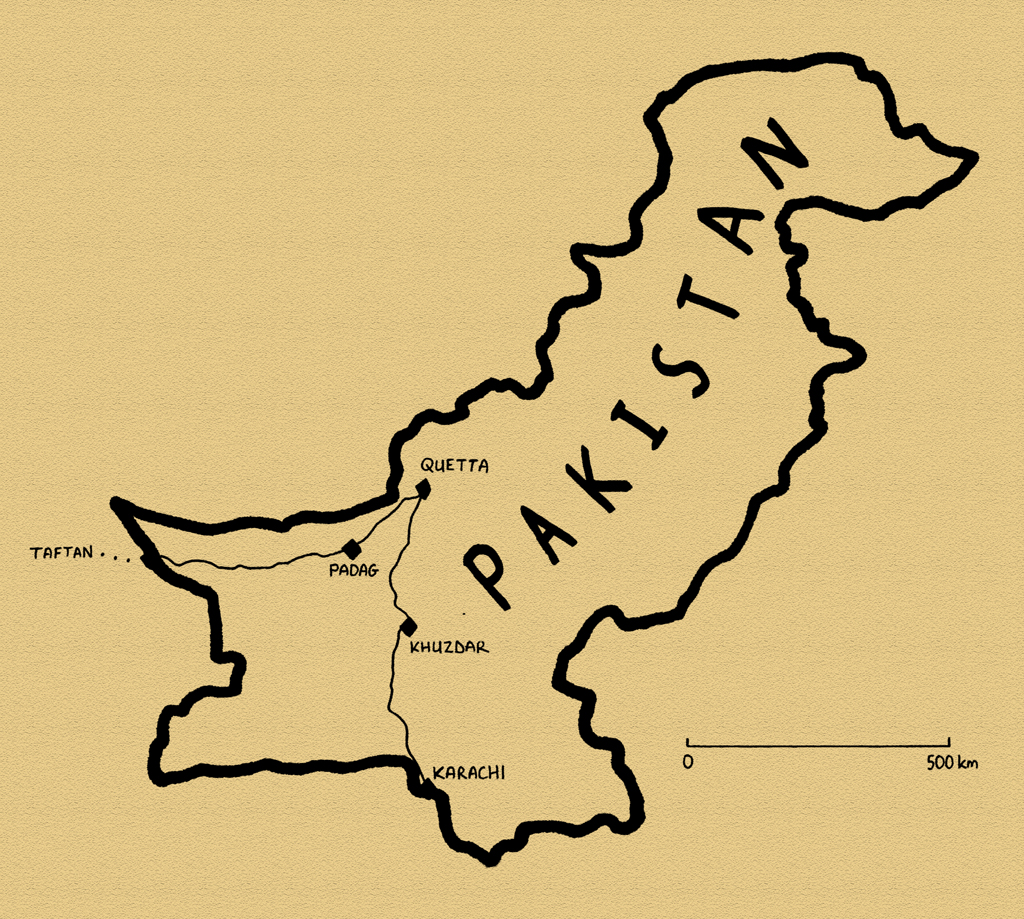
Pakistan is a very different country from Iran. The country has only existed since 1947 when the British, at the behest of Indian Muslims, partitioned the great country they were leaving as a colonial power. The territory of Pakistan however, is one of the cradles of civilisation, with the deeply intriguing Indus Valley Civilisation having built the earliest known urban settlements in the entire Indian Subcontinent. The elaborate national identity of the Iranians however, drawn from the millennia of Iranian history, is certainly absent in Pakistan. There is no ethnic group who call themselves Pakistani; the people of Pakistan are loosely bound nations whose history is tied in with the greater story of India; a history which stretches back even further than that of the Persians.
I first encountered Pakistan in the summer of 2003, as a twenty-one year-old on my first Asian overland trip from Istanbul to Beijing. I came to the country looking for the sublime scenery of the Karakoram and Hindukush Mountains, but found far more. The great charm and strength of character of the Pakistani people and the colourful, frenetic cities opened my eyes to a whole new side of the travel experience. As a legacy of its colonial history, Pakistan presented in some ways a distinctive, exotic, timeless vignette of a Britain long past, plus, of course, the opportunity for me to converse in my native tongue with people living in utterly different social and cultural circumstances. I soon lost myself in the great seething bazaars and mosques of Lahore and opened-up to the disarmingly generous people I met on the way; experiences I treasure every bit as much as the mind-bending scenery of the Karakoram Highway, the legendary high-road to China. In short, my encounter with Pakistan changed my outlook on life.
I would visit Pakistan three times during this Odyssey, spending a total of exactly one year in the country between January 2008 and October 2009. I still regard Pakistan as my favourite country and as odd as it seems, it is no exaggeration to say that I feel more at home in Pakistan than anywhere else in the world, and the basis for this lasting relationship would be my experiences on this first of three visits to the country, moving broadly up the very spine of the country, the Indus Valley.
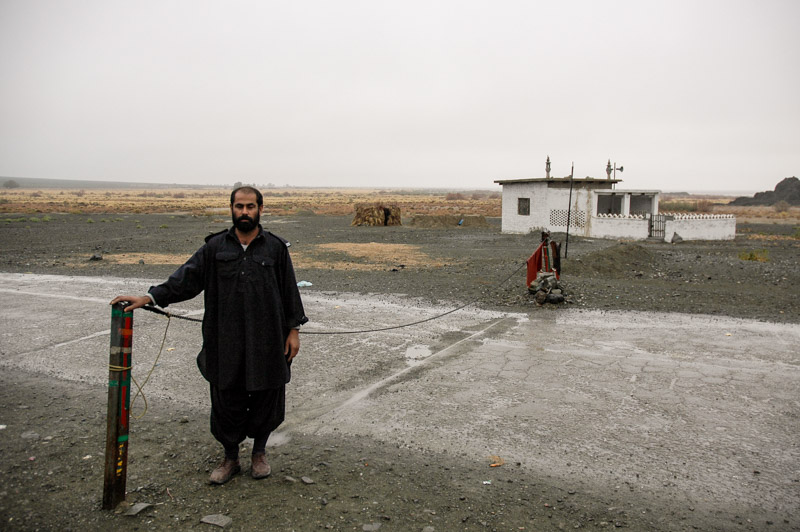
Police Checkpost, near Padag, Balochistan, Pakistan
On the morning of the 14th January 2008 I cross an imaginary line drawn across the harsh, bleak desert terrain of Balochistan and enter Pakistan. The remote border post at Taftan is the same port of entry through which I first encountered Pakistan in 2003, the only crossing between Iran and Pakistan which is open to foreign travellers on the Great Asian Overland. Just beyond the border gate I have a moment of surprise when a lorry approaches me head-on, before happily remembering that I have re-entered a country which drives on the left-hand side of the road. Other contrasts with Iran are also immediately obvious; whilst the behaviour of the Iranian officials in their soulless, modern customs compound had been somewhere between disinterested and brusque, the Pakistani officials in their timeworn office, which reeks of colonial Britain, welcome me with big smiles. I’m immediately whisked from the crowd of lorry drivers and fuel smugglers and sat down at a desk with the chief, whose manner suggests that a respected old friend has just dropped by. ‘Milk tea or green tea?’ he enquires, and I’m handed a cup of sugary, fresh, green kawa, a tea popular with the ethnic Pashtuns who staff the Customs House. An enormous ledger filled with many years’ worth of foreign tourists who have brought their vehicles into Pakistan is opened, and my details lovingly entered. There are no intrusive questions, and nothing as rude as a search of my belongings. This comes as a relief, as I have almost three hundred litres of Iranian diesel in the truck, which is slowly dripping from overfilled tanks, creating small magenta and yellow rainbows in the muddy puddles of the car park.
Surrounded by piles of rusting metal, Taftan looks at first sight to be little more than a giant scrapyard. The only activity in town seems to be repairing cars in the squalid muddy streets which run between crumbling single-storey hovels, so it is without delay that I begin the long journey east. Yesterday’s bone-chilling winds have abated, replaced by low grey clouds and steady rain. What I remember as being a swelteringly hot, waterless desert landscape in summer 2003 has now taken on a damp dreariness which reminds me of Europe, but the impression of near total desolation remains. Just under halfway into the 640 kilometre journey, beyond the town of Dalbandin, the road condition deteriorates and in the dark I have to pull off the single-track road each time a truck approaches from the opposite direction. Soon after the tiny settlement of Padag, I’m stopped at a police checkpost and told that it is too dangerous to continue at night, though the manner of the Baloch policeman suggests this is more of an invitation than an order. Glad at the prospect of a decent night’s sleep, I don’t argue for a moment.
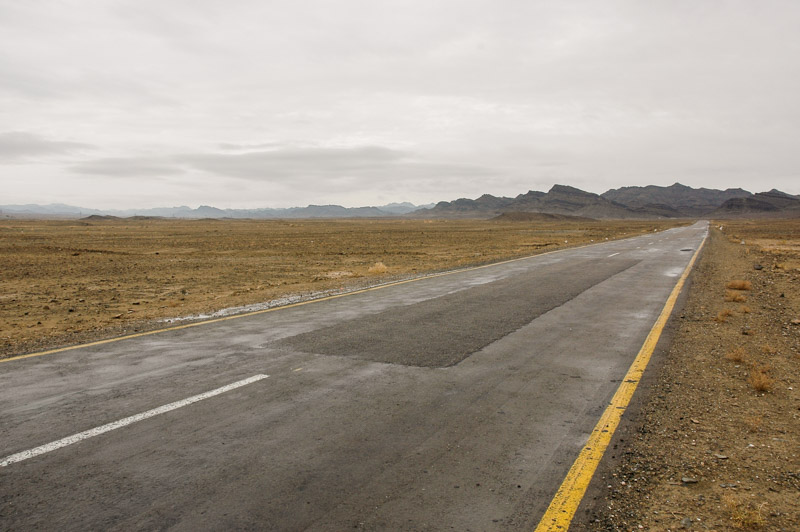
National Highway 40, near Nushki, Balochistan, Pakistan
In the dark, single-roomed hut which serves as a police checkpost, the policeman, Syed Mohammad, lights an old paraffin lantern and reveals a number of faces, dark-skinned with wiry black hair, all smiling. I’m given a dinner of mattar, goat stew with peas, eaten with greasy roti; all very welcome after another foodless day. After a chat in basic English I retire to another hut and stretch my sleeping bag out on a charpai, a traditional Indian rope-bed. I lie back, listening to the rain drumming on the roof and breathe a deep sigh of relief to be away from the restrictive theocracy and police harassment of Iran and in a country so laid-back and friendly, even in a harsh wilderness like Balochistan, that the police will invite one to stop for dinner sleep for the night, just out of hospitality.
It’s still raining in the morning when I leave Syed Mohammed and his companions in their damp hut. It must be a pretty bleak existence out here, hundreds of kilometres from the nearest city in a (usually) waterless waste with not even the most rudimentary facilities. The road gradually improves as I continue east, through the town of Nushki, winding into the low mountains of the greater Sulaiman Range which mark very roughly the collision zone between the Indian Subcontinent and the Iranian Plateau. The road passes close to the southern-most reaches of Kandahar Province in Afghanistan. For months I have been roughly circling the borders of this infamous mountain country and I’m frustrated at not quite having the knowledge or confidence to enter it.
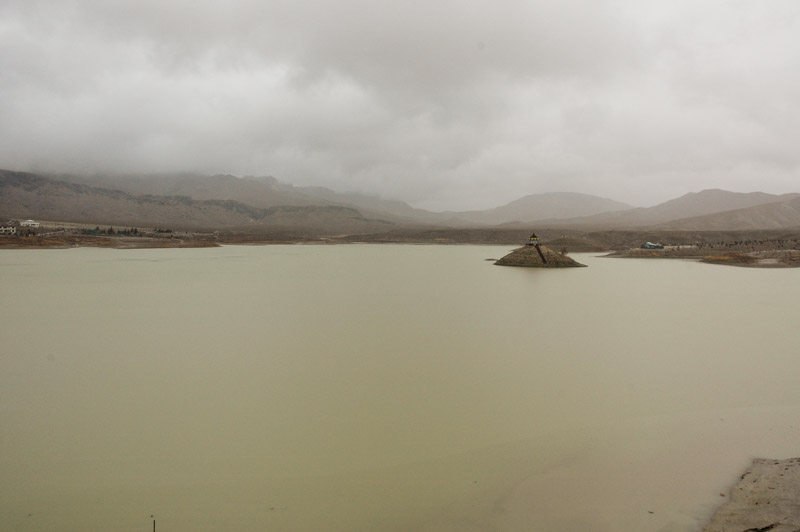
Hanna Lake, Quetta, Balochistan, Pakistan
Quetta, capital of the province of Balochistan, nestles in the jagged thrusts of the Sulaiman Mountains and is for me one of the most evocative cities on the entire Subcontinent. Though mentioned as early as the eleventh century when it was part of the (Afghan) Ghaznavid Empire, it was in the late nineteenth century when the British incorporated it into the Raj that Quetta began to grow and become a strategically important city. Quetta guards the Bolan Pass, one of only two traditional overland routes from the west into the Subcontinent and remains an important garrison out in this wild and rather lawless corner of Eurasia. Despite being the capital of Balochistan, Quetta is a predominantly Pashtun city with strong links to Afghanistan. The native population has been swollen by hundreds of thousands of refugees fleeing the turmoil in Afghanistan over the last few decades and, lying under two hundred kilometres from Kandahar, is a staging post on a busy modern-day trade route between the sea-ports of Karachi and landlocked Afghanistan. Pashtuns, who run very nearly all the transport services in Pakistan, carry out cross-border commerce on a huge, usually semi-legal scale. The city’s bazaars are incalculably vast, filled with what must be one of the world’s largest collections of used-car parts and consumer electronics, where whole containers of used Japanese goods disappear into the muddy streets and passageways of this mega-market.
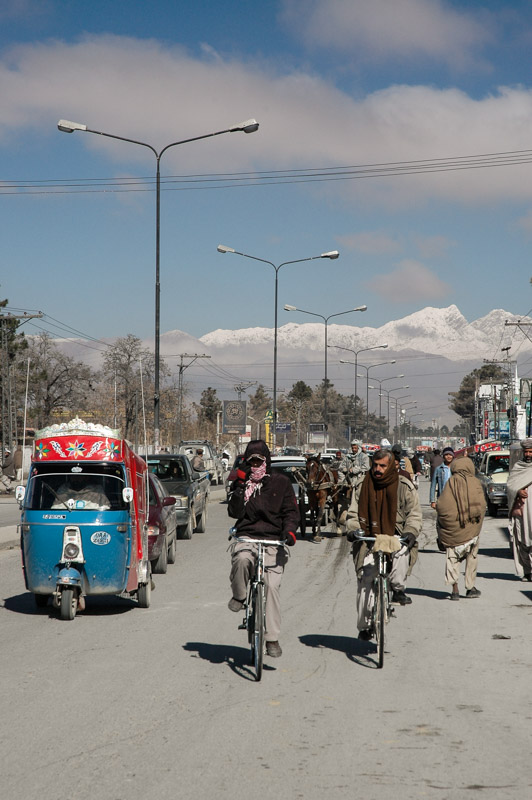
Zarghun Road, Quetta, Balochistan, Pakistan
My host in Quetta is, fittingly, the son of a Pashtun customs officer, and is named Zahir. His father, Baharuddin, holds a highly sought-after position, making a living from the thriving cross-border trade and receiving an apartment in the city’s ‘Customs Colony’. I drive through Quetta’s flooded streets, which are a sea of muddy rainwater through which trucks, buses, autorickshaws, cars, taxis, horse tangas and bicycles all career around unseen potholes and mudbanks, until I reach the customs district. Zahir is a student, and with handsome, chiselled good-looks, is also a part-time male model. We start to talk a little about Pakistan and I soon find that Zahir regards himself as anything but a Pakistani. “I am Pashtun, I am not Pakistani. I am an Afghan”. He clearly distances himself from his lowland countrymen, people whom he regards as having simply accepted colonial rule. “We have never been beaten, not by the British, the Russians, or the Americans”. Though his words are obviously peppered with a little youthful bravado, they sum up neatly the sentiment of many Pashtuns, who identify themselves with the mountains of Afghanistan rather than with the plains of India. Pashtuns often seem to me to be the living embodiment of the romance of the North-West Frontier. Valorous, fierce tribal warriors, Pashtun society traditionally operates around pashtunwali, a code of honour based on vendetta, hospitality to strangers and fugitives, and forgiveness if mercy is begged for by an enemy. This tribal law supplements their Islamic faith and makes many Pashtuns extremely traditional and extremely welcoming at the same time.
Zahir’s family are in fact not particularly traditional. Zahir and I sleep in the same bedroom as his sister, and we are even driven around town by his mother; a rare occurrence anywhere in Pakistan. On one evening we visit some members of the extended family who live across town. Zahir’s family belong to the Jalalzai Clan, one of dozens in Pashtun society, and originate in the Afghanistan border region north of Quetta. I’m right amongst the family, male and female members, who quiz me with questions about my own family; parents, brothers and sisters, and of course my own plans to produce offspring. Interestingly, Zahir’s father must stay in another room; social mores dictate that he may never see his sisters-in-law. As we are chatting, we hear the sound of a very distant explosion. I assume it to be a car-backfire or gunshot, but my hosts assure me it’s a bomb, planted in the hills by the BLA, the Balochistan Liberation Army, to sabotage the gas lines on which the city relies. ‘Welcome to Pakistan!’ says Zahir’s cousin wryly.
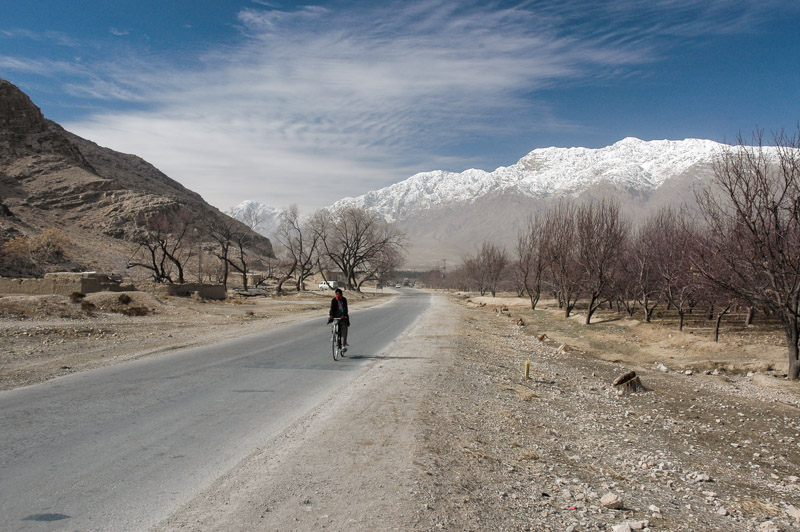
Orchards, near Quetta, Balochistan, Pakistan
My time in Quetta is a wonderful re-introduction to my favourite country. In addition to being treated to Pashtun hospitality I have some minor work done on the truck (a new clutch bearing) and stock up on spare parts from the city’s well-stocked bazaars. After nine days however I am ready to continue. As I leave the Jalalzai’s household, Zahir’s mother kisses me on the arm as if I were her own son and it is in high spirits that I set off south, deviating from my 2003 route on a road which will take me on a 740 kilometre journey to Karachi. Quetta’s famous apple orchards line the road immediately south of the city, but the land soon becomes depopulated, emphasising its barrenness, with only occasional Baloch settlements consisting of fortified castle-like compounds of local clans. It’s a tribal landscape which can have changed very little in centuries. I pass through the historical town of Kalat, seat of the once-powerful Khan of Kalat who in 1876 signed the Treaty of Kalat with the British chargé d’affaires Robert Sandeman. The treaty nominally brought the warring Baloch tribes under direct rule of the British, though in reality the area was left almost totally undeveloped outside of Quetta, and it remains so today. Kalat is now nothing more than a large village, a wretched place of rudimentary hovels, and the present Khan’s authority extends little beyond the settlement’s edge.
I break my journey roughly halfway to Karachi in the town of Khuzdar. Here I have been put in touch with a colleague of Zahir’s sister. His name is Zaman, a local Brahui (the Brahui are a tribal group similar to the Baloch, but speaking a Dravidian language), whom I meet in a small office. As it gets dark, the lights of course go out, a common occurrence all over Pakistan, but especially severe here. “Pakistan Zindabad!” (long-live Pakistan!), Zaman says sardonically as we are plunged into darkness and he fumbles for a candle. Balochistan is rich in natural resources; principally natural gas from the Sui Gas Field (domestic gas is in fact called Sui Gas in Pakistan) but also gold, copper, chromite and more. Zaman tells me that these resources are taken by Pakistanis (by which he means Punjabis), yet the province remains starkly undeveloped, used as a testing ground for the Army’s nuclear weapons. “What do they give back? Nothing. Look at this place! There is no light, no gas, there are no facilities, the roads are bad, the people are poor. Even the smallest village in Punjab has gas. They are raping us”. As we sit in a cold, candle-lit room in Balochistan’s fourth-largest settlement, where people have to buy bottled gas in order to cook, I couldn’t help but sympathise with Zaman. It’s perhaps unsurprising that the BLA enjoy support among the local population, and I have seen ‘BLA’ sprayed on what seems like every road-sign and wall along the road from Quetta.
After dinner, Zaman introduces me to some friends of his who work at BUETK, Balochistan University of Engineering and Technology Khuzdar, an island of higher learning in a province where according to a 1998 survey just one in four adults has basic literacy. Here I have the slightly surreal experience of playing snooker in a lounge looking out across the utterly desolate moonlit wilds of Balochistan. The lecturers staying in the bachelor hostel are almost all Punjabis. Very few Baloch receive higher education.
Beyond Khuzdar, the road gently winds down to lowland Balochistan on its way to the Arabian Sea. I leave behind the rugged mountains and sub-zero air, entering a landscape of scrubby and rather nondescript foothills. Just outside the town of Bela, resting place of Robert Sandeman, I reach the plains with their balmy, slightly muggy warmth; I am in the Indian Subcontinent proper at last. On the hazy eastern edge of this featureless, dusty plain lie the jagged Kirthar Mountains and beyond them, unseen, the Indus Valley. The first sign of having reached Karachi is the sprawling industrial city of Hub, home to several large food industries, a squalid agglomeration of factory units and wasteland which crawls with slow-moving but colourful lorry traffic. I cross the dry Hub River into the southern province of Sindh and, not long after, rather abruptly enter the city from what feels like its back door. My first impression is that Karachi is a terrific mess, an unsigned farce of waterlogged and half-dug-up streets around which traffic snarls up, though eventually, through asking a few helpful pedestrians, coupled with a bit of instinct which I’ve acquired from driving blindly around huge cities, I find my destination in Askari III, one of Karachi’s up-market army cantonments.
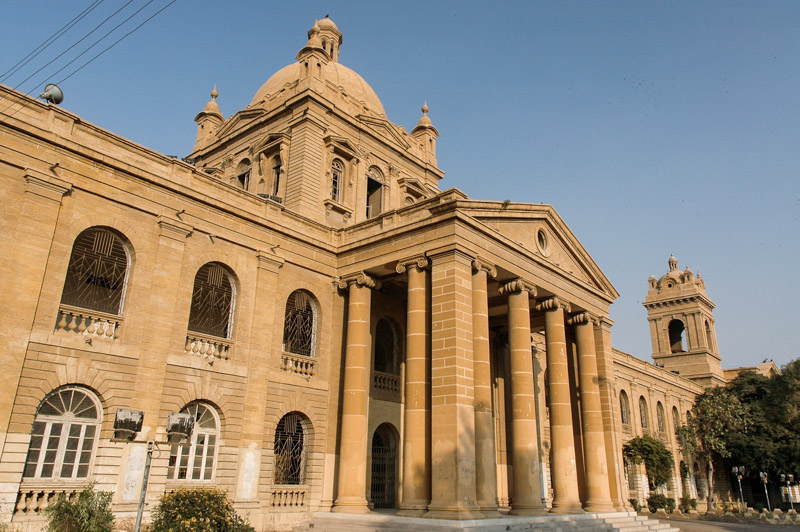
DJ Sindh Government Science College, Karachi, Sindh, Pakistan
Despite being Pakistan’s largest city by far and, with a population estimated to be between fifteen and twenty million, one of the world’s largest cities, Karachi is a modern place. It was indeed the British who founded Karachi as a city; capturing the insignificant fortified village of Kolachi from the Baloch Talpur Dynasty in 1839 and incorporating Karachi into the British Raj four years later. With connections by rail to the rest of India, Karachi soon became a flourishing port city. At independence in 1947 the city became Pakistan’s capital and from a population of less than half a million, very rapidly expanded with the arrival of hundreds of thousands of Muhajirs, Muslim refugees from India, and later migrants from across Pakistan as Karachi became a thriving metropolis. Though having lost its position as national capital in 1962 to newly-built Islamabad, Karachi remains the commercial heart of the country, with almost all of Pakistan’s foreign trade passing through the city’s two large sea-ports.
Because of this history, Karachi is fundamentally cosmopolitan, with a (sometimes fractious) mix of Muhajirs (known to themselves as Urdu-speakers), Pashtuns, Sindhis, Punjabis and almost every other ethnic group in South Asia. The city has an atmosphere very much of its own, and without a single ethnic identity, is perhaps the most Pakistani place in Pakistan. For many migrants of course, the dream of prosperity never quite happens and like any big South Asian city, there are vast, wretched slums where millions live without even the basics of life. Every extreme exists in Karachi, from the slums to the super-rich mansions of Pakistan’s top government and military officials in Clifton and the Cantonments of the Defence Housing Agency. With all these nations and such extremes of inequality it’s perhaps unsurprising that Karachi has a history of communal violence and gang wars. This, together with a lack of conventional tourist attractions means that the city is not of obvious appeal to tourists, and few make it here. This is a shame, as one can hardly claim to have seen Pakistan without seeing its largest, most vibrant city.
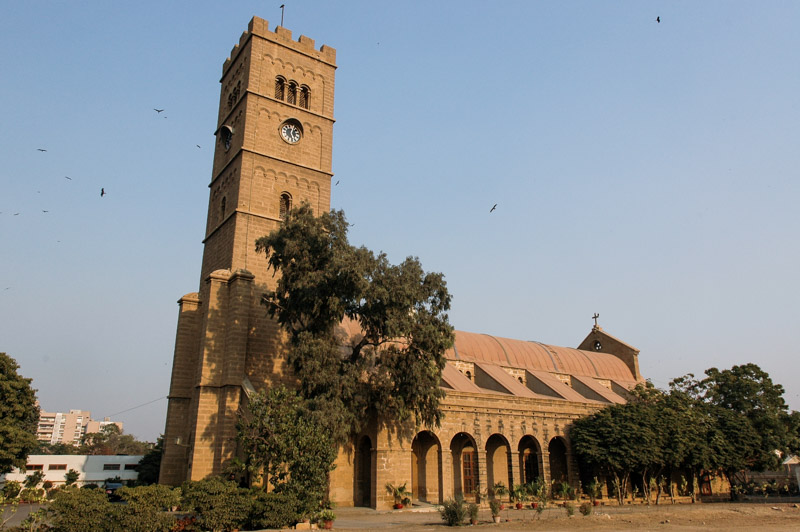
Holy Trinity Cathedral, Karachi, Sindh, Pakistan
My host in Karachi is Zeeshan, a soft-featured Punjabi from Lahore. The son of a high-ranking army officer, Zeeshan lives with his wife, son and parents in a military cantonment, in ‘western-grade’ apartments; a great luxury in Pakistan. On such army cantonments one can escape the squalor and unplanned expansion which typifies Pakistani cities and live in well maintained, high quality housing, a privilege of army life. Zeeshan shows me around Karachi, whose centre is relatively compact. Here, amidst the snarling traffic and press of colourful shoppers and hawkers which congest the streets of the centre, are small islands of preserved imperial splendour. Buildings such as that of the Karachi Metropolitan Corporation or the Government Science College are beautiful examples of the Indo-Saracenic style popular in the heyday of the British Raj; crisp buildings of yellow or pink sandstone which stand out as landmarks in a city which often gives the impression of a vast concrete sprawl. A number of churches also hark back to the colonial era, though are still in use by Karachi’s small but visible Christian population. The Anglican Holy Trinity Church, lying in a calm city park, has a restrained Victorian Gothic belfry in the same soft yellow sandstone, around which vultures slowly wheel in the warm afternoon air. Inside, where three colourfully dressed women sing hymns in Punjabi, plaques commemorate fallen soldiers of the Baluch Regiment in campaigns in India, Afghanistan, Burma, Yemen and Gallipoli, evoking in me an odd sense of nostalgia for a Britain which ceased to exist many decades before my birth.
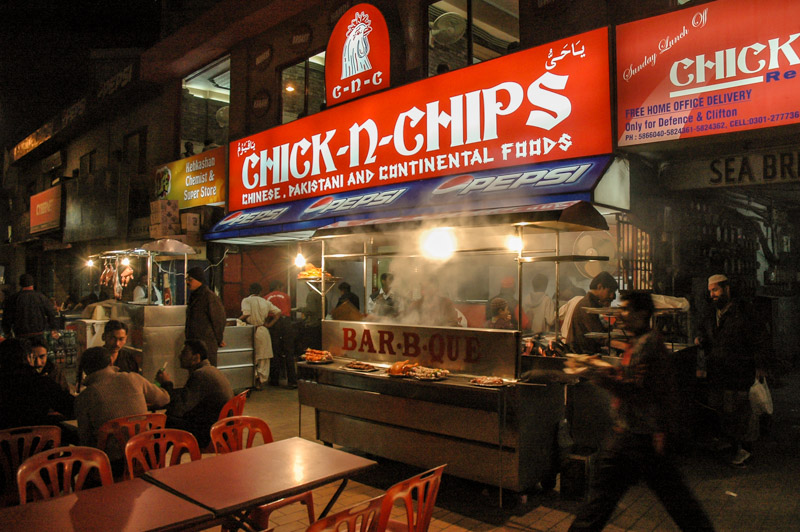
Restaurant, Karachi, Sindh, Pakistan
In the evening, Zeeshan and I meet with two of his friends; Naeem, a fellow Lahori who is in the clothes business, and Faizan, a local Urdu-speaker who, like Zeeshan, works for a multinational. The three hail from the upper echelons of Pakistan’s nascent middle class; a small group found mostly in Karachi and the largest cities of Punjab, who exist squeezed between the all-powerful ruling and landowning families, and the vast numbers of urban and rural poor. Zeeshan and Naeem, the Lahoris, see Karachi as a place of opportunity, a place to earn good money. Neither are particularly attached to the place however, citing common complaints of the city being too big, noisy, dirty, crime-ridden and of its muggy coastal climate. For them, Lahore is the greatest city in Pakistan, and perhaps in all Asia itself. Faizan on the other hand, whose parents came from what is now India but who has grown up in the city, loves his native metropolis: “I love the action; it’s a non-stop city. You can’t find as much nightlife, good food, as many different people, or the same facilities in any other city in Pakistan”.
Together we head down to Clifton, Karachi’s affluent seaside district, and stop at the beach which would be nice to walk along were it not for the piles of festering rubbish which have washed ashore. Clifton seems a pleasant and reasonably orderly place, but here families move about in cars, stopping at air-conditioned malls, and so it feels rather characterless in a place as vibrant as Pakistan. We end the day at Boat Basin, a colonial-era park set around a lagoon, across Chinna Creek from Karachi Port, having a dinner of fresh kebabs in an outdoor restaurant on ‘Food Street’.
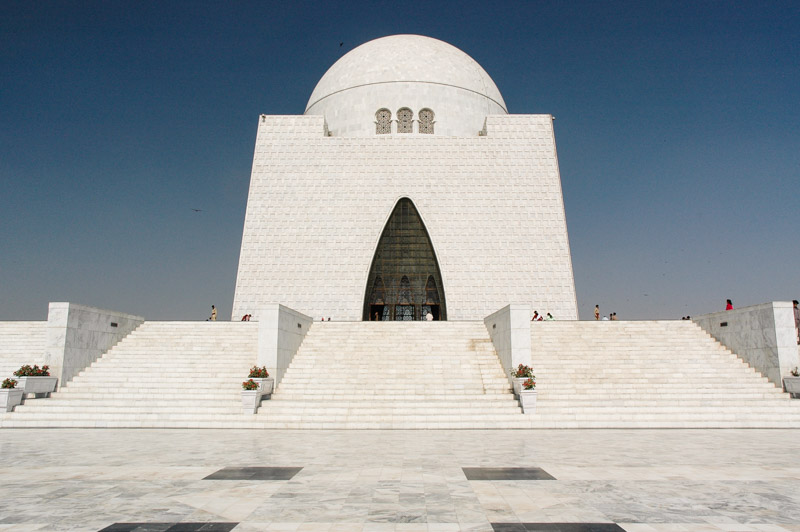
Jinnah Mausoleum, Karachi, Sindh, Pakistan
The next day is Sunday and Zeeshan takes me out once more for some sightseeing. We start at what is perhaps Karachi’s most recognisable landmark; the gleaming white mausoleum of Muhammad Ali Jinnah, known locally as Quaid-e Azam (Founder of the Nation), the founder of Pakistan. The white pepper-pot building, a modernist interpretation of Bukhara’s Samanid Mausoleum, is quietly busy with visiting families and the dazzling white-tiled walls illuminate the beautiful colours of women’s shalwar kameez dresses. Jinnah, a highly successful, British-educated lawyer, was head of the All India Muslim League, which relentlessly and stubbornly campaigned throughout the 1940s for the creation of a Muslim state upon the British withdrawal from India. Jinnah is revered in Pakistan, though he is a contradictory figure. In terms of lifestyle, he identified himself as a sahib, wearing a suit and tie, with a distaste for the shalwar kameez and iconic karakul hat in which he is invariably pictured, and which has become known as a Jinnah Hat. His command of Urdu, the national language, was faltering. Considering that he was responsible for founding the world’s first state based on religion, it’s surprising that privately he was very much a secularist, far more Atatürk than Khomeini. He is known to have been a drinker and chain-smoker who was partial to a bacon-breakfast each morning, followed by a walk with his dogs; hardly the behaviour of a pious Muslim. Nevertheless, Jinnah was indeed a great politician. Despite long fostering divisions between Muslims and Hindus in India, the British in the lead-up to their withdrawal were totally against the partition of India, as was the Indian Congress Party. It was Jinnah’s unbending demands for a separate Muslim state that led, for better or worse, to the partition of the subcontinent. Perhaps because he died just six months after the birth of his nation, or perhaps because he had neither the humanitarian charisma of Gandhi, nor the socialist genius of Nehru, in history he is overshadowed by his Indian counterparts.

Saddar Bazaar, Karachi, Sindh, Pakistan
From Jinnah’s white shrine we make our way south-westwards along Karachi’s main thoroughfare, M. A. Jinnah Road, entering the commercial district of Saddar. Normally furiously busy, on a Sunday there is a strange quiescence about the place, with shop-fronts shuttered and trade limited to informal trolleys from which fruit and second-hand clothes are sold. The backdrop is of faded grandeur; of once elegant streets with strong Gothic touches overwhelmed by the disorder of the modern era; arcades and towers poke vacantly from a dusty mass of concrete extensions, colourful billboards and hanging nests of informal electrical cables. M. A. Jinnah Road terminates at Kemari Harbour, whose foul reek of fish, oil and sewage one may smell from a distance of hundreds of metres. Here I see people throwing chunks of offal into the air to be caught by circling vultures, which hardly improves the foul-smelling atmosphere. Beyond, small boats putter among floating litter on the murky, mangrove-filled waters of Chinna Creek. Not far beyond, but out of sight, huge mangrove swamps stretch along the indented mouths of the Indus River all the way to the Indian border.
I wrap-up my stay in Karachi with Faizan in a hectic, small restaurant hidden in a backstreet of Empress Market. It’s a simple place, but it is at places like these, visited on a local tip, that one often finds the best of local culinary culture. The restaurant serves a distinct variant of haleem, a spiced dish of ground wheat, lentils, barley and meat and a speciality of the city and is delicious.
In just two weeks in Pakistan, I have traversed a swath of the country which has taken me from its wildest, most undeveloped and isolated regions, to its commercial heart in this simmering, multicultural metropolis. As in Iran, I have heard a great many opinions from a great many people of diverse ethnic and economic backgrounds. Unlike Iran however, these people seem to exist without much in the way of shared history or national identity. The great unifying force in Pakistan is of course religion, and I will now set off away from the big city towards what people in Karachi call simply ‘the Interior’ in order to try and see more of the country’s spiritual background. I have an invitation to stay with a Mr Bossin, of French origin, in the city of Hyderabad, 180 kilometres from Karachi on the Indus River. I am about to turn an important page in The Odyssey.
Stage 6 – Iran: Great Iranian Empires [2/2]

The second part of my ten week journey around Iran would take me from the centre of the country high into the rugged Zagros Mountains, then down to the plains of ancient Khuzestan and the Persian Gulf coast. Here, amongst the ruins and relics of Iran’s earliest, pre-Islamic empires; the Elamites, Achaemenids and Sassanians, I would witness a different side to Iran. Away from the country’s main axis, I would meet Sunni minorities of Kurds and Arabs and experience the more relaxed ‘Bandari’ culture of the Persian Gulf ports, before heading across the desert wastes of Baluchistan towards the Pakistani frontier.
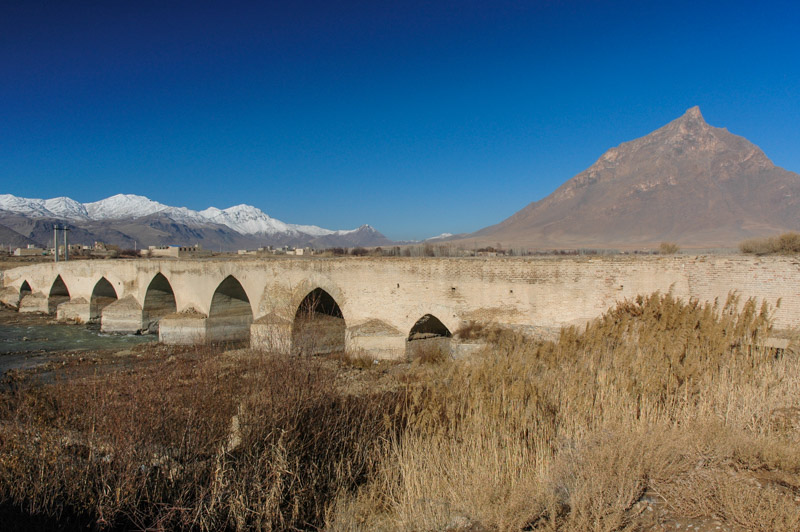
Do Ab Bridge, Shahzand, Markazi Province, Iran
On the evening of the 9th December 2007 I leave Kashan and after a night sleeping just outside the city of Qom, turn westwards and climb into the undulating plateaus of the Zagros Mountains; a cold, dry land of brown-streaked fields and distant, snow-capped mountains. In the province of Lorestan, I spend a few hours in the city of Borujerd which still shows signs of damage from a devastating earthquake which occurred eighteen months earlier, before turning north and stopping for a cold night sleeping on the edge of Hamadan, where temperatures plunge well below freezing. Hamadan is thought to be the location of ancient Ecbatana, capital of the Medes, an ancient Iranian people. Located at an elevation of around 1850 metres above sea level, Hamadan was one of the capitals of the Achaemenids and was the location of the summer palaces of the Parthians and Sassanians. Any remains from these periods however are buried below the modern city, which gives little impression of its great age.

Tomb of Esther and Mordecai, Hamadan, Hamadan Province, Iran
One intriguing site close to the central square is a relatively modern brick shrine, attributed to Esther (Hadassah), Jewish wife and queen of an Achaemenid Persian king, and her cousin Mordecai. Through the ages, Jews in Iran have, as in Europe, made up a significant minority and have experienced times of freedom, times of life as second-class citizens and times of outright persecution. As described in the Old Testament, it was the Achaemenid king Cyrus II (Cyrus The Great) who conquered Babylon and freed the Jews from captivity in the sixth century BCE, allowing them to return to Judea and build the Second Temple. Today, ‘Zionists’ are portrayed as the country’s greatest enemy in the propaganda of the Iranian regime and despite making a distinction between Zionists and Jews in general, most Iranian Jews have long-since emigrated to Israel or the US, and those that do remain keep a very low profile. A little further from the centre is the stout fourteenth century Seljuk-era Alavian Dome with fine interior stucco plasterwork that deeply impressed Robert Byron in my favourite travel book, The Road To Oxiana. Lastly I have a look at the modernist mausoleum of Avicenna, the medieval physician whose eleventh century Book of Healing remained in use in Europe until the seventeenth century.

Behistun Inscription, Bistoun, Kermanshah Province, Iran
I leave Hamadan in its bowl of snow-capped mountains and press deeper into the Zagros, crossing high ridges on the ancient road connecting the interior of the Iranian Plateau with the lowlands of Babylonia. Today the road is a significant pilgrim route for Iranian Shias making the journey to the holy cities of southern Iraq, and there are road signs counting down the distance to Karbala. The road passes under the cliffs on which is carved the magnificent Behistun Inscription; a huge relief from around 500 BCE showing King Darius I (Darius the Great) proclaiming his victory over various subject peoples of the ancient Achaemenid Empire. It also has hundreds of lines of cuneiform script in three languages; Old Persian, Elamite and Babylonian, and was therefore crucial to the deciphering of cuneiform script.
I stop for the day in the Kurdish city of Kermanshah, which is large but feels like something of a backwater, clearly less economically prosperous than the cities of central Iran. My Kurdish host here is Abdollah, the youngest of ten children, whose family are exceptionally generous and welcoming. More traditional and less westernised than other families I have stayed with so far in Iran, the warm family home is largely free from furniture with meals being taken on the floor in traditional Iranian style, and most of the family sleeping on the carpeted floor on a rolled-out mattress with a blanket; a clear cultural inheritance from the days when Iranians lived nomadic lives. Though they clearly identify themselves as being Kurdish Iranians, the family seem culturally very similar to Persians and hold no ambitions of an independent Kurdish state. For many members of Abdollah’s extended family who I meet at his brother Mojtaba’s house, I am the first foreigner with whom they have had contact and I’m asked whether I am a Christian, about my views of the current Iranian president, and my views of Palestine and Israel; a major topic promoted by the propaganda of the current Iranian regime, though Palestine is physically and culturally rather remote from Iran.

Investiture of Ardeshir II, Taq-e Bostan, Kermanshah Province, Iran
At the the foot of the mountains on the very northern edge of Kermanshah lies one of the finest carvings from the time of the Sassanian Empire. The Sassanians ruled Iran from 224 to 641 CE and oversaw the establishment of the second great Iranian empire, taking over the land of the loose confederacy of the earlier Parthian Empire. The Sassanians, whose capital was Ctesiphon, near Baghdad in modern-day Iraq, were in some ways the culmination of many centuries of Persian culture, and oversaw a golden age which lasted until the conquest of the Arabs. The Sassanians bequeathed a huge cultural inheritance to the invaders from the deserts of Arabia and greatly influenced the medieval Islamic world, particularly in the fields of architecture, art and governance.
The series of carvings, known as Taq-e Bostan, show the investiture of the fourth century king Ardeshir II, whose hair is tied up in a curious ball, by his predecessor and brother Shapur II, standing on the dead body of Roman Emperor Julianus Apostata and overlooked by what is thought to be Ahuramazda, the god of Zoroastrianism, which the Sassanians at times made the state religion of Iran. In a nearby archway carved from the native rock, overlooked by angels holding diadems are fantastically detailed hunting scenes from King Khosrow II, who reigned from the late sixth to early seventh century, and who remains perhaps the most celebrated Sassanian king. Khosrow expanded the Sassanian Empire to its greatest extent, very nearly matching that of the Achaemenids more than a millennium earlier, but he would also be the last to have more than a fleeting reign, as the Sassanian Empire, exhausted from wars with Byzantium, was rapidly overrun by the Arabs in the middle of the seventh century.
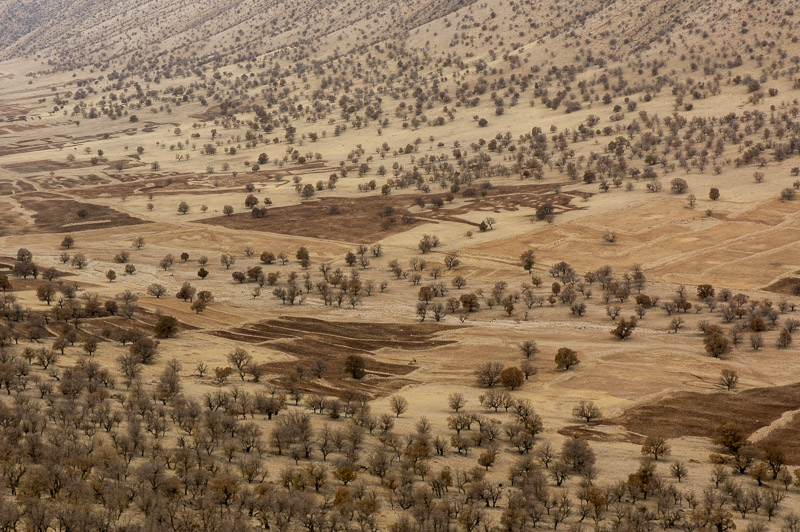
Landscape, Ilam Province, Iran
I leave Kermanshah driving westwards once more, through a sprawl of shabby and unplanned buildings on the city’s edge which look as if they will be levelled by the next earthquake. I crest the final passes of the Zagros, some penetrated by tunnels, and wind down from the freezing highlands through a beautiful landscape of rolling, dry hills covered in bare scrub oaks and chestnuts and separated by crenelated ridgelines, entering the south-western province of Ilam, named after the ancient civilization of Elam. As I delve deeper into Iran, further from the lightly-touristed central axis of the country I am subject to ever-more attention from the police; sometimes friendly, sometimes suspicious but usually a frustrating and time-consuming encounter with rather incompetent and sometimes unprofessional young conscripts. This (together with the appalling standard of driving throughout the country) would be a minor but ever-present annoyance when travelling in Iran, and a small insight into the the authoritarianism which so many Iranians complain about.

Chogha Zanbil Ziggurat, Khuzestan Province, Iran
South of the city of Ilam, the road drops down the last foothills and leaves the Iranian Plateau into a lowland area contiguous with Mesopotamia; a wide, open landscape of small dry hills, deeply incised river valleys and badlands. I stop in the evening in the small, calm border town of Mehran, where full Iranian oil tankers wait in long lines to enter Iraq. The air is warm and damp, and the streets are lined with palm trees and eucalypts. Mixed in with the soft tones of Persian are the harder, guttural notes of Arabic. I’m on the edge of the Arab world, just ten kilometres from the Iraqi frontier and the chaos unleashed by the Americans in much of the country beyond. In the morning I continue southwards, passing the occasional black-tent camps of Luri nomads which dot a landscape more reminiscent of Palestine than anywhere I have yet seen in Iran. After weeks in the freezing highlands and plains of the interior, the temperature is a balmy twenty degrees as I cross into the province of Khuzestan: a wide, sweltering alluvial plain watered by rivers which may be among the Biblical Rivers of Eden and which nurtured some of the world’s earliest civilisations.
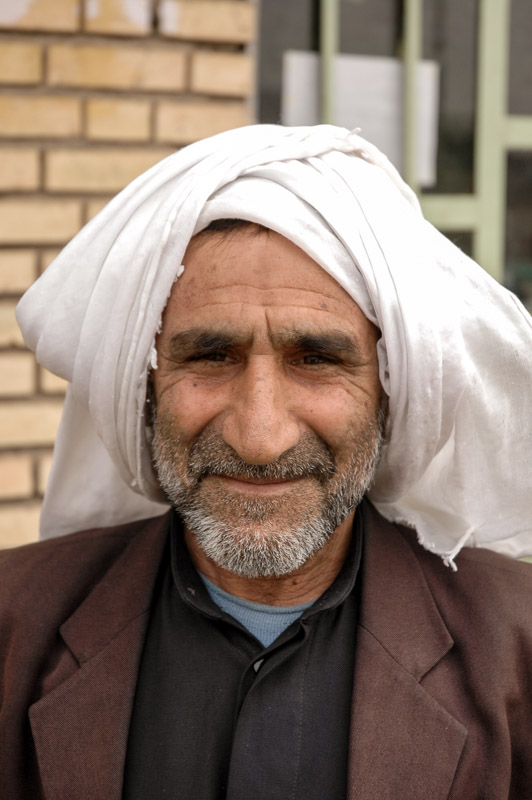
Arab Man, near Shush, Khuzestan Province, Iran
I stop in the sleepy provincial town of Shush, better known as ancient Susa, which is among the world’s oldest continuously inhabited settlements. Shush was at one time capital of what the Greeks called Susiana, but is known now as Elam, the name used historically in neighbouring Mesopotamia. The Elamites were a pre-Iranian people of the Ancient Near East, contemporaries of the Sumerians and Akkadians who from around 3200 BCE built up a rich and long-lasting culture in these fertile plains. Just outside Shush lies their finest surviving monument, the ziggurat of Chogha Zanbil, which was known as Dur Untash to the Elamites, named for the Middle Elamite king Untash. Dating from around 1250 BCE, the ziggurat preserves three of its original five tiers and among its huge brick walls are individual bricks bearing remarkably well-preserved Elamite cuneiform inscriptions.
The rich culture of the Elamites was adopted by the earliest arriving Iranian tribes, who are thought to have migrated into the Zagros sometime in the early first millennium BCE and who would go on to found the Achaemenid Empire, which retained Elamite as a court language. The Achaemenids, having conquered Elam, made Susa one of their capitals and the scant remains of the palace complex built by Cyrus The Great in the sixth century BCE lie next to the modern town, devastated by time, invading Arabs and Mongols and, more recently, plundering by Western archaeologists.
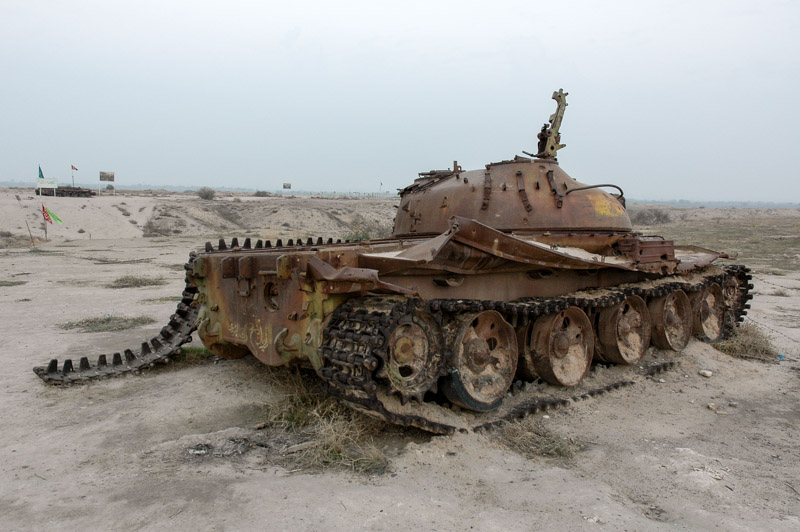
Destroyed Tank, Fath ol-Mobin, Khuzestan Province, Iran
The highlight of my stay in Shush however is Reza, a seventeen year-old budding musician whom I meet by chance in an internet café, and who invites me on the spot to come and stay with his family. This turns into a wonderful eight-day stay with his family, who seem genuinely thrilled to have a foreign guest. We spend days relaxing in the mild winter warmth (in summer Shush can reach an unbearable fifty degrees), exploring Shush and its surroundings, while evenings are often spent at the homes of extended family members being fed chicken, kebabs and stews, with fine rice from the Caspian region, fruit and endless rounds of tea until I’m absolutely full and ready to sleep.
Reza and his family are Persians, but much of the population of Shush are Arabs and Reza takes me to meet Saeed, an Arab teacher of his. Saeed explains how he feels a second class citizen in his own country, and makes it clear that he wants nothing but to leave Iran with his young family, even if it means being split from them for years.
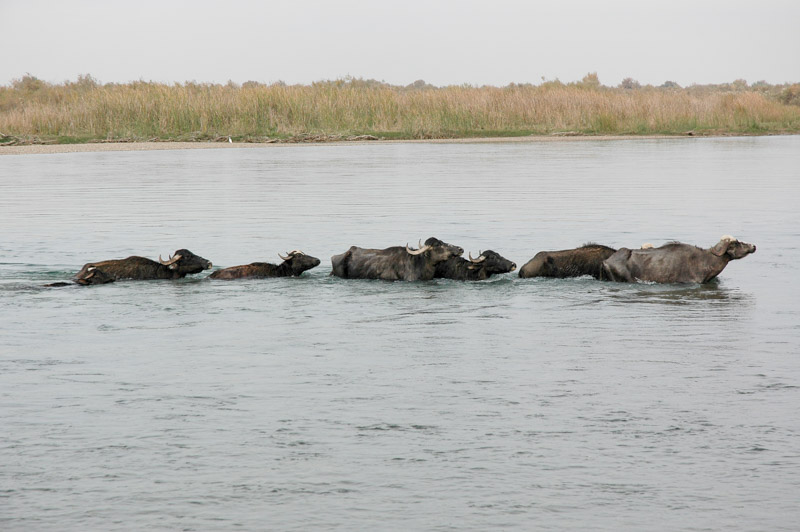
Water Buffalo in the Karkheh River, Khuzestan Province, Iran
Together with Reza and his uncle Mehdi, we drive with Saeed out into the countryside just beyond Shush to the Karkheh River and a spot littered with wrecked tanks, trenches and barbed wire, named for the key Battle of Fath ol-Mobin which saw Iranian forces drive the Iraqis back from the edge of Shush in March 1982, with the battle raging on the exact day that I was born. The horrors of the Iran-Iraq War, which saw trench warfare, waves of infantry attacks by teenage conscripts mowed down by machine gun fire, and the use of chemical weapons still traumatises many Iranians. Shohada (martyrs) from the Iran-Iraq War are commemorated in all Iranian cities with moving plaques bearing portraits of boys as young as fourteen who were sent to war. Beyond simple grief however, the death of these young men plays very much into the Shia identity, drawing strong parallels with the martyrdom of Imam Hussein in the Battle of Karbala in 680 CE, one of the most important events in the history of Shia Islam. For Saeed however, a Sunni Arab, there is a more immediately personal note. He tells me that his uncle and grandfather, whilst fighting for the Iranian side during the war, were accused of espionage by fellow soldiers and were later executed. Whilst the welcome from the Iranian people is exceptionally warm, the brutality of the Iranian regime is chilling.

Hawizeh Marshes, Khuzestan Province, Iran
Sadly, the time comes to depart from my adopted family in Shush and as I leave the family home, Reza’s mother holds a copy of the Qur’an in the air, under which I pass whilst she says a prayer to wish me a safe onward journey. I stop in the ancient town of Shushtar to look briefly at the Sassanian-era dam on the Karun River, built by captured Roman soldiers in the third century CE, then continue southwards towards the provincial capital Ahvaz. In the outskirts of the city I stop in a car parts shop and after haggling over the price of my purchase, the two Arab brothers running the shop, Razi and Nasser, immediately invite me to the family home for a lunch of kebabs. They live in what appears to be a standard Iranian home, but the dynamic of the family is slightly different; less European with the men eating separately, reclining and shouting for the women to bring food, drink and all other accoutrements to the meal. South of Ahvaz the road becomes arrow-straight as it tracks the Iraqi border, with spiny acacia trees on one side and eucalypts on the other. The air becomes thicker as I near the Persian Gulf; a white haze at midday which turns to a warm, pale blue in the afternoon as the sun softens. To the west, an expanse of beautiful deep-blue water appears, and to the east is a sea of lush green reeds, chattering with birds. I am driving through the eastern edge of the Hawizeh Marshes, part of the great wetlands around the Lower Tigris and Euphrates rivers, on the Iraqi side home to the Marsh Arabs who continue a way of life not dissimilar from the ancient Sumerians.

Shatt al-Arab River, Abadan, Iran
In the evening I reach Abadan, which has none of the ancient atmosphere of many Iranian cities, but is a clean and pleasant place, made affluent by the proceeds from nearby oil fields and refineries. Arabic seems to be the language on the street and the city feels more cosmopolitan than any other I’ve visited so far in Iran. Large American cars stand out against the normal background of Iranian-made Kias and Peugeots, and some of the affluent suburbs of the city look startlingly like suburban America, with spacious detached houses surrounded by lawns. There is even a well-kept Armenian church in the city centre. With this cosmopolitanism come a cast of eccentric characters, beautiful girls and a far less authoritarian atmosphere than the cities further inland. The focus of the city is the Shatt al-Arab, the sum of the Tigris and Euphrates which the Iranians call the Arvand, which leads down to the Persian Gulf around sixty kilometres away. The details of the demarcation of the Iran – Iraq border on the bed of the river were a long-standing point of contention between the two countries and one of the main causes of the outbreak of war in 1980, which devastated Abadan and saw the adjacent city of Khorramshahr occupied by Iraqi forces. The remains of shelled city blocks can still be seen in Abadan as a poignant reminder of a war which ended less than twenty years ago. Today of course the city is tranquil and the river buzzes with traffic; simple wooden lanj vessels, motorised versions of the ancient dhow whose crews shuttle goods between Iran and the Gulf States. Beyond the far shore stretch the palm-dotted plains of Iraq, ancient Mesopotamia, embroiled in war and sadly off-limits.

Persian Gulf Coast, Bushehr, Bushehr Province, Iran
From Abadan my journey takes a new direction; since leaving Siberia almost six months ago I have been gradually making my way south-westwards but Abadan marks the point from which I will begin a long journey eastwards to the Indian Subcontinent. Leaving the environs of the city, the road immediately enters a rank, salinated plain of drained and cleared marshland which reflects a blinding white in the sunlight. There is nothing on which the eye may settle, except for the straight road and a line of electricity pylons stretching in a perfect line into hazy infinity, and I settle into an almost meditative state. I pass a huge petrochemical plant in the city of Bandar Imam Khomeini, which fills the air with noxious-looking brownish-white fumes, then later enter a scrubby landscape of squalid-looking villages and goatherds, catching my first glimpse of the sea off to the south since leaving the UK on the very first day of the trip.
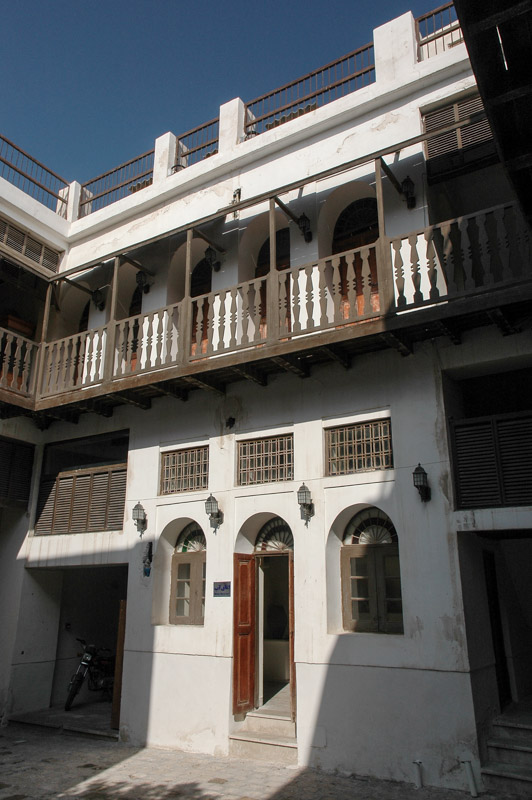
Bandari House, Bushehr, Bushehr Province, Iran
I stop in Bushehr, an ancient port picturesquely situated on the northern edge of a curving headland which juts out into the Persian Gulf. Like Abadan, Bushehr has a more relaxed and worldly air than most Iranian cities. In the twentieth century Bandar Abbas, off down the coast to the east, became Iran’s premier port, leaving Bushehr in an air of gentle decay. A crumbling old city still holds glimpses of once-elegant mansions in the Bandari style of the Persian Gulf Coast and a neglected British cemetery is a reminder that Bushehr was the location of the British Persian Gulf Residency for almost two hundred years.
I’m hosted in Bushehr by Pedram and his beautiful young wife Zahra who doesn’t cover her hair in front of me, and neither are religious. Once out of the house, Pedram is very much a bachelor, cruising around town and stopping by his various businesses, some of which I see, and others of which I don’t. After a hot-dog from Pedram’s own fast food restaurant, we head off to a pool hall and meet his friend Reza, whom I meet again the following day in his family house. Reza’s family are clearly wealthy, with a comfortable, well-equipped house and a big, luxury car. They are Old Rich; before the revolution, Reza’s father was a high-ranking engineer in the Imperial Iranian Navy, a well-respected and well-paid job.
In the evening we go out on a foray to purchase black-market petrol (to circumvent recent fuel rationing) from some boys in a shabby house in the harbour, then return to Reza’s own comfortable apartment. As we are talking in the evening, Reza brings out a pair of handguns and tells me of the story of a three-million dollar illegal deal with two friends to sell some unspecified ancient artefacts they had uncovered to British art dealers. Unfortunately, the trio had been caught in the act and were jailed, with only Reza escaping thanks to a bribe of several hundred thousand dollars while his accomplices still languish in jail.

Apadana Palace, Persepolis, Marvdasht, Fars Province, Iran
Drawing myself away from the slightly iniquitous underbelly of this charming port city, I drive north-eastwards back up to the deep-blue skies of the Iranian Plateau in Iran’s southern Fars Province, the cultural heartland of the ancient Iranian Achaemenid and Sassanian Empires and arguably also the Elamites. This area is littered with the remains of past empires but its undoubted highlight is the ancient Achaemenid city of Persepolis, located on the plain of modern Marvdasht. Persepolis appears to have been a largely ceremonial capital in the Zagros, a remote and inaccessible location, but of importance as the ancestral heartland of the Persians. Thought to have been built by Darius The Great in the sixth century BCE, the ruins of the great city are hugely impressive; comparable to Palmyra in the Syrian Desert, with clear remains of ancient imperial palaces; punctuated against the winter sky by old columns; some still standing, some toppled, some truncated to mere stumps, which would have supported long-gone roofs of Lebanese cedar and Indian teak.

Apadana Staircase, Persepolis, Marvdasht, Fars Province, Iran
Darius oversaw the expansion of the Achaemenid Empire to its greatest extent; connecting the ancient civilisations of Mesopotamia and Egypt to the Mediterranean in the west and the Indus Valley in the east, by far the largest empire the world had ever seen at the time. Persepolis was the cultural centre of this and it is thought that on the Iranian New Year Nowruz, still widely celebrated today in Iran and many surrounding countries, delegates would come from across the vast land empire to pay tribute to the great Shahanshah, the king of kings, and be thoroughly awed and humbled by the grandeur of the palaces of the imperial capital. It is the surviving bas-reliefs depicting such scenes which make Persepolis so much more compelling than other ancient ruins in the region, for their crisp depiction and detail, thankfully still on show in the open rather than being museum pieces. One experiences these scenes when passing through the tall doorways of the palaces and, most spectacularly, on the Apadana Staircase, a long walkway leading to the royal audience hall. The sides of the Apadana show supplicants in brilliant detail of their distinctive dress, bearing gifts, having made journeys from across the empire; from what is now Iran, Afghanistan, Armenia, Tajikistan, Uzbekistan, Iraq, Syria, Pakistan, Turkey, Egypt, plus parts of Greece, the Black Sea Region, Arabia and Ethiopia.
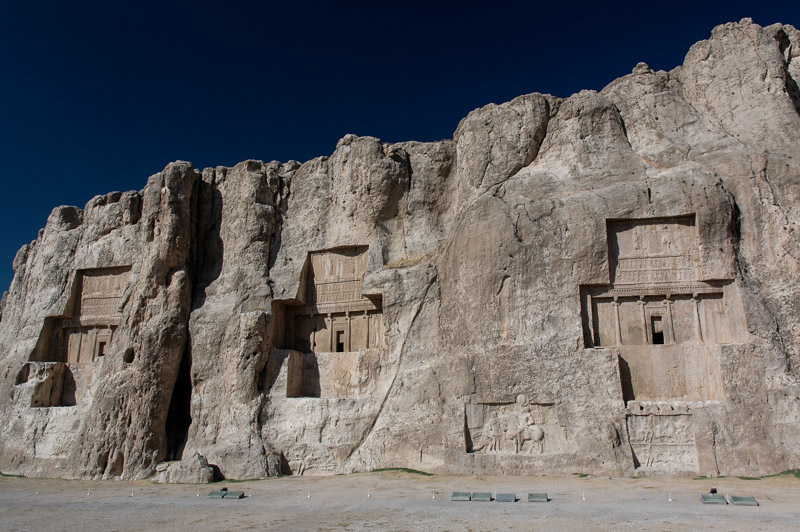
Naqsh-e Rustam, Fars Province, Iran
The Greeks, once they had come into contact with the Achaemenid Persians became sworn enemies, regarding them as eastern Barbarians and making the distinction between Europe and Asia based on this prejudice, a distinction which lasts until today, splitting Eurasia through the straits of the Dardanelles across which Xerxes I, son of Darius the Great, attacked the Greeks and burnt Athens to the ground in 480 BCE. When Alexander The Great came east into Achaemenid Persia in 331 BCE he was unaware of the existence of Persepolis, such was the obscurity of the ceremonial capital. Perhaps in vengeance for the burning of Athens, or perhaps by mistake in an orgy of drunken revelry, Alexander’s forces burned Persepolis to the ground, and it has remained an enigmatic ruin ever since. Alexander marked the end for the Achaemenid Empire, chasing the last Achaemenid King Bessus (Artaxerxes V) into Bactria, then returning him to Iran for trial and gruesome execution.

Tomb Of Cyrus The Great, Pasargadae, Fars Province, Iran
The following day, I return to the plain just north of Persepolis, to a site known as Naqsh-e Rustam, most famous for the striking rock-cut tombs of four Achaemenid kings, including Darius The Great and Xerxes I. The site is though to have been of significance to the Elamites, who left a now-faint carving from around 1000 BCE. Below the Achaemenid tombs are third and fourth century CE Sassanian reliefs, similar to those at Taq-e Bostan. It’s quite amazing to think that the Achaemenid tombs were already seven to eight hundred years old when the Sassanians left their mark. This area was clearly also of cultural importance to the Sassanians and their early capital of Estakhir lies just across the road, though like the Achaemenids they soon moved their capital west to modern-day Iraq. Crossing a ridge to the north of the Marvdasht Plain lies Pasargadae, the Achaemenid capital of Cyrus II (Cyrus the Great) prior to the construction of Persepolis. Here lies the simple yet imposing tomb of Cyrus the Great, on a tall, stepped plinth; the great founder of the Achaemenid Empire, a king renowned for his respect for all subjugated nations and declaration of human rights, liberator of the Jews from Babylon and the only non-Jewish messiah in the Old Testament. In a country so overwhelmed with intransigent theocratic rhetoric, this elegant tomb of the founder of a great empire who lived long before any revelation had come to the Bedu of the Arabian Peninsula, is perhaps the most common national and cultural emblem for the non-religious portion of Iranian society. It’s a portion of society whose existence the ruling clerics don’t like to acknowledge, and a history whose pre-Islamic nature the government are not keen to promote.
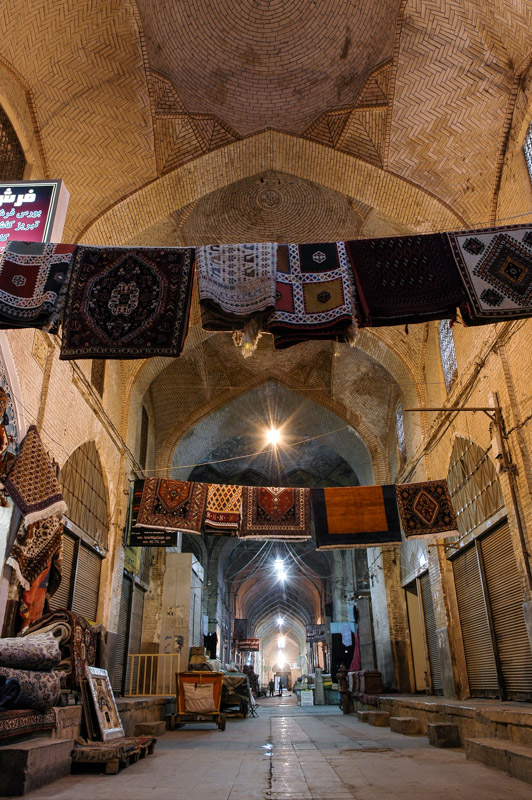
Vakil Bazaar, Shiraz, Fars Province, Iran
The modern capital of Fars Province, Shiraz lies around fifty kilometres south of Persepolis, and is the favourite city of many Iranians, a city known for its poets, literature and fine gardens and flowers. Shiraz was capital of Iran in the second half of the eighteenth century under the short-lived Zand Dynasty, and though it lacks the exotic architecture of Isfahan’s centre, it strikes me as a slightly nicer place to wander. For me, the highlight is the magnificent, vaulted Vakil Bazaar whose passageways lead to fine mosques, caravanserais and madrasas (seminaries), all well integrated into the cultural fabric of the city.
Among more religious-leaning Iranians Shiraz is also a place of pilgrimage, to places such as the Safavid-era shrine of Shah Cheragh, brother of Imam Reza. However, I am beginning to see such places as much as mouthpieces of the government’s propaganda machine as they are places of genuine religious piety, and am starting to lose my admiration of them. Instead, on my final evening in the area, I go to the shrine of the fourteenth century poet Hafez, perhaps the most popular of all poets in Iran and whose tomb is located in a pleasant small park, covered by a simple eight-columned pavilion. Hafez seems to be a great uniting figure in modern Iran, almost universally loved by all strata of Iranian society. It’s a rare chance to see young and old, liberal and conservative, secular and religious come and enjoy the very same place, and I watch as a small gathering of people come to sing and recite poetry above his marble tombstone, admiring the richness of Iranian culture.

Zagros Mountains, near Lar, Fars Province, Iran
The next day is New Year’s Day in the Western calendar, but I’m barely aware of the fact. I leave my base in the town of Zarghan and begin a circuitous route southwards towards the southern edge of the Zagros and the Persian Gulf. I pass the huge salt pan of Lake Bakhtegan, driving on small county roads until, well after dark, I get lost and end up on a dead-end road in a dusty village in the middle of the desert. Retracing my steps I find the correct road but am almost out of fuel when I’m stopped and detained by the police in the small town of Lar, where I sleep in the police station’s mosque. The next day everything is better; the matter with the police is sorted and I find that a curious noise from one of the rear wheels is just loose wheel nuts from a tyre changer in Shush who failed to re-tighten them. Leaving Lar, the scenery is striking as I enter the folded ridges of the southern Zagros, where the high plains turn into waterless desert; a huge arid region which extends all the way east from here to the Indus River in Pakistan. The road passes through sweeping, dry valleys punctuated with domed water cisterns and sparse acacias, then crosses a low pass to the south in order to enter the next valley on its the way down to the sea. People here look different; darker skinned and poorer as I wind down through villages of shabby hovels, goats and camels, onto the barren coastal plains of Hormozgan Province.

Camel Herder, near Bandar Abbas, Hormozgan Province, Iran
I stop in the evening in the port city of Bandar Abbas, known to locals simply as Bandar (port). Architecturally a characterless modern sprawl even worse than Tehran, Bandar has the slightly seedy air of a major port and a population whose faces show influences of Arabs and Africans. Indeed, even more than other port cities of Iran, these cultural contacts with the outside world together with, perhaps, the proximity to the neutrality of the ocean mean that Bandar feels even more remote from the joyless theocracy based in Tehran. I’m hosted in Bandar by Mehdi, a Bandari student who seems to embody the city’s easy-going atmosphere. Whilst the rest of Iran is experiencing one of its coldest and snowiest winters in decades, with temperatures plunging to twenty below zero, here the temperature is a balmy twenty to twenty five degrees, another factor which encourages me into staying for eleven days in the city.

Masked Women, Minab, Hormozgan Province, Iran
Mehdi and I make a trip to the nearby city of Minab, famed for its colourful Thursday market that takes place on a large, dry riverbed, with stalls spilling out quite haphazardly on the gravelly surface. Amid the stalls, a crowd gathers around one young man who wrestles a viper, then wraps himself in chains and appears to break free by his own strength, all in the hope of some donations from entertained shoppers. There’s also a slight air of corruption, and in the backrooms of the city there is a flourishing trade in illegal, smuggled alcohol. Most striking by far however, are the masks which some Bandari women wear here. These colourful embroidered masks, most commonly in rich shades of burgundy or vermilion, cover that small par of a woman’s face which is exposed by their chador and is a traditional fashion peculiar to this region of the Gulf coast. They seem hugely impractical, with a central vertical ridge dividing the sight of left and right eyes, but they are a striking dash of colour and novelty in a country where people generally dress in plain clothes.
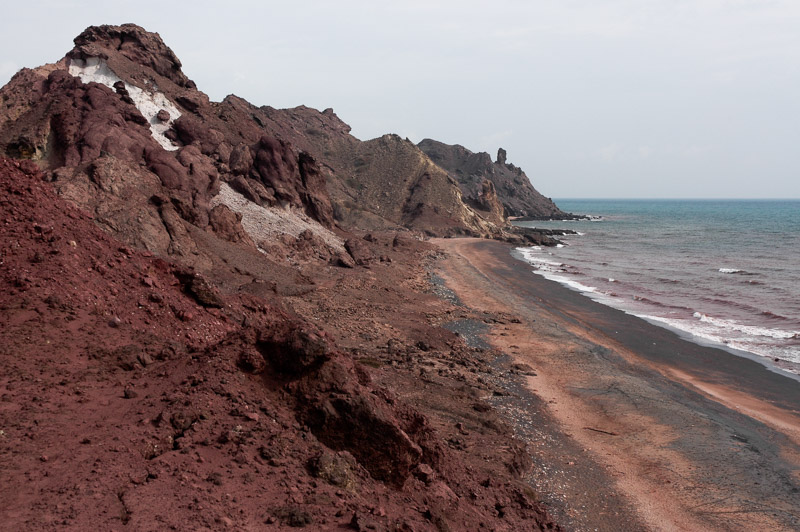
Salt Dome, Hormuz Island, Hormozgan Province, Iran
On another day, Mehdi and I make the short journey from Bandar by motor launch to the island of Hormuz, at the northern edge of the politically sensitive Straits of Hormuz. All across southern Iran, salt domes appear amongst the folds of the Zagros, pushed to the surface by their own buoyancy compared to surrounding rock. Hormuz Island has formed by the actions of one such salt dome, and parts of the island’s surface are pure salt. Despite being tiny and waterless, the island has a long history owing to its strategic position on maritime trade routes, though it was the Portuguese who left the most enduring mark, in the form of a fortress with an underground church and water cistern hewn out of the native red rock. Whilst enjoying the warm sea breeze we meet an Iranian woman with her daughter and friend, and the five of us hire a taxi to drive us around the island. On a beautiful beach on the south coast, where soft, salty red rocks dissolve into the lapping seawater causing it to take on a blood-like colour, we paddle with the girls, who even go so far as to remove their headscarves. In a country where it is technically illegal for unmarried or unrelated men and women have any kind of social interaction, this feels like a rare treat indeed. In more than two months in Iran, it is the first time I have seen a women’s hair in public and the only time where a young woman has felt comfortable enough to open up to any degree in public without continually looking over her shoulder.

Highway 91, Kerman Province, Iran
The time comes to leave Mehdi and his welcoming family, and the warmth of the coast, and head inland to make the journey of just over eight hundred kilometres to the Pakistani frontier. The road climbs through cold, purple-tinged mountains, crossing a high pass back onto the Iranian Plateau, now lashed by damp, freezing winds. It’s a scene of marvellous desolation where dark, barren mountains float on the endless gravelly plain as I head north on Highway 91, then east onto Highway 84. Shortly beyond Bam I slip through a security checkpoint unnoticed and enter wild Sistan and Baluchistan Province, which every Iranian has warned me is unsafe. While I know this is rather over-hyped, I am nevertheless glad to reach the capital Zahedan without incident, well after dark. I remember Zahedan as a wild, swelteringly hot frontier town where I was struck down with heat exhaustion and dysentery in July 2003, but tonight I stop only long enough to have dinner. I continue alone towards the border but am finally stopped at a police checkpost around fifty kilometres short of the border crossing at Mirjaveh. In the morning I am given a gormless, unarmed teenage conscript as a ‘guard’ and before long am processed at the customs hall and ready to leave the Islamic Republic of Iran.
I leave Iran with many very positive experiences, but I am glad to leave. My greatest impression has been of the people; deeply welcoming, cultured and sensitive, products of a glorious history stretching thousands of years, made rich by the influences brought by countless invaders. This, together with the ability to find relics from all historic epochs makes Iran for me one of the most rewarding countries in which to travel, and one which I would return to many times more in subsequent years. But along with all these joys is a slight feeling of unease; the pressure of being in a police state which seeks to control almost every aspect of the lives of the Iranian populace; a regime which, together with crippling foreign sanctions, holds back the country’s potential, drives many of its greatest minds into exile and seeks to replace Iranian culture with its own joyless, regressive theocracy, which seems so at odds with the richness of Iran’s dynamic history. However, Iraniyat, the concept of Iranian-ness, is far older than the current regime, and indeed older than Islam itself, and it seems inevitable that the country will one day regain its place on the world stage.
Now however is the time to reacquaint myself with the marvellous country of Pakistan.
 EurasiaOverland