
Stage 8 – India & Bangladesh: Punjab To Bengal [2/2]
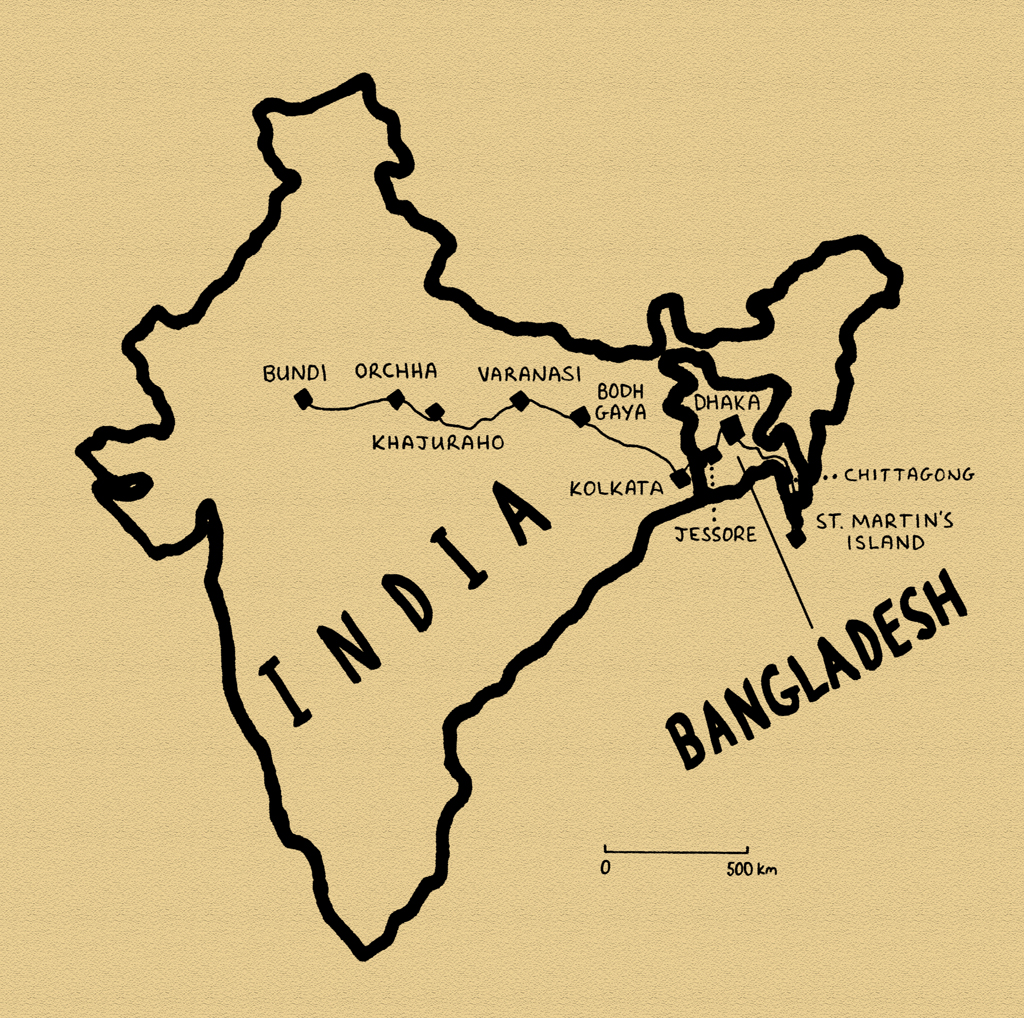 Having crossed the Indian Punjab and explored the impressive desert state of Rajasthan, I would now set off across the historic Gangetic Plain of northern India, following the Grand Trunk Road to the vibrant city of Kolkata, crossing into the teeming lowlands of Bangladesh and completing my eastward crossing of the subcontinent on the paradise island of St. Martin’s, overlooking the forbidden coastline of Myanmar.

Temple, Orchha, Madhya Pradesh, India
It’s the 24th March 2008, and I leave Boštjan in the city of Kota, where we had relaxed for a day after the excesses of Holi. Boštjan is moving north, to go skiing in Kashmir (somewhere I will not reach until the end of August), and I am heading east, out of Rajasthan. The traffic is light on the smooth new road which moves from the arid plains of Rajasthan onto the red-rock plateau of the state of Madhya Pradesh. Farmland starts to appear, and I stop in the ancient town of Orchha, where the wheat fields are dotted with centuries-old Hindu temples, many abandoned (a temple may no longer be used if the main idol is broken). I relax here a day before moving on east.
Beyond the reach of zealous Muslim invaders and covetous colonial art-collectors, the sandstone temples in the village of Khajuraho, hidden away in the sparsely populated Panna Hills of northern Madhya Pradesh, show perhaps the largest and best preserved collection of erotic temple sculptures in India. A set of twenty-five 10th to 12th century, Chandela-era temples lie in the village, the exterior of many of which is covered in thousands of intricately carved figurines. Whilst most show scenes of battle (as is common in temple architecture of the period), some show highly erotic scenes reminiscent (though not representative) of the Kamasutra.

Temple Sculptures, Khajuraho, Madhya Pradesh, India
Some of the dioramas show extremely elaborate coital arrangements, necessitating the use of several assistants, while others are far cruder, and some show outright bestiality. Behind the light-hearted titillation lies considerable artistic skill, and for carvings up to a thousand years old, they are in an amazing state of preservation. Some of the ‘dancing girls’ (a euphemism still used today in South Asia for prostitutes), whose more curved areas are polished smooth by centuries of (presumably male) caresses, are of eye-catching sensuality, depicting lithe, full-breasted and comely girls in scanty clothing. It’s surprising how similar their poses and attire are to models in contemporary western ‘gentlemans’ magazines, but poses the obvious question in this prudish society, where women of wealthy families are usually rather large, and hidden from view, of what these pictures really represent. Are they depicting the antics of kings and their ‘dancing girls’ or was Indian society of a thousand years ago more open with regards to sex and sensuality than today?
The answer lies the invaders who have come to India in the intervening period; firstly the Moghuls, who although famed for their harems and pleasure palaces, represented a religion which found the artistic rendition of the human form unacceptable. One can only imagine the reaction of Muslim settlers on seeing that the temples of these idolatrous Hindus were adorned with such obscene decorations. But it was under the Victorian British colonial overlords that the last blow was dealt to Indian sexual liberalism. Together, the Muslims and the British brought a prudishness into Indian society, which remains largely intact. Interestingly, Indian society is slowly loosening-up when it comes to such matters, with scenes of mild intimacy arriving for the first time on Bollywood screens, amid much controversy.
The time has come to head down onto the Gangetic Plain of Northern India, the wide, lowland belt between the Himalaya and the Deccan Plateau, through which that most venerated of Indian rivers, the Ganga (Ganges) flows. This swathe of fertile land lies at the very heart of the Indian story; it is here where the invading Aryans planted the seeds of Vedic beliefs that would become Hinduism, and here where Buddhism was born. I head straight to one of India’s great cultural centres; the holy Hindu city of Varanasi.

Manikarnika Ghat, Varanasi, Uttar Pradesh, India
At Manikarnika Ghat (a concourse of steps leading down to the banks of a river), one sees laid-bare one important aspect of Hinduism, in fact of life itself: Death, in the funeral ritual of Antyesti. Varanasi is a holy place to die; it is said that anything which dies here will break free from the cycle of endless rebirths, and the soul will be transported to heaven. People come to Varanasi to die, and along the river there are buildings full of old people waiting to do just that. These ghats on the Ganga are the municipal funerary grounds, and the air is thick with the smoke of numerous funerary pyres. The body of the deceased, wrapped in new clothes, is brought down to the riverside by members of a caste of untouchable undertakers, who ritually cleanse the body in the murky green waters of the Ganga. The chief mourner, generally the eldest son of the deceased (women are not permitted at the funeral, lest their displays of emotion prevents the gods from accepting the soul into heaven), his head shaved, and dressed in the mourning colour of white, leads the service. The body, rigid, emaciated and cocooned, is placed upon the pyre, feet facing south, and an untouchable carrying a flaming handful of straw from a nearby temple sets it ablaze. The fire soon consumes the body, giving off a subtle but nauseating odour. The critical point is the breaking of the skull, which releases the soul of the deceased into the hereafter. The bereaved men look on, showing no emotion aside perhaps from a hint of celebration as their loved one’s soul departs, unmoved by the destruction of the soul’s Earthly vehicle. It’s a deeply telling scene of Hinduism.
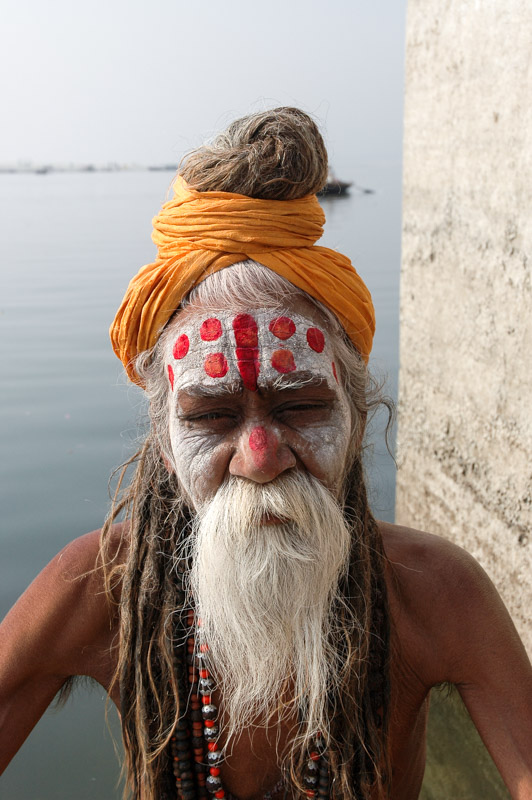
Saddhu, Varanasi, Uttar Pradesh, India
This amazing spectacle unfolds openly, hundreds of times each day along the short stretch of ghats here in the city’s old centre, whilst in a street not twenty metres away motorcycles wind through crowds of busy pilgrims, foreign tourists and itinerant cows. A hundred metres downstream of the funeral ghats, close enough to see the last remains of funeral pyres floating past (plus plenty of sewage outfalls), hundreds of pilgrims gather at dawn each day to bathe in this most holy of Indian rivers; families bring their aged relatives and help them into the soothing murkiness of the Ganga, children are anointed with its waters and people will even take nips of the stuff. The streets throng with visitors, holy men, souvenir peddlers, beggars, con-artists and pickpockets, all jostling through the crowded bazaars and deftly avoiding the numerous piles of cow manure.
Varanasi is in many ways the quintessential Indian experience. For all its piety as a holy city, and the insight into Hindu life, it’s equally soulless, embodying the seedy Indian tourist industry and the most revolting squalor. It’s shocking, fascinating, life-affirming, repulsive, tiresome, and awful all at once; no place better embodies the Indian travel experience for me. The city is something of a milestone on my Indian journey, as from here, everything will feel more low-key and easy-going as I head further east towards the point where the Ganga and the Brahmaputra meet and flow into the Indian Ocean: Bengal.

Mahabodi Temple, Bodh Gaya, Bihar, India
Sometime shortly after 500 BC, at the southern edge of the Gangetic Plain, south of the city of Patna in the sweltering green plains of the state of Bihar, Prince Siddhartha Gautama, one of the region’s many haggard mendicants and renouncers, sat under a pipal tree. He was tempted by a she-demon with all the pleasures of the world, and in denying them attained supreme enlightenment, to become the Buddha. Today, this sacred spot, the most holy site for Buddhists, lies in the village of Bodh Gaya. Though Buddha would have rejected the notion of making a place, or even himself, the object of adoration, such is the human need for some physical object of worship, that the village has grown into what resembles an embassy district of temples constructed by various Buddhist countries. In the desperately poor Bihari rice paddies, amid scenes of un-mechanised agriculture which must have changed little since the time of the Buddha, stand the temples, monasteries and guest houses from Tibet, Nepal, Sikkim, Bhutan, Sri Lanka, China, Myanmar (Burma), Thailand, Vietnam, Japan, Bangladesh and South Korea. Monks flit around town from their respective centres, dressed in crimson, bright orange, mustard brown or sepia robes, amongst pilgrims from all over Asia. At the centre of the entire complex is the 5th to 6th century Mahabodhi Temple, built next to the very point upon which the Prince Siddhartha is said to have sat, where there stands a tree which is said to be a descendent of a tree in Sri Lanka which itself was a descendent of the original. To this revered spot, some come after days, weeks, months, or sometimes even years of painful prostrations; moving two steps before stooping to lie flat on the ground, pressing their forehead against the Earth, their palms pressed together ahead of them in prayer.

Prostrating Monk, Mahabodi Temple, Bodh Gaya, Bihar, India
Sitting around this temple, watching the shades of devotion from pilgrims and tourists from across a huge swathe of Asia, I meet Tenzin, a forty-seven year old monk from Tibet. He speaks good English, and he tells me he is here as a refugee, rather than just a pilgrim. After guiding an American journalist in Tibet for five months, he was left with a videotape from the Dalai Lama containing messages of support from western activists; a dangerous thing in Tibet. The authorities soon came to hear of the materials, and seven PSB (Chinese police) visited his monastery, beating the eighty-seven year old head Lama until Tenzin arrived at the scene. They told Tenzin to spit and urinate on a picture of the Dalai Lama, and when he refused, beat him savagely, inserted a baton into his anus and wiped it on the picture, before beating him unconscious.
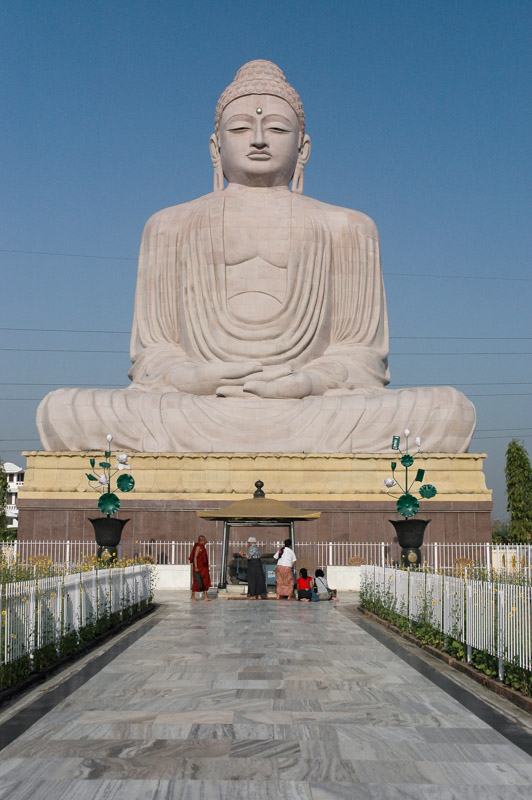
Japanese Buddha, Bodh Gaya, Bihar, India
Tenzin was sentenced to three years in a Lhasa prison, but in October 2007, he and two others bribed a prison guard and fled. After making a final visit to his only remaining relative, his eighty-eight year-old mother (his father was killed by the PSB in 1960, and his sister died within a week of being released from a PSB jail in 1986), he started a hazardous journey across the freezing wastes of the Tibetan Plateau, travelling by night for fear of being spotted, crossing the world’s highest mountain range to reach the Nepali border. Here the Nepali authorities took everything he owned except for his clothes, destroyed his identity documents, but finally allowed him to pass. Tenzin, a man who had lived in a monastery since the age of seven, suddenly found himself alone and destitute in a foreign country, but managed to make his way to Bodh Gaya, where he survived on handouts and some work showing foreign tourists around. He’s an immediately endearing guy, and has a hint of child-like wonder at his new life. He plans to make it all the way south to a Buddhist monastery in Bangalore. There are thousands of such stories of the brutalities from the present-day Chinese occupation of Tibet, but the story also reminds one of just how religiously tolerant India really is, and has been, for centuries.
Consider the story of the Buddha himself. As he wandered through this region of India, then known as Magadha, in the 5th century BC, he renounced not just the technicalities of the early Hindu faith, but its very basis; that the ancient Brahmin fire-rituals were not bringing people any spiritual gain. For doing this, no harm came to him, and Buddhism spread peacefully throughout the region. Buddhism subsequently spread across Asia in two schools, Theravada (south and east to South-east Asia) and Mahayana (initially west, then north and east to Tibet and Mongolia). Ironically, given it was the birthplace of Buddhism, India now has virtually no Buddhist communities which can trace their faith back to its origins here in Bihar. A renaissance and resurgence in the popularity of Hinduism between the 5th and 11th centuries largely replaced Buddhism, with Nepal and Sri-Lanka having the only indigenous Theravada Buddhist communities on the subcontinent.
I leave Bodh Gaya with a more positive view of India, and make my final drive along the Grand Trunk Road through the dry hills of the tribal state of Jharkhand, down into the almost fluorescent green rice paddies and water-hyacinth fields of West Bengal, to the metropolis of Kolkata (Calcutta). My first indication that West Bengal is a little different from the rest of India, a little more civilised, comes shortly after the state border, as I’m driving through a small town. I sound the horn to scatter some pedestrians from a zebra crossing (standard practice in India), and am immediately pulled over by a policeman, who shrugs his shoulders and raises his arms; the message is clear. In West Bengal, there are rules!
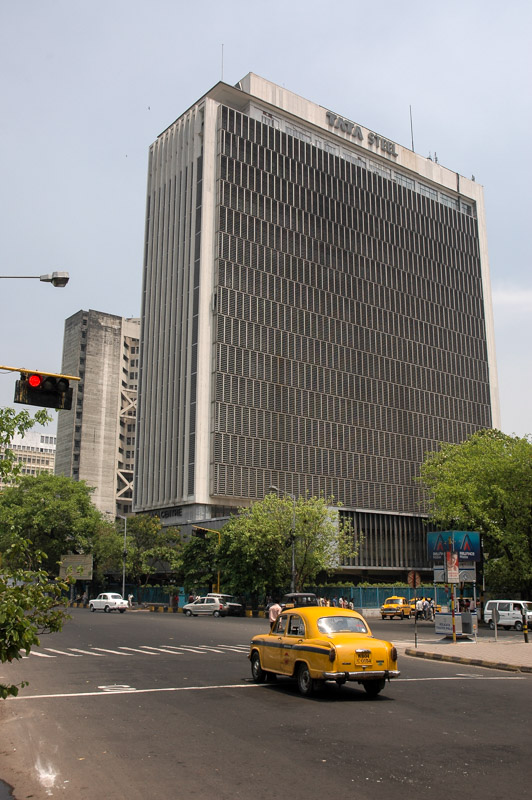
City Centre, Kolkata, West Bengal, India
I drive over the Hugli River into Kolkata and immediately warm to the place; despite being a city of fourteen million, it has a noticeably different air from other parts of India; not of a holy city, or a tourist trap, but of a real city in the modern sense of the word; a place of commerce, unrelated to the spiritual. This in my mind is due to two reasons; firstly that the city was created from scratch as a planned city (principally by the British), but more importantly, due to the Bengalis themselves. Bengalis strike me as being more civilised, open-minded, intelligent, and cultured than other Indian city-dwellers I have encountered. Bengal was the intellectual and industrial centre of the British Raj, with Calcutta its capital from around 1690 to 1911, and this legacy survives today. Many of the country’s big industrialists such as Tata and Birla hail from, and still base themselves here, recruiting from the city’s prestigious universities. It’s a city of modest attractions; colonial churches and monuments, which seem more conspicuous than the many Hindu temples, a welcome respite from Varanasi. It’s the first place in India I’ve enjoyed as a whole, rather than for a specific attraction.
My host in the city is Rudradeb, a Bengali Lawyer who speaks English with a public-school accent that I’m a touch envious of. He comes from a wealthy and once powerful Bengali background, and as we sit on his balcony in the salubrious suburb of Tollygunge, watching the oily clouds of a pre-monsoonal storm gather, he indicates that much of the land in this area once belonged to his family. Now, luxury new apartments have been constructed here, and a squad of painters, balancing without ropes on a scaffolding of lashed-together coconut-palm trunks, put the finishing touches to the facades of the twelve-storey buildings.

St. Paul’s Cathedral, Kolkata, West Bengal, India
The storm gathers into a great deluge of lightning and rain, and in the morning I wade through flooded streets on the way to the Bangladeshi Mission. Everyone has their trousers rolled up beyond their knees, and steps carefully through the murky water, leaping onto passing buses and helping others on. There’s an air of excitement at the impending coolness and change of season which the monsoon brings, and I further warm to the citizens of Kolkata; people here seem friendlier, and more decent to one and other than elsewhere.
After six wonderful days with Rudradeb and his wife, who cooked traditional Bengali food quite different from that known in Europe, rich in fish and fresh vegetables, I move on, ever east, crossing the border from West Bengal into what was once East Bengal, then East Pakistan, and is now the independent country known as Bangladesh, or ‘Land of the Bangla speakers’. Bangladesh, the world’s most densely populated large nation, had an extremely troubled birth, witnessing the upheavals of independence twice in twenty-five years; firstly from British India, and secondly from Pakistan. Bengal, rather like Punjab was split by the partition of India in 1947 to form the eastern section of the disjointed country of Pakistan. In this rather ludicrous country, its capital in Karachi, thousands of kilometres from Bengal, the Bengalis were pushed to breaking point after marginalisation, flawed elections and most crucially the adoption of Urdu as state language, one which virtually no Bengali spoke. This culminated in a liberation movement, based largely on the right to speak Bangla, the native tongue of Bengal, and led to the birth of Bangladesh in 1971.
Having crossed the border in the town of Benapole, I’m struck by how much emptier the roads are compared to West Bengal, as I pass through endless villages of intense cultivation. Simply everywhere is green and fecund. My first port of call is the city of Jessore, a homely, charming provincial town of friendly bazaar merchants and quiet streets. The city’s traffic consists almost entirely of bicycles and bicycle rickshaws and the silence is profound, almost eerie, after the infernal noise of India. This was to be a cruelly, brutally deceptive introduction to my next destination, the capital city of Dhaka.

Traffic, Dhaka, Bangladesh
One’s first impression of Dhaka is simply chaos, as one gets swept up in the traffic through broken, shambolic streets. There are no real suburbs in this incredibly densely packed aggregation of humanity, one simply enters the city. After only a couple of hours, I manage to squeeze and scrape the car down old lanes to the apartment of my host, thirty-four year-old filmmaker Joyanta. He represents part of a huge group of highly intelligent, university-educated Bangladeshis, who not only make Bangladesh something of an intellectual powerhouse (though sadly many of the most intelligent move abroad), but who, as a student movement, were crucial in the very formation of the country in 1971, and still play a very active role in politics.
One’s second impression of Dhaka is of crushing, omnipresent poverty. Beggars work the lanes of traffic at every intersection; wild, scruffy street children, and skeletal polio cripples who stagger painfully on all fours or are pushed along on porter’s carts. Beggars line the main streets, amputees and hideously deformed cripples writhing in the filth, muttering ‘Allah u Akbar!’ Like many beggars in the subcontinent, where alms-giving is a deeply rooted feature of society, they are controlled by gangs, who organise them into territories and cream-off their profits. As I walk with Joyanta along one street which is something of an open air freak show; a toddler with a vastly swollen head, and a man so covered in warts he might have smallpox, he tells me that such eye-catching deformities are often deliberately induced in the children of the destitute to make them successful beggars. With so many people living on the streets of the city, one must step carefully around the sleeping bodies of vagrants; on the pavements, in parks, and just about any free space, and there is the near constant, unmistakable stink of human excrement. It lies, slowly drying in the torrid heat behind every street-side tree, against every park wall, in every shady corner; anywhere where one may find a modicum of cover.

Bicycle Rickshaw, Dhaka, Bangladesh
Joyanta lives in a middle-class district of the city, a small area of narrow, unpaved streets alive with bicycle rickshaws (the most convenient mode of transport in the city), and filled with an unthinkable concentration of apartment buildings. From one window I can see – close up – at least five other apartment blocks, the nearest perhaps three metres away, while from the other window, the gap is just a metre. I’m within a stone’s throw of at least twenty apartment buildings, and in the sweltering, sticky heat which builds-up before the monsoon breaks, everyone’s windows are open. I’m surrounded by the sound of other people’s lives; that low, featureless hum which one only hears when one listens for it, occasionally punctuated with the scream of a child, the nasal, nagging voice of a woman, or a man clearing his throat and spitting – carefully so as not to spit into someone else’s apartment – out of the window. There is a proximity of humanity, the concentration of which I have never experienced, not in Kolkata, Karachi or Cairo.
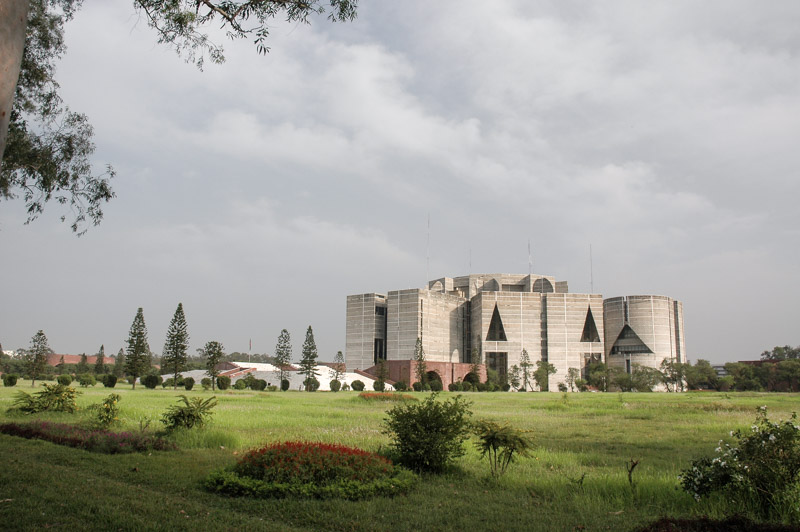
Parliament, Dhaka, Bangladesh
Dhaka’s public transport system is predictably startling. The buses are quite a sight; not for their decoration, as in Pakistan, but for their bodywork, which has the appearance of having been worked-over by an angry, hammer-wielding mob. Not one square centimetre is flat, and the skin of the bus resembles a hand-beaten copper bowl. The reason for this becomes obvious on the cripplingly choked streets of the city, where the buses are all in competition for fares, and race along with reckless abandon up to traffic lights, stopping in such a way as to obstruct other buses from passing. To counter this, shunting is an accepted technique, as is clipping corners. A small shunt will not so much as move the eyebrow of a driver, though the loss of a wing mirror may elicit a tirade of abuse at his driving adversary. All this time, the ticket boy, who manages to keep his balance inside the careening and crashing bus, and remember exactly who has, and who hasn’t paid, is busy shouting out destinations (important in a country where many are illiterate), and physically cramming more and more passengers on the already far-overloaded bus. The opportunities for death and serious injury are rife, and constant.

Buriganga River, Sadarghat, Dhaka, Bangladesh
Despite the shocking quality of many of the city’s aspects – the chaos, noise, beggars, filth, traffic and sheer squeeze of humanity – I like the place, which is not without its attractive corners, and spend almost two weeks here. The National Assembly Building, for instance, is a fine piece of modern architecture, though it has been closed since parliament was dissolved by the army in January 2007. A history of military coups and martial law are one of the few things Bangladesh does have in common with Pakistan.
In Dhaka’s old city, on the bank of the Buriganga River, amid the stinking piles of rubbish which are being picked-through by the poor, one catches glimpses of past grandeur; elegant mansions now all but lost in a sea of modern sprawl. Down close to the riverbank is the Ahsan Manzil, the ‘Pink Palace’, in which Lord Curzon would stay when visiting the city. I take a short boat trip on the Buriganga, a moving mass of fluid so filthy it looks to be made as much from raw sewage and used engine oil, as from water, and can be smelt from across the old city. Huge sewage outfalls dump a constant stream of filth into the already black water, yet on the river’s shore, where a truly unspeakable accretion of muck exists, men sell food from roped-together wooden canoes, and women wash clothes. The Buriganga makes the Ganga look clean, and the Nile in Cairo look like spring water.

Bengali Women, Dhaka, Bangladesh
Nevertheless, in a country where more people move on the waterways than on the roads, it’s a quintessential view of the city. Dozens of enormous ferry boats are moored in the river port of Sadarghat, filled with village-like encampments of humanity waiting to move on to their destinations in the interior of this flat, sponge-like country. In all this glorious human squalor lies the vibrant heart of Dhaka.
Before leaving the city, Joyanta tells me of an upcoming festival; Bengali New Year. It’s a tradition which has been revived by the city’s strong alternative student movement, to become a notable middle-class festival, though the attractions are as much the artistic output of the central university as of clear folk beliefs. Like Pakistan, the middle class here are not too numerous, but being Dhaka there are throngs of brightly clad, well-fed and beautiful people. The women here are striking, with beautiful smooth, fair skin, and large, dark, slightly elongated eyes. For the first time in the Indian subcontinent I see a concentration of genuinely attractive women. They remind me of the girls on the temples in Khajuraho.

Beach, St. Martin’s Island, Chittagong Division, Bangladesh
From what is almost certainly the most intense spot in the subcontinent, I move to one of its most relaxed, out in the Bay of Bengal, off the coast of Myanmar; St Martins Island. The drive takes me south from Dhaka, along the base of the very first ridges which demarcate the eastern edge of the Indian Subcontinent, a world whose western boundary I crossed three months ago as I descended from the interior of Baluchistan to Karachi. The end of the road comes in the smugglers town of Teknaf, which lies on a spit of land separating the Bay of Bengal from a coastal inlet, beyond which, lies Myanmar. Along the coast lies 120 kilometres of sandy beach, the world’s longest. I leave the car in Teknaf and take a boat down to St Martins.
St Martins is, after Dhaka, very nearly paradise. It’s a small tropical island with a tiny population, no real roads or cars, and is ringed by wide, clean and empty sandy beaches. I camp on a vast expanse of sand on the island’s north-east coast, overlooking the distant, hazy coastline of Myanmar. The waters of the Bay of Bengal are turbid; it is after all not far away that the two largest rivers of India, the Ganga and the Brahmaputra, pour out all the sediment of the subcontinent into the Indian Ocean, but they are bathwater-warm. During the day, when the heat and intensity of the sun are uncomfortable, I snooze in the foyer of a nearby hotel, part-owned by Joyanta, until the late afternoon when a few souls wander the beach pulling up nets, or digging for shellfish. At other times however, the beach is all mine to enjoy; the long, red skies of dusk, starry nights sleeping under the fly-net of my tent, and the warm dawn, when I float in the warm seawater as a large, pink sun quickly rises over the distant hills of Myanmar, then sit and watch the crabs at the water’s edge, foraging in the flotsam and jetsam, cleaning out their burrows, and leaving intricate and ephemeral concentric patterns of sand around their entrance-holes.

Dawn, St. Martin’s Island, Chittagong Division, Bangladesh
I’ve traversed this vast, seething plain of humanity, through the modern states of Pakistan, India and Bangladesh. Upon its surface unfold the age-old scenes of worship; the Sufis of Sindh, the Sikhs of Punjab, the Hindu revellers in Rajasthan, the Buddhist monks of Bodh Gaya. Religion is so fundamental in these societies, so defining for people, that I had of course, to question my own beliefs, or rather my lack of them. As a child, I’d dismissed the puerile notion of a bearded, all-seeing God in the sky along with Santa Claus and the Tooth Fairy, and had never given religion any further consideration. I see few merits of scripture, though it obviously gives a great deal of comfort and reassurance to billions of people. It seems to me that across the religions, and across the ages, there is a struggle between the dumbing-down of a god ‘who’ exists (i.e. the man in the sky), and the god of the philosophers, the metaphysical god of the Hindus and Buddhists (that is, of the Indian subcontinent), or perhaps a god without any transcendence; an underlying constancy in a universe of transience, an absolute that bounds the continuum of existence. That, is what I had come to believe, but what’s the point of that? How does that inspire one to be a decent person, how does that build society?
Leaving these philosophical thoughts, I reflect upon the next stage of my journey. From here, I can only head west; it is very, very nearly impossible to enter Myanmar by land from India or Bangladesh, and entering China is almost as difficult. So I will re-traverse the subcontinent, arcing across the world’s greatest mountain range, the Himalaya, through cultures not of the crowded lowlands of the subcontinent, but of the Burmese and Tibetan peoples which lie in the forbidden lands just beyond.
Stage 8 – India & Bangladesh: Punjab To Bengal [1/2]
 India is quite possibly the most astoundingly exotic and multi-faceted country on Earth. Its long, human history is one of the continual arrival of people; settlers and conquerors drawn alike by her legendary fertility and riches. All have added to the rich tapestry of Indian culture, yet none has ever changed it completely. It’s a land in which entire religions and philosophies have been born and grown-up side-by-side, in what must be one of the most tolerant societies on Earth. Incredible India, as the Indian Tourism Ministry likes to call it.
My first encounter with India came in 2005, when, following a work placement in Bangalore, I spent three weeks backpacking around the southern states of Karnataka, Kerala and Tamil Nadu. I came away with very different impressions of India, than those I had come away with from Pakistan two years earlier. As a foreign visitor to India, one must be constantly alert in order to avoid being scammed, cheated or over-charged, and must endure the omnipresence of touts and beggars; it seems there are no depths of dishonesty or self-debasement short of outright robbery to which some will sink in order to make a few dollars from a passing foreigner. This is all well enough, and can be seen in numerous tourist hotspots across the globe, where large discrepancies exist between the standard of living of visitors and that of the locals. But I soon saw that it was not just the foreigners who were being cheated; my Indian colleagues in the office would complain just as vehemently of over-charging rickshaw drivers or scamming bazaar merchants as any of us, though this impression was best embodied at a Keralan bus station. In the city of Alappuzha a bus rolls into the station, and an unruly crowd form a scrum to board, with middle-aged men pushing past frail elderly women, stepping on children in order to secure a seat on the vehicle, and avoid standing up. It seemed that through desperation, people here would literally step over their own grandmothers in order to get what they wanted. Pakistan might be hopelessly divided along ethnic or sectarian lines, but here in India it seemed simply like a free-for-all. Surely the great religious tolerance in India was not simply contempt for all fellow countrymen, regardless of creed?
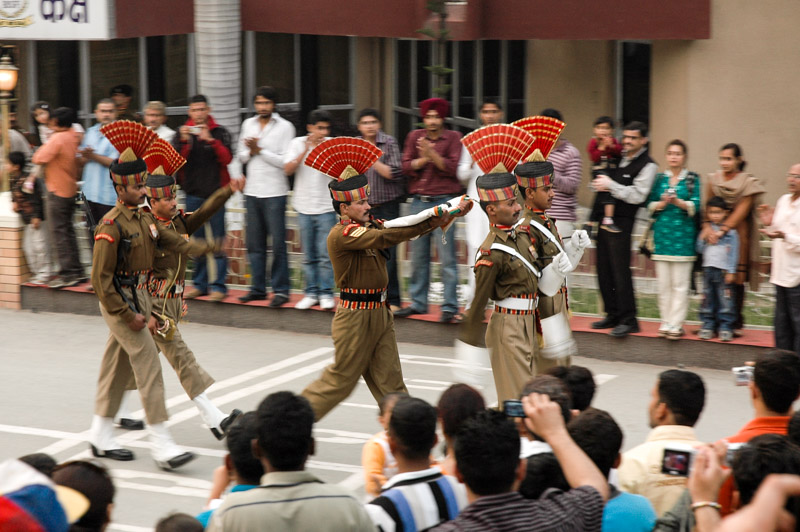
Border Ceremony, Attari, Punjab, India
I am entering India on the 7th March 2008 with a mind to forget my previous experiences, and try to approach the place as if it were my first time here. My journey will take me across the plains of northern India, through centres of Sikhism, Hinduism and Buddhism, through the city of Kolkata and on into Bangladesh, to the very edge of the subcontinent. It will take me through some highly touristed areas, but I hoped to bypass the worst of the tourist traps, stay with locals, and of course avoid the horror of Indian public transport at all costs.
At the previously quiet Pakistan-India border crossing, known as Attari Road to the Indians, crowds gather on both sides in the run-up to sunset when a ceremonial closing of the border gates takes place amongst all manner of pomp. Each side selects its tallest soldiers, who wear dark red cockscombs giving them the air of courting grouse, march forward and back in great goosesteps, shouting, gurning and finally slamming the gate in symbolic anger. It’s rather a sad testament to the division between two countries which for centuries were largely a single unit, with millennia of shared history. Returning to the car, I find that one of the idle men loitering around the border station has covered my car in blooms which have fallen from the overhanging trees, and of course his hand comes out for payment. The tribulations of India begin, before I have driven even one hundred metres into the country.
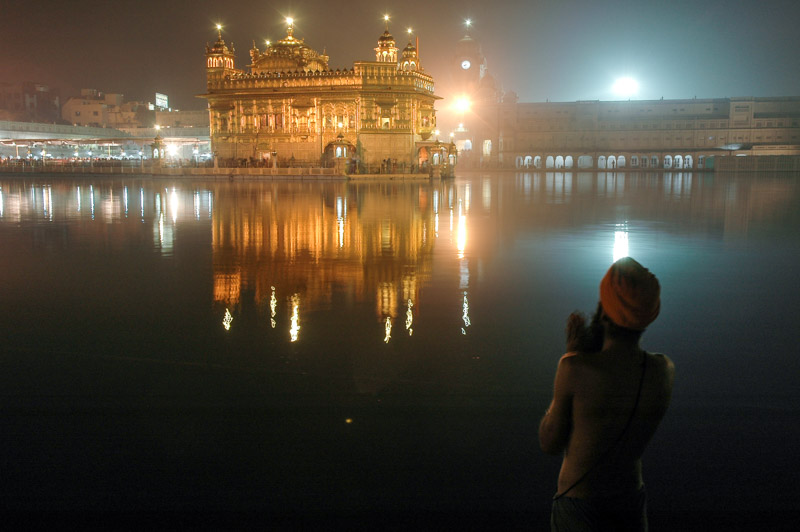
Golden Temple, Amritsar, Punjab, India
My first city in India, as for all overlanders, is Amritsar, the holiest city of the Sikhs, whose name means ‘pool of the nectar of immortality’. My host is Alvin, a Malaysian expat, station manager for Singapore Airlines who tells me I’ll be met at the reception of the four-star hotel in which he lives. I get half of his suite; a private bathroom, a double bed which is the most comfortable I’ve ever slept in, and a pool table. I’m feeling pretty lucky, but all these comforts fade into insignificance when I’m invited to join the crew for drinks. After months in the strict Islamic societies of Iran and Pakistan, it’s an immeasurable delight to walk into a room full of Singapore Airlines’ attractive female cabin crew, be offered a beer, and chat and drink with some of the most beautiful women I’ve ever seen.
Amritsar is the main city of Sikh cultural, political and religious history, and bustles with pilgrims who flock to the Harmandir Sahib, or Golden Temple, to bathe in its waters, all equal in front of God. The Golden Temple has a very welcoming air; non-Sikhs are equally welcome to enter and eat at the langar (a communal canteen where vegetarian food is served free of charge to all), and even sleep at the temple. Men and women mix freely, and whole families arrive with an air of celebration, adults and romping children all bathing in the temple’s jade coloured waters. Sikhism was founded here in Punjab in the 15th century by Guru Nanak, a Hindu born near Lahore who came to refute both Hinduism and Islam, and the injustice of the caste system. Sikhs are supposed to embody faith and justice as ‘saint-soldiers’, and can easily be identified with their long, unshorn hair covered in lofty turbans. I get chatting with an elderly Sikh gentleman who accompanies me to the langar. Often of large stature, swarthy, charming and valorous, Sikhs remind me slightly of the Pashtuns of Pakistan’s north-west frontier, and during colonial times, the British found them almost as difficult adversaries as those fierce tribesmen of the Hindukush.

Havelis, Bikaner, Rajasthan, India
From Amritsar, I head south from the lush greenery of Indian Punjab (noticeably greener than Pakistani Punjab) through thinning vegetation, and eventually barren, sandy desert, into the state of Rajasthan. The area is buzzing with Indian military vehicles; another reminder of the huge distrust between the two neighbours in this sensitive border area. My first stop is the city of Bikaner, where I am staying with Manvendra, a fifty-two year old lawyer and artist. The sweltering pre-monsoon heat is already making the days unpleasantly hot, and it’s not until evening that we venture out. We get into Manvendra’s car, which has ‘ADVOCATE’ prominently displayed on the windscreen (which, he explains, will deter police from pulling him over or making any trouble) and drive to the Sardul Club, which with its manicured lawns, full-sized snooker table, dining room complete with long antique dining table, and fleet of waiters in tails, reeks of colonial days. Initially we sit in the warm evening air sipping gin and tonics and scotch, chatting about India. Later, we are invited to join three club members – who have obviously enjoyed a good bit more whisky than Manvendra or I – and I’m given the dubious honour of being hand-fed lamb curry by one gentleman, who manages to land a good dollop of the stuff on my shirt. Eventually, after drunken pleas of eternal friendship, we make our retreat. Manvendra, also a touch tipsy, drives me back very carefully through the empty streets, reaches home, backs his car lightly into mine, and we retire for the night.
Next morning, Manvendra’s friend Durga collects me on his motorcycle and takes me around Bikaner’s old town, made up of anarchic, squalid lanes of open sewers which wind through the city’s beautiful old havelis, or rich merchants’ houses. Hugely ornate, often with overhanging first-floor balconies, and with echoes of North African Islamic architecture, each is painted in pastel shades; peppermint green, lilac, terracotta or butterscotch, the iconic colours of India. In the afternoon, Durga seems to step down a little from his role as a guide, and invites me to the house of a friend of his, where we eat, drink and smoke together. Despite all Rajasthan’s beggars, ‘one-pen’ kids, rickshaw drivers and hotel touts, here I’m back in the same old Asian hospitality, no different from Pakistan or Iran.
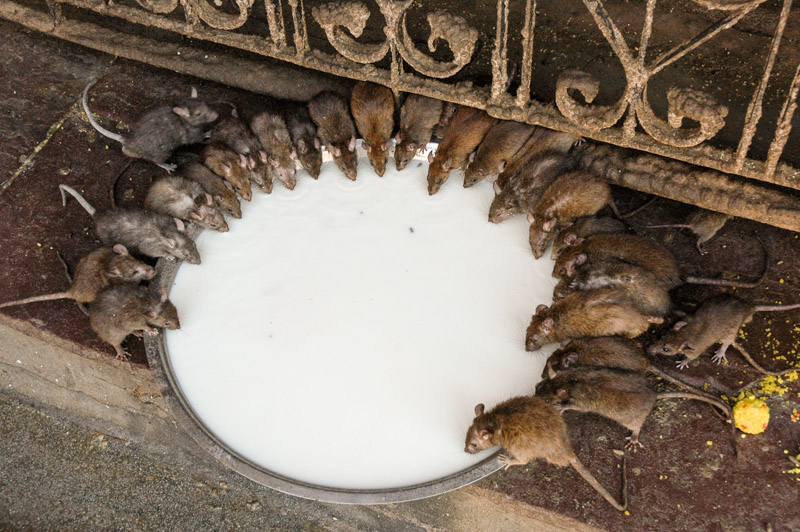
Rats, Karni Mata Temple, Deshnoke, Rajasthan, India
Near to Bikaner lies one of India’s more eccentric places of worship, the Karni Mata temple in the town of Deshnoke, which Manvendra takes me to one morning. Karni Mata was a local sage believed to have been an incarnation of the goddess Durga, who re-incarnated the family of her favourite storyteller into rats. This temple in her name, out in the Rajasthan Desert, has become a sanctuary for its burgeoning muroid community. One must remove one’s shoes at the entrance and walk among hundreds of scurrying, playing, fighting, squeaking, stinking vermin. Some of the rats seem diseased with open cuts and festering wounds, some are in the final throes of death, and in one corner two rats are ripping open the carcass of a pigeon which has had the misfortune to fall into the temple. Walking barefoot among these creatures – and plenty of their droppings – and with the thought in mind that the world’s most recent epidemic of bubonic plague occurred fourteen years ago in the neighbouring state of Gujarat, I’m a little uneasy, but local worshippers come and kiss the floor, take nips of sour milk from large pans around which dozens of rats are jostling to drink, and generally attach great reverence to the place.
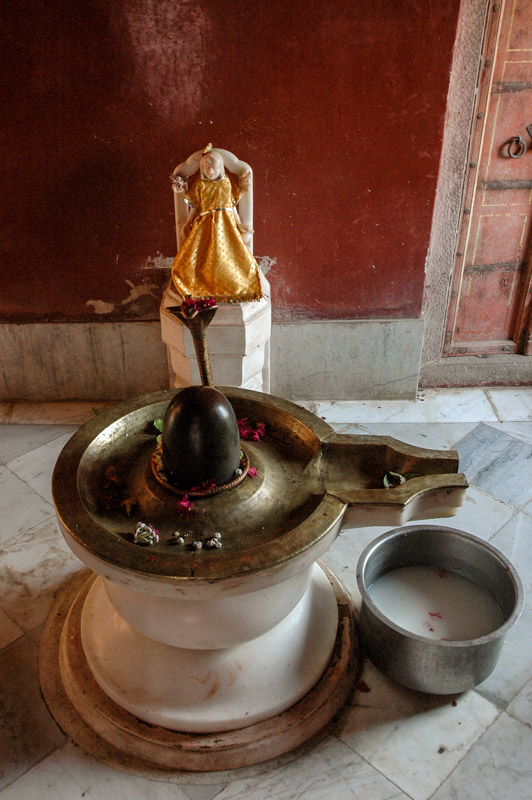
Shiva Linga, Shiva Temple, Bikaner, Rajasthan, India
Hinduism is not an easy religion to understand, certainly if one attempts to approach it from a rational perspective and attempts to elucidate concepts which simply don’t apply. It’s a set of distinct, and sometimes contradictory philosophical ideas, rather than a rigid set of beliefs. It can be interpreted as being monotheistic, for there is ultimately only one (rather metaphysical) ‘God’, Brahman / Atman (actually a statement of one’s ‘true self’ being identical to God), though there is also the trinity of Brahma, Shiva, and Vishnu, respectively the creator, destroyer and maintainer, plus an almost uncountable pantheon of local deities and incarnations, said to total some 330 million. There is no dogma in Hinduism, no strict or rigid moral code, and no organisation such as the church.
One comes into contact with this most popular of India’s many religions in the mandir or temple, which may be dedicated to any deity, though some are more popular than others. Shiva temples for instance, feature a linga, representing the penis of Shiva within the vagina of the goddess Shakti. Deshnoke’s rat temple is just an example of another deity of the pantheon. Hindu temples have an unmistakable smell, a mixture of sour milk, sickly milky sweets, incense, bat droppings (in older temples) and humanity, and are usually intensely gaudy, with garish pictures of six-armed, blue skinned gods, tinsel and flashing lights. But then to Hindus, God is everything, so therefore everything may be God, and consequently a subject of worship. This extends of course to living creatures, and Hinduism has a staggering list of holy animals; cows, monkeys, dogs, rats… and so on. As Mark Twain observed of India, ‘..all life seems to be sacred, apart from human life’.
I’ve grown fond of Manvendra; he’s a quiet, entertaining and intelligent man. On the morning of my departure, he drives with me to the edge of the city, and seeing me about to embark on a journey across the breadth of his country, looks at me a little wistfully; ‘Goodbye young man, enjoy your life!’ he says, and waves me off.

Jaisalmer Fort, Jaisalmer, Rajasthan, India
From Bikaner I drive south-east, deeper into the Rajasthan Desert, through rolling sand dunes dotted by scrubby acacia trees which shepherds hack down to feed their goats in this marginal environment. The area borders my ‘home’ province of Sindh, in Pakistan, but my destination, Jaisalmer, couldn’t be further from the gentle hinterlands of Sindh. This small desert outpost, nicknamed the ‘Golden City’ has a magnificent sandstone old-city of tall fortified buildings, with intricate carved balconies, looking out over the surrounding desert. However, herein lies its downfall, for the town is wholly sustained by its seedy tourist trade, utterly ruining any shred of romance which the town must once have had. Almost every building is a hotel or guesthouse, restaurant or camel and jeep safari business, and the streets are filled with souvenir stalls selling a range of goods from tastefully crafted souvenirs to absolute rubbish. Here one sees the full spectrum of tourists in India; the tour groups of French, German and British retirees, young, naïve gap-year students, the old fans of India – the gaunt, long-haired modern hippies in native clothes, often slightly mad from years of drug consumption – the Japanese, too polite to resist the touts, commonly seen trying-on local clothes or playing souvenir instruments in the curio shops, and the Lonely Planet backpackers with their lists of ‘must-sees’, ready to book contrived and over-priced desert tours. This is the very worst of India; every interaction with a local person boils down to a business transaction, however genuine it may seem at first. Children – rich or poor – hold out their hands on reflex when a foreigner comes near, for pens, chocolates, or that old favourite, money. Touts will find any way to attract one’s attention; screaming like chimpanzees, making kissing or hissing noises, or just hollering incessantly down the street. Decades of tourism have eroded peoples’ dignity to the base; I have absolutely no wish to be in such a place, gain no satisfaction from the experience, regardless of the magnificence of the town’s architecture, and leave after one night feeling disappointed and frustrated.

Rooftops, Jodhpur, Rajasthan, India
My spirits are lifted somewhat at my next stop, Jodhpur, the fabled ‘Blue City’, with its tightly crammed lanes of periwinkle-blue house and the massively imposing Mehrangarh Fort. The city is large enough to have its own non-tourist based economy, and crucially, I am staying with a local, Kiv and his family. Kiv’s traditional Hindu family are every bit as welcoming as any I’ve yet stayed with. The air in their two-roomed house is filled with the aromas of incense, the spices of cooking, and the ghee (clarified butter) which is burnt at the small shrine to the deity Krishna, one of India’s favourites, which sits on a small table. Kiv’s mother, who keeps her hair covered but is not as timid as the women of most Muslim households, serves a traditional vegetarian meal of daal (pureed lentils), a spicy curry and rice on polished metal dishes which are ubiquitous in India. Despite understanding very little of Hindu ideology, I feel comfortable and at-home with his family, who, in accordance with Hindu tradition, tell me that ‘guest is God’.

Aravalli Range, Rajasthan, India
The drive from Jodhpur further south to the magnificent city of Udaipur passes through a beautiful landscape of red-rock hills and outcrops, the first hints of the ancient red-rock geology of the Deccan, which features some of the oldest remaining surface-rock on the planet. Small villages and patches of jungle, dry in the heat of the pre-monsoon season, dot the hills either side of the winding road, but the traffic is horrendous, with slow lorries crawling past each other into oncoming traffic. Unsurprisingly, in India the law of the jungle applies on the road; the largest has right-of-way and all other vehicles must leave the road if a lorry or bus chooses to overtake. Soon I see an all-too-common sight; the mangled remains of a motorbike, a blanket-covered corpse, and a lorry stopped at the roadside nearby. Whilst preferable to using public transport, driving in India is not without its hassles. Aside from the outright danger of driving amongst people who have seemingly no concern for the safety of others, there are toll-booths to negotiate, the staff of whom will of course take the chance to over-charge a foreigner (leading to me simply driving through without stopping) and then there is the truly soul-destroying sight of watching Indian drivers negotiate a closed level-crossing. Once the gates have closed and the traffic must wait for the train to pass, cars will line up across both lanes of the road, nudging the barriers, meaning that when they finally open, there is a scrum of perhaps twelve vehicles all trying to be the first to move on. It goes without saying that this takes far longer to clear than if the drivers had stayed in their respective lanes, but in India nobody seems willing to risk that another person may get ahead of him. It happens at every level crossing in India, everytime.

Jag Mandir, Udaipur, Rajasthan, India
Udaipur is a stunningly beautiful city, famous for its palaces and lakes, most notably the Lake Palace which sits as an island in the dazzling blue waters of Lake Pichola, and is surely one of the most romantic and evocative images of the splendour of India. But it also shows India in microcosm; right next to where I’m sitting, admiring the beauty, is a sewage outfall discharging a steady stream of grey-brown filth into the lake’s cerulean water. The lake’s shore is a swathe of muck, awash with plastic litter, even an old tyre, and filled with green algae which thrive in this anoxic soup. Not thirty metres from me, men and women are bathing and washing clothes at the waters’ edge. Beauty and squalor, like ying and yang.
I’m lucky to have a host in the city, who lives away from the lanes of banana-pancake backpacker cafes and ‘one pen, uncle?’ children. His name is Ranjan, a young graduate geologist, and though he’s studying here in Rajasthan, he’s originally from Bihar, one of India’s poorest states. Like many Biharis, Ranjan is darker skinned than most North-Indians, and in a country where whitening creams such as Fair & Lovely are big business, this can traditionally be a source of prejudice. This is due largely to the infamous Indian caste system, which strictly divides Indian society into a hierarchy of social strata, most simply: Brahmins (the ancient priestly class), Kshatriyas (the warriors and kings), Vaisyas (merchants and farmers), Shudras (artisans and servants), and finally an ‘untouchable’ underclass. The Sanskrit word for caste, varna, can be translated as ‘colour’, and although it’s a highly sensitive and contentious subject in a modernising Indian society which is, nominally at least, trying to move past archaic prejudices, it seems to link one’s position in society with one’s skin colour. It is said that the system was introduced millennia ago by the fair-skinned Aryan invaders of India in order to maintain their social dominance over the dark-skinned native Dravidian population. Certainly, one need only look at Bollywood actors and actresses, public advertising materials, or at a group of high-level Indian executives to see that India’s rich, beautiful and powerful are overwhelmingly fair-skinned.
Traditionally, one’s caste has placed the limits of one’s life – birth, marriage, career and death – within one’s caste; in short, it’s a centuries-old system of selective breeding which makes up the basis of Indian society. As repugnant as the idea is in principle, this strict delineation of the limits of one’s life seems to be a great binding force, smoothing over some of the gaping inequalities between rich and poor, forces which lead to extremism and war in other societies. When an untouchable Bihari road-sweeper who struggles to earn a dollar each day sees a Mumbai businessman drive past in a $100,000 car, the look of the road-sweeper seems less of hateful envy, than of resignation that, on the great ‘Wheel of Life’ (a central concept in Hinduism), that is simply his place; to sweep the roads. Unsurprisingly, the three major religions which have emerged in this background of inequality – Buddhism, Jainism and Sikhism – all place social equality (as does Islam) as a central doctrine.

City Palace, Udaipur, Rajasthan, India
Attitudes are of course changing as India rapidly modernises; discrimination based upon caste has been officially banned since the introduction of the Indian Constitution in 1950, and Ranjan is evidence of this emerging middle-class based on social equality and equal-oppurtunity free-market economics. The sociopolitical ambitions of this middle-class, as well as their inherent spending power, drives progress in Indian society, something glaringly absent in Pakistan.
One beautiful warm evening, I accompany Ranjan and his Sikh friend Jagdeep to a local restaurant, Ranjan on his motorcycle and myself riding pillion on Jagdeep’s Vespa. Indian food is one of the undisputable and unending delights of travelling here; for a dollar or two one can eat a good meal, five to ten dollars will pay for a veritable feast. Like the richness of Indian society, Indian food is a delicate, harmonious mix of strong and subtle flavours, and is in my opinion the world’s finest cuisine. On the way back, Jagdeep needs to make a call, and so driving the Vespa is down to me. I’ve never ridden any type of motorcycle, but I’m soon zooming around the now-quiet backstreets of Udaipur, with Jagdeep riding pillion, turbaned and shouting into his mobile phone. We stop at the lakeside and watch the city lights across the shimmering black water. It’s a magical moment of enjoying simple pleasures with friends; the difference between loving and hating India clearly depends upon one’s company.
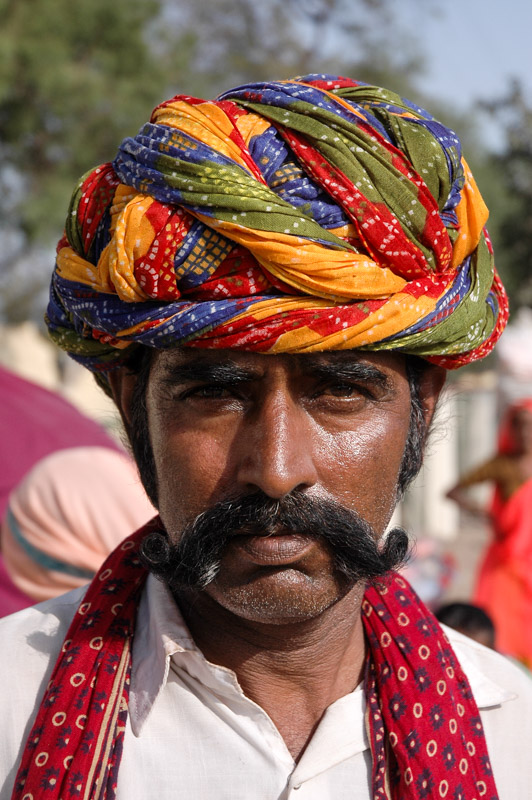
Rajasthani Man, Bundi, Rajasthan, India
The Hindu festival of Holi celebrates the end of winter and the oncoming colour and fertility of spring. It’s perhaps the least ‘religious’ of Hindu festivals, and the most public, as thousands of joyous revellers flood the streets and throw coloured powder and water at each other. One of its nicest aspects is a breaking-down of traditional social barriers; between male and female, rich and poor, and even between castes. As a foreigner, it’s by far the most spectacular and enjoyable of festivals, and I intended to take part. I would be meeting an old character from the trip; Boštjan, the Slovenian whom I had met in Bishkek last September, and with whom I had driven to the Pamirs. Boštjan has chosen the small Rajasthani town of Bundi as our place to meet and celebrate Holi, and it’s a good choice; small enough to be intimate, obscure enough not to be over-run by other tourists.
Revelry begins at about eight in the morning, with people pouring out on the streets and handfuls of pink, yellow, green and lilac powders flying through the air, covering everything in vibrant colour. Strangely, it’s the middle-aged and elderly who dominate the crowds, who ritually smear colour over one and others’ cheeks with time-practiced skill. Many of the men have clearly had a little bit to drink, but it is in the local Shiva Temple that the real elixir is dispensed. Here, under the watchful gaze of the temple idol, which is wrapped in a mass of strobing multicoloured fairy lights, a group of punch-drunk men assemble, awaiting the bhang lassi, an infamous Indian concoction made of milk, water, crushed marijuana leaves and pistachio nuts, which is served out from a huge steel tea caddy, free of charge. At first the mixture has no discernible effect, and we fortify ourselves with some revolting Godfather 50,000 beer, and move for some lunch into a Punjabi dhaba (a simple restaurant). Here, an hour or so after drinking the narcotic lassi, its effect is suddenly obvious; the senses dull, one’s perspective pulls back, and everything is tinged with hilarity.
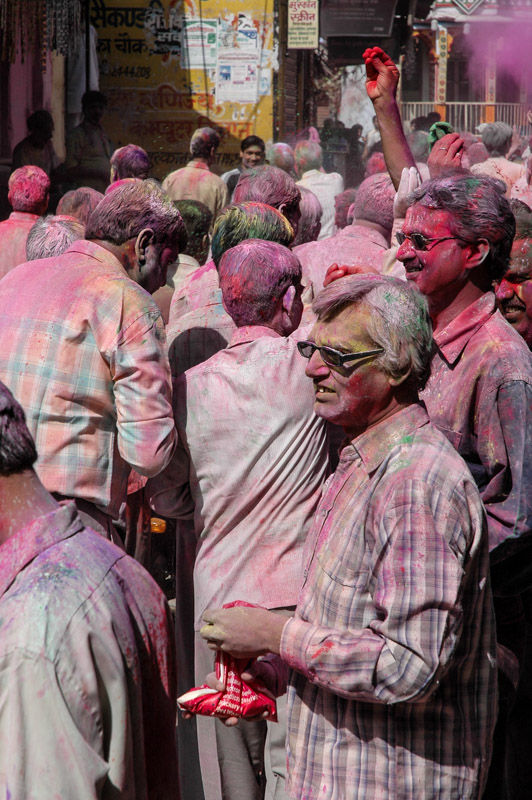
Holi Celebrants, Bundi, Rajasthan, India
The tubby Sikh owner of the establishment, who is covered in colour, paces around the dhaba madly, shouting orders at errand boys whilst taking nips of whisky from a metal cup. Three drunken men, covered head-to-toe in all shades of coloured powder, stagger out of the room, down some steps, and start their motorbike. Just as the third man giddily swings his leg over the seat of the bike, the driver guns the throttle and roars off, leaving the inebriated man in the middle of the road, legs astride, in a hilarious state of perplexity. Boštjan and I are in fits of laughter, watching this bizarre street pantomime of multicoloured people.
The Sikh offers us some beer, labelled ‘Super Strong’, which we politely decline. ‘NOT STRONG, ONLY LIGHT STRONG!’ bellows the Sikh, and demands with the vehemence of a Russian alcoholic that we take some. Moments later, he pours some soda into his whisky, then demands that we take soda too; ‘TAKE! NOT STRONG!’. ‘BEER!’ we shout, tilting our cups to show him we’re fine, but he sends his can of Super Strong our way. Memories become hazy after this point, though I recall the proprietor banging his head with a silver tray, drinking a great deal of whisky, and bellowing down three mobile phones at once. I vaguely remember walking into a lamp-post, and passing out in the street, but by three in the afternoon, when the effect of the bhang was finally beginning to weaken, Boštjan and I were already sleeping it off in the guesthouse. This wild, irreverent festival was, truly, Incredible India.
Stage 7 – Pakistan: The Indus Valley [3/3]
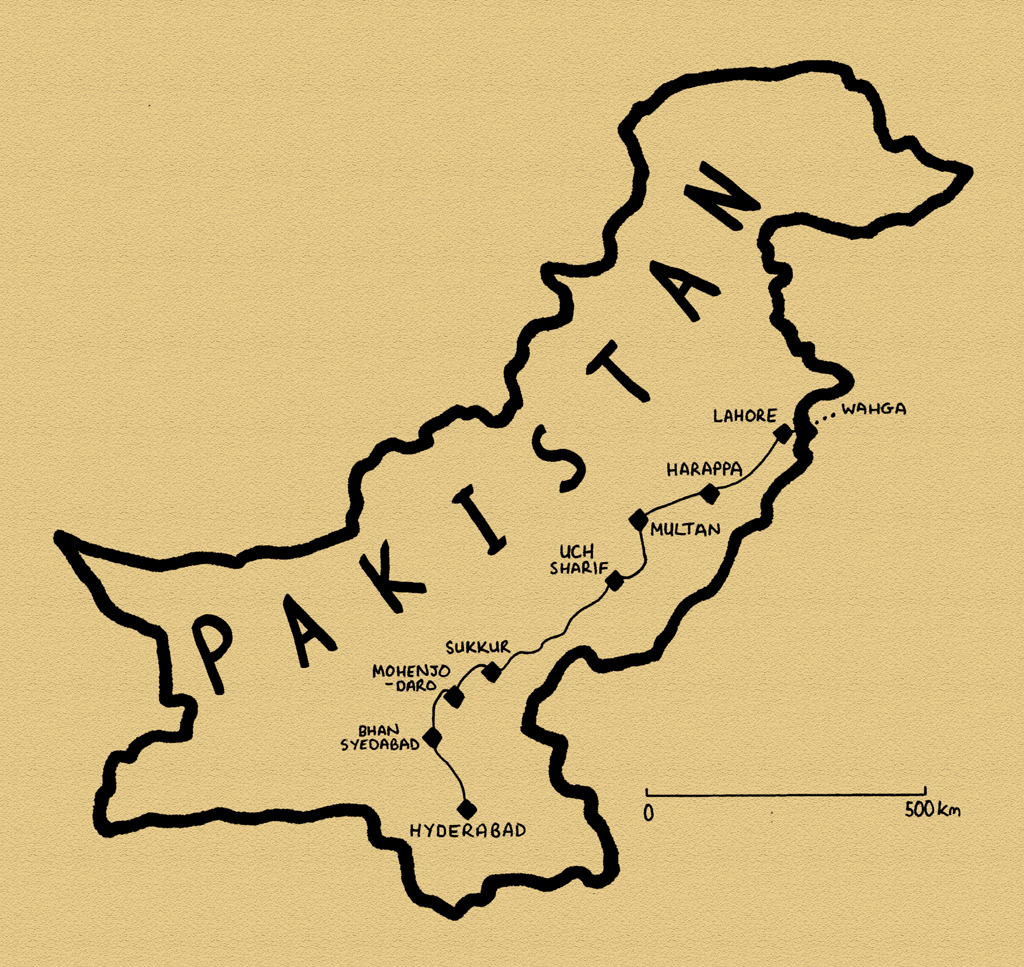
In my unplanned four-week stay in Hyderabad I had become very much attached to my adoptive family, to the city and to the magical province of Sindh, but deep down, I needed to continue my journey eastwards across the Indian Subcontinent (though Shahana suggested that I stay and settle down with a local girl). My immediate onward journey would take me up the Indus Valley, from the tranquil backwaters of Sindh into the more hectic Punjab, a great swathe of agricultural land watered by the great rivers which flow down from the Himalaya. I would pass the intriguing ruins of the Indus Valley Civilisation; the earliest recorded in South Asia, and the teeming modern cities of Punjab, before leaving Pakistan at Wahga; the only international border crossing with India accessible to foreign travellers. Always in my mind however were the people of Sindh, a place I missed almost immediately.

Ranikot Fort, Sindh, Pakistan
It’s the 28th February 2008 when I say my goodbyes to the family in Hyderabad and resume my journey up the Indus Valley. I take National Highway 55 northwards following a corridor between the right bank of the Indus and the barren Kirthar Mountains, which mark the edge of Balochistan through which I passed last month. In the town of Sann, I turn off the highway, leaving the irrigated farmland and driving through a scrubby plain towards the hills, where after almost thirty kilometres I reach a defile which has been fortified in the Talpur-era with a defensive wall. This circular wall, supposedly thirty two kilometres in length, encloses Ranikot Fort which, if it may be considered such, would be the world’s largest fortress. Once a no-go area famous for dacoits (bandits) during Sindh’s troubled years in the 1980s and 90s, Ranikot is a wonderfully tranquil spot which I have all to myself. From the eastern Sann Gate, I ascend the steeply climbing wall, which looks like a narrow-gauge Great Wall of China, though has recently been rather clumsily restored. I am rewarded with expansive views in all directions; to the east is the floodplain of the Indus, the traditional western boundary of India, while to the west is the tortured rock of the Kirthars; dramatic peaks and ridges thrust up by the collision of the Indian Subcontinent into Eurasia. Picking its way along nearby ridgelines, towards what seems like pure wilderness, Ranikot’s defensive wall is dotted with distant watchtowers, all but unknown to the outside world.
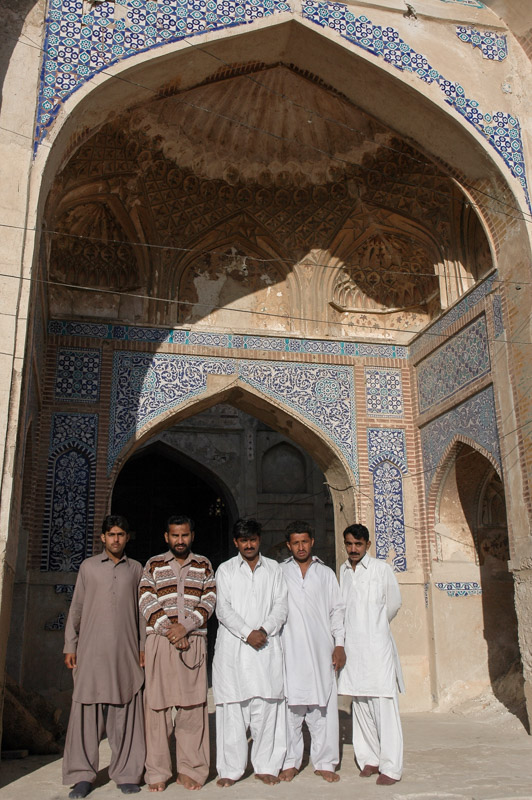
Jamia Mosque, Khudabad, Sindh, Pakistan
I stop for the night with a friend of Shahana’s, Sayyid Hajenshah, a local businessman, zamindar (feudal landlord) and close friend of the Chief Minister of Sindh, whose compound lies in the small town of Bhan Syedabad, a little beyond Sehwan. I arrive without warning and am met by one of the the man’s staff who directs me to park the truck in a garage, escorts me to the uthak (guesthouse) and brings me a cold drink before politely inquiring who I am. Hajenshah himself is unfortunately absent, so I have the luxury of occupying his personal suite. One of his guards comes in to make sure I am comfortable and have everything I need. He lays his shotgun against a wall, then pulls out a bottle of Scotch. After spending the whole day out in the burning sunlight on the road and at the fort, it takes quite some time for my eyes to adjust to the cool, dark room, and I realise that I am slightly sunburned. Despite not being even being March, the light outside is blinding and I can only imagine the ferocity of high summer.
I leave early the next morning, stopping first in nearby Khudabad which feels like a large village but was once the capital of Sindh as seat of the Kalhora Dynasty (vassals of the Mughals) until the title was transferred to Hyderabad in 1768. Just off the road is the slightly neglected though surprisingly beautiful early eighteenth century Jamia Mosque. The mosque sits above the dusty village and the fields which surround it on a plinth reached by a semicircular staircase. Ten steps lead to a triple-arched facade of flaking faïence, and an interior of finely painted stucco. Outside in the dazzling light, a class of schoolboys file along a path in dazzling orange uniforms, standing out against the haze of smoke and dust which hangs above the green fields in the morning air.
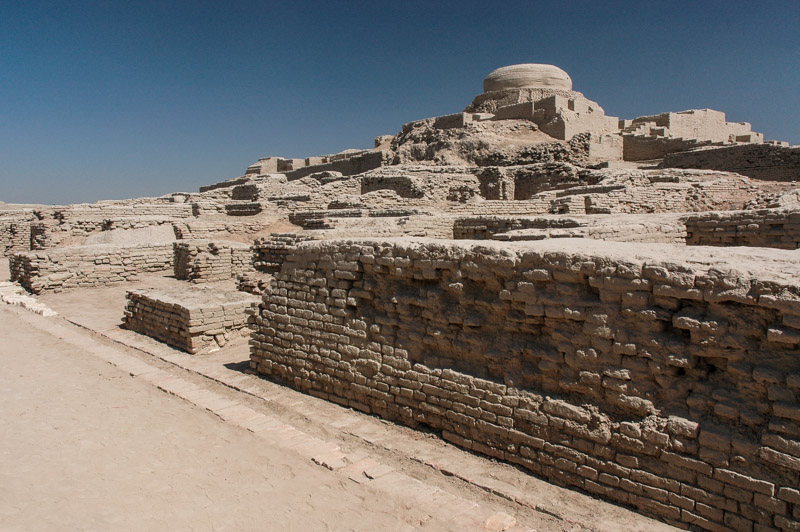
The Citadel, Mohenjo-Daro, Sindh, Pakistan
My next stop is one of the few places in Sindh which is at all known to the outside world: the Indus Valley (Harappan) Civilisation city of Mohenjo-Daro. These burning, dusty, dry flatlands astride the Indus are in fact one of humanity’s cradles of civilisation and Mohenjo-Daro, founded around 3500 BCE, was one of the world’s earliest major cities. Visually less arresting than Giza’s pyramids, Mohenjo-Daro is impressive instead for its skilled civil engineering: the beautifully paved, wide irrigation channels bringing water into the city; the narrow, partly-covered sewage channels taking waste out; a raised well-shaft, keeping out polluting floodwater and walled rubbish dumps. There is also very clear urban planning, with the city built on a regular grid and divided into two sections. The Citadel is the compact city centre with a communal bath, halls and more opulent housing, topped by the recognisable ruins of a much later and unrelated, second century CE Kushan stupa, built a staggering sixteen centuries after Mohenjo-Daro was abandoned. The rest is the Lower City with rectilinear living blocks for the lay-folk, complete with wide streets, staircases and drainage channels, all magnificently preserved. Somehow, the human-scale and recognisable features of a city clearly made by an advanced society make it more impressive than a singular monument to a megalomaniacal ruler or long-dead cult.
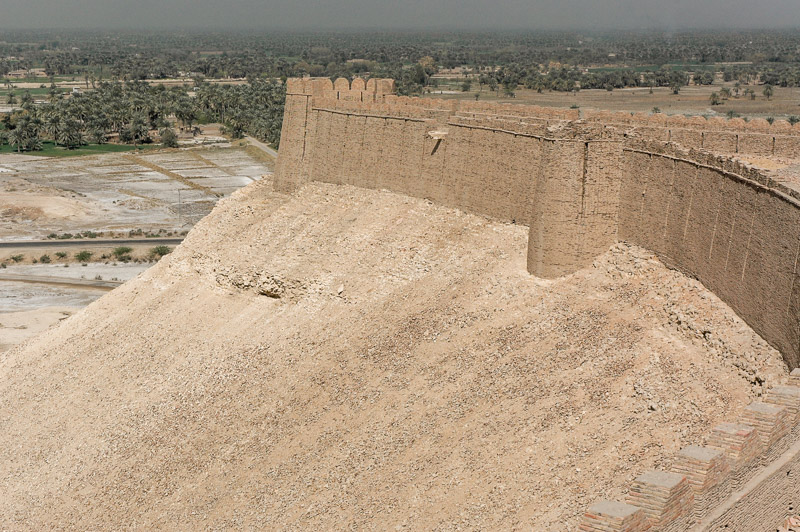
Fort Ahmedabad, Kot Diji, Sindh, Pakistan
From Mohenjo-Daro I pass through Larkana, home of the Bhutto Family, then head east to the shambolic riverside city of Sukkur, the third-largest in Sindh, where I am hosted by Asif, whom I meet at an ice-cream parlour. I notice a slightly different atmosphere in this northern part of Sindh; it’s noticeably more conservative than Hyderabad, and I see the odd burqa, a blanket-like garment which completely covers a woman from sight. It’s done as much out of ancient tribal customs as from Islamic piety and Asif’s home is no exception. The family practice purdah (curtain), referring to the practice of completely separating male and female sections of the house, so that a male visitor will never set eye upon any females in the building. Meals are slid through a curtained doorway, and the door quickly closed behind. We eat dinner with his father, who mutters ‘Allahu Akbar’ between each mouthful. It’s quite a contrast to my ‘second’ family down in Hyderabad.

Sukkur Barrage, Sindh, Pakistan
In the morning I get on a minibus to the nearby town of Kot Diji, where a beautiful and imposing late eighteenth century Talpur Fort Ahmedabad sits on a mound looking out across a sea of green palms and the outliers of the Rohri Hills, which punctuate the edge of the desert like islands. Below the fortress are the remains of a Harappan city, the majority of which is though to be covered by the fort. In the afternoon I return to Sukkur and join Asif to visit a couple of minor shrines, then go for a stroll along the Indus embankment. As a hazy, orange sun dips behind the vast Sukkur Barrage, a blind river dolphin jumps out of the murky Indus waters held up behind the dam. The deafening roar of motorcycles and autorickshaws is just distant enough to make the place almost tranquil, and I savour my last evening in Sindh, this beguiling province which I had unexpectedly fallen in love with.

Tomb of Bibi Jawindi, Uch Sharif, Punjab, Pakistan
Leaving Sukkur the next morning, I cross the Indus a final time, almost mesmerised by the sixty-six arched locks of the fifteen-hundred metre long barrage, the head of the world’s largest irrigation system, built by the British and completed in 1932. Without the life-giving, silty Himalayan waters of the Indus, Sindh would be a burning desert plain, but instead, rather like Mesopotamia or the Nile Valley, it is a landscape which has nurtured one of humanity’s earliest civilizations.
I join National Highway 5 heading north-east and by late morning cross the provincial boundary into Punjab where I notice a change in the landscape immediately. The agriculture is more intensive, the settlements look more prosperous, and there are large, industrial suburbs outside cities. The atmosphere changes too; gone is the gentle, relaxed atmosphere of Sindh, replaced with a more hectic, business-like air. The Punjabis enjoy the highest standards of living in Pakistan, the best infrastructure, and exert considerable political and economic influence over the country. The Army, by far the most powerful organ in the country, is dominated by Punjabis. It is perhaps understandable then that the Punjabis are collectively not particularly well-liked by the other nations of Pakistan. Just as the Baloch see their gas piped down from Sui to Punjab as a one-way deal, so the Sindhis watch much of the income generated by Karachi, Pakistan’s largest city, disappear up the road to into Punjab.
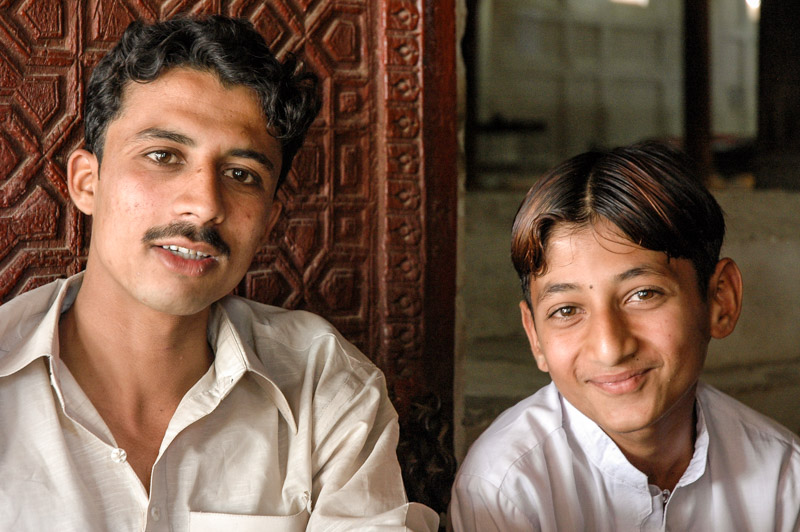
Punjabi Man and Boy, Uch Sharif, Punjab, Pakistan
My first stop in Punjab is the ancient town of Uch Sharif, which may have been established by Alexander the Great on the Indus (which has since changed course) and today is a pleasant country town. Uch Sharif is famous however as the adopted home of the Sufi saint and missionary Jalaluddin Surkh-Posh Bukhari, who arrived here in 1244 from his native Bukhara as part of a wave of Islamic arrivals who would spread Islam far deeper into the Indian Subcontinent than the initial incursion made by the Arab Muhammad bin Qasim in the early eighth century. Bukhari’s shrine, remodelled and rebuilt long after his death is however upstaged by three nearby shrines, each in the Turkic-influenced style of southern Punjab, built of red brick on an octagonal base, variously decorated with glazed turquoise tiles from nearby Multan and surrounded by simple grave-mounds of the native grey-white alluvium. The most exquisite of the three is the fifteenth century shrine of Bibi Jawindi, a great-granddaughter of one of Bukhari’s grandsons, which has tapering ornamental bastions topped with distinctive petal-like mouldings. Sadly, all three of these venerable shrines are mere facades, for a flood in 1817 washed away much of their structure, leaving them little more than magnificent, teetering walls. Bukhari’s shrine remains intact and active, though the atmosphere seems more business-like and less innocently welcoming than many of the shrines of Sindh, and so I push on northwards.
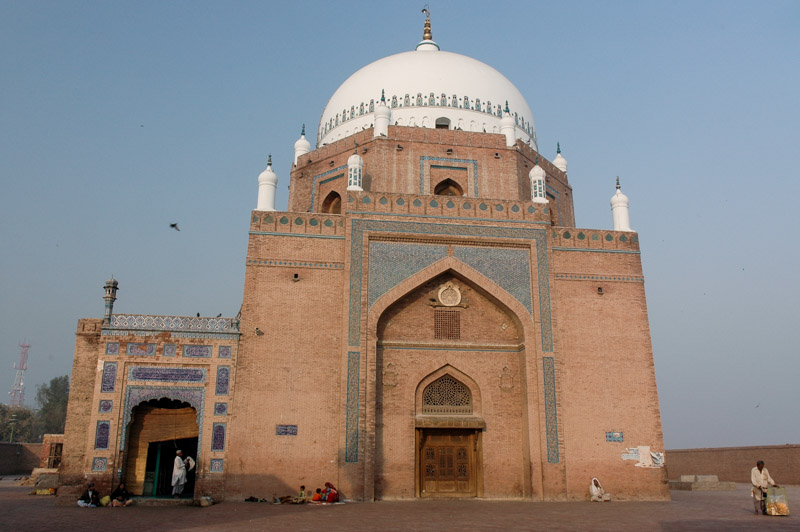
Shrine of Bahauddin Zakariya, Multan, Punjab, Pakistan
I stop for the night at the roadside and push on early the next morning towards Multan, the largest city in southern (Pakistani) Punjab. The name Punjab derives from the Persian ‘panj ab‘, meaning ‘five rivers’, which are the Jhelum, Chenab, Ravi, Sutlej, and Beas. These all flow south-westwards from the Himalaya, meeting at various points around Multan before flowing into the Indus near Uch Sharif. This generously watered swath of land has long been the breadbasket of India and has naturally attracted invaders and settlers for millennia, nurturing the culture of modern South Asia. It was here that, more than three thousand years ago, the first texts of the Rigveda were formulated: the oldest religious texts still in use today. It’s no surprise then to find that Multan is one of the oldest surviving cities of the subcontinent, is mentioned in the ancient Hindu epic Mahabharata, and is a truly ancient pilgrim city which long pre-dates Islam. Situated on a natural route between Central Asia, the plains of India and the Arabian Sea, it has a long history of riches and ruin; it was the first city taken by bin Qasim and swapped hands between the Seleucid Greeks, the Umayyads, the Ghaznavids, the various dynasties of the Delhi Sultanate, the Timurids, the Mughals, the Sikhs and finally the British, before becoming part of modern Pakistan.

Shrine of Shah Rukn-e Alam, Multan, Punjab, Pakistan
I enter the city at first light, in the calm of dawn before the day’s frantic traffic, crowds and noise overwhelm the cool dawn air. In Multan’s winding streets and time-worn, low-rise housing, I immediately sense a place of great age; a city whose millennia of history have woven a richness which belies its current status as merely a provincial city. An old saying tells that Multan is famous for gard, garma, gada o goristan (dust, heat, beggars and tombs), an accolade my own experience would give me no reason to dispute. I start at the city centre, in what once was Multan Fort but is now a pleasant urban park with only some low walls and the lonely, pink-arched Qasim Gate remaining of the fort, which was devastated by both the Sikhs and British in the nineteenth century. Within the park are Multan’s most celebrated shrines. The earlier of the two dates from the twelfth century and belongs to the Punjabi Sufi Bahauddin Zakariya; an elegant cubic-based structure with an octagonal-based dome, decorated by turquoise tiles, which is considered the archetype of the shrines of southern Punjab. The second, thirteenth century shrine is yet more impressive; similar in style to those of Uch Sharif, though intact, and belongs to the Multani Sufi Shah Rukn-e Alam, the ‘Pillar of the World’. The exterior of the shrine is richly decorated in bands of faïence, with a tapering octagonal base divided between eight powerful bastions. Inside, pilgrims from Multan and beyond pray at the Shah’s elevated tomb, set in an ornamented small pavilion of polished marble.

Pilgrim, Shrine of Shamsuddin Sabzwari, Multan, Punjab, Pakistan
Once outside again, the early calm has vanished and Multan has come to life. Groups of visitors are flocking towards the shrines with families sitting in the freshly-swept courtyards. Multan’s famous beggars are out in force; business-like in their wheedling persistence. In the park a wandering masseur rattles his bottles of oils, offering massage and ear-cleaning services to clients while they lie on the grass. Away from the central fort area I pass the impressive British-era Municipal Office and then head off to find more shrines. The first of these belongs to the fourteenth century Shamsuddin Sabzwari, a Sufi from Sabzevar in what is now Iran, which teems with pilgrims who light butter candles in small clay dishes, squatting with their hands clasped together in benediction. The second is the rather quiet tomb of the eleventh century Sufi Shah Yusuf Gardez from Gardez in what is now eastern Afghanistan; evidently far less popular with pilgrims but a very unusual box-like shrine completely covered in glazed tiles, with a dark, mirror-tiled interior.
Aside from the rich legacy of these Sufi missionaries, Multan has a sprawling central bazaar which makes up much of the city centre; a maze of old alleyways, timeworn by centuries of shoppers. Finding the minaret of the modern Ismailia Mosque open, I climb a long spiral staircase for a view out across the bazaar. The teeming lanes of the bazaar are covered with grubby tarpaulins to fend off the ferocious heat, which can exceed fifty degrees in summer. These lanes merge into shambolic suburbs, a sea of light greys and browns which give the impression that the entire city might be made from dust. Amidst the nearby roofs, invisible from street-level, a steeple-like shikhara roof of a Jain temple sticks out from the formless brick-box architecture; despite the influence of Sufi missionaries and the rather less glorious partition of India, the ancient, indigenous beliefs of the subcontinent still have a foot-hold in old Multan.

Harappa, Punjab, Pakistan
After two full days in Multan, I head off towards Lahore and the Indian border, though there is one last stop of interest on the arrow-straight dual carriageway of National Highway 5 as it runs through the burgeoning Punjabi countryside. Here, next to the small village of Harappa is the type-site of the Indus Valley (Harappan) Civilisation, the first of the sites to be excavated in the 1920s. Shamelessly raided for railway ballast by the British in the nineteenth century, there is far less to see at Harappa than at Mohenjo-Daro, though traces of the same highly developed urban planning remain. Harappa’s small museum is however fascinating, showing the extent of the civilisation, with city sites found as far as the Oxus in northern Afghanistan and the Rann of Kutch in Gujarat. There is also evidence of trade with other contemporary civilisations; with the Egyptians and the Elamites on the fringes of Mesopotamia and a number of seemingly linked cultures in southern Iran. The Harappans made touchingly beautiful artefacts with striking features that can be seen in contemporary South Asian culture; use of the Swastika, women wearing earrings, nose-studs and decorative bangles on their arms, perhaps as social indicators. Yet despite such a rich legacy, the Indus Valley Civilisation is shrouded in mystery; their distinctive hieroglyphs remain undeciphered, leaving many questions unanswered. Were the Harappans native Dravidians? What caused the decline of their civilisation? Were they displaced by Aryan arrivals? Who are their modern ancestors? The Harappan Civilisation remains a tantalising unknown in the early human history of the Indian Subcontinent.
I reach Lahore on a suddenly cold evening and meet Nabeel, a self-made businessman, philanthropist, Prince-fan and ludo player. He takes me to one of Lahore’s most (in)famous shrines; that of Baba Shah Jamal, a sixteenth century Lahori Sufi and descendant of Jalaluddin Surkh-Posh Bukhari. Each Thursday night, vast crowds of young men come to the shrine under the apparent pretences of piety. As the darvishes beat out a deafening, fast rhythm on their dhol drums, some perform a whirling, trance-like dhammal as the crowd becomes more deeply intoxicated, issuing billowing clouds of hashish smoke into the evening air. Scuffles and fights break-out occasionally, pickpockets circulate through the jostling crowds and rickshaw drivers tout for fares. I can’t see anything spiritual at this event, which has the air of an illegal rave rather than a holy shrine; whilst the musicians are skilled and bona fide, the crowds of frustrated, drugged young men seem to be pushing the boundaries of Sufism a little too far to be believed. There’s an unpleasant atmosphere and I indicate to Nabeel that I’d prefer to leave. He tells me it’s a good idea, as things are likely to kick-off later on.

Gate of Freedom, Wahga, Punjab, Pakistan
Lahore is a city I have fond memories of from my first visit to Pakistan in 2003, but in view of the extra time I have spent in Sindh, I decide to push on to India. I take an overnight bus to collect my passport from the Indian Embassy in Islamabad, then return the following morning to Lahore. After saying goodbye to Nabeel, I drive the last thirty kilometres in Pakistan, now on the ancient Grand Trunk Road, east to the Indian frontier at Wahga. During the terrible events of Partition in 1947, perhaps half a million were killed; not from any war, but simply from animosity between the Hindu, Muslim and Sikh communities. This front-line in the vast population exchange where Muslims fled west and Hindus and Sikhs east, was left drenched in blood and strewn with bodies. So widespread were the carcasses of the dead that they could be smelt across the region; even the vultures became picky in what they stripped from the cadavers, such was the plethora of carrion. I complete border formalities in the early afternoon and then proceed to the International Border. Touchingly, the last border gate which faces India is named in Persian: ‘Bab Azadi‘ (Gate of Freedom).
I’m sad to leave Pakistan, especially my adopted family in Sindh, a place I could quite easily see myself calling home. My trip up the Indus Valley has been a fascinating journey through the western boundary of the Indian Subcontinent, the frontier through which all its most important cultural influences arrived, to be incorporated into its complex modern culture. Yet as I progressed northwards into Punjab, an air of tension built up with distance from the tranquil, timelessness of Sindh. There seems little hope of finding solace in the crowds of northern India.
 EurasiaOverland