
Stage 15 – Pakistan: Interlude

A little less than two years into my journey, I am entering Pakistan for the third time. I have recently abandoned a plan to cross the Persian Gulf to the Arabian Peninsula and attept to make my way to Africa, preferring to stay in Eurasia, with the nagging frustration of not yet having visited Afghanistan often on my mind. I have no wish to return to Western Europe but want a break from travelling for a few months, to experience living as well as travelling in my favourite country, to read and think, and to plan the next stages of my Odyssey. My enfatuation with Pakistan had in no way diminished over the weeks and months I had spent here in 2008 and I can think of no better place to spend a few months off, than with Aly and his family in the wonderful province of Sindh. In the months I spent here in the sweltering summer of 2009 I would soon feel very much at home; more so than I ever had in Europe, and the friends I would make and perspectives I would have into Pakistan’s vibrant culture would make a profound impression upon me, changing slightly my outlook on life and my ambitions far into the future. It would be an interlude from travelling but in no sense an interruption to the travel experience.
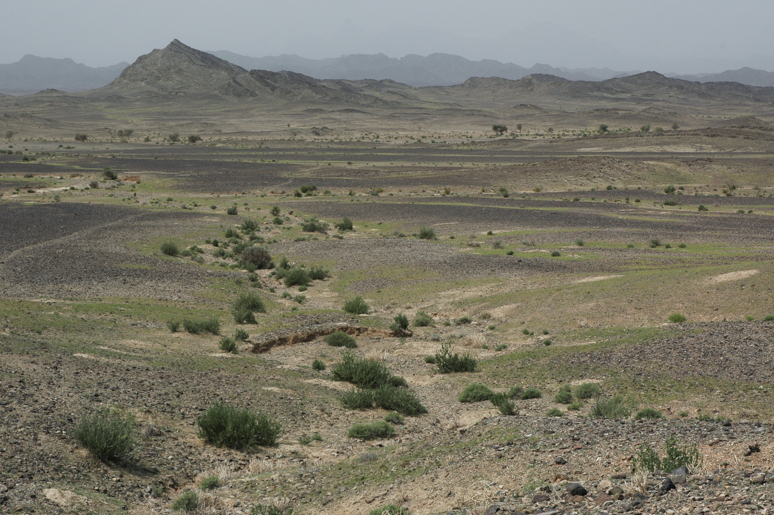
Ras Koh Mountains, near Ahmed Wal, Balochistan, Pakistan
It’s the 21st of March 2009 as I resume my third crossing of Baluchistan on this journey, and the rugged desert reveals yet another face as a sparse carpet of fresh and short-lived grass has just sprouted from the lifeless desert. I decide to make a side-trip to the apparently ‘dangerous’ town of Kharan, to see a fort which is marked on my map. Karez Fort is a neglected nineteenth century throwback to the days of the princely state of Kharan and is in rather poor shape, but the fly-blown town is cheerful and friendly. The police soon find me, and insist on escorting me round with the courtesy that makes them the polar opposite of their equivalents in Iran and they tell me I am the first foreigner they remember being here, except perhaps for some Japanese oil explorers many years earlier.
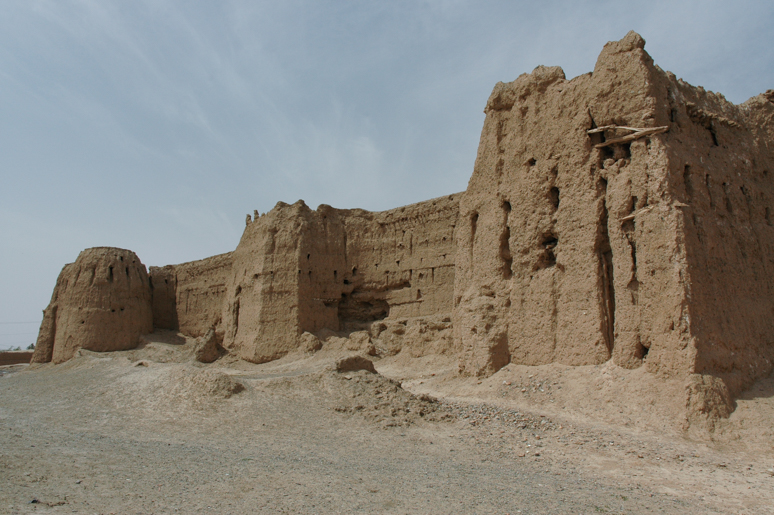
Karez Fort, Kharan, Balochistan, Pakistan
I spend a few nights in Quetta, re-adjusting to the delights of Pakistan; the action, the colour, the chaos and the squalor exciting all one’s senses. I realise how much I have missed conversation (my own fault perhaps for speaking poor Persian); not the limited, formulaic questions in Iran, but the spontaneous and irreverent diatribes one has with complete strangers on the street; one might be approached by a man who at length professes an undying love for Princess Diana, or may have one’s ear bent for ten minutes by another describing in great detail the virtues and shortcomings of the England Cricket Team, despite my repeated appeals that I have no knowledge of, nor interest in the game. Most of all perhaps, after the malign theocratoc presence of Iran’s regressive clerical regime, I enjoy the freedom for, despite the country’s reputation, Pakistan really is a marvellously free place.
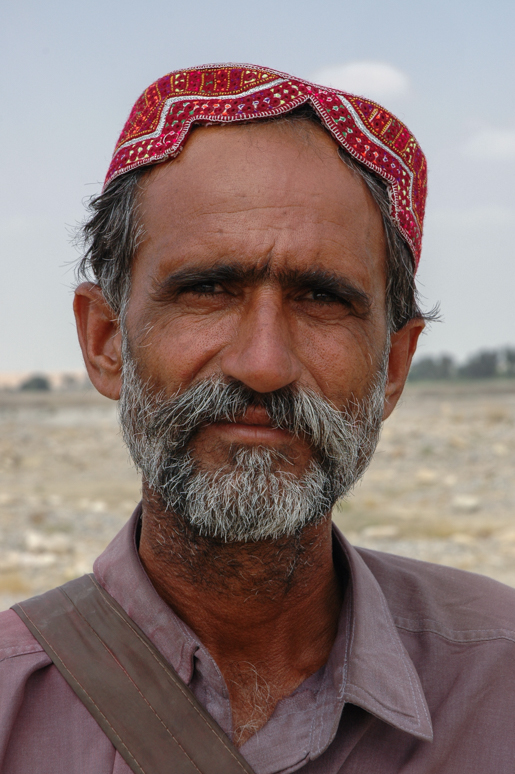
Baloch Man, near Dhadar, Balochistan, Pakistan
I soon slip down from the sere mountains of Balochistan through the Bolan Pass with its impressive, British-built railway, stopping at the archaeological site of Mehrgarh in an area inhabited by friendly Baloch tribesmen shouldering ancient-looking rifles. Mehrgarh is the site of the earliest known settlements in the Indian Subcontinent, dating back to the Neolithic and continuing into the Harappan-era, spanning the transition from hunter-gatherer to settled civilisation. While many artefacts have been uncovered – the site caretaker shows me a beautifully carved miniature head which I am quite sure is genuine – there is nothing like the staggering urban planning one can see at Mohenjo-Daro and the site is visually unimpressive. Continuing east, I reach the scrubby plains around the Indus and turn south to the city of Hyderabad, which becomes home.
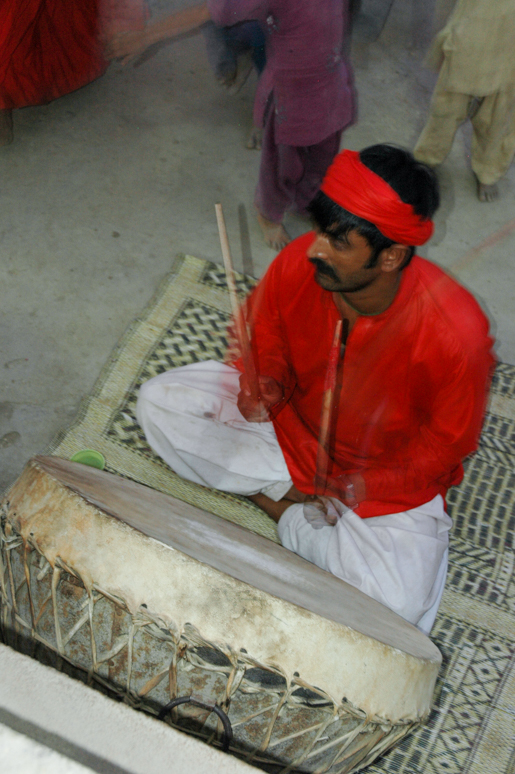
Malang, Sehwan, Sindh, Pakistan
The tremendous heat of summer is already building up, and so trips out of the city are few. Instead, I start to adjust to a sedentary life, taking up a place in Aly and Shahana’s school – something which to their immense credit they have built up themselves – as a trainer to the cohort of teachers. I suggest that mathematics would be a good subject for me to teach to their teachers, but I am shocked to find that few of them – who all have high-school diplomas – can even conceptually grasp multiplication, let alone recite a multiplication table. It’s a frustrating, though highly rewarding experience to teach to these adults what I had learnt when I was perhaps five years old. My posting is also highly unusual in that all my students – i.e. the teachers – are female, something truly irregular in this conservative and highly gender-segregated country. It’s a unique and wonderful privilege and insight into the lives of the other half of humanity in Pakistan, to have this post.
At the same time, my mechanical urges lead me to dismantle the engine in the truck in order to overhaul it (it has used rather a lot of oil ever since I have owned it), especially as the spare parts here in Pakistan are cheap, and the cost of labour truly nominal. The heat soon becomes so acute however that I’m confined to an hour or two each day in which I can work; just after sunrise and before leaving for school, and in the hour between the hellish afternoon heat and the hordes of mosquitoes which appear at sunset.
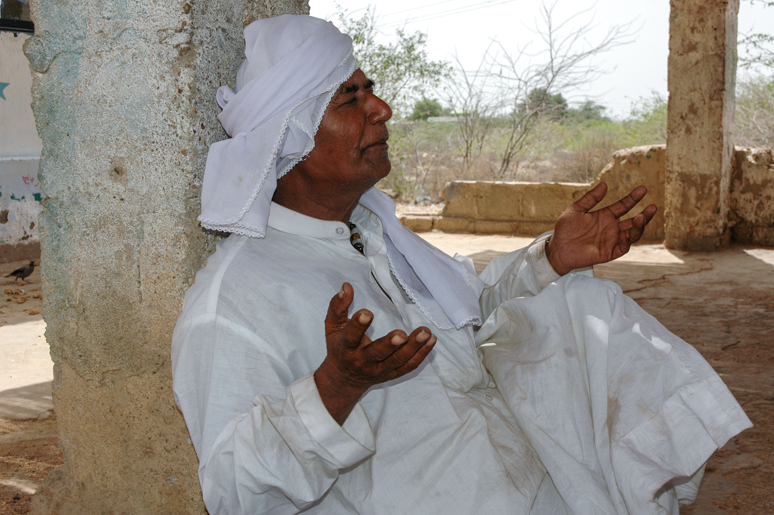
Holy Man, Makli, Sindh, Pakistan
Whilst Aly is fully occupied with his university post, and overseeing the completion of a second storey to the school, Shahana additionally seems to have become more deeply involved in her spirituality, and has made close friends with the Mursheed (Sufi spiritual teacher) of the shrine of Bodlo Shah in the town of Sehwan Sharif, a few hours north of Hyderabad. The great man’s Malangs (disciples) are frequent house guests, and we make the occasional trip into the oven-like surroundings of the shrine to watch the malangs play drums and perform whirling dervish dances in the evening.
My lifestyle is very relaxed; school in the mornings, then rest after lunch while the temperatures outside climb into the high forties, then a little car tinkering in the evening before enjoying the cool nights chatting with friends and relatives who invariably visit, or having long, deep socio-theological conversations with Aly across the dinner table. I feel absolutely at home, and revel in the Pakistani way of life. I make some good friends, such as Khaled, a tall, gentle giant of a man, a native Sindhi and a police chief in the nearby metropolis of Karachi. Khaled occasionally takes me out on his bike late at night, to his friends’ for a smoke, or maybe some gin (Khaled would never drink or smoke), confiscating a bottle from a nearby illegal liquor shop on the way. I feel that I am really putting down roots, and love the place I am living in.

Ultar Massif, Karimabad, Northern Areas, Pakistan
As the summer reaches its peak, school is out and I take a holiday to the north of Pakistan, using public transport as the car engine is still in a jumble of pieces. I hang out in a few overlanders’ haunts; the campsite in Islamabad, the Madina Guesthouse in Gilgit, and the small town of Karimabad in the Hunza Valley. To be in the stunning mountains of northern Pakistan, meeting and making friends with the trickle of intrepid and interesting travellers whom the country’s exaggerated reputation for unrest filters out from the tourist chaff is absolute bliss, and I fancy I could spend the rest of my days admiring the mountains from a watered green garden in the Karakoram. I make friends with a British-Australian couple, Andrew and Amelia, who are driving their Toyota Landcruiser from Australia back to the UK. They are kind enough to take me along on their tour of the north, where I am glad to show them ‘my’ country. We visit the glorious, Shangri-La Valley of Shimshal, a hidden, watered oasis high in the sublime mountain wilderness of the Karakoram. We stay in the tranquil village of Shimshal, a carpet of bright green fields scattered with simple Pamiri-roofed mud-brick dwellings, inhabited by friendly, gentle Gojali Tajiks and reachable only down a long, single lane road which clings precariously to sheer cliff faces.

Shimshal Valley, Northern Areas, Pakistan
It is when I am back in Islamabad however that I come across a truly life-changing piece of information. At the campsite I spy a black Toyota Landcruiser, and get chatting to Hans, its Swiss owner. Hans, who works in ‘business’ (on which he doesn’t elaborate further) has driven overland from his home in Cambodia, crossing China without any state supervision (he clearly has some very good friends in the right Chinese ministries) to get to Pakistan. Far more interestingly however, he has recently been into Afghanistan. To my knowledge, the Pakistani authorities have barred foreigners from approaching the pass since March 2008, but somehow Hans managed to speak to the right people and get permission. Admittedly, he had been stopped within a few kilometres by the Afghan authorities and made to turn back on grounds of security – but I could deal with that problem when it arose. The fact was that he had crossed the border. If I could get the permission which he had obtained, and then cross Afghanistan, I would accomplish one great ambition in life.
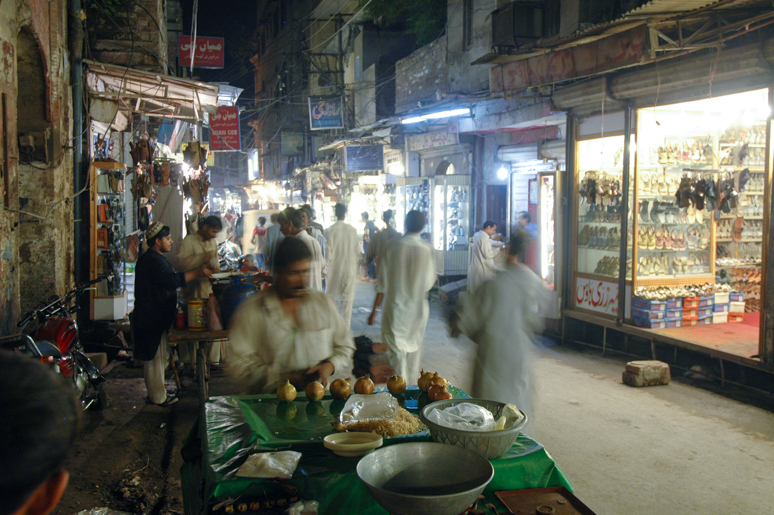
Heera Mandi, Lahore, Punjab, Pakistan
With new direction, I start the journey south, taking the time to see a better side of Rawalpindi, which in 2003 I thought was the worst place I had ever been, not realising that I was in the foul Pir Wadhai transport junction rather than the city proper. In Lahore I also find some new places of interest, visiting (as a spectator naturally) the city’s infamous red-light district at Heera Mandi. All the time however that I am relaxing in these places, I am aware that I have rather a lot to do in the next few weeks, and so return to Hyderabad with renewed vigour for the road. Although the path ahead is clear in my mind, in reality it is littered with obstacles; my car is in pieces and far from being completed, and post-election demonstrations in Iran have lead to allegations by the Tehran regime of British complicity, meaning no visas are being issued to British Citizens. I have no visa to Afghanistan, or anywhere beyond there, meaning I am at present technically stranded. I also have to extend the customs allowance for the truck, or face having it confiscated on grounds of non-payment of customs duties. Most importantly perhaps, I have to do some real research into my next country; is it really suicide, as most people warn me, to attempt to drive across Afghanistan? This is something I will have to consider very carefully.

Saddar Bazaar, Rawalpindi, Punjab, Pakistan
In order to stock up on new parts for the engine, I make several trips to Karachi, two hours away by bus. By this point in my stay in Pakistan I am completely at home, wearing the native shalwaar kameez (it would be miserable to wear jeans in such a climate, and shorts are frowned upon in Pakistan) and more importantly, moving like a local. Karachi in August is a breath of fresh air compared to the scorching heat of Hyderabad, and I move around the city as if it was my own. Getting off the coach from Hyderabad at the chaotic traffic junction on the city’s eastern edge, I jump onto a city bus, a very ancient Bedford jalopy, riotously decorated in every imaginable colour and draped in exuberant polished metalwork. A Pashtun ticket boy leans out of the door, swishing at flies with a rag on a stick, whilst the driver jerks the clutch repeatedly to give the impression of imminent departure, until we finally move off in a cloud of smoke to fly down the choked streets of Karachi, scattering pedestrians and cyclists. The windows thankfully don’t have any glass in them and give a wonderful and constant breeze, and I smoke Korean cigarettes as we move towards the centre. Reaching the commercial district of Saddar, I jump off with local savvy and proceed to go shopping.
Cheap, tax-free Toyota parts come from a cavernous shop in Tibet Plaza, which has the smell of new fan belts, the aroma of car-parts shops the world over. I befriend the shop-owner who fulfils my every wish, sending a boy out to get new pistons, rings, bearings, hoses, gaskets and any other thing I need. A little further into the bazaar I know a tool emporium which has every accoutrement for engine building. It’s wonderful to know one’s way around such a metropolis like a local. I think Pakistan is the first time I’ve ever really loved the place I live in.

Dancer, Sehwan, Sindh, Pakistan
Shortly after returning from the north it is the urs (anniversary) of Bodlo Shah in the pilgrim town of Sehwan Sharif, and we head up to what is Pakistan’s greatest mela (festival). It’s by no means the first time we’ve been to the shrine, but this time we are sleeping in the house of the Mursheed of Bodlo Shah, an almost unthinkable privilege, as many would regard this man of something just short of a God. Sehwan Sharif has the look of an ancient place, clearly a centre of worship for centuries in this desolate spot where the Kirthars meet the Indus and the great plains of the Subcontinent. Oven-like winds of temperatures approaching 50ºC whip up from the filthy open sewers all manner of foul smells and clouds of pestilent flies and dust. Despite the heat and squalor, this is clearly a nerve-centre of Sindhi dargahs (shrines). Bhit Shah, closer to Hyderabad and on the other side of the Indus may be the intellectual centre of spiritualism in Sindh, but here one certainly finds the devotional centre.

Mela, Shrine of Bodlo Shah, Sehwan, Sindh, Pakistan
On these festival days the town is packed with people; petitioners, beggars, holy men, vagrants, pickpockets, police, curious visitors, photographers, charm sellers, religious leaders, prostitues and drug addicts, all drawn to this place at this time. Approaching the shrine, the frenzy reaches a maximum, as a crowd which has pushed, squeezed and shoved its way along the dirty and broken streets of the town, as if fleeing a blazing building, reaches the threshold of the dargah. Overtaken at this point by the power of the experience, visitors fall into a series of ancient rituals, which must have been rooted in the psyche of these people for millennia. They violently hit bells which are suspended from a bar across the courtyard threshold, calling on the deity or saint inside. Next stop is a small altar where hundreds of incense sticks smoulder, giving off a voluminous plume of smoke which twists around the courtyard of the shrine, driven by the currents of hundreds of hot, sweating worshippers who anoint themselves on the forehead with a finger dipped in lamp oil. At the steps to the shrine itself, they prostrate themselves and kiss the door-frame as they enter, moving straight to the main shrine wherein lies the the tomb of Bodlo Shah, surrounded by a brass trellis which is polished to chrome by pilgrim fingers, some of whom throw rose petals onto the grave. Some men may start to pound their chests as during the ritual of Ashura, though most are content with a moments thought or prayer, or maybe a photograph with relatives on this auspicious occasion.

Mela, Shrine of Bodlo Shah, Sehwan, Sindh, Pakistan
The crowd processes anti-clockwise around the tomb, and women head off to a corner where there are festooned some kind of fertility idols in the shape of miniature baby cradles. The women swat nervously at the cradles like cats, maybe throwing in ten rupees and saying a prayer for abundant offspring. All the time, outside the shrine, musicians wander, their drumming a constant onslaught of rhythm which drives the crowds forward in their ecstatic ritual, helped along by frequent shouts of ‘Ya Ali!‘ from within.
People flock here from across the region, seeking… something. What exactly is happening here, I am not sure. Perhaps some come for real reasons of religious piety, some perhaps in the hope of personal spiritual reward. Many seem to come for reasons of pure hedonism, but maybe there is something more subtle, beyond my understanding. Perhaps its a conceit of my rational Western mind to wish to answer such a question simply with words. The crowds consist largely of the lower classes; farmers, peasants, small businessmen and traders, people of the towns and villages of the interior. I don’t believe they are coming here to worship the ancient mendicants who are buried here; Bodlo Shah, for instance, is not a very well known figure. Perhaps however in the absence of a tangible god, people need an outlet for devotion – Bhakti in the ancient language of the Subcontinent – be it a stone idol, a sacred relic or the tomb of a deceased person.

Sindhi Man, Sehwan, Sindh, Pakistan
People come here and enjoy themselves, but is there really a religious element to it? Certainly, seeing a group of women cross-legged on the floor, eyes rolled back into their skulls and heads drenched in sweat, with long, glossy black hair cascading over their faces, rocking and swaying rhythmically in the manner of the possessed, seems more like West African Voodoo than anything that might be called Islam. As for the reason why this place is chosen, this must be long lost in the depths of time, perhaps as far back as the ancient Indus Valley Civilisation which grew up exactly around this region. The mela is a truly fascinating, puzzling and human insight into the region’s spiritualism, this amorphous band of devotees who may be referred to as Sufis, who worship in the shrines of the holy men, polymaths and poets who wandered Central Asia centuries ago, and like so many, settled in the Subcontinent. Another fascinating and unique experience in this wonderful country I have started to call home.
As much as I love Pakistan however, I am not blind to reality. The country is a basket case of problems, which has been verging on being a failed state since its creation. As much as anything, my six months of sedentary life have given me a chance to think and to read, and to speak to some very interesting people, some of my favourite activities in life. One cannot live in a country of such pressing poverty and social strife without thinking as to why humanity still has to live like this.

Dancer, Sehwan, Sindh, Pakistan
Without doubt, I am convinced that until the population of a country is freed from the yoke of poverty, with its ugly siblings of ignorance, social inequality, communal violence and crime, and until said population can be emancipated from superstition and blind faith in organised religion, that country will never be freed from exploitation by an elite for whom it is all too easy and favourable to maintain these conditions. The qualities of greed, megalomania, nepotism, selfishness and so on, thrive in these conditions, though it would be absolutely wrong to assume that such qualities exist only in the undeveloped world – it is after all the developed nations who support such people – but the forces and fruits of social and cultural evolution are hard to resist.
A population who can question – through education, knowledge of the outside world, and religious, cultural and ideological ecumenism – is far less likely to stand for such an exploitative elite, be they installed and maintained by false religious legitimacy, such as the Ayatollahs of Iran, by sheer fear and repression of individual though as in Uzbekistan or Turkmenistan, or by the crushing force of poverty, ignorance and powerlessness as here in Pakistan. It is these opressors who are the greatest perpetrators of ill to humankind, along with those powers whose hands are often – openly or discreetly – behind such regimes.

Malang, Sehwan, Sindh, Pakistan
More universally, I have seen the shortcomings of human nature – inherent in us all – but all the more obvious in those in power, whose influence almost invariably magnifies these flaws. Is the future of mankind to live together in peace, with respect for diversity and individual differences? Are we to be expected to evolve in sufficient time before the crush becomes too great to bear? Are the fine distinctions which may differentiate human society from any of the other fauna of this Earth an indication of an uncontrollable outcome of a distant genetic mutation, which will ultimately make us in-viable for life on Earth? This journey has taken me into many of the areas in which it seems humankind transgressed from living basically as animals – as small bands of hunter gatherers – to some sort of organised civilisation where man could begin to gain some degree of security in life from famine or attack. But in my mind, it seems that a new ‘Axial Age’ is required – one in which humans start to deeply – truly – think about each other instead of themselves and their immediate kin. I myself certainly cannot admit to being imbued with such qualities.
Eventually, the time comes to move on. My feet are itching to travel again, see new countries and meet new people. I finish rebuilding the car engine, have a route through Afghanistan in mind, and say a sad farewell to the teachers at the school knowing that I will most likely never have an experience like this again. I also must leave my adoptive family, who have taken me in without question for over five months. I feel I am closing a wonderful chapter in my life, but another is opening; one in which, I hope, to fulfil a long-standing dream.
Stage 14 – Iran: Deserts And Borders [2/2]
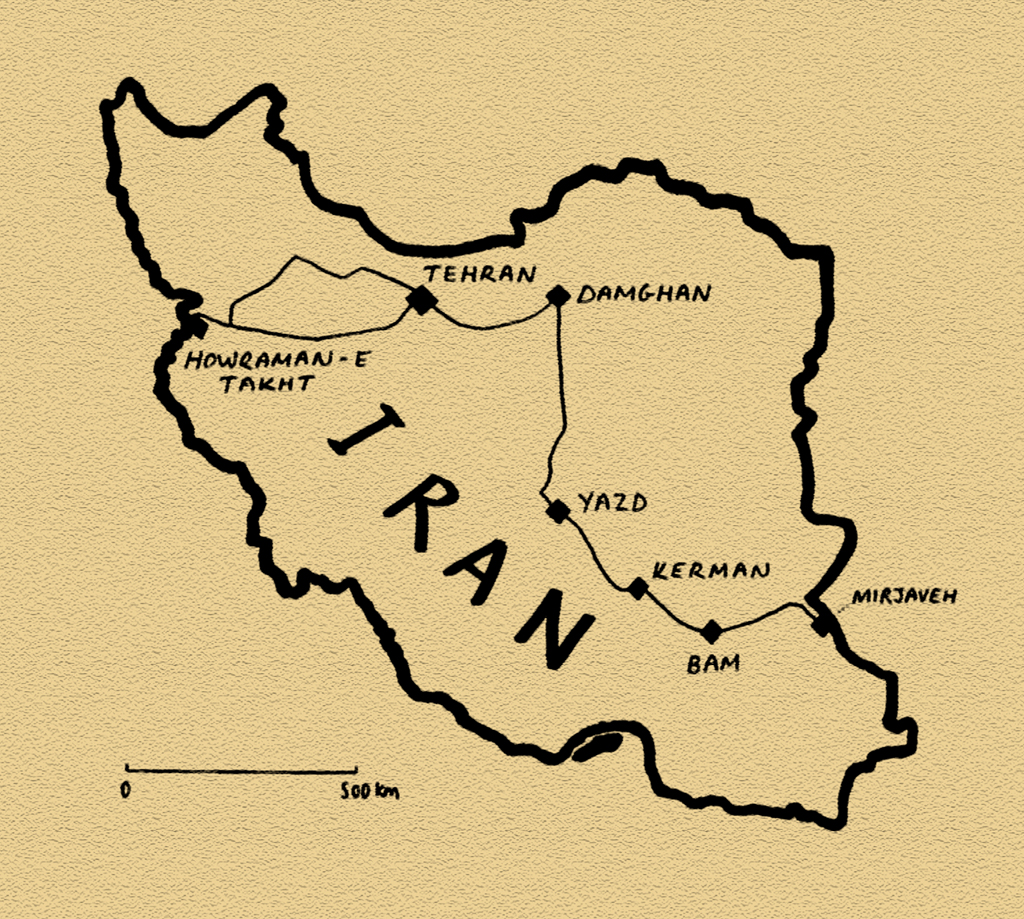 Having explored the wild beauty of Iran’s eastern borders, and joined by new travel partner Maciej, I make a journey from the capital to the country’s western border in the freezing mountains of Kurdistan. Alone once again, I spend a few weeks in the capital and in Yazd, my favourite Iranian city, before slipping back into Pakistan, taking the Odyssey east once more and abandoning plans to head to Arabia.

Zagros Mountains, Hamadan Province, Iran
It’s the 4th February 2009, and Maciej and I, together with Slovenians Matjaz, Ana and their friend Manca with whom we had all stayed the previous night, leave a cold, grey Tehran. We drive west, up onto the frigid expanses of the Zagros mountains, now deeply covered in snow as we pass the city of Hamadan and enter the province of Kordestan (Kurdestan). Moving west, the towns become scruffier, with shabby, rough architecture and litter-strewn streets. At the same time however, the welcome is warmer; the Kurds are perhaps the warmest and most genuinely welcoming people in a region renowned for hospitality.
After dark we reach the freezing mountain town of Marivan. The Slovenians head to bed in a comfortable hotel, but Maciej and I, after finding cheaper digs in a rather seedy establishment, go out into town in search of some entertainment, soon finding a warm chaikhana (teahouse) packed with Kurdish men. The atmosphere inside is dark and thick with tobacco smoke, and warm thanks to a brazier burning wood and walnut shells. Rough-hewn Kurdish figures, whilst thumbing strings of rosary beads are engaging in heated conversations over endless cups of fragrant black tea and games of nard (backgammon). Despite being very obviously foreign, Maciej and I are not pounced upon with the usual string of questions, and spend a relaxing time with a huge, ornately turned wooden ghelyun (waterpipe) smoking wonderfully soft and fragrant unflavoured tobacco – far nicer than the rather artificial-tasting apple or mint tobaccos one usually finds in the region.
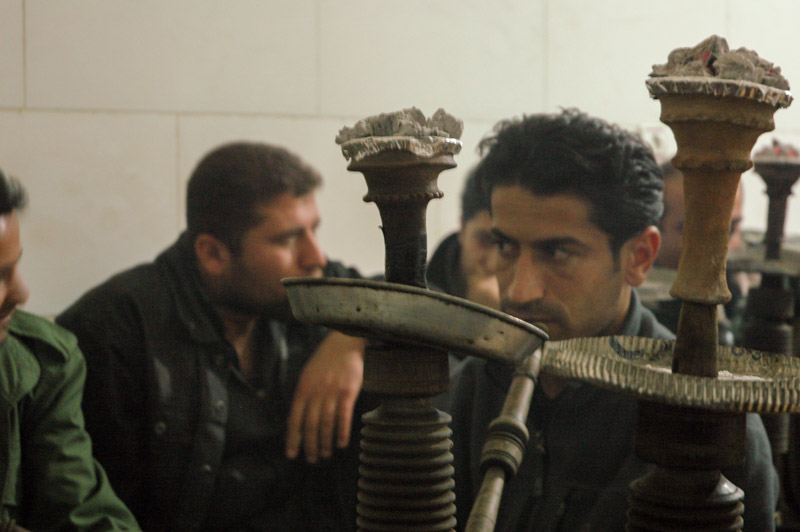
Tea House, Marivan, Kordestan Province, Iran
After a short time, we start a conversation with some of the local men, one of whom, Hadi, speaks good English. These are not farmers or wild mountain men, but teachers and engineers. The conversation soon turns to the issue of the repression of Kurds under the Iranian regime, and we are shown some truly shocking footage of the aftermath of attacks by the Iranian border forces on Kurdish smugglers – mutilated and pulverised corpses strewn in the hills around the Iraqi borders.
Kurds, like all of Iran’s repressed minorities, are Sunnis, and rather like their Baluchi cousins at the opposite corner of Iran, are a people who long for self-governance. Marginalised economically, farming and smuggling are a major industry, which belies the fact that many Kurds, despite being very traditional, are highly educated, worldly and forward thinking. One need only look at the great Kurdish diaspora throughout the West however, to see that these are a repressed people, desperate to live dignified lives. Our new Kurdish friends insist on giving us a ride back to our hotel; a warm welcome to a cold and rather bleak place.
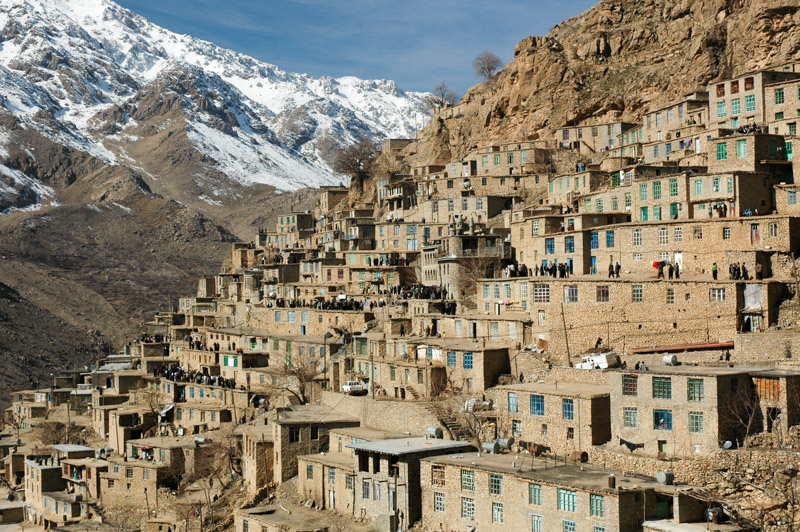
Howraman-e Takht, Kordestan Province, Iran
In the morning we head out to our intended destination in Kordestan, the small, isolated Howraman Valley which lies right on the Iraqi border, and hosts the uniquely Kurdish mid-winter Pir Shalyar festival. Pir Shalyar was a (perhaps mythical) Zoroastrian magi (saint) whose marriage to a princess nine hundred years ago is celebrated annually by Kurds of the Hawrami clan, who speak an unusual dialect of Kurdish. The valley’s main town, Howraman-e Takht is a picturebook image of medieval-looking stone houses with large latticework windows of green or blue-painted wooden frames, which spill down the steep wall of the valley. It is also the site of Pir Shalyar’s shrine, and the centre of today’s festivities which see the town packed with Kurdish men from the surrounding villages. The older men can be seen wearing a very distinctive felt waistcoat with protruding shoulders, looking almost like the neck of a goatskin. Others wear the more traditional low-crotched Kurdish pantol trousers and kava, which is often rather unflatteringly translated as a boiler suit, held around the waist with a sash known as a peshtend, and almost all wear tasselled black head-scarves.
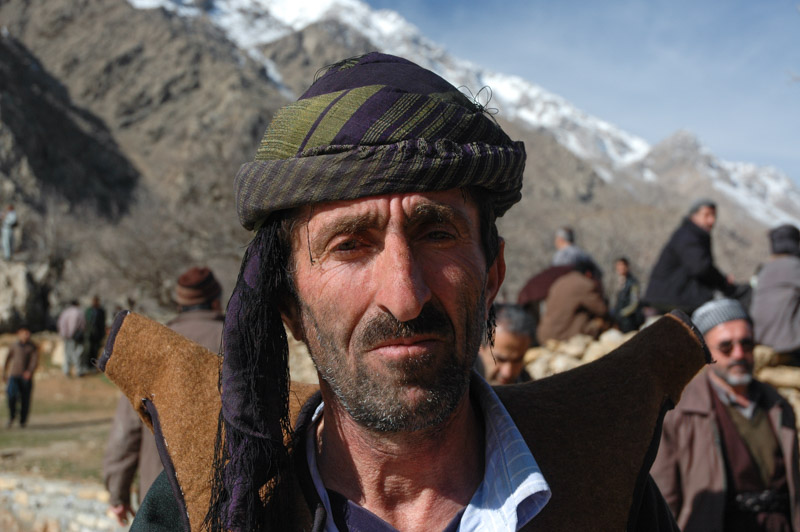
Hawrami Man, Howraman-e Takht, Kordestan Province, Iran
After making offerings at the shrine – the clearly pagan influences of the holiday hint at pre-Islamic roots – the men move up into the village where music on traditional daf drums begins, and the elders, arms entwined, begin a ritualistic dance. Two long-haired dervishes (Sufi ascetics) become the centre of the crowd, and feed from their frenzied energy, bounding into the air in a swirl of black hair, spitting razor blades from their mouths. Apparently the town clerics had requested the devishes to refrain from their wilder stunts such as pushing swords through their necks, or dousing themselves in petrol and setting themselves ablaze.
After the daytime festivities, Maciej and I are invited by a tall, wiry Kurdish man to the home of his friend, Mr Jamal, who without a moment’s hesitation welcomes us into his home and tells us we should make it our own for as long as we wish. His wife serves us a wonderful lunch of rice and chicken, which we take in typical Iranian style sitting on the carpeted floor. Mr Jamal speaks good English, and tells us his story. Six years ago he flew to Bishkek where he purchased a fake Greek passport, with which he flew to Germany, making his way then to Calais where he ditched the passport and entered the UK hidden beneath a lorry. In the UK he sold cigarettes illegally posted to him from Greece for five years until he had enough money to return, when he met his five year-old son for the first time.
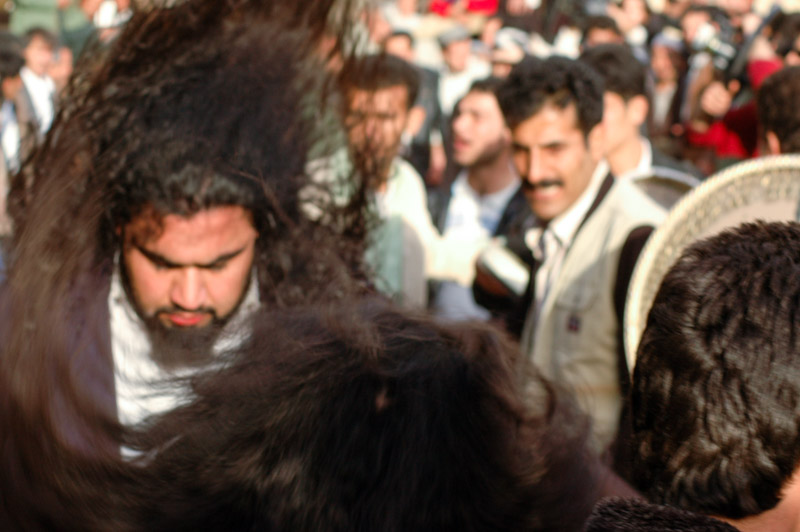
Darvish, Howraman-e Takht, Kordestan Province, Iran
Mr Jamal praised the justness of the British police, by whom he was detained more than once, and I could see that, far from being a criminal, Mr Jamal was a man who was a victim of circumstance, and went to extreme lengths to do what he needed to do to have a normal life in his homeland.
In the evening, as wolves howl from the surrounding mountains, the festival action moves to a large, stonewalled barn, said to be the former home of the Pir himself, which is utterly packed with people sitting on tiered shelves as bowls of a soupy stew consisting of wheat and beans is passed round from an enormous cauldron. I feel like I’m in the pages of some medieval banquet. Indeed, I come away from the festival feeling I have glimpsed a rare and fascinating insight of this most traditional region of the Kurdish world.
The Slovenians leave on the first evening, with Matjaz and Ana heading back to Europe and ending their journey, which has now twice intersected with mine. Maciej and I spend three nights with Mr Jamal, spending one day with a Persian film crew on the Iraqi border along with Giovanni, an Italian photographer, and the second just wandering the friendly streets of Howraman-e Takht, enjoying cups of tea in the local chaikhana. Kordestan really is a magical and endlessly welcoming place.
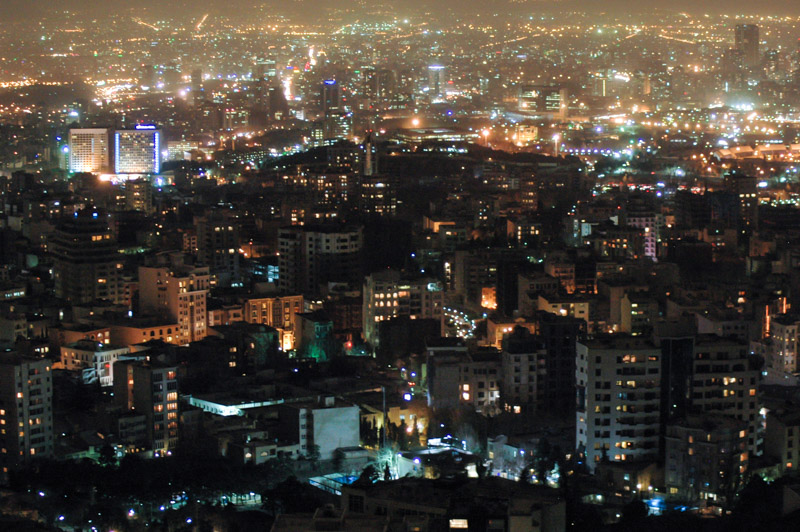
Nightscape, Tochal, Tehran, Tehran Province, Iran
We leave on a Sunday morning, retracing our steps to Sanandaj and having a run-in with the irksome Iranian authorities who wish to dismantle the car’s luggage (Toyota pick-ups are a favourite tool of the smuggler). We drive on eventually, through the bleak mountain town of Bijar, dropping down to join Iran’s main artery at Zanjan and heading east through Qazvin back to Tehran, where Maciej has to catch a flight home. We’ve travelled together for over two weeks, and I’m sad to see him leave.
I spend a month in Tehran, during which time I obtain a Pakistani visa, and have some rest time. I’ve been travelling for around 18 months and I’m starting to feel I need a break. Although Tehran is not an appealing city in any conventional way, it does have some hidden charms. One is the two-part National Museum, of which only the building covering the pre-Islamic era is open. The museum covers a considerable span of history; from the earliest signs of human culture; 9000 year-old shards of pottery, which by the 6th Millennium BCE bear the mark of artisans, and by the early 1st Millennium BCE had become highly stylised and decorative ceramics. The influence of neighbouring Egyptian and Baylonian empires becomes apparent during the magnificent Achamaenid Empire, a fascinating demonstration of how interconnected the area was during this remote epoch. Then comes Alexander the Great and the Seleucids, the Parthians, and finally the Sassanians, the second great Persian Empire, and the last before the arrival of the Arabs and Islam. Coming from northern Europe, it’s deeply impressive to find a museum full of the earliest artefacts of man which come not from plunder, but from the same country and same people as inhabit the place today.
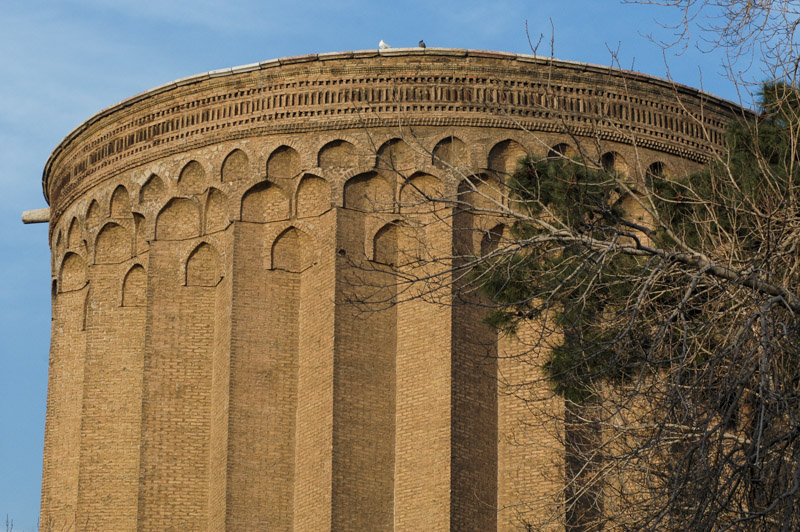
Tughrul Tower, Rey, Tehran Province, Iran
For the capital of a country so magnificently rich in history, Tehran is purely drab and modern. With some determination however, one may find some hints of history in the vicinity, such as the ancient city of Rey, now wholly absorbed into the capital. Known to the Romans and Greeks, Rey still has hints of past glory, such as the dome-less, fluted Seljuk Tughrul Tower, a typically Turko-Persian structure of brute-force and elegance, though the relentlessly ugly modern sprawl of south Tehran makes it rather hard to appreciate.
Moving further out, but still not leaving the crush of the endless suburbs, I visit the town of Varamin, once no doubt a pleasant place when unconnected to Tehran. Varamin hosts the glorious Ala-e Din Tower, another example of the intriguing tomb-towers which dot the north of Iran, as well as the slightly decrepit, though glorious Azari-style Friday Mosque which was photographed by Robert Byron in his overland epic The Road to Oxiana in 1934. In the mosque however, I’m reminded of everything I hate about Iran; my passport is checked, and I am watched continually by suspicious guards and prevented from taking photographs, while Iranian visitors openly do so, as if this were an object of national security rather than a relic of a bygone age of perhaps higher culture.
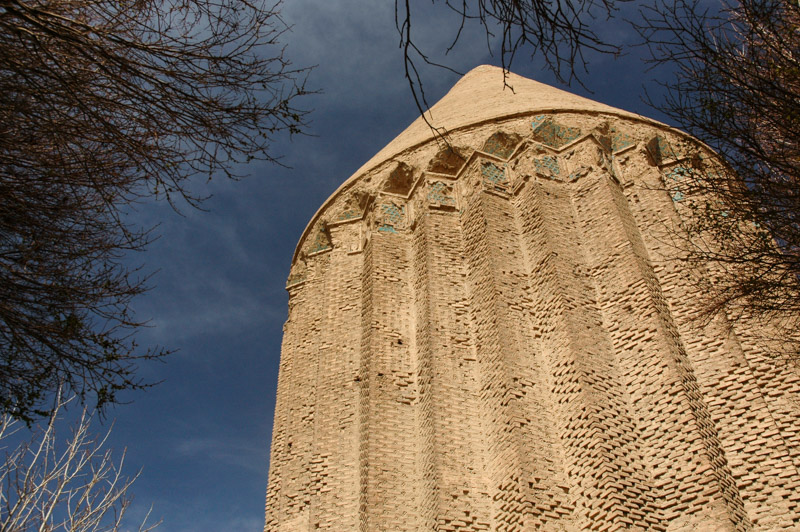
Ala-e Din Tower, Varamin, Tehran Province, Iran
Much more than the ancient however, it is the modern Iran which one can see perhaps best by spending some down-time in the dowdy capital. Elections are due this summer, but the atmosphere on the streets is down-at-heel, with worries of unemployment, inflation and rises in commodity prices seeming to take precedent over the long-standing longing for greater freedom. Memories of the Revolution and war that followed are still fresh, and these temper demands for change. The Iranians are a deeply troubled nation, surviving under one tyrant after another, trapped equally by a history of in-fighting, and then taken advantage of by the intervention of foreign powers. Now the ayatollahs are talking of removing the subsidies on public services; one of the key pledges of Khomeini during the Revolution. One wonders how the regime might weather the backlash from such a move.
I spend my month in Tehran in the company firstly of Karim, a British-Iranian who lives a hermetic and nocturnal life living with his father in a large, old-money house in a nice part of North Tehran, which Karim manages to set on fire one afternoon. The house is full of reminders of a past age; an old American Dodge camper which lies rotting in the garden hints at the freedom of pre-revolutionary Iran, which today seem a world away. My second host is Pezhman, a nineteen year-old student from the Caspian region of Iran, with whom I eventually leave Tehran, after a month of wonderful lassitude and reading.
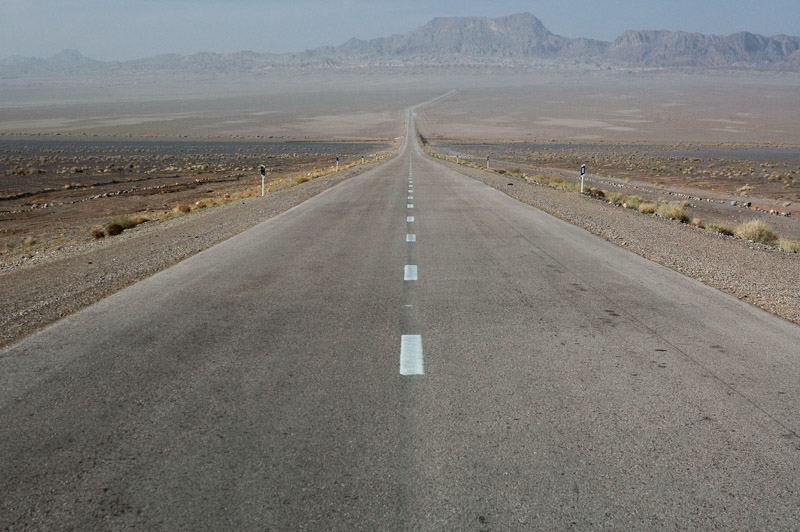
Desert Road, near Ardakan, Yazd Province, Iran
Pezhman and I head east out of Tehran late one night, on the road back towards Mashhad. At daybreak we are in the town of Damghan, where we turn south into Iran’s largest desert, the Dasht-e Kavir, a vast, barren salt waste. We drive along an endless desert road, through barren plains, passing banded pink hills and a vast salt pan where a dust storm blasts across the road, reducing visibility to just a few metres. Desert towns such as Reshm and Jandagh seem trapped in glorious, timeless isolation, but nowhere is the desert as attractive as the abiotic void of the Dasht-e Lut. In the late afternoon we begin to see some distant mountains, and when we reach the town of Ardakan we are back on the Great Eurasian Overland route to India.
We are heading for what was, on my first visit to Iran in 2003, my favourite city in the country. The desert city of Yazd is a jewel of unique architecture, Zoroastrian culture, and magnificent, winding mud-brick bazaars. Yazd’s fourteenth century Jameh Masjid (Friday Mosque) is an architecturally unique structure; one of the most striking in the Islamic world. Its soaring rectangular iwan (portal), covered in exquisite faïence and lines of Kufic tile-work is supported on one side by what looks to be a flying buttress, and topped directly by two closely set, needle-like minarets, which are said to be the highest in the country. The mosque was an iconic image of my 2003 journey, and may well have inspired my great love of Islamic architecture.
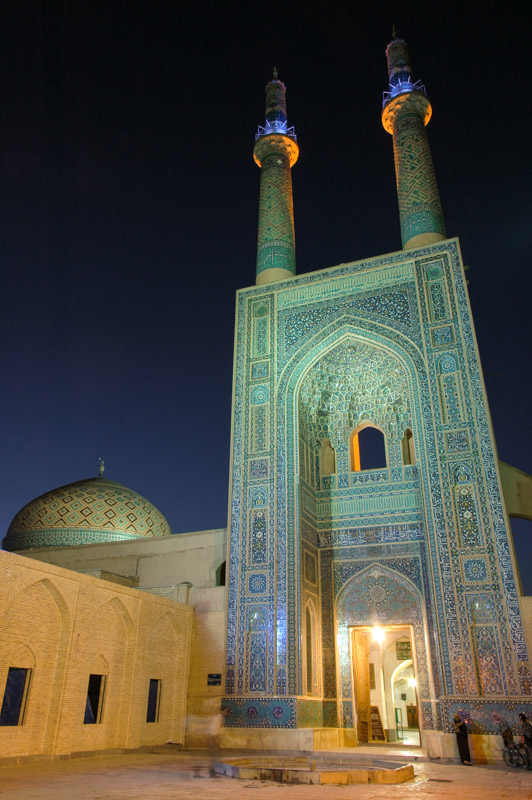
Friday Mosque, Yazd, Yazd Province, Iran
Yazd is a city in which to wander; through mazes of adobe back-alleys dotted with ancient doors, set below street level and with separate knockers for men and women; past tall and elegant badgirs (wind towers) which cool the clustered houses of this desert city; past large, domed water cisterns with their own badgirs to act as vast, ancient water coolers; and shrines and other charming relics. It’s one of those cities which exemplifies long-standing urban civilisation, suffused with oriental charm from the ancient and time-worn alleys to the evocative scents of spices brought from across the continent, which waft from the stalls of the bazaars. The ubiquitous modern squalor of snarling motorbikes and ugly charmless architecture hardly seem to penetrate this rich and timeless heart of the city.
The city is also a modern centre of Zoroastrianism, a religion which is thought to have evolved from ancient Indo-Aryan beliefs almost 4000 years ago, to be formalised most likely in the sixth century BCE. It was the state religion of the pre-Islamic Achamaenid and Sassanid Empires, and although heavily replaced by Islam, it retains a significant number of followers in Iran, and also India. Often mistakenly called ‘Fire-Worshippers’, Zoroastrians believe in a single, non-immanent God, Ahura Mazda, and worship in the presence of fire, which is seen to be a medium through which spiritual insight and knowledge may be gained. Yazd hosts the country’s only Atesh Behram, the highest grade of Zoroastrian Fire Temple, containing the ‘Fire of Victory’ which has been drawn from 16 types of fire, and is the most consecrated in the religion.
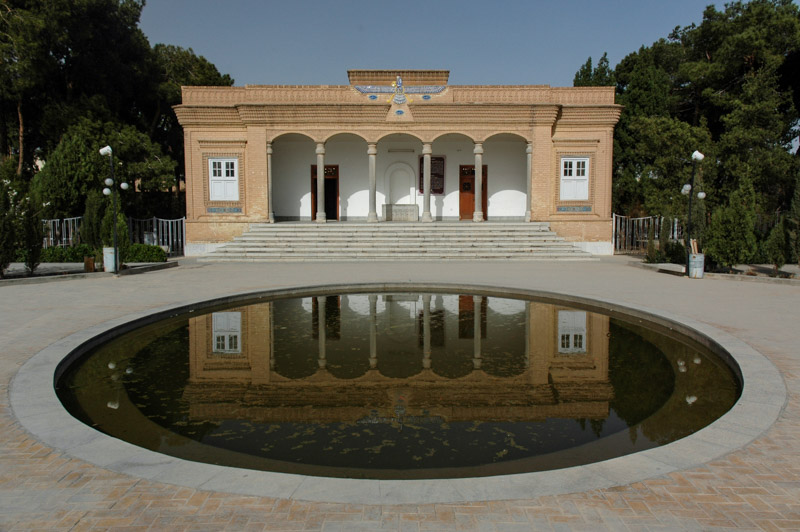
Atash Bahram, Yazd, Yazd Province, Iran
It is outside of the city however, that the most evocative testament to this ancient religion is found, at the Dakhmeh, or ‘Towers of Silence’. Believing a dead body to be unclean, Zoroastrians will neither pollute the Earth by burying it, nor pollute the air by burning it. Instead, the corpse is lain out on a dakhma, and allowed to be picked to pieces by scavenging birds. Although disused since the early twentieth century, the two simple, stone-walled towers are wonderfully peaceful and poignant, sat on outcrops of dark basalt at the desert’s edge.
After a couple of days Pezhman leaves for Tehran once more, whilst I indulge in days of nostalgic walks in this wonderful city. I must however pull myself away eventually, as my visa – extended as far as possible – is due to expire soon.
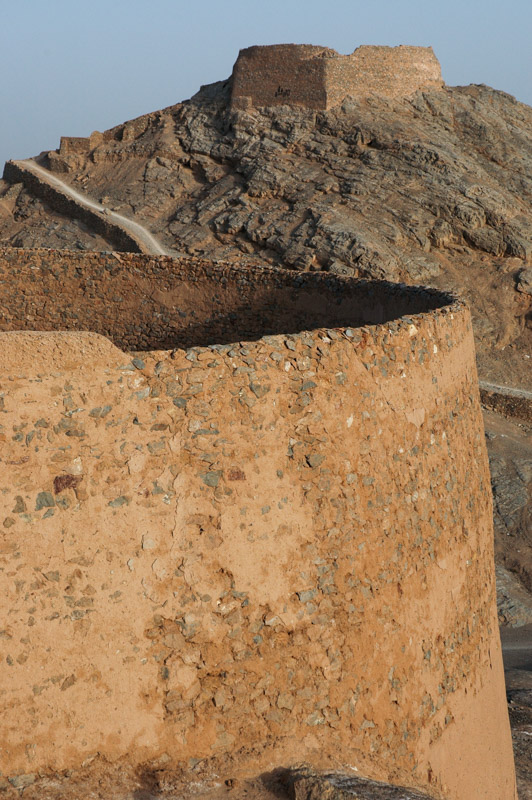
Towers Of Silence, Yazd, Yazd Province, Iran
The small, searing desert city of Bam used to be one of Iran’s wonders; perched at the edge of the country, a massive, mysterious mud-brick arg (citadel), surrounded by an oasis of verdant palmeries. A node on the Great Eurasian Overland, it represented the end of Iran, of her romantic cities of faïence and vast domes and dusty bazaars. It was a final, glorious burst of magnificence before the 1000 kilometre void of Baluchistan; hot, unforgiving and lawless, before entering the colourful melee of the Sub-continent proper.
All the romance came to an end, tragically, on the 26th December 2003 when an earthquake levelled the poor city of Bam, killing more than 26,000 people, and totally destroying the arg. Bam is now a sorry shadow of itself; the citadel, more than five years after the earthquake remains a largely unrecognisable pile of rubble, whilst the city, though largely reconstructed still shows the obvious signs of destruction, and has lost its timeless desert charm of old. I wrench myself away, not wishing to overwrite my previous memories from the summer of 2003, memories of the glorious arg and chaotic, palm-lined streets; memories I truly cherish.
My visit to Bam is not all sad however, as I have an invite to stay in the Arg-e Jadid, the ‘New Citadel’, which although not in any way a citadel, is intriguing in its own way. Set on a large desert lot about 15 kilometres out of Bam, it has the look almost of an American out-of-town mall. It’s an industrial free-trade zone set up by the Rafsanjani government in the 1990s, and seems to have been forgotten. Reza, my host, lives here in a closed community which feels a world away from the rather lawless surrounding desert (where he tells me there were 7 kidnappings last month). It also feels rather distanced from urban Iran, with quiet streets, empty parks and modern amenities. It’s a comfortable bubble of freedom, and we even manage to drink a little vodka – which Reza sneaks into a restaurant – openly in Iran: unthinkable anywhere else in the country.
Nowruz (Persian New Year) is coming, and I am lucky enough to spend Charshanbe Suri, the last Wednesday before Nowruz, with Reza and his family. Outside, Iranians let off firecrackers and observe the ancient purification ritual of jumping over fires. Like many non-Islamic rituals in Iran, the participants are largely the young who, despite coming from Muslim families, revel in their Persian identity by observing such ancient, pre-Islamic festivities, which the clerics tend to disapprove of. Later, Reza and I join his father and observe another non-Islamic Persian ritual; smoking the bofoor, which comes with an elaborate, octagonal charcoal brazier and fine tea service. It’s a wonderful end to my trip in Iran.

Camel And Calf, near Nosratabad, Sistan and Baluchestan Province, Iran
Two days later, on the eve of Nowruz, I set off east once more, to make my third crossing of Baluchistan. I pass Zahedan in the afternoon, and arrive at the grim border town of Mirjaveh, where I find the border crossing is closed. I elect to stay at the border, and am luckily given tea and food by a group of Turkish truck drivers who are similarly delayed. In my three months in Iran, I’ve seen not only a different side to the country, around the deserts and borderlands which separate the magnificent cities, but also a different side to the people. Iranians have suffered a tragic hand from history, caught up somehow – through their own actions and through those of others – in a tyrannic, repressive police state. My tiresome run-ins with the police have shown another side to the Persians; a deep-rooted mistrust, insecurity and xenophobia which must stem from centuries of backstabbing, invasion and intervention.
My thoughts however are of upcoming freedoms in Pakistan, away from the Iranian authorities and grim regime of Tehran, of staying with Aly and his family, stopping my travels for a few months and regathering my perspectives and plans. An interlude in my odyssey.
Stage 14 – Iran: Deserts And Borders [1/2]
 Although I’d been in Iran for about three weeks, it wasn’t until I struck north from the Persian Gulf, up onto the Iranian Plateau, that I entered the real Persian heartland with all its history and cultural attractions. I had visited many of the country’s great cities the previous winter, and on this visit my aim was to look instead at the places in between – in the great, empty deserts of Iran, and farthest reaches of the country along the borders of Afghanistan, Turkmenistan and Iraq. In these marginal areas one finds some of Iran’s many minorities; Sunni Persians, Turkmen and Kurds, who make up a significant proportion of the country’s population. It would be a tour of Iran’s empty and forgotten places.

Portal, Friday Mosque, Kerman, Kerman Province, Iran
On the 13th January 2009 I leave Bandar Abbas and head north, going from the balmy but arid Persian Gulf Coast and gently climbing into the ‘real’ Persia, that from the pages of Curzon and Byron, of dry-raked mountains where oranges, pistachios, pomegranates, grapes and walnuts have been grown for generations in neat fields irrigated by channels of crystal-clear desert water. It is here that the Persians live amongst their history; in the restored magnificence of the country’s mosques, bazaars and mausolea, or crumbling caravanserais and castles which litter the landscape, markers of an ancient overland trade route.
I arrive in the early evening in the city of Kerman, which seems to embody all of the delights of Iran, though still has something of the air of an outpost surrounded by ranges of mountains and vast deserts. It’s the last in a string of magnificent cities on the modern overland route from Europe to India. Kerman is a very fine example of a Persian city, centered around the atmospheric and time-worn bazaar which interconnects the social, commercial and cultural life of the city; with magnificently tiled mosques, ancient mausolea, bathhouses and rueful parks. Although it does not quite match the monuments of Esfahan or the refined air of Shiraz, it manages to perfectly juxtapose the modern with the ancient in that uniquely Iranian manner. Like all of Iran’s cities however, there is an ever-growing sprawl of bland, characterless suburbs of pale brick houses, glass shopfronts, neon signs and snarling traffic which one cannot reconcile with the elegant, graceful and timeless masterpieces of Persian antiquity.

Citadel, Rayen, Kerman Province, Iran
I make a day trip out of Kerman into the surrounding countryside which is dusted by windblown snow and framed by bleak, white mountains. My first stop is Mahan, which hosts the shrine of fifteenth century wanderer of Central Asia, Sufi master and poet Shah Nureddin Nematollah Vali, which is topped with an exquisite turquoise-tiled dome. In the nearby town of Rayen I wander around the empty arg (citadel), an impressive brown adobe structure which has echoes of the once splendid arg in Bam. Out in the nearby countryside is another monument of classical Persian civilisation, the Qajar-era (nineteenth century) Shazdeh Garden. Set across a sloping plain, Shazdeh is the epitome of the Persian garden; a long, rectangular, tiered pool, lined its entire length by cypress and plane trees, and ending in a two-storey pleasure-palace. The garden is telling of Persian tastes; for greenery and water in a country which is often desert, of natural beauty and indulgent hedonism.

Yardangs, Dasht-e Lut Desert, Kerman Province, Iran
I leave Kerman early one freezing morning and begin my journey into the hinterland, crossing the snow-covered mountains which lie immediately to the east of the city, then dropping gently more than two thousand metres through villages such as Shafiabad, with its crumbling fortified mud-brick caravanserais, to the edge of the real desert.
The Dasht-e Lut, literally meaning the ‘plains of nothingness’ is the southern of Iran’s two large deserts. It records the world’s highest surface temperatures (70.7º C is the record) in summer, and much of it is abiotic: beyond the desert’s edge there is simply no life; no blade of grass, no insect, nothing. It could be another planet. The stark emptiness of the desert with its pure, silent simplicity serve to cleanse the mind and soul. Pinky-brown yardangs; outcrops of rock beautifully eroded by the wind, float over the grey-brown sandy plains like a flotilla of ships extending off into infinity, under a perfect cloudless sky of deep winter-blue. The road plunges ever east, mesmerisingly straight for dozens of kilometres at a time. There is absolutely no other traffic, and I begin to wonder if this road (which is not marked on maps) is actually completed, and if it goes anywhere at all. It’s not a thought which really troubles me however, as it is a pure pleasure to drive here.

Desert Highway, Dasht-e Lut Desert, South Khorasan Province, Iran
After perhaps two hours of solitude on this perfect desert road, the landscape starts to change. Sand is replaced by barren plains and salt deposits hint at ephemeral watercourses; patches of sparse vegetation appear and the other-worldly desert becomes monotonous scrubland. It’s in this scrubby wasteland that I spot a red pickup truck parked at the roadside, and four men standing around it. One is in army fatigues and the other three plain-clothed, one of whom walks to the roadside and waves for me to stop. I have no intention of doing so until the man pulls out a Kalashnikov and points it at me. I stand on the brakes and pull up near the other truck, where one of the other plain-clothed men approaches the window. This wild area is a prime drug-trafficking route from Afghanistan towards Europe, and there are warnings about run-ins with drug traffickers in the desert. I’m only slightly relieved to find out that these men are police (by law plain-clothed police are not permitted to stop motorists), but the man I speak to turns out to be friendly, and (perhaps worryingly) able to speak English. I’m allowed to pass with little fuss, but it’s not the most pleasant end to a wonderful drive.

Persian Man, Torbat-e Jam, Razavi Khorasan Province, Iran
I reach the Sistani town of Nehbandan in the late afternoon and, finding nowhere to eat, push on north. After dark I have another run-in with the police, this time at a conventional checkpoint. A small Mercedes lorry has been pulled over, and the driver is handcuffed. The police lead me over and point at some old gas cookers and refrigerators strapped to the back, which on close inspection are full of packages of heroin. The Iranian police universally see nothing wrong with wasting my time and after a long wait in the dark and cold, my car is carefully inspected. Cooking and kitchen apparatus are now of great interest to these people, and my gas cooker is given a very thorough going over. To their surprise the police find no narcotics in my truck and eventually allow me to leave, only to be stopped a few kilometres later by some of their colleagues. Interactions with the police are definitely my least favourite experience in Iran.
Late at night I reach the freezing desert town of Birjand, whose frozen streets I explore the following morning. The frozen air is crystal clear and beyond the city’s labyrinthine streets of traditional adobe houses lies a range of frozen mountains which contrast attractively with the ubiquitous browns of the surrounding desert. In the afternoon I push on to the sprawling city of Mashhad, where I am hosted by Mehdi, who lives in a very comfortable apartment with his mother. Mehdi is a thirty-something traveller and opens his house to all travellers passing through Mashhad, and it is here that I meet Maciej, a Polish photographer with whom I strike an immediate, and lasting friendship.

Tomb Tower, Karat, Razavi Khorasan Province, Iran
Maciej and I leave Mashhad together and strike out yet further east towards the city of Torbat-e Jam, and the borders with Afghanistan and Turkmenistan. The area has a slightly different feel from much of Iran; many of the people here are Sunni Persians and one sees bearded, turbaned men on the city streets where sheepskins are laid out for sale and destitute Afghan beggars sit forlornly, their lives ruined by war. In the smaller nearby town of Taybad, on the Afghan border lies the magnificent mausoleum of Sheikh Zeyn-ed Din Abubakr-e Taybadi, with a soaring tiled iwan (portal) towering over the sheikh’s grave, which lies under an straggly ilex tree in a paved courtyard reminiscent of Samarkand.
South of Taybad, in the small village of Karat I find one of my favourite structures in Iran, an ancient brick tomb tower; unique to this part of the world, minarets such as these are not connected to a mosque, but serve as monument to a long-interred local notable. The lower two-thirds of the tower are octagonal in section, covered in elaborate bands of brickwork picking out floral motifs and Kufic inscriptions, whilst the circular upper section of the tower has a pronounced lean, somehow adding to its charm. Maciej and I squeeze into the entrance and climb up the tower’s dark spiral staircase, to be rewarded at the top with a view over the surrounding countryside, set against soft, ochre mountains which fade away into Afghanistan. What an incredible landmark this must have been to the passing camel caravans as it appeared out of the desert wastes of Khorasan, on this arid stretch of the Silk Road.
The following day the two of us drive north-east to the Hari Rud River, which marks the border between Iran and Turkmenistan. We drive along the river, much to the suspicion of the local police, which is dammed and forms a striking turquoise lake against the powdery hills of Turkmenistan on the far side. Cotton fields line the road north to the border town of Sarakhs, where we turn west, passing the magnificent Silk Road caravanserai of Robat Sharif on our way back to Mashhad.
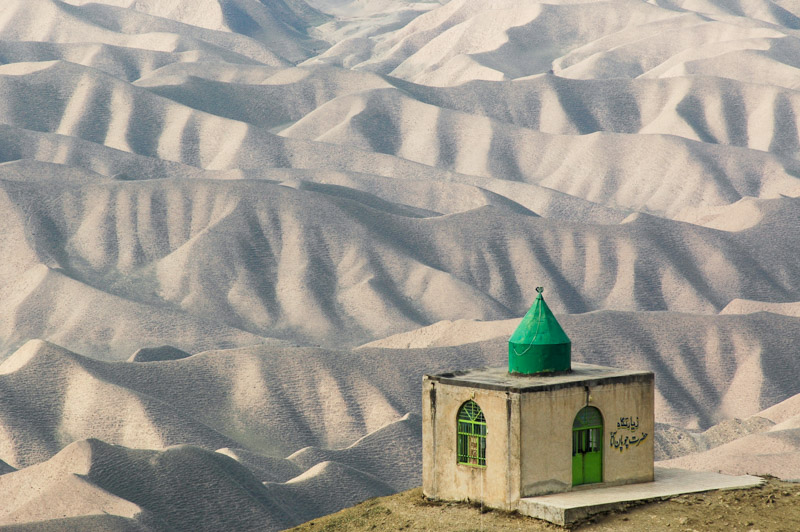
Shrine Of Khaled Nabi, Golestan Province, Iran
West of Mashhad, we spend a couple of days in the town of Bojnurd, before heading to the far north of Iran, to the beautiful province of Golestan, where the land rises into the dusty foothills of the Kopet Dag Mountains, which mark the border with Turkmenistan. North of the town of Gonbad-e Kavus we drive off the main road and join an unsurfaced road – a real rarity in Iran where all but the most minor of roads are perfectly sealed – into an area known as the Turkmensahra, or Turkmen Desert. We drive past isolated Turkmen farmsteads to the only rocky outcrop in the region, upon which sits the small shrine of the sixth century Syrian Nestorian Christian Khaled Nabi. The shrine is nothing special; a simple square building with a crude, conical metal dome, but it has perhaps the most evocative setting of any building I have seen, sat on a promontory above an endless sea of rolling velvet hills of buff, criss-crossed by sheep-trails from the ceaseless travails of generations of shepherds. It’s a true fairly-tale scene, like something out of a child’s picture-book of the Orient.

Phallic Grave Markers, Khaled Nabi, Golestan Province, Iran
In the hills behind the mausoleum is a large Turkmen cemetery filled with an almost forest-like density of what appear at first to be stone phalli. Also common and more modern are smaller, almost cross-like cloverleaf grave markers, though it is the tall, phallic grave markers which are peculiar to this site. However, rather than being some paganistic pre-Islamic ornaments, both styles of grave markers are most likely highly stylised human forms, an Islamicised version of the ancient turkic balbal or man-stone which can be found across the steppes of Eurasia, with what seems to be the hood of the phallus actually representing a turbaned head, as can be seen in many more recent Islamic tomb designs. Nevertheless, the utterly remote location of this unique cemetery in a conservative Islamic country is the only reason it hasn’t been vandalised by zealots. I don’t believe I have ever met a single Iranian – zealous or (usually) otherwise who knows of its existence.

Turkmen Cleric, Chenarly, Golestan Province, Iran
The following afternoon, as we drive north towards the town of Maraveh Tappeh, we stop at a funeral in a small village, where we are obviously spotted. A little further up the road, we are overtaken by a car containing two young men, who promptly hit their brakes, forcing us to stop. The two young men jump out, and to our initial bewilderment ask, or rather insist, on inviting us to their house for tea. We eventually accept, and follow them to the small village of Chenarly which nestles between the hills a few kilometres from town. We find ourselves in the house of our Turkmen hosts, where we are warmly welcomed by all the family and implored to stay for the night, an invitation we accept without hesitation.
Throughout history, the Turkmen were renowned as fearsome, rapacious barbarians who kidnapped or murdered anyone who entered their territory, yet my only experience to date of Turkmen people was of gentle warmth, or even timidity. The highly varied features of Turkmen do perhaps speak of a past of intertwined bloodlines; who knows what genes came into this lawless population over the centuries. Our host family is a testament to this; brothers Khodayberdy (Khody) and Abu Bakr who initially met us, are Turkish-looking whilst their cousin Binyamin and his brother have clearly Mongol features. After some hours of meeting family, eating and drinking, we move to another house across the village, and have a smoke whilst a fantastic thunderstorm rolls in. Rather a nice outcome, hostages to hospitality.

Turkmen Motorcyclist, near Incheh Borun, Golestan Province, Iran
In the morning we say a fond farewell to out new-found friends and continue towards the Caspian, tracking the Turkmenistan border westwards, the land becoming increasingly flat and rather sterile looking, dotted by distant flocks of sheep watched by sole Turkmen shepherds. These marginal grasslands must once have been dotted by the felt ak oi (yurts) of Turkmen nomads, the only points of human artifact on this vast Central Asian landscape but for the occasional grave marker, though not a trace of them seems to remain. The Turkmen of Iran were in fact settled by Reza Shah in the twentieth century into modern, controllable, tax-paying, sedentary citizens.
We stay the night in the Caspian port town of Bandar-e Torkman, with our Turkmen host Ali. Ali’s mother, whom I estimate is in her late fifties, has memories of the nomadic way of life, but does not miss it; modern conveniences at least are naturally preferable when compared to the stark life out on the plains. In the course of the evening I remark to Ali how gentle and shy the Turkmen of today are in my experience, when compared to their forebears. He gestures towards his groin making a scissor-like cutting motion with his index and middle finger.
It never stops raining in Bandar-e Torkman, and we leave the Caspian coast, passing through Gorgan, crossing the mountains to Bastam and then heading west to the capital where we will meet Matjaz and Ana, with whom I travelled in Ladakh last year. We camp for the night out in the desert, but the weather is miserable; damp grey clouds roll overhead and the night is frigid. We leave the next morning for the long drive to Tehran. At some point during this long, soporific journey I reach a decision on a problem that has been troubling me for a couple of months now: I abandon any ideas of crossing the Persian Gulf and returning to Europe via Arabia. My plan now is to move east once again, back to my beloved Pakistan.
We reach a salubrious district of North Tehran that evening, where I have a joyful reunion with my old friends Matjaz and Ana in the apartment of one of their friends. Tomorrow we shall all head east to the far side of the country, into the deepest valleys of Kurdestan.
 EurasiaOverland