
Stage 16 – Pakistan & Afghanistan: Across The Khyber Pass [3/3]

Afghanistan is a small, landlocked and isolated country of rugged mountains and deserts, which forms something of a melting pot of Persian, Indian and Central Asian influences. I had lusted after a chance to visit the country for years, and when that time came in late 2009, I had high expectations; ones which were not disappointed. I sometimes wondered quite what about this war-ravaged and neglected country exerted such a magnetism. The cynical might attribute it to voyeuristic urges of seeing a fresh warzone, or some thrill of danger, but the country has enchanted travellers for generations. Afghanistan is no stranger to war; Alexander the Great, The Mongols, and Tamerlane are just a few notables in a long line of invaders who have used the country as a theatre for combat. It has also drawn plenty of adventurers, forming the keystone in the Great Game as the country became a buffer zone between Russian and British Empires. It seems always to have been a country renowned for rugged, wild beauty, fierce yet welcoming tribesmen and the romance of the unknown. By the early 1970s Afghanistan was a popular travel destination, with backpacker guesthouses catering to overlanders crossing the Hippy Trail from Europe to Delhi and Kathmandu.
Things started to fall apart in the mid-1970s as the country was once again used as a theatre for someone else’s war; a revolution part-fomented by the Soviets in 1978 saw the beginnings of an insurgency, which in one form or another has continued to the present day. Violence escalated and in December the following year, the USSR formally invaded. A full Cold War proxy battle ensued, with the US and Pakistan funding insurgents in a war which raged on until Soviet withdrawal in 1989, though continued as a civil war until 1996 when the Taliban brought some degree of peace and stability to the country. Rather than covertly fund opposition groups, the US and supporting Coalition Forces found grounds to occupy the country, and such was the status quo when I crossed the border from Pakistan.
Whilst generals reported progress of some sort to the Western media – admittedly some limited development work had been done in the country – it was clear to those on the ground that the country was slowly slipping away; more and more areas were reverting back to Taliban control, violence and deaths were slowly but steadily increasing, and many started to look back with some fondness to Taliban times when, if nothing else, there was peace. It was with this as a backdrop that I entered the country; hoping to see as much as I could before the whole place fell back into the chaos and isolation which had defined much of the last thirty years for the Afghan people.

Pashtun Man, Jalalabad, Nangahar Province, Afghanistan
It’s the 10th October 2009, and I have just crossed the Khyber Pass, left Pakistan for the final time and am standing at the locked gate which leads into Afghanistan. A guard bars my way, and indicates with wrists crossed that the car is not coming in. An old hand in Asia by now, I am used to these kind of obstacles, and smile back, indicating that I am indeed coming in. The guard asks for my ‘Road Permit’, some kind of endorsement for the car which the Embassy in Islamabad had refused to give me. I am really not keen on lying, but occasionally needs must. ‘I was told that I don’t need one, as it’s a British vehicle, not Pakistani’ I lie. There is some discussion amongst the soliders, and then I’m offered lunch – which I politely decline – and am waved through to immigration. One of the soldiers jumps in, so that I find the building without a problem amongst all the chaotic activities of trade and smuggling which go on all around. Immigration and customs are easy, without so much as a sniff inside the car, and I’m soon merrily driving alone along the infamous Torkham – Kabul Highway.
The first few hours in a new country can often be quite intense, but here especially I’m looking carefully at the reactions of people. With Pakistani-style number plates on an unmodified Toyota Hilux, wearing a long, flowing shalwar kameez and a Chitrali cap, and with my complexion which I’m told is remarkably Pashtun in appearance, nobody takes a second look. Nevertheless, I do my best to be inconspicuous.

Vegetable Market, Jalalabad, Nangahar Province, Afghanistan
The 76 km drive to Jalalabad is beautiful; the landscape is far greener and less forbidding than on the Pakistani side of the border, with quiet farming villages interspersed by fields of fruit, which children sell at small roadside stalls. Trees overhang the road, giving it a definite Central Asian feel, and the atmosphere seems secure and benign. I soon see my first US Convoy, and remember Shahab’s (my host in Kabul, whom I had met in Peshawar the previous evening) advice to stay well clear of them. With suicide bombers and roadside IEDs, the Coalition Forces are liable shoot the driver of any car coming too close or attempting to pass, and ask questions later.
Jalalabad takes me somewhat by surprise; I had imagined a wild and shambolic Pashtun city, but it turns out to be a fairly neat, sedate and relaxed place. There’s a heavy Pakistani influence – Pakistani Rupees are more widely used than the Afghani – but there is also some noticeable Soviet influence in some of the architecture, and the planned layout of the city. The US Military are here in number, with convoys passing through the city centre and Hercules, Chinooks and drones passing overhead from a nearby airbase.

Grand Trunk Road, near Jalalabad, Nangahar Province, Afghanistan
Through Shahab in Peshawar, I have the details of Aemal, a local opthalmist who has an office on one of the city’s main streets. We sit talking in his office while he sees patients, my first chance to speak in detail with an Afghan in Afghanistan. Aemal has lived in Afghanistan throughout the wars, telling me that the worst time for him was during the Mujahiddin wars in the 1990s when he lost his ten year-old brother. His anger is however focused not at the Soviets who ignited the war, nor the Americans who again destabilised the country in 2001, but at the foreign (mostly Arab) Jihadists who come to Afghanistan to fight. “The Islam we have here is just a little faith, then mostly politics, Arab nationalism and anti-Semitism. The Arabs are doing this. They send us, their Muslim brothers, nothing except Jihadists. They want to revive an Islamic Caliphate, but nothing good will be built by these people. They have no knowledge, their culture has produced nothing. At least the Soviets came with some ideological convictions, and built something. They were civilised people.”
As I’m sitting in Aemal’s office, I notice a bullet hole in the glass shop-front, and ask him about it. “Oh, the Taliban were shooting here last month, but I wasn’t in here, it’s no problem.” A little later, a huge Pashtun man from neighbouring Kunar Province comes in carrying a wounded boy, who has shrapnel in his eye from an American mortar attack. Aemal is unable to treat the child, and has to send the man away. Just as he turns to leave, he looks at me for a moment, then walks out wordlessly.

Kabul River, Sorobi, Kabul Province, Afghanistan
In the evening I find a hotel which is built in the old caravanserai style, covering small shops and filled with goods on their way up-country. In one of the shops I befriend a group of Nurestanis, a wild-looking bunch from the inaccessible mountains to the north of the city. Only relatively recently converted from Paganism to Islam, the Nurestanis are something of an ethnic mystery, similar to the other Dardic tribes in the region such as the Kalash in Pakistan and the Brokpa of western Ladakh. Almost no foreigners have visited Nurestan in recent years, and it’s something of a dream destination in Afghanistan. My Nurestani friends are particularly struck at how much I look like them, insisting that I am the image of one man in their village. They invite me to their homes, suggesting that I could pretend to be mute at any Taliban checkpoint we encounter (a US checkpoint would likely be more troublesome). It’s a tempting offer, and I think about it for a moment, but decide that it would be pushing my luck a little too far, especially on my first day in the country.
I spend the next day walking in the city; sitting in the park, wandering through the bazaar and the fruit orchards on the city’s edge, and sitting in solitude at the riverside close to where the Kunar River meets the Kabul River, which will flow back towards Peshawar and meet the Indus, ultimately flowing past my former home in Hyderabad and out into the Arabian Sea. Jalalabad has been a very pleasant introduction to Afghanistan, and I’m beginning to feel just how different the country is from Pakistan, not least for the absence of the latter’s ever-present overcrowding.

Kabul River Gorge, Kabul Province, Afghanistan
After two nights in Jalalabad, I continue my journey west, re-joining the main road to Kabul which is effectively an extension of the Grand Trunk Road which runs to Kolkata. The road starts to wind around hills and valleys, following the Kabul river as it winds through a lush green landscape which is particularly beautiful near the town of Sarobi, famed for some of the world’s best pomegranates. US convoys patrol the road, and when I see one a little way ahead, I slow right down to stay clear of any fire they may draw. The road starts to climb and enters the impressive Kabul Gorge, switching back over blasted rock ledges which would make a perfect ambush point.
Shortly after leaving the gorge, the road drops down slightly to the edge of a great plain, and I roll into the eastern outskirts of Kabul. The traffic is chaotic, watched over by US forces who are hopelessly outnumbered by the melee of trucks and taxis, but I’m soon in the city centre. Reaching Kabul marks the end of the Peshawar – Kabul leg of my journey, which is likely to be the most insecure, though has passed without incident. I eat lunch in the old city centre before moving out to Shahr-e Nau, the New City, where I meet Shahab once again, who kindly accommodates both myself and the truck at the guesthouse of the consultancy firm for which he works.

Kabul, Kabul Province, Afghanistan
In the morning I decide to orient myself in the city by climbing the large hill which wedges itself into the southern edge of the city, and is crowned by the old mud-brick city walls, eroded by war and by the elements. It’s a steep slog, but the views are magnificent. Kabul sits in a dusty bowl of mountains, not unlike Quetta in Pakistan. From an aerial view, the city is obviously more planned than any in South Asia, with mostly regular grid blocks and streets. At this distance, the city bears no scars of war, these only being visible on closer inspection when one sees the occasional rubble-strewn plot, or bullet-pocked wall. At the western end of the ridge, which plummets down into the city again, one has a marvellous panorama over the bustling streets of the bazaar, and over the gardens of Babur, the sensitive, journal-writing founder of the Moghul Empire who was infatuated with his native Central Asia, and with Kabul.

Kabul, Kabul Province, Afghanistan
I too, soon fall in love with Kabul. Although an ancient city, it has never rivalled the region’s great cities such as Herat or Samarkand, and the years of war have left it with very little of historical note. It is however, a fascinating blend of the cultures which surround it, and one which I later realise is Afghanistan in microcosm. Walled, tree-lined streets are highly reminiscent of Central Asia, though there is not the post-Soviet authoritarianism which pervades that region. The public presence of women – often very beautiful and elegantly dressed – gives an Iranian touch to the place, though there is not the drab, mundane uniformity one finds in all Iranian cities. The frenetic bazaar and thronging crowds add a South Asian touch, but there is not the overwhelming squalor and unplanned sprawl from the over-population which one finds in every city of Pakistan. Instead, it’s a charming and quintessentially Afghan blend of these cultures.

Bird Market, Kabul, Kabul Province, Afghanistan
Also different from Pakistan are the people, who seem a touch more worldly and confident. There is not a stuffy air of religious posturing, but rather one of greater tolerance. These don’t seem like a people cut out for Islamic fundamentalism, and I imagine it must have been quite a sour time under the Taliban.
One part of the city in particular has a strong Soviet feel to it; the Mikrorayon, which is a Soviet housing district identical to those found in many Central Asian cities. I am surprised by how much the Soviets have built in Kabul, and find it at once homely and tragic. The apartment buildings are probably the best-built structures in the city, certainly of better quality than the new apartments which are popping up like mushrooms in Shahr-e Now, and might collapse just as quickly. In the 1970s, Soviet technocrats and a nascent Afghan middle class lived in these housing projects, and they are still amongst the most sought-after real-estate in the city.
The Mikrorayon is tragic however, for the loss it represents; the modernising, egalitarian and secular ideology of Soviet Communism which had actually invested in the country. Whatever of the motivations and subsequent war which the Soviets had brought to the country, they had built something, and stood for some positive change. Whatever communism might have brought the Afghans, it would most likely have been better than what they have inherited.

Tea House, Kabul, Kabul Province, Afghanistan
There is clearly a lot of money in Kabul; plenty of brand new bullet-proof Landcruisers belonging to the various warlords, NGOs, multinationals, consultancies, armed forces and security firms which cream the profits of war and foreign-sponsored reconstruction. Plenty of Afghans are making money, but their investments are all short-term; vastly overpriced guest-houses aimed at expatriates, flashy restaurants and faux-boutique shops. Most of these Afghans have foreign passports, meaning that as soon as the bubble bursts, they can take themselves, their families and their money out of the country. Nobody is investing in industry; everything imported from Pakistan, Iran, China, the UAE and Europe. About the only locally made product I find is Coca-Cola – even the matches are low-grade Pakistani exports. It’s difficult yet to see a future for Kabul; what will be left once this ‘international’ community pulls out?
I spend a week in Kabul, and when I’m not wandering the various parts of the city; the atmospheric Ka Faroshi Bazaar (Bird Market) near the river, the Mikrorayon, the ruined tomb of Shah Mohammed Telai on Tepe Maranjan, or sitting in a park in the city centre, watching life go by, I am usually sitting with AJ in his bookshop. AJ is an Afghan who has lived in and out of the country in the last few years, and is one of a small class of secular but locally educated Afghans who have travelled abroad, but who have returned to Afghanistan. People such as AJ are those that have the greatest potential to make a prosperous and stable Afghanistan, but sadly they are a tiny minority. Spending hours in a bookshop is never difficult, but here in Kabul, with an interesting stream of customers and AJ’s wild stories, it’s a real pleasure.

Cattle Plough, Bamiyan, Bamiyan Province, Afghanistan
Leaving these comforts, I decide to push on into the mountainous centre of the country. I leave early one morning and drive north for an hour out of Kabul, then head west into the Ghorband Valley, on a hellishly rough road which winds slowly up through mountain villages, over the dusty Shibar Pass and then down into the Bamiyan Valley. The drive takes all day, and it’s after dark when I finally roll into the town of Bamiyan and call my host Simon, who brings me back to his farmstead in which he lives with some local Afghans. Simon works for a French NGO which sets up greenhouses in the valley, to allow villagers to grow a wider variety of crops over a longer growing season. It’s a simple, grass-roots initiative, and unlike many NGOs, has measurable results. Simon’s life is far from the cosseted security of expats in Kabul who are virtually imprisoned by security fears, and he leads a wonderfully independent life living like a local in the friendly Bamiyan Valley. It’s not long before I’m rather envious of his position.

Buddha Niches, Bamiyan, Bamiyan Province, Afghanistan
Bamiyan is one of those special places, like the Hunza Valley or parts of Ladakh, which is marvellously isolated and bucolic, removed seemingly in both space and time from the modern world. The town sits on a wide, fertile plain between pinky-buff eroded hills, beyond which are the higher grey ridges of the western Hindukush. Small farms create a patchwork of fields, and the pace of life is almost medieval; a glimpse of the pre-modern world as men till field with oxen, or carry winter wood supplies in horse-drawn traps, while women wash clothes and dishes in the icy mountain streams. Bamiyan is a perfect example of the remote and timeless mountain communities which exist right across Asia.
Despite the slow pace of life however, Bamiyan has a considerable history. Lying on the ancient Silk Road, Bamiyan was perhaps most famous for its two giant Buddhas, the largest standing Buddhas in the world until their mindless destruction by the Taliban in 2001. What remains today are the two vast niches hollowed out of the pinky cliffs to the south of the town, together with the hundreds of troglodyte meditation cells hacked out of the soft rock. When the Chinese Buddhist Pilgrim Xuanzang (Hsuan Tsang) visited Bamiyan in the seventh century CE, it was a religious centre of considerable importance, with numerous active monasteries. Today just a few frescos inside the odd cave exist, thought to have been left between the 5th and 9th Centuries by travellers on the Silk Road. In the niches themselves, almost nothing remains of the Buddhas, though in one, a single foot still stands, the size of a lorry. They must have been an awesome sight against such a timeless agricultural scene.

Hazara Man, Bamiyan Province, Afghanistan
Another highlight of the valley is the people, who are predominantly Hazara (with a Tajik minority), and invariably friendly, gentle and smiling. The Hazara, as Shia Muslims, suffered sectarian prejudice from the Taliban who murdered many, and are thus well-disposed to the occupying Western forces in Afghanistan. The Hazara have strong Mongol features, but seem in reality to be descended from a mixed bag of Asian ancestries, and are quite different from Uzbeks, for example. The only people who are not friendly in the town are the local police who, in this most tranquil part of the country, treat me with the greatest suspicion.
After three wonderful days with Simon in Bamiyan, I push further into the mountains, west towards the very heart of the country. Up here in the stark mountains lies what first sparked an urge to visit Afghanistan in my imagination; the stunning blue Band-e Amir Lakes. Driving west out of Bamiyan, the road starts to climb, the valley broadens and the mountains recede to a distant backdrop, until the valley becomes wide open, undulating plains of barren, dusty hills. Men leading donkeys laden with firewood, or small herds of goats cross these barren plains of rippling velvet, following an invisible path which seems to lead from nowhere to nowhere.

Stone Columns, Band-e Zulfiqar, Bamiyan Province, Afghanistan
It is against this setting of colourless pastel and dust, of barren plains lying over 3000 metres above sea-level, that one first glimpses a slash of the most dazzling sapphire-blue water, part of the largest of a series of six lakes, each held up behind naturally deposited dams of travertine. It’s a truly stunning and thrilling sight, and one that must have struck awe into the souls of the travellers on this stretch of the Silk Road. Local legend tells that the lakes formed in a rent in the Earth created by Emam Ali striking the ground with his sword, and the highest and largest of the lakes, Band-e Zulfiqar, is named after that sword. It’s well out-of-season, but I manage to find a small guesthouse operated by a local man, who claims not to be Hazara or Tajik, but Syed, descended from the Prophet Mohammed himself.

Band-e Haibat, Bamiyan Province, Afghanistan
I spend five days around the lakes, mesmerised by their beauty and the peaceful solitude of the environment. The lakes are soundless but for the cascading waters falling over the edges of the huge natural dams, and I am immediately in love with the place. The sheer contrast is also striking, for beyond the cerulean lakes is an endless expanse of rolling mountain steppe. To the north, steep cliffs have been eroded by water over the aeons, not unlike a miniature Grand Canyon, and are reflected in the perfect mirror of Band-e Ghulaman, around which a small village spreads. Band-e Paneer, a small lake to the east, has the look of a Caribbean lagoon, with underwater plants, and turquoise water fringed by a white shore.
The whole area is so marvellously tranquil that I spend my days just sitting around their shores, walking, writing and enjoying the solitude after so many months in the frenetic cities of Pakistan. I have a huge sense of fulfilment in coming here; I’ve filled a blank in the middle of Asia, completed a dream journey to the heart of Afghanistan, and also found one of the most wonderful places I’ve ever visited, tucked into the bosom of this vast and fascinating continent. I have plenty of time to think of the future too; what to do after Afghanistan. After two and a half years away I still have absolutely no wish to return to western Europe, so I begin to plan a journey to Russia and Mongolia in my mind. All this lies far ahead however; I still need to find a way to cross Afghanistan to Iran.

Cemetery, Bamiyan, Bamiyan Province, Afghanistan
On my final morning at the lakes, there has been a touch of snowfall; the harbinger of what must be a long, cold, bleak winter. I drive back down to Bamiyan, and as Simon has left town for Kabul, stay in a traditional Afghan chaikhana (teahouse). The chaikhana is a legendary institution in Afghanistan, and harks back to the days of traders on the Silk Road. One eats dinner in the chaikhana, then simply beds down on the carpeted floor and sleeps, free of charge. In a country where night-time travel is often insecure or inadvisable, a night or two in a chaikhana is an inevitable break in a long overland journey. Bamiyan’s ‘Turkistan Restaurant’ is my first such experience. I enter a huge, carpeted room filled with sitting men sipping from bowls of tea. There is a lot of shouting going on; calls for tea, and for the food to be ready. The owner, an ebullient Hazara with a bowl haircut wearing a black leather jacket, oversees the operation, whilst his staff unroll long mats in rows across the floor, then bring round bread and the main meal; a choice between kebabs, stew, or soup, all deliciously fresh and filling.

Headstone, Bamiyan, Bamiyan Province, Afghanistan
I spend three more days in Bamiyan exploring the surrounding area; the intriguing formations of the Ajdhar Valley, said by the locals to be more work of Emam Ali and his sword, and the defensive fortress at Shahr-e Zohak, where an old Soviet gun still stands sentinel over the valley. In the town itself, I am intrigued by the atmosphere of the graveyard, where the surrounding tall trees are totally leafless, in stark contrast to others in the valley which are in riotous autumnal colours. Women circambulate the squat, domed mausoleums of the cemetery, showing the typically Shi’ite love of grief and mourning. The lesser graves are marked by beautifully carved tombstones; almost Picasso-esque roundels of Quranic Arabic adorned by beautiful birds. I feel that I could spend weeks in the valley, but while Bamiyan is a beautiful place, I begin also to realise just how backward it really is; it’s the capital of a province in which there is no mains electricity, no sanitation, no paved roads, and no industry.
Eventually, I must retrace my steps to the capital on the torturous road, back to the main highway, which I reach just before sunset. The sight of electricity pylons (which carry electricity imported from Uzbekistan down to Kabul) and a smooth asphalted road transport me back to the twenty-first century, though the joy of driving is somewhat offset by the utter free-for-all of Afghan driving. Afghans drive like invading hordes of rapacious Mongols swooping down upon civilised Asia, and it’s little wonder that the country has just about the highest road fatality rate in the world. Nevertheless, as the sun sets in a cold, pink autumnal sky over the Shomali Plain, two Chinooks pass low over the horizon from Bagram Airbase towards Kabul, and I revel in what a beautiful, raw and exciting destination Afghanistan is.

Salang Pass, Baghlan Province, Afghanistan
I spend nine more days in Kabul exploring the city, and passing time with AJ in his bookshop. I make a journey to the Embassy of Turkmenistan in hope of securing a transit visa, which would allow me to reach Herat without passing through the highly dangerous province of Badghis. I am fully expecting to be turned away from this, an Embassy of one of the world’s most insular and recalcitrant dictatorships, but instead come out with the promise of a visa (to be collected in Mazar-e Sharif as the computers here are not working) after giving nothing but my name and a photocopy of my passport.
After four highly enjoyable weeks in the country, it’s time to move on to Uzbekistan, where I will meet Duncan, whom I had met and trekked with to the base camp of Kanchenjunga in Sikkim 18 months ago. I leave Kabul one morning for the last time, driving back over the Shomali Plain, up into the Hindukush, winding ever up through long Soviet avalanche tunnels, finally ploughing into the unlit, smoke-filled tunnel of the Salang Pass at 3350 m, then down through clouds, down past autumnal villages of stone and earth buildings, hugging hillsides ablaze in the reds and golds of autumn, inhabited by bearded Tajiks. The Anderab Valley opens up as I enter Baghlan Province, passing through the muddy town of Pol-e Khomri and on, past rice paddies and oily grey skies bearing rain, over the low Robatak Pass and into Samangan Province, plunging briefly into mountains in an awesome, steep, twisting gorge.

Road To Heyratan, Balkh Province, Afghanistan
On the north side of the gorge the road exits the mountains with breathtaking abruptness, rolling onto the vast, absolutely featureless plains of Oxiana as if by teleportation. Deep blue skies replace the boiling grey cloud of the mountains, and a bitter wind howls across the steppe. On the horizon is a wall of windswept dust, like a curtain shielding nothing as the sky here simply meets the plain at an indeterminable distance. Camels and mounds of heavily eroded ruins dot the plains around the town of Kholm; I am back in Central Asia.
I spend a night in Mazar-e Sharif (where I will return next month), then head north to the border. A brand new road winds through the scrubby desert for the final fifty kilometres of Afghanistan. Wind blows sand dunes onto the asphalt in places, and it’s not until I’m practically at the edge of the mighty Amu Darya that the desert suddenly breaks into greenery. After three searches of the car by police, I am allowed to cross the Amu Darya on the infamous ‘Friendship Bridge’, into the most sensitive underbelly of the former USSR.
Stage 16 – Pakistan & Afghanistan: Across The Khyber Pass [2/3]
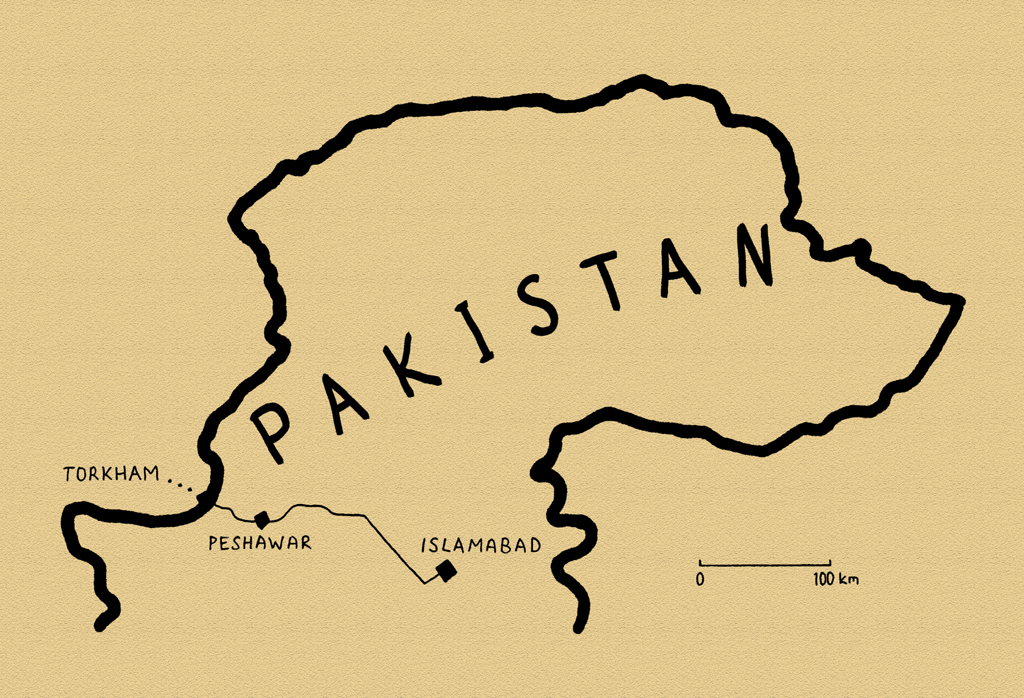
I arrive in the Pakistani capital of Islamabad on the 16th September 2009, and set down my tent at the ‘Islamabad Campsite for Foreign Tourists’. The days are rather humid, but the nights cool and pleasant and I enjoy fresh doughnuts for breakfast and lunches and dinners of fresh dal, chick peas, pakora curry, or kebabs; life is pretty comfortable. There is a clutch of other travellers camped here; a German couple heading back to Germany with their young children after three years driving around the world, an older Dutch couple in an enormous mobile home lorry-conversion, Walter and Lori, a German couple whom I had met last year, on the road for nine years in their mobile home, and Simon, a Swiss traveller whom I had met earlier in the summer in Gilgit, who sadly had been turned back from the Chinese border with his donkeys (with which he had been planning to walk back to Switzerland), and was now trying to replace his broken passport and dissuade his girlfriend from flying home.
The less pleasant part of my time in Islamabad is all the running round from office to embassy. I request a second visa extension, and am told to leave Pakistan by a pompous Punjabi at the Ministry of Interior, who eventually agrees to give me a three week final visa extension (marked ‘FINAL’ in my passport) on the grounds of my appeal that I had no way out of the country at the time.
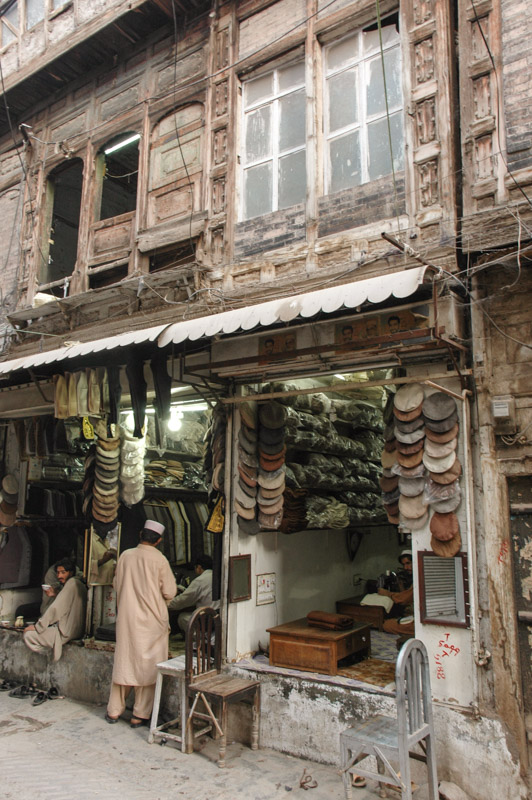
Khyber Bazaar, Peshawar, North-West Frontier Province, Pakistan
I also need to extend the duty-free period for the truck, to avoid it being confiscated (something which has befallen a few oblivious travellers), at the Federal Board of Revenue. Here I have a wonderful stroke of luck, in meeting Sadiqullah, a marvellously intelligent and entertaining middle-aged Pashtun from North Waziristan, whom I immediately befriend. He helps me sort out my documents, and we meet in the evening for dinner. Although his name rings a bell, it’s not until he starts to tell me of his previous postings that it strikes me that Sadiqullah is a long-lost friend of Aly in Hyderabad, who is very happy to hear from him when we call a moment later. In a country of 170 million people it’s quite a coincidence.
On another evening, as we are strolling through a park, I tell Sadiqullah of my recent journey through the rather unstable North West Frontier Province (NWFP), close to his family home. We move on to the subject of why the country has become so destabilised, particularly in the regions inhabited by his fellow Pashtuns. Sadiquallah spreads a little light on the incredibly murky and impenetrable subject of politics in Pakistan, as follows. Persian was previously – for a long time – the second language of Pakistan, a language he remembers learning at school. It was the language of the court of India, of the Moghuls. During Pakistan’s upheavals under the military government of Zia ul-Haq in the 1970s, Arabic was introduced by an administration of Punjabis, a people whom Sadiqullah describes as “having no culture, and who have never been rulers”. Whilst Persian was a language of poetry, with close links to Urdu, Arabic was the language of religion, a language which virtually nobody knew. Thus came increasing control from the Mullahs and medressahs, which infiltrated Pakistani society. In the case of the Pashtuns, it sat especially easily alongside an extremely strict and rigid code of tribal values which has given rise, with the help of US sponsorship of the Mujaheddin in the 1980s, to the current situation of Islamic ‘extremism’ which blights the life of so many Pashtuns, both directly as a threat from bombings and counter-insurgency, and in an increasingly widespread mistrust of Pashtuns. Sadiqullah would love to take me to his native North Waziristan, but explains that to do so would be a threat to both our lives. He’s a man who fears returning to his native home, thanks to the machinations of geopolitics which have destroyed so many lives in Pakistan and Afghanistan.
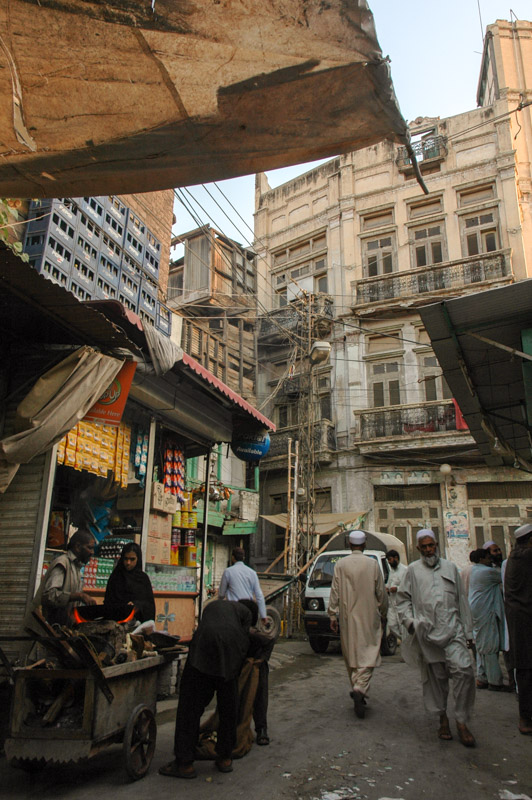
Khyber Bazaar, Peshawar, North-West Frontier Province, Pakistan
I receive news from the Iranian authorities that I have been approved to apply for a visa, and I also receive a visa for Afghanistan with little fuss. The largest piece of paperwork remains however; the permit to drive from Peshawar to the Khyber Pass. For this, I must speak to the right people in Peshawar, an ancient city which was the Kushan capital Purushapura. Despite having travelled widely in Pakistan, I have somehow never managed to visit Peshawar, something I regret slightly on arrival as it’s an immediately endearing place. I am here primarily for paperwork however. At the office of the Khyber Political Agent, I am immediately refused a permit to travel to the Khyber Pass, though on explaining that I have a vehicle and must pass this border, I am directed to speak to a Mr Munir Ullah, at the Federally Administered Tribal Areas (FATA) Secretariat across town. Mr Ullah, who turns out to be ‘Head of Narcotics’ is a patient and helpful man, who listens sincerely to my case that I have a visa which is due to expire, no visa for Iran, and must therefore return to my home via Afghanistan. I leave his office optimistic.
The next day I make a phone-call from a chaikhana in the bazaar, and speak to Mr Ullah, who tells me: “Mr Daniel, there are two districts which you must pass through in Khyber Agency, Torkham and Jamrud. We have received permission for you to proceed from Torkham, and once we receive the permission from Jamrud, we will be able to issue you a permit. Please call tomorrow at 10.” I begin to believe that the impossible is possible; one must simply ask the right people in the right manner.
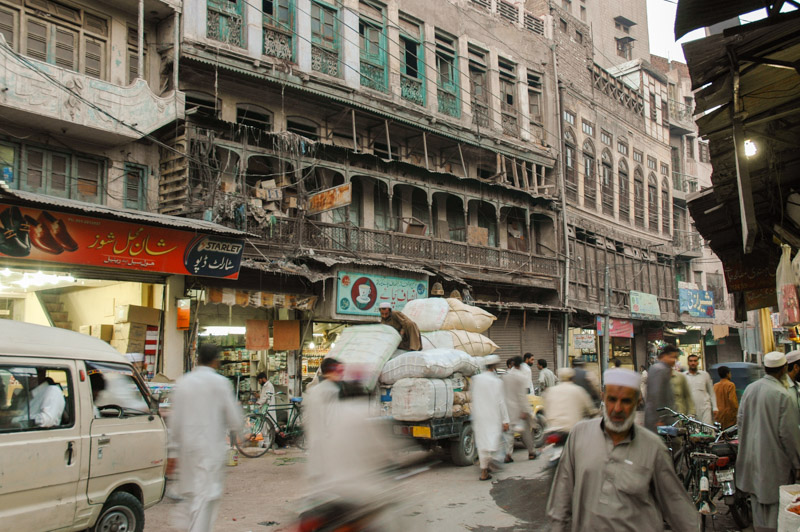
Storytellers’ Bazaar, Peshawar, North-West Frontier Province, Pakistan
The very next day I have my permit in hand, to drive from Peshawar across the Khyber Pass on the 10th October. I don’t think I’ve ever valued a piece of paper as much as this simple typed document. Years of dreaming of Afghanistan are about to come to fruition. But with the final barrier dropped, permit in hand, visa in passport, the doubts and fears seem closer. I’m about to enter what, to all intents and purposes, is a warzone, for nothing more than to satisfy my curiosity about the country. Afghanistan has become more than just another country and a string of sights however; this isolated, savagely beautiful, wild and war-torn country has become something of a Shangri-La. It is to me what what Bukhara was to Alexander Burnes, or Tibet to Francis Younghusband. I simply must see this country. I have become obsessed by it, and will happily risk my life to see it. A fear of death is perhaps more a fear of wasted life, for death is inevitable. If one is doing exactly what one wants in life, perhaps death becomes less frightening.
Returning to Islamabad that evening to collect the last onward visas and take stock before moving off, a storm comes over the plains. Beyond the city, to the west, a band of late-afternoon light from beyond the stormclouds picks out the mountainscape of the Northwest Frontier in a jaundiced silhouette, low but immense, occupying the entire horizon in a broad mass of sharp, overlappng, barren peaks. These are not the rolling green hills which give Islamabad its pleasant backdrop; these mountains form one of the wildest, most lawless and dangerous areas on Earth, and my feelings in anticipation are of equal parts delight and terror. I’ll certainly breathe a sigh of relief once I reach the safety of Kabul.
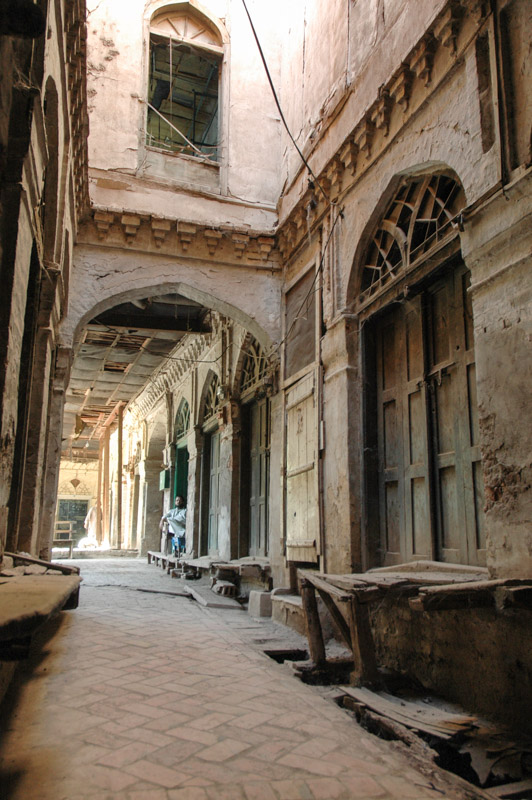
Caravanserai, Peshawar, North-West Frontier Province, Pakistan
The days in Islamabad pass easily; it’s a city of relative comforts, and something of a shock after the rest of Pakistan with its orderly green streets and relative cleanliness; a world away from the filth, chaos and noise of every other city in the country. For all its slightly characterless suburban pleasantries however, it is a city gripped by security paranoia and stacked full of barriers, security gates and concrete bollards. Near any diplomatic building or major government office will be a plethora of guards behind sandbags, checking with mirrors under incoming vehicles and otherwise sitting down and passing time doing very little at all. Tens of thousands of men spend their days sitting about with nothing to do. The most shocking of all these defences is undoubtedly outside the Marriot Hotel, which is barely visible behind four-metre high walls of sandbags and numerous security checkpoints. Islamabad’s neat grid-plan of streets, designed for easy access, has been jerrymandered into a complex system of blocked roads, U-turns and bottlenecks at security checkposts. The huge, almost Soviet-looking Constitution Avenue, which runs past many high-profile government offices, the Supreme Court, Parliament and disgracefully lavish Presidential Residence in ten neat lanes with manicured lawns and trees, is virtually empty thanks to strict police checks. Islamabad is a city on the frontline of the War on Terror, or rather the terror which results from this war.
I have two visas to collect in Islamabad, in no particular order. I had planned to visit the Uzbek Embassy this Monday morning, but at the last moment change my mind and go instead to the Iranian Embassy. When I get back I learn that there was a bombing in the headquarters of the World Food Programme which killed five. The office is directly opposite the waiting area outside the Uzbek Embassy.
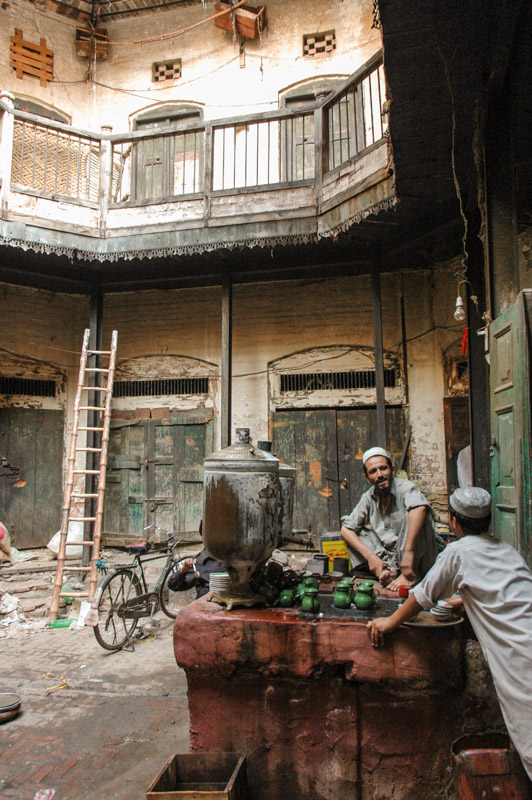
Chaikhana, Peshawar, North-West Frontier Province, Pakistan
I drive to Peshawar on the Thursday, back into the clamorous Old City. When I was here last week, I had a light-hearted look around the bazaars; this time it’s the last stop before I take the plunge into Afghanistan. I have all visas and permits in hand, and am pretty much past the point of no return. I discover new joys in Peshawar however, finding a truly wonderful section of the Old City with just enough old charm and not quite enough smoking rickshaws and furious motorcyclists to make the place every bit as enchanting as Damascus or Shiraz. It’s a delight to sit sipping kawa (zesty green tea) on a charphai (rope bed) in the old Storyteller’s Bazaar, where merchants would come from India, Inner Asia, Persia and beyond to spin yarns and exchange information, as well as sell their goods. All around is the faded elegance of the old buildings; tall, elegant town houses of the rich old Hindu and Sikh merchants who are long gone, their splendidly faded abodes with carved wooden balconies and shuttered windows a leftover from old India, British India, a past era which has been utterly and irrevocably consigned to history.
In this bazaar can be found many of the most sensuous delights of South Asia; the wafting cry of the muezzin echoing around the labyrinthine rooftops; the smell of spices, tea and roses wafting from stalls whose wares have remained unchanged through the centuries; and the momentary glance of a woman’s dark, beautiful eyes from an otherwise veiled face of deepest black, as she flits silently through the raucous crowds. I could sit here for hours in this richest and most enchanting of environments. The local residents of Peshawar are similarly charming; outrightly friendly, with even the most fierce or vagabondish face erupting into a gentle, genuine smile on hearing the most passing politeness or gesture of greeting from me. I find myself flitting from shop to shop, learning and absorbing the interactions. These warm Pashtun shopkeepers are acutely aware of the negative image which Pakistan, and Muslims in general have in the Western media and it troubles them (and frankly myself) that the extremists who have hijacked a peaceful and humanist faith are the darlings of this media, something which is degrading to these people both as Pashtuns and Muslims.
The Old City exudes a genuine, centuries-old essence of having been lived in since time immemorial; a woven tapestry of small interactions so perfectly balanced and immensely intricate – the cool bargaining of merchants and customers, the errand boys running between shops and the teahouses with trays of pots and bowls, the old men pulling carts laden with boxes, and the craftsmen at work in open-fronted rooms; tailors, goldsmiths, watchmakers, printers and cobblers. The place must have run like this for centuries, and there’s not a trace of soulless, glass-fronted ugliness, no multinationals, no e-shopping. It’s timeless, and deeply, intensely human, an enclave of the old Silk Road frozen in time, a showcase of a pre-globalised world. The murmurous patter of all the human interactions is the very essence of the Asian Bazaar, which must be as old as civilisation itself.
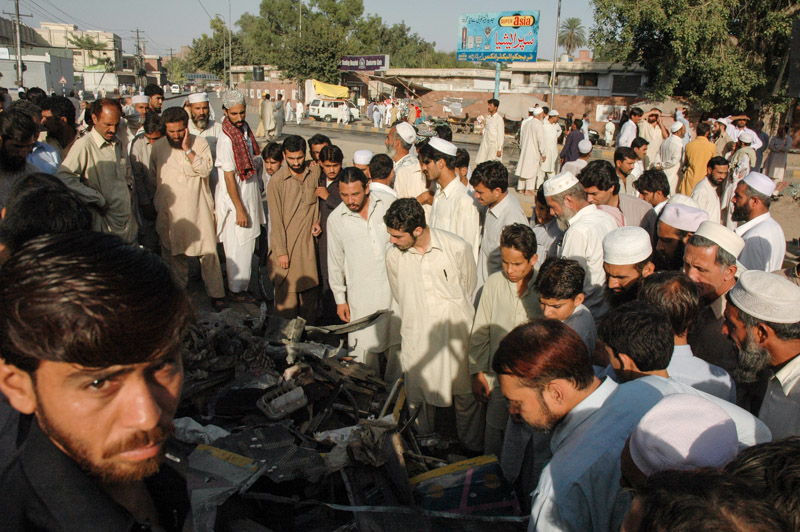
Bomb Site, Peshawar, North-West Frontier Province, Pakistan
The 9th October is my final full day in Pakistan, and together with Kausar, a native of Peshawar whom I had met earlier in the year, I take advantage of Peshawar’s well-stocked Khyber Bazaar to stock up on some last minute clothes and supplies. We leave the bazaar in a rickshaw, and ten minutes later switch on the television in his office to learn that a bomb had gone off. Moments after we left the bazaar, a minibus carrying 100 kg of explosives detonated at a busy crossroads – exactly where we had been – killing 49 people. It’s the second time this week that I have narrowly missed being at the site of a bomb attack though strangely, the fact hardly affects me at all.
In the evening I meet Shahab, a Pakistani Pashtun who moves between Peshawar, where his family live, and Kabul where he works. I’m hoping to stay with Shahab in Kabul, and looking forward to being shown around Peshawar by him this evening. We agree to meet in the Rose Hotel, which is on one corner of the crossroads where the bomb went off earlier today. The area is closed off to vehicles, and has been sanitized, though rubble and twisted wreckage remain, drawing huge crowds of curious locals and a few foreign journalists.
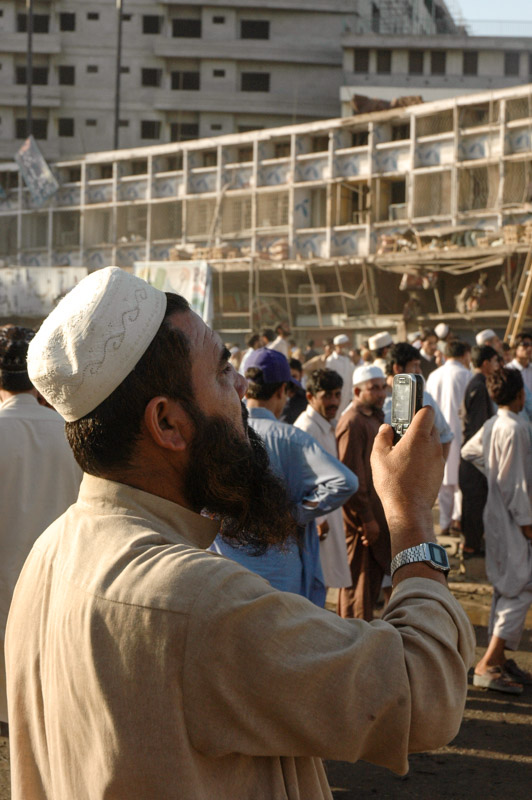
Bomb Site, Peshawar, North-West Frontier Province, Pakistan
I arrive early in the hotel, where I meet Keith, one of those unashamedly eccentric characters one seems only to meet when travelling. Tall and well-built, loud and flamboyant, Keith, half Geordie and half Turkish has long, flowing hennaed hair and wears an Egyptian jellabiya which stands out from the ubiquitous shalwaar kameez of Pakistan. Keith had been teaching music in Lahore, where I had initially met him last year, and on joining him for dinner one evening had realised that he seemed to be on very good terms with most of the young men in the neighbourhood. I meet Keith this time fleeing the lobby of the Rose Hotel, chased by a young man brandishing a cane, whom he had presumably fondled. He wouldn’t be out of place as a character in a Graham Greene novel. Being just outside the bomb site, Keith had gone out and immediately witnessed the aftermath, and was shocked not only by the carnage and gore, but at the reactions of the local people, walking around casually taking photographs of the dead and dying as if it were some kind of art installation. It seems that one can remarkably quickly become desensitised to appalling violence.
Shahab soon arrives and takes me around town briefly in his Landcruiser, to the vast Islamia University College which exemplifies the pink sandstone fusion of Moghul and Gothic styles found in the Subcontinent’s grandest Raj-era buildings. We then drive west to the edge of town and into the salubrious suburb of Hayatabad – a mini Islamabad – with orderly streets and opulent mansions. We visit a good friend of his, who is picnicking on his lawn in the pleasantly cool evening, and have tea brought to us by a servant. We then pick up Shahab’s brother-in-law to-be, Ali, and I’m taken to an upmarket restaurant on the city’s Ring Road. Here we are served some Pashtun fare, eating masses of meat; huge slabs of lamb flame-grilled with no accompaniment; just the taste of pure, fresh meat, a carnivore’s heaven. As we sit on the manicured green lawn, served by fawning waiters in tails, large trucks pass by frequently, supplying NATO forces in Afghanistan. Just earlier that day a number of them had been set ablaze by what the local media called ‘miscreants’.
After eating we head to Ali’s thirteen-bedroom mansion. “This is our town house; it gets too tiring to drive from our village every day”. The family own a large amount of land a few kilometres beyond the city limits of Peshawar, in a village which I suspect effectively belongs to them. Outside this palatial town house, which would not look out of place on the French Riviera or on a Caribbean Island is a flock of luxury cars and SUVs, though Ali bemoans that he prefers not to use the black, S-Class Mercedes, as one becomes a target for kidnapping.
We drink more kawa from ornate, bone china cups on the lawn. Just at the end of the road, a stone’s throw away from this luxury begin the Tribal Areas; Khyber Agency, an almost medieval society of fortified mud-brick buildings and strict tribal codes which include violent inter-tribal conflicts, honour killings and a huge drugs trade. With alarming regularity these days, rockets rain down on these opulent western suburbs of Peshawar, on the very limit of government-controlled territory, from the restive Tribal Areas just beyond. I’m awestruck by Ali’s house; I don’t think I’ve ever been to a more impressive home. “In England, we can only dream of living in a house like this” I say fawningly. “You’d be surprised how many of us would trade it all for the safety and security you enjoy in England” Ali counters sincerely. Many have, of course. I wonder how many of these rich landowners and warlords have left such wealth and power to live in grey and dowdy cities in the UK.
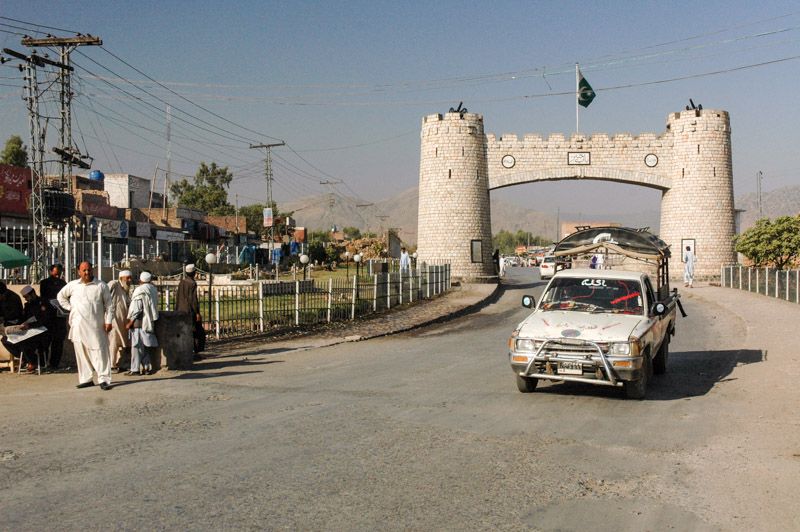
Khyber Gate, Jamrud, North-West Frontier Province, Pakistan
As often happens with Pashtuns, the conversation turns to guns: “They are part of our culture, part of being a man. Everyone here has at least one gun, even the simplest, most peaceful man will have one… you never know what can happen. They are cheap, it’s like having a mobile phone, a basic of life for us. And it keeps petty crime down; nobody will try to steal you wallet or mobile phone in case you have your gun with you”. Ali and his uncle regale me with stories of horrific weaponry used in tribal wars; these aren’t noble horsemen who fire muskets at each other, but born-and-bred fighters who are heavily armed with modern weaponry, all manner of assault rifles, high-calibre cannons and anti-aircraft guns. “In the tribal areas, they mount them on top of the house and during times of war, fire at people as they approach. Once we bought an old Russian tank from Afghanistan; it was cheap, only 130,000 rupees. We kept it and used to drive it round and fire it ocassionally. Then one day the Political Agent in Peshawar wrote to us, and asked kindly that we surrender it, which we did”. Shahab drives me back to my hotel in the city centre, my head spinning with the days events; a major bombing followed by an amazing insight into the life of the rich and powerful of the region.
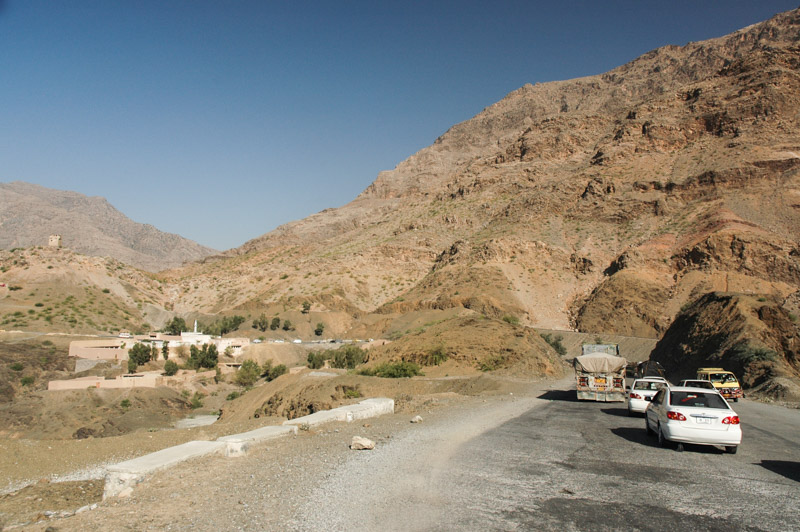
Khyber Pass Road, Federally Administered Tribal Areas, Pakistan
On the morning of the 10th October, I drive to the Khyber Political Agent’s office where I am to pick up my levies; members of the Khyber Khassadar Force (KKF), who are picked from Pakistan’s tribal areas and provide some semblance of security along the road to the border. In reality they are the subject of frequent attacks, and spend much of their time behind thick walls of sandbags, in fear of their lives. I’m feeling a little nervous; despite Shahab, who has driven the infamous Peshawar – Kabul road several times, reassuring me that it is fairly safe at present, I’m still about to enter a country where I have few contacts. I am also nervous in case this all comes to nothing, that something happens at the last minute which will prevent me from reaching my goal, after all the preparation and anticipation.
The tension eases as I pick up two armed levies and head out of the city. At Khyber Gate, the symbolic entrance to the Tribal Areas, I am joined by another Toyota Hilux, full of KKF levies. Immediately, we go back in time; all around are scattered village buildings, squat, mud-brick enclosures with fortified towers which would not look out of place on a Medieval British castle. The road is busy however and doesn’t feel hostile, but my escort puts on sirens and flashing lights, stopping traffic at the roadside as I’m whisked up like a VIP. I am a huge responsibility for these men, but at the same time their presence and haste make me a conspicuous target as we wind up the mountains into forbidding, rocky territory.
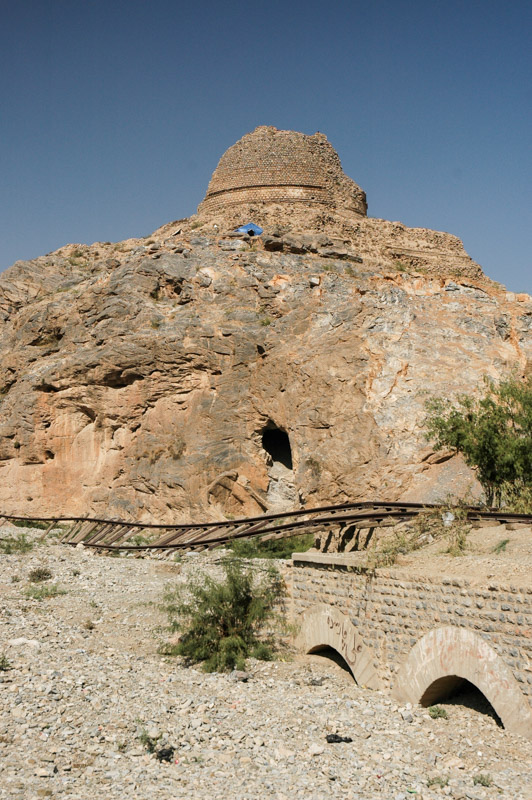
Sphola Stupa, Federally Administered Tribal Areas, Pakistan
Like the Bolan Pass, the Khyber is less of a marked crestline between two valleys, and more a winding passage through a rocky defile which snakes around the base of much higher mountains. The scenery seems to be inextricably linked with the toughness and austerity of the people here; small nondescript villages and fairly wild-looking towns give it a wonderful frontier atmosphere; wild and romantic with the old ways of tribal vendetta. Every turn seems to offer a new position for ambush from the slopes above. Shortly after the village of Ali Masjid, where the road enters a narrow, twisting valley, looming above the road is the Kushan Sphola Stupa, somewhat incongruous against the backdrop of tribal warfare, but a reminder that this artery has been the gateway between India and Central Asia for millennia. Alexander’s Armies marched through here and shortly after, it was the conduit through which Buddhism left India, spreading into Central Asia, Tibet, Mongolia, ultimately reaching Korea and Japan. I am truly privileged in this day and age to have the chance to drive myself over this historical divide.
Shortly after, I pass the huge, fortified complex of drug-warlord Ayub Afridi – Asia’s Pablo Escobar – who lives a life of vast wealth derived from drug-trafficking (it’s widely rumoured that the CIA used Afridi’s network to supply money and arms to the Mujaheddin in the 1980s), wholly unmolested by any authority. I pass through the wild-looking town of Landi Kotal, which looks to have been built specifically to withstand a siege, and shortly after, the road turns at Michni Post where the land rolls away steeply to reveal a narrow valley choked with lorries and other indiscernible chaos in the hazy distance. This sprawl is the cross-border town of Torkham. I have crossed the Khyber Pass.
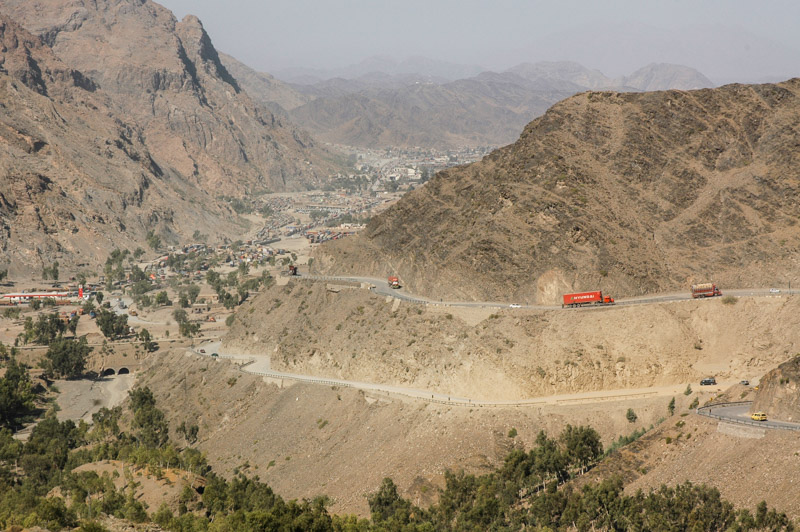
Khyber Pass , Michni Post, Federally Administered Tribal Areas, Pakistan
Heading down into town with my escort eager to have me off their hands, I first must visit the customs office to have my truck stamped out of the country. Outside, it’s bedlam with dozens of people milling around, forms and payments changing hands, huge old ledgers and walls stacked high with decaying old papers. A foreigner is not a common sight here, and so I’m led off to a beautifully serene courtyard out at the back, where the senior customs officer sits under a tree amongst voluminous bougainvillea. An enormous old ledger is brought out in which are recorded all foreign vehicles crossing this border, with records going back to the 1970s. It’s an incredible historical document charting the end of a golden age of travel, the Great Overland Trail, or Hippy Trail, which saw people routinely driving cars from Europe to India, passing a beautiful, pre-war Afghanistan. How times have changed since then. I am taking the fourth foreign vehicle across since the area was officially closed to foreigners early last year, and the seventh since my Austrian friend Oliver crossed in 2007.
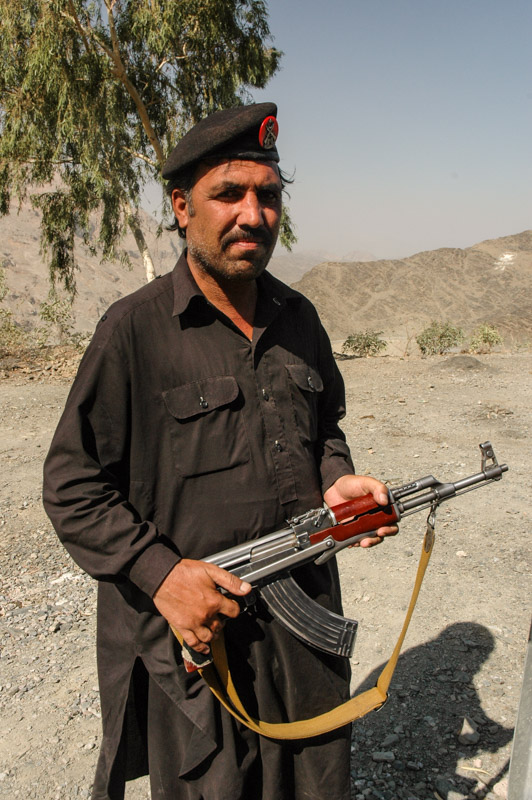
Khyber Khasadar Officer, Michni Post, Federally Administered Tribal Areas, Pakistan
I drop Sadiqullahs name to the officers, which is a good move as they all know him, and the paperwork is processed quickly. They comment that I have considerably overstayed, but Sadiquallah’s letter seals any problems. After tea and biscuits, my force of levies, which by now has grown to a small troop, take me to the immigration window, where my passport is stamped in deep red: ‘EXIT PAKISTAN VIA TORKHAM’, and I’m bundled past the last gate and onto the border line. I have reached Afghanistan at last. Ahead of me lies a transect through some of Central Asia’s least visited places, and I can’t think at present of any trip, anywhere in the world that appeals to me more than this.
Adding up my three visits during this journey, I had been in Pakistan for exactly 365 days. At once I was eager to leave and see new places, but at the same time I was still sad to leave. I could spend weeks sipping tea in the bazaars of Quetta or Peshawar, or relaxing in the mountains in Gilgit, enjoying meeting other travellers, for Pakistan attracts a small but interesting crowd of visitors. Such inertia could occupy a lifetime, but I realised that in Pakistan I had finally, found somewhere I could call home.
Stage 16 – Pakistan & Afghanistan: Across The Khyber Pass [1/3]

Since well before leaving on this journey, Afghanistan had been the destination I was – nervously – most excited to visit. In 2007, I had wimped out, for a lack of good information, and in 2008 it had already become impossible to access the border from the Pakistani side – or so I thought. I’d not met (or even heard of) anyone who had entered Afghanistan from Pakistan since meeting Oliver in Bishkek in 2007. The problem lies not with the border crossing itself, which is technically open to all, but in the forty kilometres of road which separate the city limits of Peshawar and the border; the legendary, romantically wild Khyber Pass. This stretch forms part of Pakistan’s Federally Administered Tribal Areas (FATA), which in reality is a wild and rugged swathe of territory sitting along the Afghanistan border, and which is not under the control of the Pakistani government, but of the various native Pashtun clans who inhabit the area. FATA is considered one of the most wild and dangerous areas on the planet, filled with militants seeping in and out of Afghanistan’s porous eastern border, and the Pakistani authorities are very keen indeed to keep foreigners out – for their own safety. However, having learnt of one other foreign driver being given permission earlier in the year to drive to the border, I am optimistic that I may reach it, and finally fill in the hole in the map which is Afghanistan, fulfilling one of my greatest ambitions.
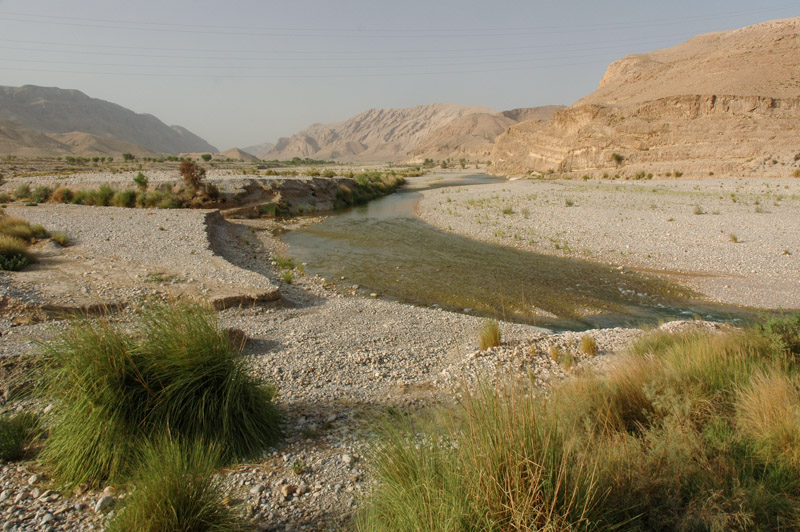
Bolan River, Balochistan, Pakistan
I leave my home, my sedentary lifestyle and my Pakistani family in Hyderabad on the 10th September 2009, Day 859 of the journey. Although I am sad to leave Aly and his family, all my friends, the teachers with whom I’ve been working, and the comforts of the family home, I am at the same time itching to be moving again, to experience the thrill of being in a totally new country, and go beyond to new parts of Eurasia. If I can cross Afghanistan, then I will have seen nearly everything I wish to in the region, and can move on without any regrets.
It’s also great to be behind the wheel of the truck again, which following a rather lengthy engine overhaul is smoother, torquier and more powerful than ever before. I cross the Indus Bridge at Kotri one last time, then head north up the Indus Highway, through Amri, Sehwan, and Dadu, reaching Larkana in the evening. The following day I drive out to Shahdadkot, where I get onto a track which is rumoured to wind up to Khuzdar in the mountains of Baluchistan. This will apparently one day be the M8 Motorway, connecting the distant port of Gwadar to the main transport artery of Pakistan, but for now it’s nothing but a rough, bulldozed track through the scrubby plains. Not wishing to drive for hours up this rough track only to be confronted with a dead end, I opt to turn around, heading through some squalid Sindhi villages and across the Baluchistan border to join the conventional route to Quetta via Sibi and up the Bolan Pass, arriving in the city at dusk.
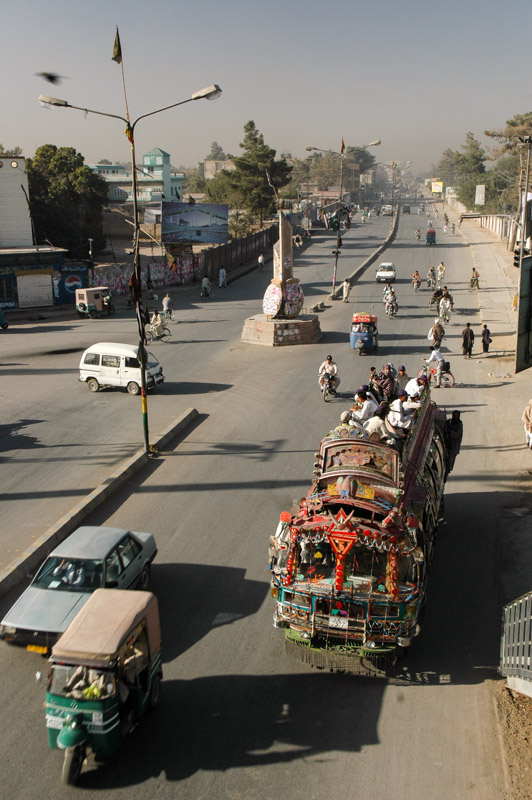
Zarghan Road, Quetta, Balochistan, Pakistan
The weather is perfect in Quetta, my favourite city in my favourite country. The mountain air and deep blue skies are wonderful, but it is the people who are the real highlight. The majority Pashtuns are perhaps the most charming and endearing people I have met; super-friendly with wide bellies and wider smiles, in their array of impressive dress; elaborate turbans, beautiful, intricately patterned sashes, vast, neatly crafted beards, ornate shoes with upturned points, jewellery set with large, colourful Afghan gems, hennaed hair and eyes often emphasised by kohl (antimony). Lying very close to Afghanistan, Quetta’s population is Afghanistan’s in microcosm. As well as the Pashtuns, one sees Mongol faces; Hazaras, some of whom have lived here for up to 300 years, some refugees from Afghanistan, and Uzbeks with their deeply Central Asian features, who seem to be on the bottom in Quetta; litter pickers, street-sweepers and cleaner. As my good friend Abdul Nasir who lives in the city said, ‘These men, who used to be airforce pilots and top government servants, are now pushing trolleys with potatoes and onions through the bazaar’. Is there any greater tragedy than war?
A wave of nostalgia overcomes me in the wonderful autumn light, and I’m reminded of my first visit to Pakistan, more than six years ago. I remember arriving at the New Muslim Hotel at around 03:00 after the gruelling desert journey from Taftan which I had undertaken with Tomasz, a Czech traveller whom I had befriended the previous day whilst ill in Zahedan, and a Pakistani student returning from Kazakhstan for the summer holidays. Tomasz and I found a room, a little basic, but we were far too tired to care. Next morning I awoke to all the delights of Quetta and my first taste of the Subcontinent. Realising I wasn’t going to get bacon and croissants for breakfast, I headed out of the hotel and found breakfast in a small bakery next door to a laundry shop, inside of which were hanging the iconic shalwaar kameez, the ubiquitous dress of the Pakistani male.
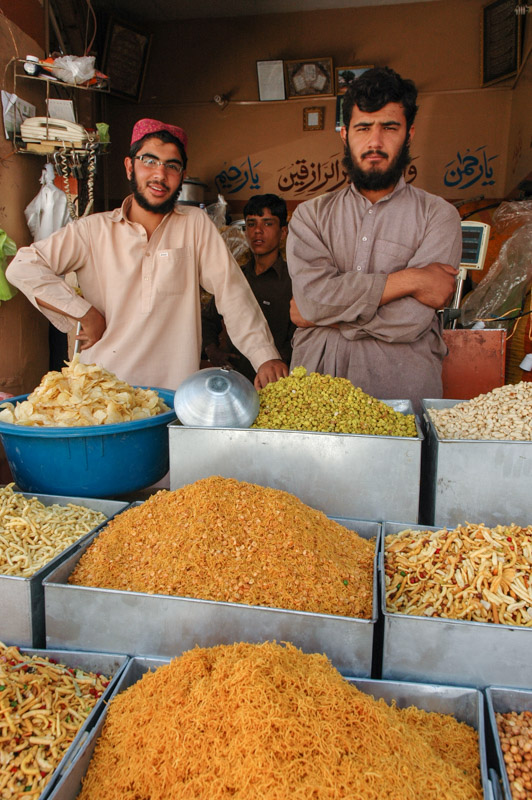
Spice Stall, Quetta, Balochistan, Pakistan
Today, on the surface little has changed. I am the same curious traveller, perhaps a little less wide-eyed and naïve, and preferring the shalwaar kameez over Western dress. The New Muslim Hotel is still there with its grassy courtyard, as is the bakery, the laundry shop and the bus companies luring Shia pilgrims to Iran. But the city has lost its atmosphere as one of the stops on the Great Eurasian Overland. Today, this old bastion of a hotel refuses to take foreigners, as pressure from the authorities has made it too risky. As the owner told me: ‘All the foreigners used to come here. Sometimes we had forty or fifty at a time. Now, if anything happens to those foreigners, here, or on the road after they have left, we are responsible. We have to foot the bill of the investigation’.
Quetta suffers at least three degrees of tension; from it’s proximity to the most dangerous southern provinces of Afghanistan, for the insurgency of the Baluchistan Liberation Army which has taken recently to killing ‘non-local’ Pakistanis (i.e. Punjabis), bombing busy city streets, and kidnapping foreigners, and from the age old sectarian violence between Shias and Sunnis. It’s rather difficult to reconcile the friendly and welcoming face of the city with its dark and dangerous undertones. Today therefore, tourists are down to a tiny trickle, usually escorted and cosseted by Police (something I manage to avoid simply by dressing and behaving as a local). Even the locals are afraid to go out too much. Few hotels are taking foreigners, the Police are more than a little jittery, and foreigners are being kidnapped. I’m still happy however to sit on a bench on Jinnah Road and simply watch the world go by; the swarthy and elegant Pashtuns, the old buses with boys hanging out, shouting ‘Sariyab! Sariyab! Double Road!’ The train still hoots past on the far side of Zarghun Road on its way to the Bolan Pass and further, down to the sweltering plains; a journey I made in 2003 which was, regardless of my rose-tinted spectacles, an ordeal of heat, dirt and discomfort.
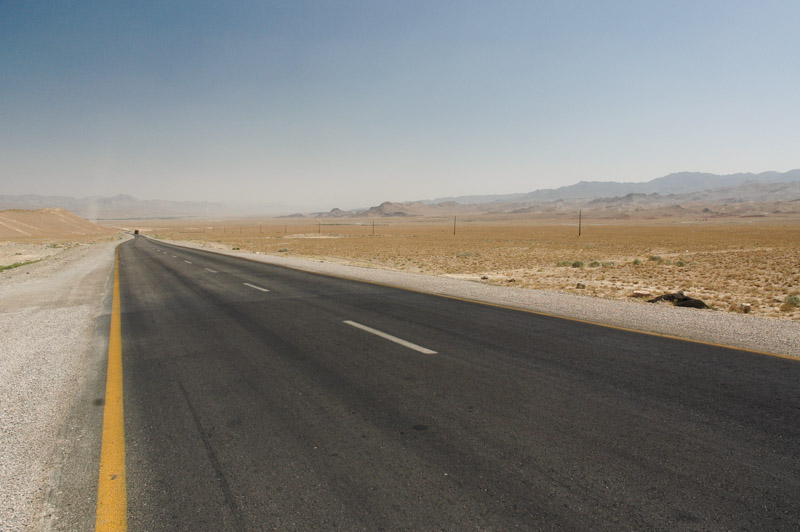
National Highway 50, near Qila Saifullah, Balochistan, Pakistan
My route out of Quetta is a new one, and I have chosen it for two reasons; firstly, it is one of the (few) areas of Pakistan which I have not seen, lying away from the main transport corridor up the Indus Valley, and secondly it is an area known for insecurity, with frequent bomb and rocket attacks, and military operations. This will be something of a water-test for Afghanistan. If I feel comfortable in these areas, then I will feel fine in Afghanistan, for this western corridor of Pakistan is probably not much safer than the worst parts of Afghanistan. The difference is that, should things get hairy, I can (hopefully) siphon myself off to the east, back to home territory. The same might not be possible in Afghanistan.
In Quetta’s huge car parts bazaar I purchase for three US Dollars a a set of license plates for the truck, with my UK registration number set out in such a way as to look like Pakistani plates on brief inspection. Together with my native dress, and a Pashtun complexion enhanced by my green eyes and (rather sparse) reddish beard, I pass on first sight in my Toyota Hilux as a native. Until I open my mouth at least.
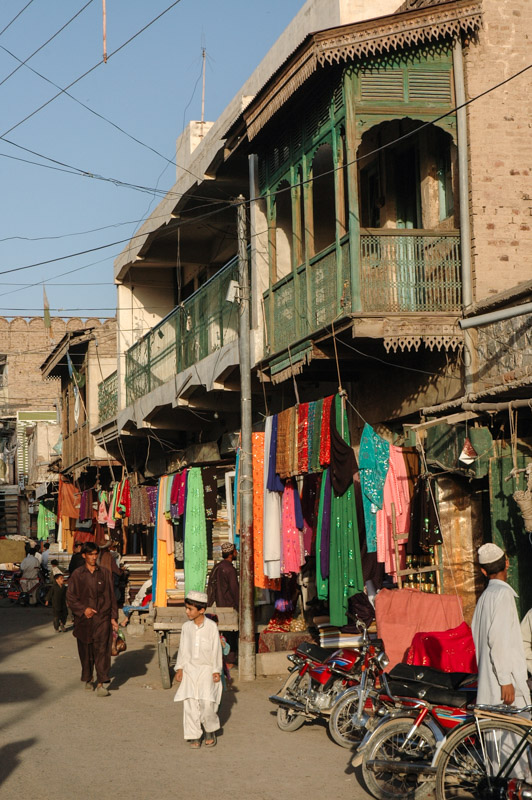
Bazaar, Zhob, Balochistan, Pakistan
I leave Quetta one morning with that wonderful excitement one gets when entering the unknown, though I initially miss my turn and drive most of the way to the border town of Chaman, on the road to Kandahar. Doubling back a short way, I start my journey north-east along a perfect road, in the gentle autumn warmth, under deep blue skies. There is little traffic on the road, which reminds me of the east of Iran and passes irrigated oases of verdant orchards and vineyards. The otherwise rocky and barren plain is dotted with scruffy white nomads’ tents, against which large piles of hay are stacked, attended by a compliment of livestock and wild-looking children.
After Qilla Saifullah the road becomes narrower and almost devoid of traffic. Stark, rugged mountains close in on either side, and I climb slightly before reaching the town of Zhob. The 1998 Lonely Planet guidebook, which I used on my first trip to Pakistan, described Zhob as a town for those ‘with a death wish’, which as I have now come to realise, most likely meant that the ‘author’ had never been there. Zhob is a quaint town quite unlike any other I’ve seen in the country; a wonderful old place of traditional wooden houses with ornate balconies, and colourful bazaars. The police have the presence of mind (an unusual presence) to keep cars and bikes out of the bazaars, which gives them a wonderful relaxed atmosphere. As another day of Ramadan fasting comes to an end, the bazaars are full of eager Pashtun men purchasing their ifthar, the greasy snack of fried potatoes or pakora which is traditionally taken to break the fast at sundown. A sizeable crowd of inquisitive men gather around me once I pull my camera out and give myself away as a foreigner, all of whom are friendly, with the exception of one man who after inquiring if I am a Sunni or Shia, is unimpressed to be told that I am not a Muslim, and walks off.
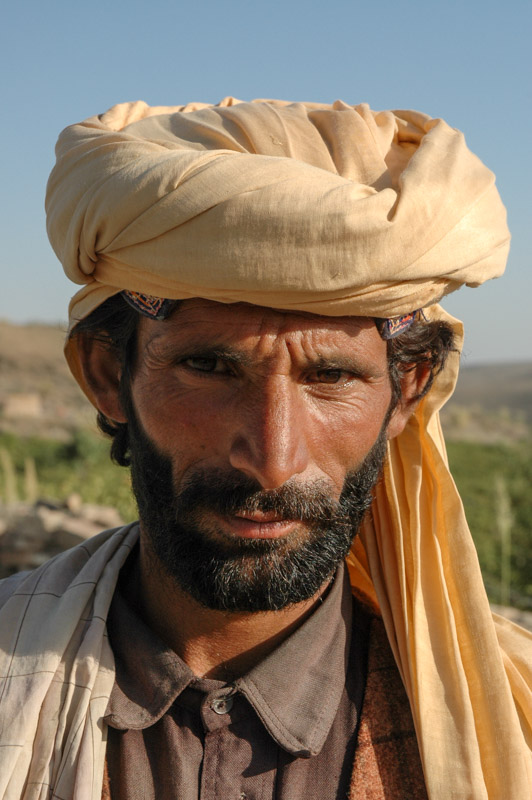
Kochi Nomad, near Zhob, Balochistan, Pakistan
I am befriended by two provincial education inspectors who are visiting schools in the region, and who take me out for dinner. ‘There is only a small Taliban presence in the area, no foreigner has ever been kidnapped here’ they tell me. That might have something to do with the fact that about one foreigner per year makes it here. I stay in a comfortable hotel in the city centre, sleeping under a blanket branded ‘Tora Bora’.
From Zhob, the road climbs gently into the Suleiman Mountains which at this time of year are teeming with Kuchi nomads making their way down from high pastures to the plains around Dera Ismail Khan. Like people from another world, they guide their livestock of camels, sheep, goats and donkeys. The men have colourful and elaborate silk turbans, whilst the women have startlingly brilliant dresses of pinks, yellows, reds, blues and purples, and guide the camels, often with gawky juveniles of their own in tow, careful to cover their heads, and often their faces in their luminous headscarves at the sight of a passing motorist. Once I catch a glimpse of one young woman; tall and slender and alluringly beautiful, her face somewhere between South and Central Asian. Perched on the camels, upon red and black nomads’ rugs with bold and simple designs sit children, with white skin and shocks of tousled, deep red hair. Occasionally there are men on horseback, deftly in control of their steeds, a skill no doubt honed through generations of nomadic life. They amble along the road, or along the gravelly plains beyond, a riot of animals, nomad colours, alluring faces and earthy, ancient smells, funnelling into the narrow passes which take them from the borderlands of nomadic Central Asia to the sedentary plains of India. The scene is so timeless that it might be a re-enactment of the original Aryan incursion into the Subcontinent, all those millennia ago.

Sulaiman Mountains, Federally Administered Tribal Areas, Pakistan
The road twists up and over some short passes and defiles as I approach the border into what I think is the North West Frontier Province (NWFP), where the police stop me. I’m nervous at being turned around and escorted back down to the lowlands by the officers who speak to me first in Pashto, then Urdu, then finally English after I say something. They are surprised, so much so perhaps that they allow me to pass, and I am loosed into what I would later learn was South Waziristan, one of the most dangerous places on Earth.
The scenery is epic and truly takes me by surprise, twisting through river beds and across wide plains with distant mountain vistas, over gravel plains with isolated yet pleasant-looking villages, whose existence is evidenced by the greenery surrounding them. Eventually, an immense valley opens up along a twist of the river, with mountains plunging over one thousand metres to the valley bottom. On one ridge sits what looks from a distance to be a fine Tibetan-style fort, but turns out to be a Frontier Corps stronghold, still in active use. The road then descends into a stupendous gorge so deep and narrow that the sun is completely blocked out, and the road hacked from right out of the mountainside. The area has the grandeur of parts of the Karakoram Highway, albeit without the snowcapped peaks and apricot orchards. Once through the gorge, the land starts to soften, and the bleak, beautiful aspect of the mountains submits to the pale skies and vegetation of South Asia. Scrubby plants start to appear on thin soils, and small villages become more frequent as the road descends around the last ridges, down onto the plains of the Northwest Frontier.
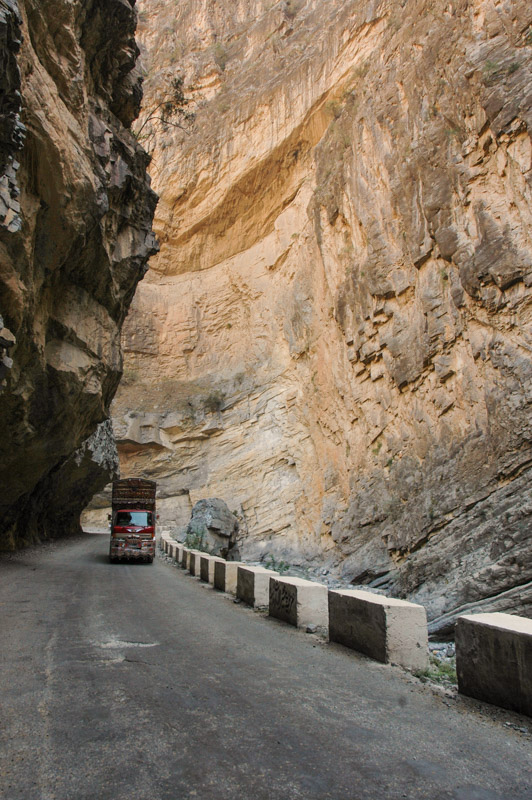
Sulaiman Mountains, Federally Administered Tribal Areas, Pakistan
Just outside of Dera Ismail Khan I rejoin the Indus Highway and head north, through an area which I deem to be potentially unsafe; towns such as Bannu are in the newspapers every week without fail for bombs, shootings and murder. Rather ominously I pass an army convoy, which causes all nearby cars to stop at the roadside. The country looks unassuming; sparse, rather arid farmland not unlike Sindh. I bypass the town of Bannu, passing the outliers of the mountains – the isolated ripples and ridges of a mass of rock which stretches north to the edges of Siberia – here dry, dusty eroded forms. Winding up onto the Potohar Plateau, the Police stop me once again near the town of Karak, this time on the grounds of my fake Pakistani number plate, assuming mine to be a car illegally smuggled from Afghanistan. They are immediately satisfied once I explain that the car is British (what a wonderful asset it is to have pragmatic law enforcement), but are rather surprised to see me, explaining that before the recent ‘operation’ in the area, it was too unsafe for them to be there.
The road is in good condition, lined with young eucalypts. The landscape is a red soil plateau, with small streams and lush, verdant grass. Small patches when flat, are cultivated, and messy villages huddle around these fertile swathes. The locals are all Pashtuns and look very conservative though friendly, but I heed the advice of the Police and refrain from stopping. It feels safe and pleasant, and is rather beautiful. I enter Kohat around 17:00, a messy city nestling at the base of a belt of mountains which separates it from the provincial capital Peshawar, and contains the tribal area of Dara Adam Khel, once famous on the overland trail as a place to fire a few guns and watch the gunsmiths at work. It’s a tempting place to visit, but I refrain, on the advice of my Pashtun friend Zia who now lives in Hyderabad; a friend of Zia’s, local to the area, was murdered in Dara Adam Khel not long ago.
Bazaar, Kohat, North-West Frontier Province, Pakistan
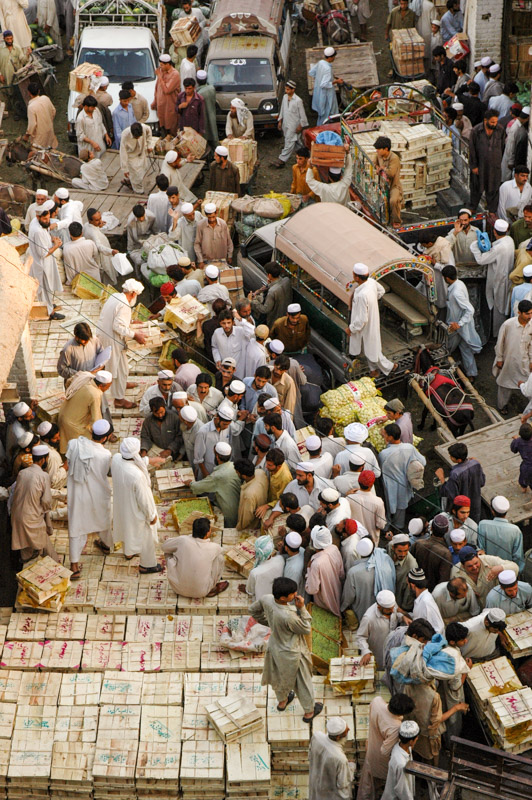
I find a hotel run by a friendly old Pashtun with a long white beard and blue cat-like eyes, who is more than a little surprised to have a foreigner check-in. Behind the hotel, right under my window, is a raucous fruit market with boxes of grapes and piles of apples in truly vast quantities, sold wholesale. One grape-seller, an ebullient Pashtun with a rich black beard and round white topi (cap) stands upon a house-sized stack of grape crates and bellows prices down with an accusing finger to thronging customers in a kind of reverse auction; ‘SAAT-SO’, ‘CHE-SO’… (seven-hundred, six hundred..). His appearance and manner would be more suited, I can’t help feeling, to delivering fiery sermons at a local mosque. Despite being Ramadan, the market starts up again at about three in the morning, reaching its climax between six and seven when most Pakistanis have long since retired to bed after Sehri (pre-dawn Ramadan breakfast).
I break the fast that evening in a local restaurant with an ice-cream salesman from Peshawar who is visiting the city on business, and warns me that it is dangerous. Everyone I meet in Kohat is friendly, warm and kind, and the place feels fairly safe, with little tension. But that was my misconception. I later learn that earlier in the day on which I had arrived, a number of grenades (which didn’t go off) were thrown at the police station directly opposite the hotel I would check-into that evening. Two days later, a massive suicide-bomb ripped through a portion of the city on the same street as the hotel, killing twenty-five people.
The road east, into the Punjab winds through the rolling uplands of the Potohar Plateau, synonymous with the Greco-Buddhist civilisation of Gandhara, with scattered small farming communities and hazy views of colourful hills. I cross a small river over a narrow bridge and, without realising it, I’ve crossed the Indus and am in Punjab, whereupon the land flattens out, becomes more populated, but feels more relaxed and secure. The road climbs steadily towards the Margalla Hills, joins the Grand Trunk Road for a few kilometres, and then I’m in the capital.
I’ve rather enjoyed the edgy drive up here from Hyderabad, and feel emboldened to make my way across Afghanistan. All I have to do now is sort out permits, three visas, a visa extension, and a customs extension. Simple.
 EurasiaOverland