
Stage 18 – Afghanistan & Iran: Khorasan To The Caspian Sea

This stage of the journey – passing through a corner of Afghanistan then heading across the plains of Khorasan to the Iranian capital and on to the Caspian Sea and the frontier of the Former USSR – would mark the last in the conservative societies of southern and western Asia in which I had been for more than two years.
It’s the 26th December 2009 and Duncan and I have just left the end-of-the-world town of Serhetabat at the southern tip of Turkmenistan, and entered Afghanistan once again. Entering the country is relatively simple despite my lack of a Route Permit, and we soon are in the muddy border town of Torghundi, which looks more like a sprawling village. The town is full of lorries making the transit to Turkmenistan and feels immediately more worldly and alive than any of Turkmenistan’s curiously comatose settlements. It’s late afternoon when we arrive and we decide to stay for the night to avoid driving the road to Herat in the dark, as it passes through areas with a Taliban presence.
As always we head to a chaikhana (teahouse) to stay for the night, but the local police soon find us and forbid us from staying there. I explain to them that we do not wish to pay for an expensive hotel (if one exists) and so we are invited to stay the night at the police station. Thus begins an eventful evening in the company of the police chief, a jolly, wiry Turkmen, and a number of young officers who are interested to meet us. We are fed a good meal which is supplemented by a bottle of illegal Turkmen vodka, though perhaps the most interesting part of the evening comes when the police chief pulls a live kestrel out from a cupboard, and allows it to hop and flap around in the room we are sitting in. Later, well after dark, some of the young officers enter the room, very heavily armed with chains of bullets thrown over their shoulders and invite us to join them on a night raid to ‘shoot Talibans’. Serious or otherwise, I imagine the police chief would not be best pleased if we were to join, and so we decline.

Mud Houses, Do Ab, Herat Province, Afghanistan
In the morning, just as we are ready to say goodbye to our hosts, the police chief becomes rather worried for our safety on the road to Herat. As there is only one road, there is no alternative and so we are given an escort, or rather a cavalcade of seven Police pick-ups filled with armed officers for the first leg of the journey. Not long after we are stopped by the US Army coming the other way down the road (who have an escort of only three pick-ups) and my pick-up is searched by one of their local officers on suspicion of being used to transport drugs – rather a curious accusation seeing whose company we are in. Pretty soon however we are moving once again, until we reach a small village. All the Police stop here before jumping out and running off amongst the mud houses with guns drawn. Our hosts from last night say just one word to us: “Go”.
The road passes through a few villages in which we don’t stop, then crosses the shallow Robat-e Mirza pass in the Paropamisadae mountains whereupon the scenery changes subtly; gone are the sparse grasslands of Turkestan, replaced instead by a backdrop of long ranges of distant black mountains, beyond which the stony plains of Khorasan extend to the centre of Iran.

Vaulted Bazaar, Herat, Herat Province, Afghanistan
The similarity to Iran becomes even stronger once we arrive in Herat, whose long streets of fine bazaars and general air of culture and history make it far more like the great cities of Iran than anywhere I have come across so far in Afghanistan. The black, Persian chador is far more prevalant on the streets than the burqa seen elsewhere; the faces have softer, Aryan features and Persian replaces Pashto or Uzbek as the predominant language. Herat is indeed so much like Iran that I find myself on several occasions forgetting momentarily that I am still in Afghanistan; the city feels just like Iran, just with a rugged, chaotic touch.
Herat features in classical history as the capital of the Achaemenid satrapy of Aria, and became a flourishing centre of culture and the arts in the twelfth century, causing Rumi to describe it as the ‘Pearl of Khorasan’. The city became the capital of the Timurid Empire in the fifteenth century following the death of Tamerlane, and much of the city’s grandeur dates this period. Though far from untouched by the ravages of recent history, Herat retains enough of its central streets and ancient architecture to be an impressive and endearing, living city; a far cry from the air of fallen grandeur which permeates Turkestan.
Duncan and I are hosted by Khalil, who works as an interpreter for the US Army in the city. He lives with his family in a modest though comfortable house which he has built himself, in a very rustic part of town which consists of linked mud-brick houses accessed via narrow and irregular alleys down which the truck can barely squeeze. Much of the centre of Herat is given over to bazaars; long streets of time-worn shop-fronts and narrow alleyways which occasionally give way to small caravanserais, some of which are beautifully restored with tall vaulted ceilings and porticoed shops. The smell of the spice bazaars immediately transports the senses to Iran and the Middle East; the pungent blend of spices, herbs and dried fruits which must have scented the trade routes of Eurasia for centuries.

Friday Mosque, Herat, Herat Province, Afghanistan
Khalil takes us one evening to the old Citadel which is undergoing restoration; an impressive towered fortress which sits amongst the melee of a busy fruit market. From the ramparts of the citadel one has a panorama over the entire city, set against low, eroded mountains which give it an aspect much like many of Iran’s great cities. Amongst the warren-like lanes of mud-brick homes and shops, the glorious relics of Herat’s heyday as capital of an empire in which the decorative arts flourished, stick out with tall minarets and blue domes.
Herat’s Friday Mosque is the city’s most complete and restored highlight; a Timurid masterpiece covered in lavish faïence which has been very carefully restored and is still clearly in active use. To the north is the Mosallah Complex which would have been the city’s greatest architectural edifice; a medressa (religious school) built by Gowharshad Begum, the daughter-in-law of Tamerlane who made Herat the imperial capital. The medressa complex was levelled by the British in the nineteenth century for fears of the Russians using it as a forward-base in an attack on India, and only five of the eight towering minarets remain, in a state of precarious decrepitude. In a adjacent park which is closed to the public, Gowharshad’s own elegant mausoleum sits forlornly; the stunningly intricate fluted dome looking rather bald after having lost almost all its turquoise tiles.
Another highlight, and one which Byron was particularly taken with, is the Sufi shrine to Khwaja Abd’allah Ansari, the pir (saint) of Herat, at Gazar Gah. Lying on a rise to the north-west of the city, the Timurid shrine has an elegant main portal with dazzling geometric mosaics of Arabic script, and a courtyard filled with the graves of those who have been buried near the pir, in the Islamic tradition. As I’m walking around the cemetery, a group of Kuchi nomads from neighbouring Badghis Province enter; three women with rough faces in heavy black chadors and wearing heavy silver jewellery make an offering to the pir, muttering prayers, whilst the men kneel and prostrate themselves towards the man’s tomb.

Gazar Gah, Herat, Herat Province, Afghanistan
On my final evening in Afghanistan, I am invited, along with Duncan to have a discussion with a local mullah, though I excuse myself from the meeting as I am not in the mood for a heavy religious discussion. Instead, I take a taxi a few kilometres south of town on the old road to Kandahar, to the Hari river; that which we shall follow tomorrow to the Iranian border, where it heads north, eventually dissipating into the Tejen Oasis south of Merv. Here the Pol-e Malan, a beautifully restored Safavid bridge, crosses the wide, shallow river in twenty-two graceful arches, with water cascading gently over a wide slipway. It’s a popular place for Heratis to come and spend time, and it’s not long before a circle of young men, one of whom is in police uniform, invite me to join them. We speak for a while and share some very pleasant Afghan hashish, and I’m soon feeling extremely mellow. By the Western calendar, it’s New Year’s Day, but the temperature is mild and the sky is slowly dimming with vivid lances of pink and white as the sun dips beyond the horizon. I filter out the sound of conversation and traffic, and hear just the gentle roar of the river which together with the atmospherics is really quite blissful.
I’ve completed my dream of crossing Afghanistan, and it has far exceeded my already high expectations. The people I have met, and the places I have seen have had a magical, timeless quality about them. Afghanistan is utterly fascinating; at once war-ravaged and untouched, tense but welcoming, wild yet sensuously beautiful, backward yet steeped with the ruins of multiple empires which have come to pass. I’m thankful that I’ve not encountered any trouble in the country, but even more glad that I made the decision to come. It would certainly have been quite crushing to have left the region without having visited at least part of the country. I finally have a sense of closure and completion, though despite being more than two-and-a-half years into my journey I still have no wish whatsoever to return to Western Europe. The time has now come to begin a journey to another side of Eurasia; that of the former USSR.

Pol-e Malan, Herat Province, Afghanistan
As darkness falls, I rouse myself and begin the six kilometre walk back to Khalil’s house. I enjoy the heightened anonymity of the darkness and deeply enjoy the soliatry walk. Reaching Khalil’s house, I enter the room looking rather distant, and soon excuse myself to go and sleep.
The following morning is spent attending to some last-minute errands; importantly, my customs document has just arrived at the TNT office, meaning that I can enter Iran with my truck. We say our goodbyes to Khalil and his family, with whom we have stayed for a week in the atmospheric back-streets of this most magnificent city in Afghanistan. We head out west, tracking the Hari river towards the Iranian border crossing at Islam Qala. On the way, we call the guys in Mazar-e Sharif and learn that tragically, Ramesh has died. It seems so stupid that a young man who grew up in a war-torn country, who was well educated and due to soon be married, has died in what was a relatively minor car accident, most likely for not having worn a seat belt. It inclines the two of us to use ours more often.
We reach the Iranian border at Islam Qala and proceed to wait while the petulant Iranian officials deliberately delay us. While hordes of Afghans with vast bags full with goods move through with relative ease, we are eventually taken into an office and explained that it is necessary to be fingerprinted, due to being British. The customs officers are little better and I only just manage to get the truck through customs before the border shuts for the night. Despite the nasty introduction it is nevertheless nice to be back on Iran’s perfectly smooth and secure roads, and I drive through the night across the northern fringes of the Dasht-e Kavir on Highway 44, bypassing Mashhad, Nishapur and Sabzevar to arrive in the pleasant desert town of Shahrud.

Vaulted Bazaar, Qazvin, Qazvin Province, Iran
We are hosted in Shahrud by Amir and his very welcoming family, who feed us wonderful meals of traditional Iranian dishes. Despite the feeling of having advanced several decades in time, there is a clear cultural continuity with Herat, and it’s interesting to see that rich Persian culture brought forward into modernity with bazaars of modern shops, well maintained mosques and gardens, and tidy small towns which are at once traditional and modern. Duncan moves on before me, to see some of the country’s great cities, while I stay a few days relaxing with Amir before moving west towards the capital.
Highway 44 continues west across the desert, through Damghan and Semnan towards the Alborz mountains and the capital. The traffic becomes thicker as Tehran sucks one in, like a massive sprawling organism of a city, feeding on the foul mass of traffic which hurtles headlong with reckless abandon towards the monster motor-city, passing through foul satellite towns such as Pakdasht; once quiet villages now witness to the hideous traffic which snarls endlessly around Tehran. Chimneys belch out smoke, casting a sickly brown light from the low sun. Cars, bikes and trucks hurtle past undertaking, overtaking, weaving through, and one has no choice but to join the locals in their reckless, lawless aggression; tailgating, squeezing in, playing chicken with two cars to squeeze through a narrow gap between trucks, like a charge of wild steeds galloping home, out of control. Entering the throes of the capital proper, one slots onto the system of expressways; speeding masses of cars flowing under bridges and round twisted spaghetti junctions. One has moments only to check a sign, before being swept past the turn, entering kilometres of unknown road twisting round and over the endless suburbs.

Mausoleum of Hulagu Khan, Soltaniyeh, Zanjan Province, Iran
More than ever, Tehran seems bland, ugly and singularly charmless; I’m on a come-down after the weeks of adventure in Afghanistan and fall into a spell of boredom. Duncan rejoins me for a couple of days before departing on the train to Istanbul, from where he will fly home. It’s a sad departure after two very memorable months spent together. I must stay in the city however to examine my options for further travel. My ultimate goal is Russia and Mongolia, and I have a remarkable stroke of luck in finding Mr Kamenev the Russian consular assistant, who is extremely helpful; he is willing to issue me a one-year Russian business visa without any bank statements, HIV test or even a legitimate business reason for visiting Russia (though he suggests that I fabricate one for the application). All I need to do is wait several weeks for an invitation to be processed and sent from St Petersburg.
I leave Tehran after twelve days, and head north-west to the city of Qazvin, with its beautiful tiled mosques and a very fine, vaulted bazaar. Even more impressive however are the ruins of Soltaniyeh, close to the city of Zanjan. Soltaniyeh was once the capital of the Ilkhanid Empire, founded by Hulagu Khan, grandson of Chinggis Khan, who ruled much of south-west Asia during the 13th and 14th Centuries. Today the former capital is little more than a village, but the vast, domed mausoleum of Hulagu still dominates the barren plains. Erected in the early fourteenth century, the 49 metre tall shrine’s vast turquoise dome is one of the largest brick domes in the world. From the exterior, which has lost almost all of its fine tilework, the building is rather brutish and imposing, but the vast interior chamber and upper galleries, reached by staircases which wind around the outer walls, are a magnificent opus of fine brickwork, stucco, and faïence. The contrast of the powerful exterior and delicate interior make it in my opinion one of the more graceful buildings of the Islamic world, and it is perhaps a fine metaphor for the Mongols themselves, whose initial wave of absolute terror gave way perhaps to western Asia’s greatest cultural renaissance.

Cloud Forest, Gilan Province, Iran
From Qazvin I cross the western outliers of the Alborz mountains and drop down to the verdant littoral of the Caspian Sea, to the damp coastal town of Rasht which I had visited back in 2003. My host is Setareh, mother of a family who live in a modern apartment in the city centre. Although technically a lake, the Caspian Sea’s damp, salty air give the perfect impression of being at the ocean, something I have not experienced since leaving Sindh months ago. After so long in deserts and at high altitudes, the cool, damp climate makes a pleasant change, despite my pathological dislike of grey skies. However, it is on a trip to an Seljuk castle which lies in the Alborz foothills that I have perhaps my fondest reunion, when I find myself with Ali, Setareh’s eldest son, walking through the cool Caspian cloud forest, with mossy covered rocks and old-growth deciduous trees, swirling mist and a castle around which could almost come from medieval Europe. Thinking back, it’s the first time I’ve walked in a forest since I was in the Himalaya.
From Rasht I drive east once more along the damp coastline, then slightly inland to the city of Sari, capital of the historically notable province of Mazandaran. Modern Sari is a fairly uninteresting town, but it is here that I fall into a small but important demographic of Iran. My host Kiavash, who runs a clothes boutique, comes from an upper-middle class family, but he introduces me to a circle of the Iranian youth who frequent shops such as his; the free, ‘kept’ youth of the rich and powerful, who spend their time driving around town in expensive imported SUVs flirting with the opposite sex, and whose most pressing decision in a day might be what to wear. I visit the home of one such family, who are descended from the Qajar shahs and have a living room furnished with lavish nineteenth century artworks. In the evenings there are parties with girls, drink and more, and I’m frequently left in a state of sheer disbelief at being in the Islamic Republic of Iran.
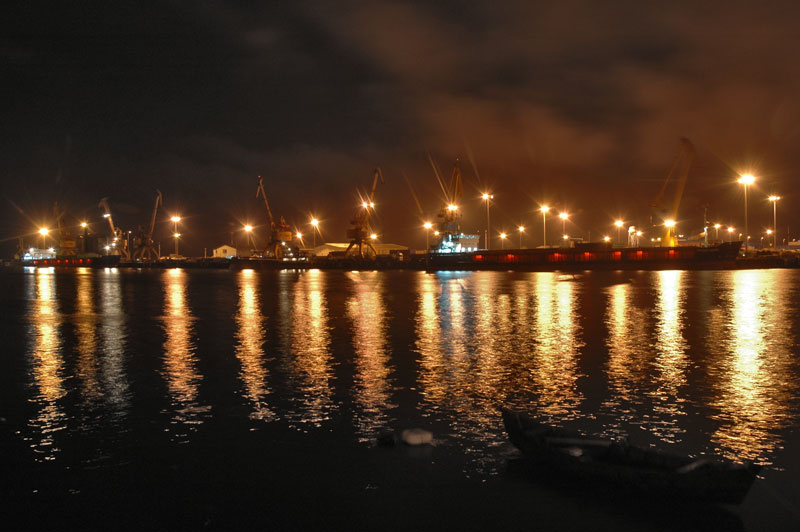
Bandar-e Anzali, Gilan Province, Iran
I reluctantly pull myself out of this world which seems so free and familiar, and re-cross the Alborz mountains to the commuter town of Karaj where I stay with Abol Fazl (Abo), who comes from a working class family and has to be one of the kindest people I have ever met. After spending more than a week in the notorious Evin prison, during which time he was tortured, and for nothing but a rumour spread by someone with whom he had fallen out, Abo is determined to leave his country. Without the money or power to enjoy a life of freedom, Abo is seeking it in the outside world.
I spend several weeks in the family home making trips to Tehran most days, where I start a brief and rather dangerous relationship with a young Iranian woman. I also meet my friend Simon who after failing to enter China with his two donkeys (with which he had planned to walk back to Switzerland), had sold them and bought a rather tired VW Beetle in Islamabad, in which he is instead driving home. We drive north in Simon’s Beetle towards Sari one evening, only for the engine to drop a valve and seize at the top of a cold mountain pass, which requires us to rebuild the engine over several days in Kiavash’s garden, much to the chagrin of his father.
Despite my unusual insights into contemporary Iran, as on previous visits I start to feel the weight of repression and frustration which is evident in much of the youth. Iran is a country with a huge young population in the midst of the growing pains of a modernising society which is slowly and precariously escaping the near-medieval rule of an Islamic theocracy. This theocracy, the Velayat-e Fakir, a party of clerics who claim a divine legitimacy to rule, are driving these young, frustrated Iranians away from Islam, and away from the country, just as the late excesses of the regime of the last Shah drove them to the seminaries and allowed the mullahs to hijack a popular revolution. Civil unrest is growing and potentially disastrous economic changes loom on the horizon in what seems a time-honoured repetition of the turbulent and fast-moving history of Iran.
Once I have finally collected the necessary visas, I bid farewell to my new acquaintances and drive through the night, making one final crossing of the Alborz mountains, then driving up the western Caspain coast, a narrow strip of sodden land below tall, lush mountains in which fine tea is grown, up to the port and border town of Astara. Here I say my final goodbye to the conservative Islamic societies of Asia, and slip into Azerbaijan.
Stage 17 – Uzbekistan, Afghanistan & Turkmenistan: Turkestan [2/2]
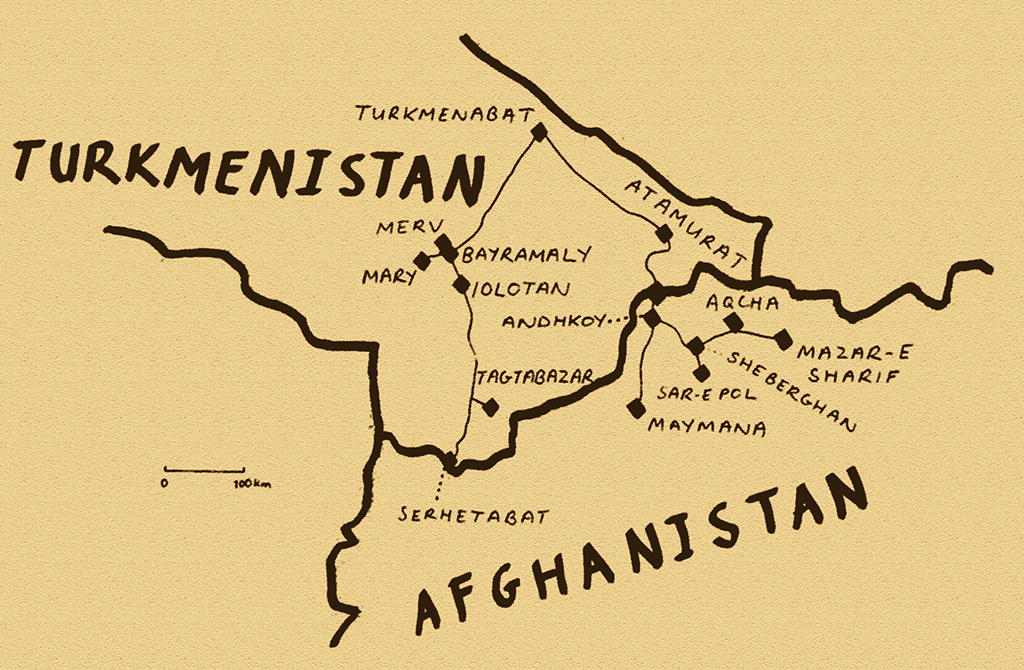
The stretch of country ahead of me incorporated some of the least-visited corners of Central Asia; provincial market towns of northern Afghanistan, and a string of sleepy kolkhozes (collective farms) and eerily quiet cities in the desert wastes of Turkmenistan. Both seemed trapped in time, but in very different ways. In Afghanistan, the decades of war have stunted any modernisation of an already very traditional society for two generations, giving one the impression that parts of the country have changed little since the thirteenth century. Turkmenistan on the other hand had emerged from the ruins of the USSR in 1991 and became even more insular and xenophobic, leaving the country with a pervading sense of lassitude, trapped somewhere in the 1980s and forcibly ignoring the outside world. For all its forlorn and end-of-the-world feel however, the area was historically at the heart of the great empires of Central Asia, with the oasis of Merv one of the world’s oldest settlements, and perhaps at some point just prior to the Mongol invasion, the largest city in the world.
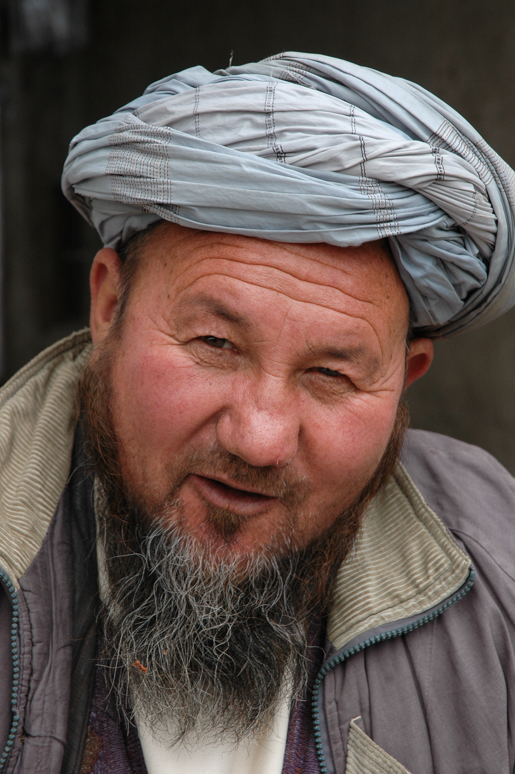
Turkmen Man, Aqcha, Jowzjan Province, Afghanistan
Duncan and I leave the company of our hosts Elias, Aimal and Ramesh in Mazar-e Sharif (Mazar) on the morning of the 16th December 2009. We head east out of the city, onto the fertile plains between the northern edge of the Hindukush and the Amu Darya. Now, in winter, the weather is cool and the landscape bleak, with only the bright white puffs of wool in the parched cotton bushes standing out from the endless shades of brown. Either side of the road is a continuous stream of small fortified farmsteads, old forts, shrines and ancient crumbling hills which dot the otherwise flat plain, all of the same beige of the native alluvial soils. It is clear that people have inhabited this place for aeons; it has the feeling of generations of cultivation and construction, with many mud-brick buildings slowly returning to the soil. Low graves and shrines are marked by colourful votive rags, which flutter in the brisk winter breeze. An old Soviet pipeline runs along the roadside, broken in places; another construction project now left to the work of time and the elements. The brand-new, western-funded road on which we’re driving is the latest layer of history in this landscape, an artery of a new Silk Road bringing goods from Europe and Turkey through Iran and Turkmenistan to fuel the nascent construction boom across Afghanistan.

Landscape, near Sheberghan, Jowzjan Province, Afghanistan
Our first stop is the market town of Aqcha, which is predominantly Turkmen. Afghanistan’s Turkmen community left the Turkmen heartlands at the time of the Russian invasion in the late nineteenth century and remain isolated from their brethren in the independent state of Turkmenistan, retaining a far more traditional lifestyle. We pull up on the muddy main street of the town, and head into a local chaikhana for lunch, before heading out to explore. The streets of Aqcha could be straight out of a nineteenth century photograph; men (and only men) are almost all bearded, and wear voluminous turbans of white, grey or light blue. Men ride horses, or lead horse-carts through the streets, laden with cotton or other goods for sale. The bazaar is ramshackle and rustic with wooden canopies overhanging the entrances to rows of shops which line narrow streets lined with fully grown trees, now totally bare. The range of wares is large, but wool, carpets and jewellery are especially well-represented, and the whole place has a real timeless, Silk Road atmosphere. The Turkmen people are slightly reserved at first, and naturally surprised to see two westerners ambling through the bazaar, but curious glances almost always turn to soft, friendly smiles upon greeting. The range of faces is intriguing; from strongly Mongol to Aryan, highlighting the mixed ancestry from the long history of invasion and migration which characterises the region.

Emam-e Khord Mausoleum, Sar-e Pol, Sar-e Pol Province, Afghanistan
In the afternoon we return to the main road and continue west towards Sheberghan. Small patches of brilliant green grass seem to make use of the cool damp winter, and are attended by Turkmen shepherds grazing their flocks. At one point we pass a large old walled fortress which like so much in the area, is in a state of advanced decay. We stop when we see some armoured vehicles of the Swedish Army, who are based in Mazar. They stop traffic in both directions on the road, and deploy with weapons drawn against a wall on the south side of the road, and seem to be targeting something in the distance which is invisible to us. Other cars are waiting patiently behind and there is no gunfire, so we wait for a few minutes before moving on when signalled to do so. It’s the first time I’ve seen anything like a hostile situation in Afghanistan.
The landscape becomes flatter, and the settlements sparser as we approach Sheberghan and turn south towards the small provincial capital of Sar-e Pol. Low, rounded hills covered in lush green grass appear along the roadside, surrounded by villages of simple mud-brick dwellings where men are harvesting the last of the cotton crop. Sar-e Pol has a slightly different feel from Aqcha; it’s population are largely Tajik and Uzbek, and it’s a market town for the communities of the mountains to the south. Parts of the town seem almost totally untouched by modernity, with unadorned flat-roofed mud-brick houses like those in the villages on the road from Mazar. There are also a number of simple but elegant Bukharan-style mosques with outdoor courtyards covered by roofs supported with carved wooden pillars. Camels walk the muddy streets of the bazaar having been lead in from the surrounding desert transporting goods for sale or trade. At the edge of town, amid a concentration of graves which make the surrounding landscape a plain of hummocky grass is the simple white-washed shrine of Emam-e Khord. Signs of animal sacrifices, as well as the more common prayer rags hanging from stakes above graves hint at an ancient paganism which is practised by some in this most remote corner of Central Asia.

Bazaar, Sheberghan, Jowzjan Province, Afghanistan
We spend the night in a cosy chaikhana whose walls and floors are covered with colourful rugs, drinking cups of green tea and eating a tasty meal of pulao; rice with meat, sultanas and shredded carrots, accompanied by a small round Uzbek-style nan (bread). Sar-e Pol is the end of a newly-surfaced spur road – beyond here are rough mountain tracks which lead to Bamiyan and the mountainous centre of the country – and so we retrace our steps north to the main road.
We stop in the town of Sheberghan, which was once the capital of an independent Uzbek khanate, and remains the most strongly Uzbek-dominated city in the country. The city is larger and more modern than either Aqcha or Sar-e Pol, with a dusty bazaar full of very friendly Uzbek traders, and Uzbek, rather than Dari is the language one hears on the street. Any remnants of the city’s past however seem to have long been destroyed by war, and after a brief stroll Duncan and I retire to a chaikhana and play cards over endless cups of green tea. In the evening we move to a different chaikhana for dinner, and sleep on the floor of an upstairs room. At around 03:00 I’m awoken by a figure standing at my feet carrying a machine gun. He turns out to be one of two policemen who visit us in the night to check who we are, then advise us that the chaikhana is not secure for foreigners. I shrug my shoulders and say that we’ll leave in the morning, and the officers, after looking rather incredulous, leave us to sleep. I imagine most foreigners they deal with are cosseted in bullet-proof vehicles with private security, and breeze into an expensive hotel.
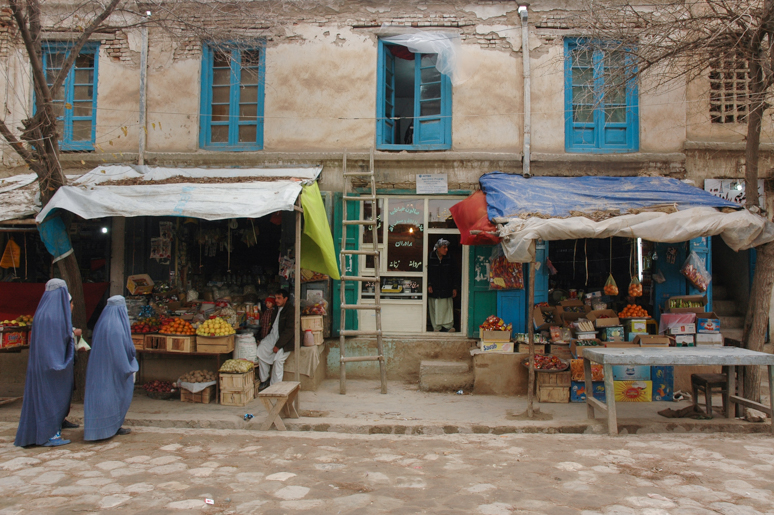
Bazaar, Maymana, Faryab Province, Afghanistan
West of Sheberghan the landscape becomes increasingly arid and the small mud-brick villages of domed houses thin-out, then disappear altogether, leaving the landscape marked only by the occasional crumbling caravanserai or whitewashed shrine. After Andhkoy, the road heads south and soon the landscape changes once more; low, powdery hills appear on the horizon, criss-crossed by endless sheep-trails which give them a velvety texture from a distance. Flash-floods and ephemeral rivers cut into this landscape of soft, loess-like soil, sometimes ruining entire villages which are left to slowly wash away. The road winds into these hills then crosses a low pass and descends into the town of Maymana; the end of the main road before it disintegrates into a terrible mud-track and enters Badghis Province – one of Afghanistan’s poorest – which presently suffers from a high rate of banditry, just as it did when Robert Byron passed through in 1934.
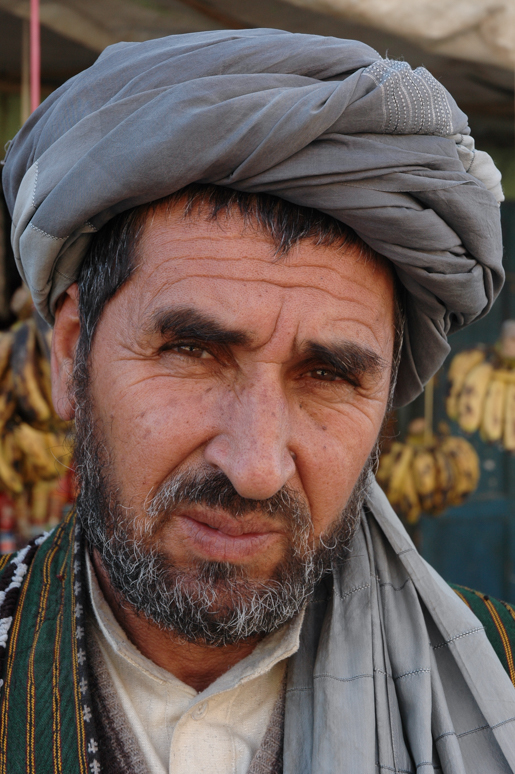
Uzbek Man, Maymana, Faryab Province, Afghanistan
Maymana has something of the air of a desert outpost, yet is large and busy enough to almost feel like a city. It’s the capital of the province of Faryab, which has been suggested as the birthplace of the ninth century philosopher and mathematician Al-Farabi (Alpharabius), a key figure in the Islamic Golden Age of thought, which developed the ideas of thinkers such as Aristotle and would subsequently fuel the Enlightenment in Europe. Like Sheberghan, Maymana was at one time an independent khanate, and has been historically important as an entry-point to Afghan Turkestan, on the trade route from Herat to Balkh. The town seems to have weathered the war slightly better than others in the region; the central streets retain an orderly grid-plan, lined with roadside channels and mature pine trees, and some of the streets in the bazaar are cobbled rather than the usual morass of sticky mud seen elsewhere. The population of Maymana are largely Uzbek, though with a significant Pashtun minority. This region of Afghanistan is not part of the traditional Pashtun heartland, but the eighteenth century Pashtun ruler Ahmad Shah Durrani, effectively the founder of modern Afghanistan, moved his own people into these far-flung frontiers of his empire.
As usual, we spend our time exploring the city, and taking breaks for cups of green tea in chaikhanas, which for us have become something of a substitute for pubs and bars. We are refused permission to stay overnight in a chaikhana due to security concerns, and end up staying in the basic Municipal Hotel, right in the centre of town. Dating from the 1920s, I imagine it is almost certainly the same hotel which Robert Byron stayed in, which is some compensation for being denied the convivial atmosphere of the chaikhana.
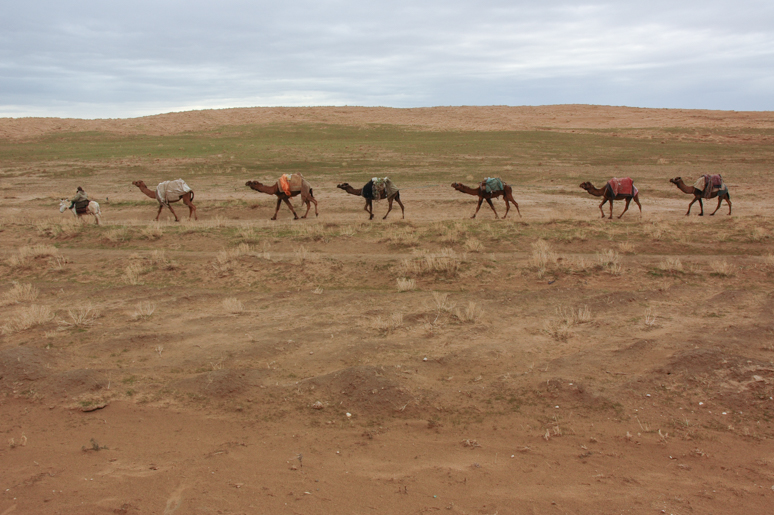
Camel Caravan, near Andkhoy, Faryab Province, Afghanistan
The following day we head north once more, back to the town of Andkhoy, the last point of call before entering Turkmenistan. We make a phone call back to the guys in Mazar, as I am expecting an important customs document for the car to be sent there, and hear some tragic news; Ramesh has been in a car accident and is in a coma in a US Army hospital.
As we emerge from the hills once more, onto the desert plains near the Turkmen border, I see something which fulfils one of the mental images I had of Central Asia, long before the journey started. Just beyond the roadside, a man on horseback leads a caravan of six dromedary camels, lightly laden on their way back from town. These camels are not for tourist rides, but are being used to carry goods to market; for just a moment, I am seeing the Silk Road in the thirteenth century.

Carpet Seller, Andkhoy, Faryab Province, Afghanistan
The sense of timelessness is continued in Andkhoy, which is a muddy and slightly shambolic frontier town, one in which trade unfolds as it has done for centuries. Duncan and I find a room in a large chaikhana, then set out to explore the town which I immediately fall in love with. Many goods are brought here by camels, often colourfully decorated with pommels and with beautiful carpets thrown over their humps. The buildings of the bazaar are delightfully ramshackle; at the edge of the ankle-deep mud which fills the streets, the shop-fronts are shaded by canopies of rickety wooden beams, covered in mud and straw to fend off the fearsome summer sun. Under these canopies sit the mostly Uzbek shopkeepers, all in flowing turbans and sometimes wearing thick traditional kaftans, some sitting out on beautiful, frayed old Turkmen teke carpets or Bukharan rugs. The whole scene is my Silk Road fantasy come true; what I am seeing is probably very close to what Marco Polo saw on his Silk Road epic ‘The Travels’. I feel like I am seeing the very last vestige of the Central Asia of old, untouched by the Soviets or indeed by modernity at all. It’s the kind of scene one hopes to see when visiting Samarkand and Bukhara, touted as being centres of Silk Road history, but comes away from disappointed, for the streets there are sanitised, and the bazaars full of Chinese rubbish.

Bazaar, Andkhoy, Faryab Province, Afghanistan
Andkhoy is a famous centre of carpet production, and we visit a number of stalls where gorgeous silk carpets are being finished, and are displayed for sale. I have a strong disliking of souvenirs, but I do look longingly at a beautiful 1 x 2 metre silk carpet of dazzling quality, which at $250 (before haggling) would be less than a tenth of its value in Europe. Regrettably I decide that the carpet would not fare well in the truck, and settle for a tiny, second hand rug which contains a fantastic amount of dust.
Another thing which Andkhoy is famed for is some coarse, locally produced moonshine, and after some sordid enquiries in the bazaar, which elicit winks and conspiratorial smiles in response, we procure two measures, sold in small clear plastic bags. Back in our room after dinner, we drink the stuff which, judging by flavour might be watered down rubbing alcohol or nail-polish remover. As well as being absolutely revolting, it inspires us to violence and we have a good fist-fight before turning in to bed.

Carpet Maker, Andkhoy, Faryab Province, Afghanistan
The next morning is grim; head and body ache in equal measure. I also need to make a trip to Mazar to see our friends, and to chase my shipment which should have arrived. We decide to take a taxi, and arrive in Mazar to find Aimal, Elias and Ashraf understandably glum, rather different from their normal exuberant selves. Ramesh is in a critical condition and, being in a US Army base, may only be visited by immediate family, or by Aimal who works there. My DHL shipment is nowhere to be found, and it turns out that they had misinformed me; they in fact cannot deliver to private addresses in Afghanistan, and my vital customs documents, without which the car cannot enter Iran, are languishing in Kandahar Airbase. Luckily, I am able to call on AJ in Kabul to collect them from their office in the capital, and send them on to Herat with a more competent and better-connected courier.
The return journey by taxi the following day, during which Duncan and I sit in the boot of a Toyota Corolla estate playing cards, becomes eventful when the driver is stopped by police. The officers find some reason to request a fine from the driver, who becomes enraged, losing his cool and shouting wildly at his tormentors. As he returns to the car to fetch something – his glasses, or some documents – the officers believe he is reaching for a weapon and wrestle him to the ground, guns pointed at the back of his head. After this everything is resolved, and the driver calmly returns and continues chatting and laughing with the other passengers. It’s a good demonstration of the desensitisation of people to violence and danger which belies their friendly and good nature; an ugly consequence of generations of war.
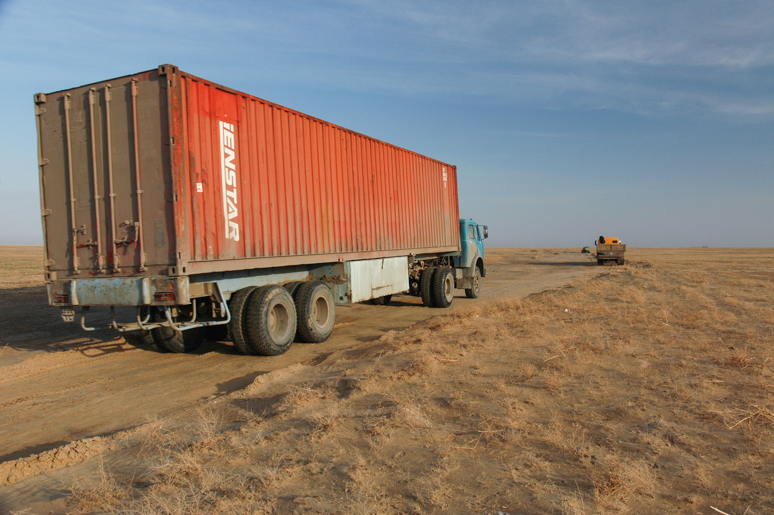
Road to Aqena, Faryab Province, Afghanistan
We leave Andkhoy the following morning for Turkmenistan, a necessary side trip on the road to Herat in order to avoid Badghis Province. The border crossing at Aqena, a place which is not marked on any maps I have ever seen, is in the middle of the desert 30 km north of town. It’s an arduous drive over muddy desert tracks gouged out by lorries into deep ruts, and it’s not until around midday that we arrive at the tiny border compound. After leaving Afghanistan we enter the gleaming Turkmenistan border complex at Imam Nazar, which has been funded by the US as a key supply route into Afghanistan. After considerable form-filling and various payments, we are loosed into the back-door of one of the world’s most inaccessible countries. We drive through featureless, scrubby desert past the Zeid reservoir and over the Karakum canal, another Soviet super-project with disastrous consequences, which takes large volumes of water from the Amu Darya and has played a major role in the disappearance of the Aral Sea. In the late afternoon, we reach the town of Atamurat on the Amu Darya, and find a clean and comfortable hotel room in the centre.
We awake to a warm winter morning in Atamurat, (which unofficially recorded the highest ever temperature in the USSR; 51.7ºC in 1983) and have a walk around. Once again it’s a sharp cultural contrast between Afghanistan and the former USSR, though the citizens of Turkmenistan are very reserved, if friendly. The city has some streets of neat nineteenth century Tsarist buildings, including a neglected old church with plastic sheeting over the windows and a collapsing sheet iron roof, but there is nothing of specific interest. We walk onto a huge pontoon bridge across the Amu Darya, finally allowing us to get close to the turbulent, muddy waters of this great inland river.
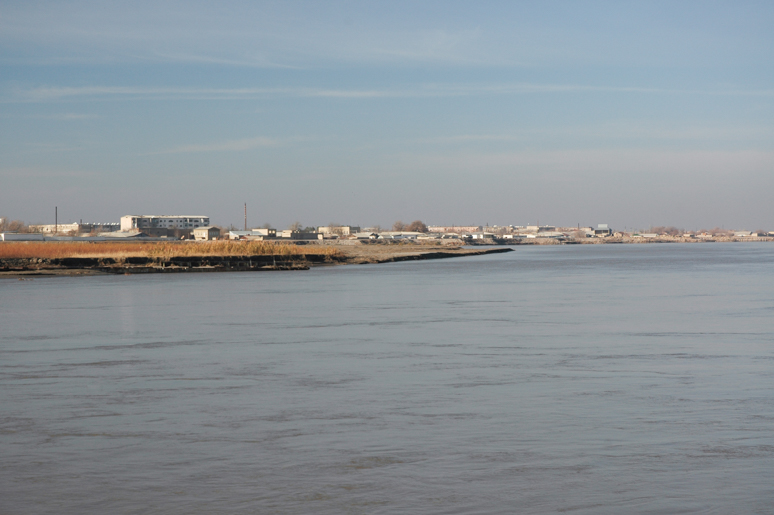
Amu Darya, Atamurat, Lebap Region, Turkmenistan
We take the road which tracks the left bank of the Amu Darya, though the river never comes into sight after leaving Atamurat, and soon stop at the first of two Seljuk shrines which lie a short distance out of town. The shrine complex of Astana Baba is today a fusion of several buildings of various ages, and provides a touching insight into the secretive and mystical form of Islam which these taciturn people practice. We enter the shrine through an elegant portal, which contains large fragments of ancient Kufic stucco and fine, mosaic-like brickwork. We walk into an almost cavernous room of vaulted ceilings and low arches, beyond which lies the dimly-lit central chamber of the mausoleum below the large brick dome, whose floor is covered in striking Turkmen rugs. The tomb of the saint Astana Baba, whose identity is unknown is also draped in a rug upon which cash offerings are made. The shrine has developed a reputation for healing and is evidently popular as several Turkmen families, all smartly dressed, enter the shrine whilst we are there. On a large rug at one side of the room, the families kneel in the Islamic style, with their palms upheld and heads slightly bowed, and are lead in prayer by a woman. In all my years travelling in the Islamic world, I don’t ever recall seeing a woman leading prayer, and I’m left wondering if this is the result of Soviet gender-equality, or perhaps a far deeper one relating to the pre-Islamic roots of Turkmen spirituality, which are evident perhaps in the votive prayer rags flapping from the trees outside the mausoleum, or the ‘evil eye’ talismans which hang in every shop and car. The second building is the Alambedar Mausoleum, a small and elegant, almost cubic mausoleum with fine exterior brickwork, which represents a very fine example of eleventh century (i.e. pre-Mongol) Seljuk architecture, though has been shown not to contain any body, and seems not to attract the same crowds.
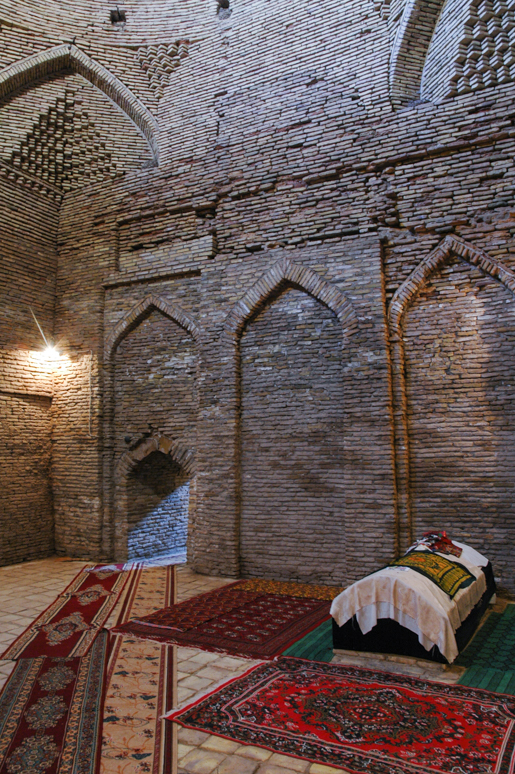
Astana Baba Mausoleum, Lebap Region, Turkmenistan
After the mausoleums, the road enters small kolkhozes, then plunges into the sparsely vegetated sandy desert which typifies much of Turkmenistan. As we approach the provincial capital of Turkmenabat, the road draws once again closer to the river and fields of cotton re-appear, before we suddenly plunge into the vast, almost empty boulevards of the city which wind between huge, modern government buildings and rows of old Soviet apartment buildings, made rather unconvincingly to look neat and modern with a coat of paint. We find a room in a basic hotel, then set out to see the city. Our fist stop is a small bar, where we meet Vlad, a middle aged Russian artist who hands us each a portrait which he has sketched in the few minutes that we have been in the bar. My heart goes out to the Russians trapped in this country by circumstance, who have no means of returning to Russia and must continue their lives in a country hell-bent on erasing the Russian language and promoting a sometimes rather fictitious Turkmen identity. After a short walk, we find a nightclub and get dead-drunk with some locals, before crawling back rather late to the hotel.
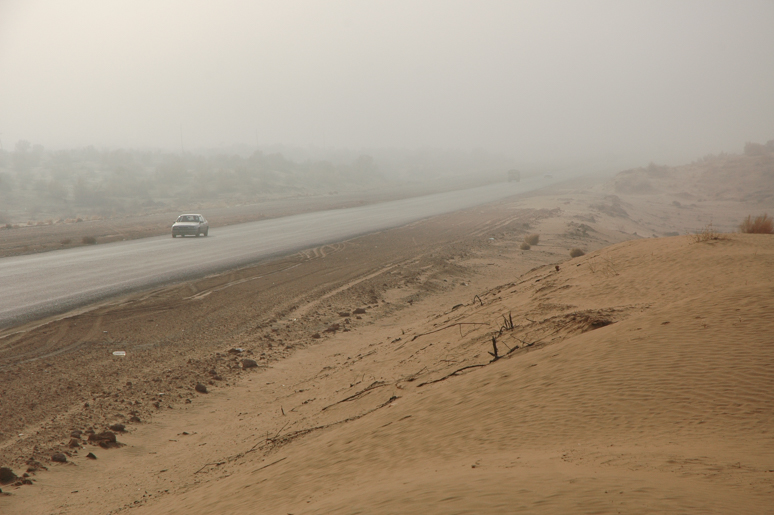
M37 Highway through the Karakum Desert, near Turkmenabat, Lebap Region, Turkmenistan
Next morning I am feeling surprisingly fresh – after recovering my shoes and bag from the car – and we set off to cross the Kara Kum desert. The air in the car reeks of vodka and I’m glad we’re not stopped by police our way out of the city, though soon enough we’re in the isolation of the desert, a monochrome landscape of brown wind-blown sand and parched brown shrubs. The drive has the pleasant, soporific quality of desert crossings which I so enjoy, but I’m struck by just how little traffic there is on this road, the only road to link Ashgabat, the capital to the country’s second city which we have just left, and the busiest border crossing on towards Uzbekistan and Kazakhstan. Perhaps this is not so surprising in a country where citizens need to apply for permission from the authorities to move from one administrative region to another.

Gurbanguly Hajji Mosque, Mary, Mary Region, Turkmenistan
After lunch in the small town of Bayramaly, we drive to Mary, another provincial capital and the country’s fourth largest city. Once again, the city is a mixture of brand new government buildings, such as the striking Haji Gurbanguly Mosque, and crumbling Soviet apartment buildings. It’s clear that almost none of the vast wealth which the country generates from sales of gas and oil is put into anything useful for the general population. Just as striking, and rather more disturbing is the eerie quietness; the city’s vast, monumental highways have light traffic, but there are almost no people to be seen on the streets, and almost no shops, only endless manicured lawns and sterile, ostentations new buildings. A few families quietly wander the park, but the overwhelming impression is bewilderment at where all the people are.
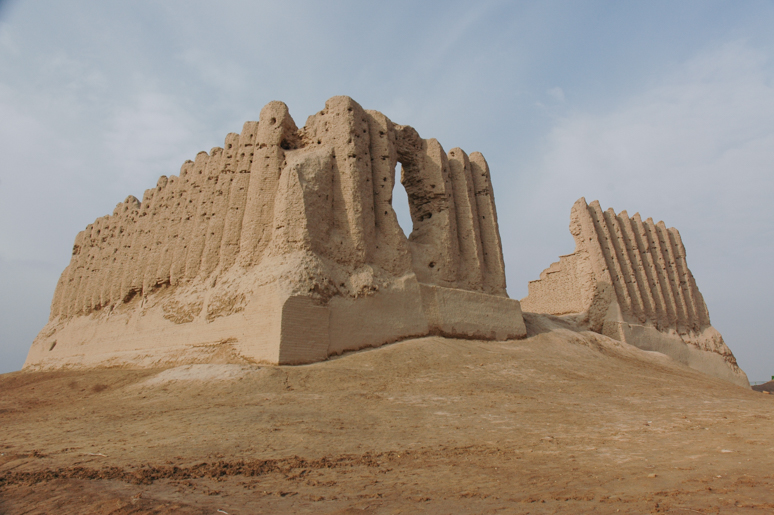
Kepderihana, Merv, Mary Region, Turkmenistan
We return to the quiet cotton town Bayramaly for the night, for it is just north of here that lie the remains of what was for a long time one of Central Asia’s most important cities: Merv, in the Margiana Oasis. Situated in the wastes of the Kara Kum desert, where the Murghab river draines into the Margiana lowlands, Merv was an important node of the Silk Road, and a strategic entry-point into either Persia, Afghanistan or the northerly cities of Bukhara and Samarkand beyond the of Amu Darya. Rather like Balkh, Merv has a long history stretching from the time of Asia’s earliest settlements, through the great empires of the Achaemenids, Seleucids, Bactrians, Parthians, Kushans, Sassanians, Arabs, Seljuks, Mongols and Safavids, before being taken by the Uzbek khans, the Turkmen and ultimately the Russians. The precise location of Merv has shifted through the ages, and thus a remarkable collection of ruins dot a wide area north of Bayramaly, which itself is merely the latest incarnation of Merv, having been inhabited since the sixteenth century.

Soltan Sanjar Mausoleum, Merv, Mary Region, Turkmenistan
We start early and drive into Erkgala, the oldest part of Merv, a large circular crater of heavily smoothed mud-walls, which would have been occupied during the times of the Achaemenids and Alexander the Great. We have the place absolutely to ourselves with the exception of a herd of dromedaries who plod along the track without any guardian. We drive down, through the sparse ruins of Gäwürgala, of the Hellenic to Arab eras, which in reality are largely formless, through a breach in some crumbling defensive walls and into the largest of Merv’s incarnations, the mostly Seljuk city of Soltangala. Here is Merv’s most striking monument; the tall, imposing, square, twelfth century mausoleum of Sultan Sanjar, the Seljuk sultan who ruled his empire from Merv, and who was responsible for first building a shrine to Hazrat Ali in Mazar-e Sharif. The once turquoise tile-work of the huge dome is now lost, and parts of the exterior have been rather poorly restored, meaning the structure looks more impressive somehow from a distance, when it rises from the desert haze long before one may discern any more details of the city.
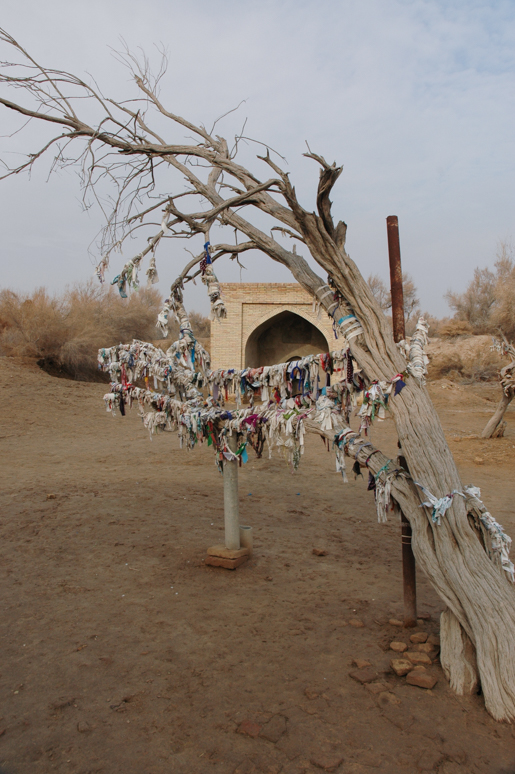
Mohammed ibn Zaid Mausoleum, Merv, Mary Region, Turkmenistan
Another of Merv’s intriguing buildings is the kepderihana, a windowless, oblong building with curious fluted walls, which is speculated to have been a pigeon house used to collect guano for fertiliser in the fields of the oasis. From a rent in these walls one may look over the scrubby plain towards Sultan Sanjar’s mausoleum, perhaps the finest view in this ruined leviathan of a city. Given the age of Merv, and the continuity of human habitation here, there is naturally an abundance of shrines dedicated to various holy men and notables. Whilst for the most part architecturally bland, these shrines are of far greater interest to the native Turkmen than any of the crumbling ruins. At the mausoleum of Mohammad ibn Zaid, we see a curious ritual; Turkmen women are circambulating a long-dead tree, whose lifeless limbs are draped in prayer rags, whilst throwing berries at the tree in what I presume is some kind of votive ritual.

Talhatan Baba Mausoleum, Mary Region, Turkmenistan
We leave Merv late in the morning, and follow the Murghab river south, back towards the border of Afghanistan. We stop at another Seljuk shrine, that of Talkhatan Baba, then have a late lunch in the charming cotton town of Yoloten, stepping into a dark café-come-nightclub with a décor straight out of the 1980s and an attractive Turkmen waitress. In small towns such as this, which feel totally abandoned by any central government, there seems to be a touch more life on the streets, and for a moment Duncan and I consider staying for the evening, a final night of fun before entering Afghanistan and Iran. Our transit visas are due to expire tomorrow however, and so we decide to push on. The road is a lumpy and undulating old stretch of Soviet asphalt which passes through low scrubby hills grazed by occasional flocks of sheep led by lonely shepherds. Shrines sometimes dot the small farming communities on the left of the road which otherwise appear to be still and dormant.
Just after dark, we make the mistake of turning off the road and entering the garrison town of Tagtabazar in search of a hotel, and find ourselves at the police station. After some considerable questioning and inspection of documents, we are let off without a fine for deviating from our specified transit route, escorted back to the main road and told we will be met by police at the border town of Serhetabat, and led to a hotel. Upon reaching Serhetabat, nobody meets us, and indeed there is no hotel according to locals. Thankfully, a kind Turkmen man who sees us inquiring in a shop invites us to his home which he indicates he will not be sleeping in tonight, and leaves us with a roaring gas fire and a bunk bed.
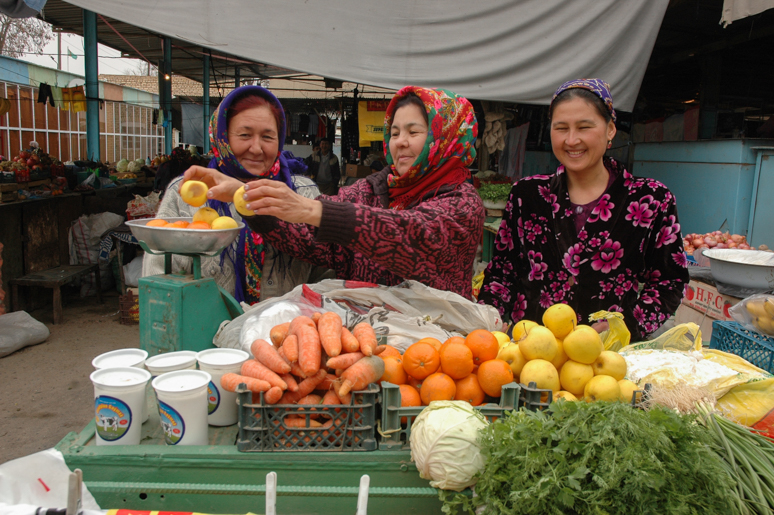
Turkmen Women, Serhetabat, Mary Region, Turkmenistan
Serhetabat marks the most southerly point of the former Russian Empire, and USSR, and is marked thus by a tall black cross. We climb up the hill on which the cross stands, through a crumbling Soviet Army barracks, for a view over the town. Rows of old and rather decrepit Soviet apartment buildings, dotted with satellite dishes march across the town, beyond which in the morning mist lies Afghanistan once more. It was through this town, known as Kushka at the time, that the Soviet Union first invaded Afghanistan in 1979. After lunch we fill the car with diesel and then head out to the border. Just as I’m getting my passport stamped, the border guard looks at me, and asks if I have been to Turkmenistan before. I tell him yes, and he tells me the exact date and place where I entered; he had stamped me into Turkmenistan just over two years earlier, on my first visit, and recognises me (or perhaps the truck).

Serhetabat, Mary Region, Turkmenistan
Thus ended perhaps the most rewarding single stage of the entire journey. In Afghanistan I had finally experienced the Central Asia I had been dreaming of and with Herat just a few hours distant across the border, I had completed the most logistically difficult part of my drive across Afghanistan. Despite Turkmenistan’s repressive government and severe bureaucracy, I had experienced the reserved warmth of the Turkmen people, and had glimpsed an insight into their slightly pagan-influenced Islam. As much as I would love to spend a few months in the country, for the moment at least it is impossible to do so without state supervision, and thus I cherish the brief but unfettered access I have had to the country in my two visits. Underlying everything however is the region’s great history; two cities which were once the centre of the civilised world, rather than a distant and forgotten outpost. Somehow, their dignified ruin merely adds to the melancholic charm of Turkestan.
Stage 17 – Uzbekistan, Afghanistan & Turkmenistan: Turkestan [1/2]

Ahead of me lay a stretch of territory which up until the 1990s had been off limits to outsiders since the Middle Ages. I was entering the heart of Turkestan, the searing plains along the near-mythical Amu Darya (or Oxus) River which lies at the very heart of Central Asia. I’m entering the world of Robert Byron’s ‘The Road to Oxiana’, perhaps my favourite travel book; an account of a car journey made in 1933-34 into deepest Turkestan in search of the Oxus, which Byron would eventually be barred from even setting eyes upon. For me too, this would represent perhaps the most memorable stage of the entire journey (despite its rather debauched beginnings), and it would be where I finally glimpsed the Central Asia I had been dreaming of since long before I set off – that of turquoise domes, camel caravans and authentic Silk Road bazaars.
On the 9th November 2009 I drive with considerable excitement over the ‘Friendship Bridge’, a simple 9-piece boxcar bridge across the Amu Darya constructed by the Soviets for the friendly purpose of supplying an army. Off limits until 2006, I imagine I am one of only a handful of foreigners who have driven over it. The Uzbekistani customs procedures are extremely thorough, with everything removed from the truck and searched individually. I know the process could be expedited with a payment of twenty dollars, but I’ve nothing to hide and allow the officers to take their time. It’s after dark by the time I finally leave the border compound, and drive through the huge, empty streets of Termez to the Osiyo Hotel.
The Hotel is wonderful and I’m surprised upon walking in to find a woman at the desk. After so long in conservative and gender-segregated Asia, I almost feel uncomfortable speaking to her. She’s very pleasant however; a rotund and motherly Ossetian who shows me to a room which is very reasonable, and gives me instructions on how to flush the lavatory, lock the door, and tells me to hang my clothes in the wardrobe along with other instructions which I don’t understand.
Crossing the Amu Darya from Afghanistan to the Uzbekistani town of Termez represents a staggering change in culture and atmosphere, and I spend the following days with a sense of profound culture shock; the shock of re-encountering a culture which is really quite similar to my own when compared with those I have lived in for the last two years. I am suddenly in a country where I don’t have to worry about my appearance, or what time I’m in what place, or whether a given place is safe at all… it’s all safe. There are no bandits, no Taliban, and no landmines. The other half of the human race (and in fact it seems like more than half in Termez) are out in public; beautiful young Uzbek and Tajik women with dark eyes and slender figures, and these women run shops, and must even be spoken to during the course of normal transactions. Couples go out hand-in-hand; lovers. It’s all so strange… yet so normal and natural.

Bazaar, Termez, Surxondaryo Region, Uzbekistan
The city itself is planned, beautified and well-maintained. Things have been built for everyday enjoyment; benches, parks, playgrounds and sports centres. There are signs, road rules, law and order. I see an old man stoop down and meticulously move a few leaves off the road, just to keep things looking neat. These Soviet citizens certainly aren’t keen on living among piles of their own refuse and excrement, something which until my first encounter with South Asia I had considered an intrinsic human preference, rather than a learned cultural trait.
It all puts Afghanistan and South Asia in contrast, highlighting just how backward they sadly are. In comparison, people here in Uzbekistan seem to enjoy life more, unworried by war or religion, despite their crumbling economy and repressive government. It also has that very endearing post-Soviet feeling of being somehow isolated from the vice and excess of the outside world; it can sometimes feel like a parallel universe, a more innocent and secluded one where people are happily free from both religion and class. Now I really start to appreciate Marx’s vision; this certainly isn’t a country where one sect may choose to kill another, or where beggars clamour to extract a few pennies from the driver of a $100,000 car waiting at the traffic lights. Ironically, the very core social principles of Islam are not far off those of Marx; of social equality, anti-sectarianism and distribution of wealth, yet the concepts seem never to have caught-on in any Islamic country I have yet visited.

Alexander Nevsky Church, Termez, Surxondaryo Region, Uzbekistan
I mention these reflections to my contact Abdugafur, a young man who works in the city in a construction company. “How can people say that the Soviet colonisation was a bad thing? If it wasn’t for them, we would be like Afghanistan. After all, we are the same people, who have the same culture and traditions, the same beliefs… or rather we were” Things are far from perfect in Uzbekistan however; inflation is a real problem and there is a genuine shortage of cash in the country, not surprising given that the largest banknote is worth just US$0.50. This is hardly conducive to a thriving market economy; which is precisely what the president wishes to avoid.
Autumn is here in Termez, with fat, ripe persimmons hanging on trees and parks beautifully coloured in yellows, oranges and browns and with crunchy leaves underfoot, swiftly being swept into piles by broom-wielding women. The city’s wide streets, characteristically Soviet are quiet; it’s a low-density place with no real centre, which instead radiates out in huge blocks. Termez has a range of Russian architecture; from the old, single-storey frontier houses, joined in long rows with thick walls and iron roofs, an old Russian Orthodox church which must pre-date the 1917 Bolshevik Revolution, then vintages of Soviet apartment blocks all the way to independence. Modern buildings are rather sanitary looking, but clean and neat, though often sporting nasty blue-tinted glass windows and doors.
Sitting in a street café in this tranquil backwater, with a oversized plastic bottle of lager and a hot-dog, I feel I’m in heaven. Nevertheless, I must move up-country to Tashkent where I will meet my friend Duncan, with whom I shall travel for the next few weeks, all the way to Tehran. I decide to leave the car with Abdugafur in his business premises, and take the newly-opened railway line which runs overnight through Samarkand to Tashkent.

Uzbekistan Avenue, Tashkent, Uzbekistan
As much as I dislike public transport, I do have a soft-spot for overnight train journeys in the Former USSR, and I find myself sharing a sleeper compartment with three women. As the train rolls north, we pass through fields full of brightly-dressed women and children gathering in cotton, small single-storey farmsteads with golden gardens of persimmon and walnut trees, old Soviet tractors, trucks and buses parked in the fields. The kolkhozes (collective farms) are still alive here, and I think back to the night I spent with a family near here in just such a setting, just over two years ago. At the stations, crowds of people wait; old white-bearded Uzbeks, fair-skinned Tajiks, beautiful Turkic faces of all forms, touches of Russian-Soviet fashions, colourful headscarves and dresses, long flowing velvet kaftans. It’s rather like an old poster of Soviet cosmopolitanism. The women share their food with me and before long, a large Uzbek gentleman returns from the concertina between the carriages reeking of booze and with a twinkle in his eye. The sun sets outside against the stunning backdrop of the Kugitang and Hisor Mountains, and I bed down for the night. What a joy the train journey is.
I arrive early the next morning in Tashkent, and take the Metro from the station to the end of the line at Chkalov. Memories flood back from my visit two years ago as I make my way to the Grachev’s flat and meet Nail, who soon has to leave for work. I too leave before long to meet Duncan back at the Metro station, where we sit on a bench catching up over a morning beer. Back in September, in Islamabad I had acquired an Uzbek visa in order firstly to have an escape route out of Afghanistan should it have proven to be too insecure, and secondly to get a Turkmenistan visa in Tashkent. Both these considerations turned out to be unnecessary now, and so apart from getting a new visa to re-enter Afghanistan, I have no real business to attend to.
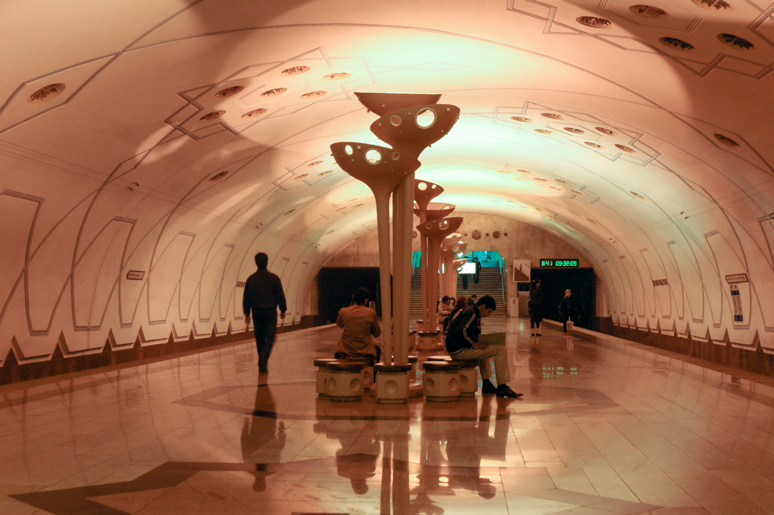
Bodomzor Metro Station, Tashkent, Uzbekistan
Duncan and I dedicate these three weeks to debauchery; all day drinking between wandering the city streets and bazaars, hopping onto trams until we spot the next drinking den, and falling in to further fortify ourselves with marvellously cheap beer, vino (a rather industrial port made locally, specifically for alcoholics) and vodka. Tashkent has a sordid Soviet underbelly of alcoholism, and a selection of ultra-basic bars to cater for them; places I find infinitely more convivial than the tawdry theme bars and ‘Irish Pubs’ which one usually finds abroad. The clientèle of such establishments are usually punch-drunk and cheery, but occasionally are desperate, comatose, yellow-skinned life-long drinkers. Returning ourselves somewhat giddily one night, we see one such soul silhouetted in the sodium-yellow of a street light, teetering back home on auto-pilot but making little forward progress, until he loses balance and falls flat into a deep, muddy ditch. It’s a slightly depressing window into the negative side of Soviet colonisation, but one that I find seedily fascinating. Often a small drinking den exists within the confines of a shop, allowing one the convenience of purchasing alcohol at retail prices and consuming it on-site. Occasionally we get marvellously lost in the city suburbs, and navigate back through a mixture of luck and perseverance, always finding ourselves eventually in the warmth of the Grachev’s flat to sleep for a few hours before repeating the formula.

Shah-i Zinda Necropolis, Samarkand, Samarkand Region, Uzbekistan
I love Tashkent for its monumentalist Soviet architecture and air of being trapped somewhere in the 1980s, a comfortable island of a European city adrift in the ocean of Central Asia. Possibly my favourite part of the city is its Metro system, which is designed along the lines of a 1970s science fiction film set, with deep tunnels doubling as nuclear bomb shelters, dimly lit by elegant Soviet chandaliers, eerily devoid of conversation, heavily policed and with a pervading odour of floor-polish. Some of the stations are real masterpieces of design, such as Bodomzor with its modernist uplighters, and Kosmonavtlar with its ethereal portraits of Soviet cosmonauts, as well as the Timurid mathematician and astronomer Ulugh Beg, grandson of Tamerlane himself.
Every so often in the afternoon Nail’s mother Gulya who lives in the flat next to us, brings her English students to meet us, ignoring or not realising our tipsy state. The students are genuinely pleased, though a little nervous to have the unique experience of speaking to two scruffy, boozy Englishmen, and we are glad to talk to some locals in English. We manage a trip to the Afghan Embassy to acquire new visas, plus a couple of out-of-town drinking trips, but the three weeks fly past and before long we’re heading back south on the train. In Samarkand we moderate slightly, and take in the magnificent architecture, though spend the cool nights drinking at the Bahodir Guesthouse where I receive a warm welcome from the family more than two years after my last visit.

Jarkurgan Minaret, Jarkurgan, Surxondaryo Region, Uzbekistan
We have an arduous bus journey back down to Termez in an asthmatic old Hungarian Ikarus which is reduced to walking pace when faced with any hill and has two tyre blowouts en-route. We check back into the Osiyo Hotel, and make a trip the next morning by local train – which coststhe equivalent of twenty US cents – to the small farming town of Jarkurgan where, amongst the walled farmsteads and cotton fields lies a stunning Seljuk minaret. The tomb-tower is a finely preserved masterpiece of fluted brickwork, with beautiful bands of Kufic verse. A friendly local girl fetches the gatekeeper and we squeeze up the spiral stairs for a foggy view across the nearby kolkhozes. Uzbekistan seems so gentle and innocent, a place where time has stood still for the last thirty years whilst neighbouring Afghanistan has been thoroughly destroyed. It’s rather hard to look forward to returning.
I feel quite melancholic on the morning that we leave Uzbekistan. Duncan is understandably slightly nervous before entering Afghanistan for the first time, whereas I am rather reluctant to leave the refinements of Uzbekistan; order, cleanliness, the public presence of women, draught beer, people who mean what they say and know what they are talking about, and the wonderfully benign and friendly atmosphere. To be leaving such civilised comforts doesn’t presently give me the thrill which it usually does. The morning is cold, grey and dull, and perfectly reflects my mood. A cold persistent drizzle begins as we head for the border, disposing of our last few shards of Uzbekistan’s farcical currency in a shop en-route. The Uzbek authorities are thankfully rather less thorough upon leaving, and as we leave the border and head for the Friendship Bridge I’m asked for a lift by Mr Rajabi, an Afghan emigrant from London who is visiting Afghanistan with his wife and baby.

Masood Shahid Boulevard, Mazar-e Sharif, Balkh Province, Afghanistan
On the Afghan side of the border the trouble starts, once again for my not having a Road Permit. After a few minutes of wrangling with the customs officer I am passed to the chief; a large ugly man with a puffy mongrel face who is drunk and angry. Mr Rajabi, who has been my translator and has been frantically arguing my case is deeply offended by the Swine behind the glass of the customs post: “Look at our country, at our people! He is absolutely drunk! How will our country ever progress with people like this? No education and totally corrupt; these are the problems we face”. Behind Mr Rajabi a Turkish lorry driver with a large mole on his brow smiles a warm Turkish smile and rubs his thumb and index finger “No problem!”, gesturing to the Swine. I know I could bribe my way through, but I stick to my principles of patience and perseverance.
Finally, the Swine makes a call to his superior regarding the British tourist with a car and no Road Permit, and by his sudden increase in fury has obviously been told to let us in. He orders a full search of the car, and a swarm of officers come out. It’s clear that they are highly embarrassed and offended by the Swine, but have nevertheless to follow his orders. He stands in the rain, screaming at his subordinates before ordering one to bring a pick-up, from which he resumes his screaming from the passenger seat with the heater runing. Eventually, the Swine’s gaze settles upon two large books which he indicates are illegal; a large paperback history tome by Jawaharlal Nehru (admittedly a Marxist, but I doubt he knows this), and a totally inoffensive hardback travel guide to Afghanistan, endorsed on the first page by the president himself. It’s hard to imagine that these books can be in any way illegal, or indeed that the Swine is literate, but he obviously intends to keep them for it takes one and a half hours to rescue them from the censors, none of whom can read English. What excites the censors most is a picture in the guidebook of a pair of Uzbek womans boots, which elicits great bouts of sordid schoolboy laughter. How I dislike being in a country where a picture of boots is an illicit and titillating sight.

Shrine of Hazrat Ali, Mazar-e Sharif, Balkh Province, Afghanistan
It’s raining hard when we leave, but the road is brand new and we soon dry out. My spirits are buoyed by having come out on top from the ordeal, though I feel Duncan has had a slightly rough entry into the country. In Mazar-e Sharif (Mazar) I collect my Turkmenistan visa from the fawning consul, who is a picture of politeness and helpfulness compared to the surly staff in the Tashkent Embassy. The streets of the city centre are flooded in up to half a metre of muddy water; cars sit stranded, headlight-deep in the middle of the road and filling with water, but we emerge warm and dry onto the driveway of our hosts. A hellish border crossing completed, and a new visa in hand, we are set to cross Afghan Turkestan.
Our hosts run a small logistics company in the city, and we stay with them for just under two weeks. They are Elias, Aimal and Ramesh, and are often joined by their friend Ashraf. They are wonderfully generous hosts, putting on dinners of local fish from the Amu Darya, giving us endless information on the surrounding area and great company each evening. I soon forget the spoils of Uzbekistan and flip back into the Asian lifestyle.

Buzkashi Match, Mazar-e Sharif, Balkh Province, Afghanistan
Mazar is the country’s fourth largest city, and effectively the capital of northern Afghanistan. The city is named after the shrine of Emam (Hazrat) Ali, cousin and son-in-law of the Prophet Mohammed, who is generally regarded as being buried in Najaf in Iraq. Nevertheless, a twelfth century local Mullah saw the location of Ali’s grave in a dream, and a shrine was erected by the Seljuk sultan Ahmed Sanjar. Mazar lived in the shadow of nearby Balkh for centuries, but the tables were turned in the late nineteenth century and Mazar has been the more prosperous and important city ever since. The Shrine of Hazrat Ali marks the very centre of the city, attracting pilgrims from across the country and beyond. In the large park around the shrine, families stroll and feed the flocks of white doves for which the park is famed, giving it a pleasant and relaxed atmosphere. The shrine itself, a fifteenth century reconstruction of the original which was razed by the Mongols, is strikingly tiled though does not quite have the same grace and exotic flair as the Timurid masterpieces of Samarkand. Around the shrine, the city centre radiates out in blocks of street markets and narrow bazaars which are frantic with activity. Whilst not particularly traditional, Mazar is certainly more down-to-Earth than the economic bubble of Kabul.
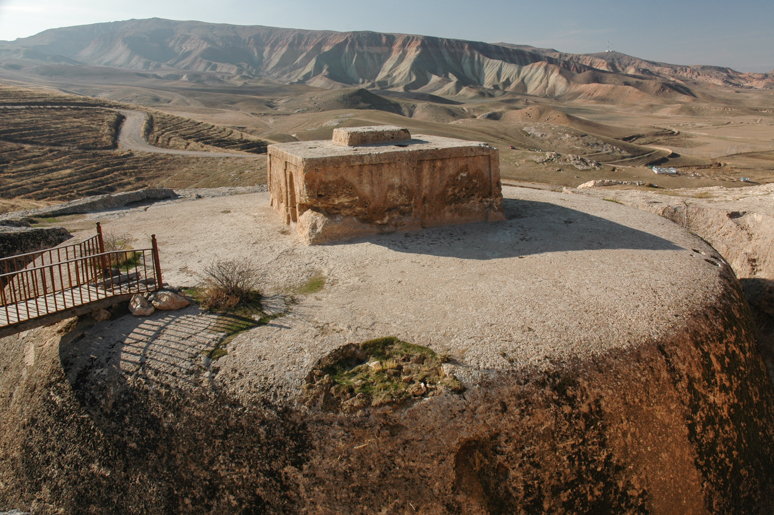
Stupa, Takht-e Rostam Monastery, Aybek, Samangan Province, Afghanistan
One Friday morning we all head out to the stadium at the edge of the city to watch a match of the peculiarly Central Asian game of buzkashi. It’s a game played on horseback by a seemingly unlimited number of men, who must each attempt to pick up the headless carcass of a goat or calf, and carry it across a marked boundary without any other player gaining the carcass. It’s clearly a game which came off the nomadic steppes of Central Asia, but the Afghans play it with such vigour and brutality that one can see the spirit of the Mongol hordes which swept down upon this region in the thirteenth century.
Duncan and I make a day-trip to the south-east, back down the main road towards Kabul, through the stunning gorge beyond Kholm and into the mountains to the town of Aybak. The main street through the town is lined with old pine trees and single storey shops, and feels far less modern than Mazar. Bearded Afghan men in shawls and turbans mill through the bazaar, often riding horses pulling traps. What lies just behind the town however, is one of Afghanistan’s oldest surviving ancient monuments. On top of a protruding dome of limestone, out in the fields which spread across the broad valley between the outliers of the Hindukush, is a huge carved Buddhist stupa dating from the fourth to fifth century CE. The stupa is carved wholly out of the native rock, a smooth inverted bowl topped by a cubic reliquary. Carved out of a lower nearby hill is a small cave monastery complex reminiscent of those in Bamiyan, though from the Theravada, rather than Mahayana school of Buddhism.
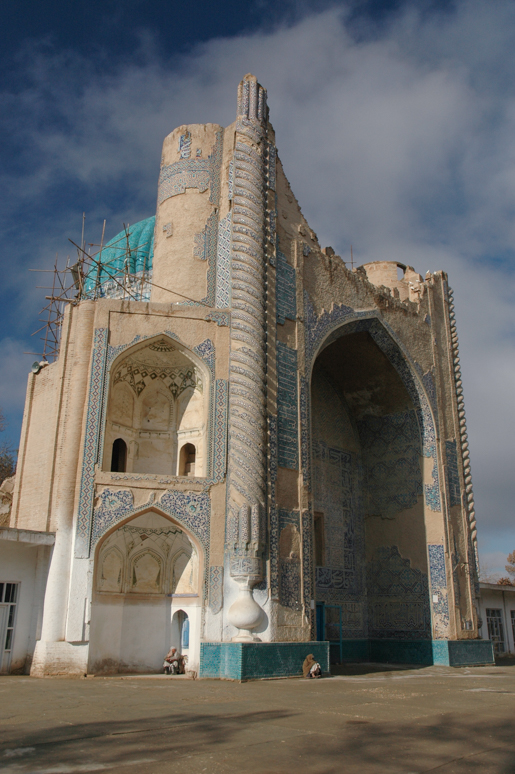
Mausoleum of Khoja Abu Nasr Parsa, Balkh, Balkh Province, Afghanistan
On another day, we head west from Mazar to the quiet country town of Balkh. Today something of a agricultural backwater, it is hard to overestimate just how important the city has been in the context of Asian history. Located on a wide floodplain just north of the point at which the seasonal Balkh River spills its water from the northern fringes of the mountains onto the barren Oxus Plains, Balkh has been inhabited for at least 4,500 years. Balkh may have been one of the first cities of the Aryans as they moved south and east from their homeland on the Pontic Steppe. Zoroaster, founder of Zoroastrianism, is thought to have been born in Balkh in roughly the eleventh to tenth century BCE, and to have also died here. When Alexander and the Greeks arrived they called it Baktra, and from this came the name Bactria for the historical area as a whole. Following a period of Buddhist influence under the Kushans, the Arabs arrived, and sensing the antiquity of the place named Balkh the ‘Mother of Cities’. Balkh figures heavily in Persian mythology and literature, and is considered to be the home of of Jalal ad-Din Mohammad Balkhi, one of Asia’s greatest poets. Today however Balkh is little more than a collection of villages – albeit with some intriguing remains – and perhaps best captures the ruin of Central Asia. Balkh was levelled by the Mongols in 1221, and again by Tamerlane in the fourteenth century, yet it was an outbreak of malaria following widespread flooding in the mid nineteenth century that finally sealed its fate.
Balkh today is centred around a circular park, in which sits the elegant Timurid shrine of Hoja Abu Nasr Parsa. A slightly jaded but charming victim of both neglect and war, the shrine has lost its minarets though retains some beautiful Kufic faïence in the main portal and a delicate, fluted turquoise dome. The shrine looks very much the same as it did when Byron sketched it in 1934, but in its heyday must have been every bit as impressive as the buildings of Samarkand and Bukhara. On the far side of the park, which is filled with straggling mature plane trees, is a single ruined arch from an old medressa, still bearing patches of striking tile-work.

Bala Hisar, Balkh, Balkh Province, Afghanistan
The most atmospheric of Balkh’s ruins however is immediately to the north of the town centre. The Bala Hisar, the town’s old defensive fortress, is a huge circular citadel roughly a kilometre in diameter whose heavily eroded perimeter walls are dotted with the stumps of long-collapsed defensive towers. Locals scour the area for glass beads and occasional coins in the sticky mud, and one feels that the whole area might still echo with the sounds of ancient battles, or just the hum of millennia of habitation, such is the palpable sense of history about the place. At the western edge of the citadel are some modern shrines, one of which is currently used by the followers of another historical figure. Baba Kuh-e Mastan is attributed with the first cultivation and use of hashish, the resin of the cannabis plant harvested by running the palms of one’s hands up and down a budding plant. Originally on the main road into town, the police have moved the followers to this discreet corner of the citadel, where they are left to smoke in glorious worship.
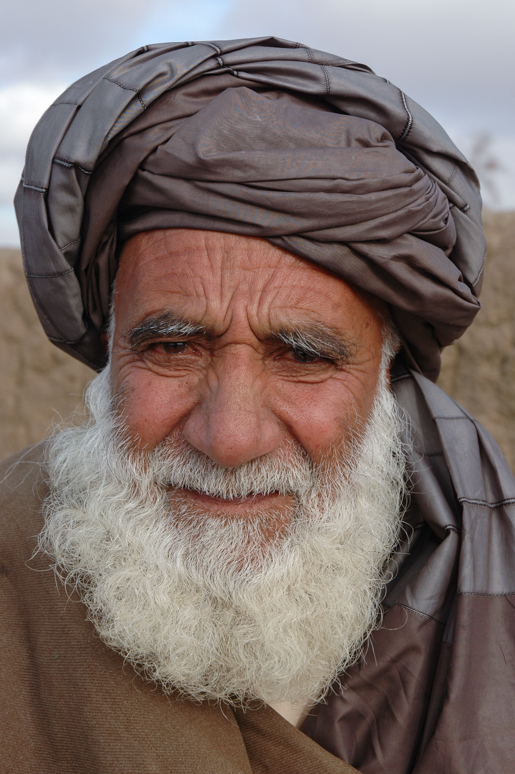
Uzbek Man, Balkh, Balkh Province, Afghanistan
We walk into a dingy, smoke-filled room where half a dozen frazzled-looking men sit on mud benches around the walls, centred around an enormous hookah pipe containing at least five grams of hashish. Turns are taken and I take three lungfuls of choking, burning smoke which leave me with a raw throat, hacking cough and a deep and rather pleasant sense of detachment from reality for several hours.
To the east of the citadel, one may walk down a breach in the old walls into the villages which dot the surrounding farmland. Graves here are marked with poles bearing the Shi’ite symbol of a hand and are tied with colourful pennants in a manner which reminds me of the Sufi shrines of Sindh. It was indeed from this region of Central Asia that Sufism penetrated the Sub-continent. Though having declined greatly in popularity in recent decades, Balkh has strong Sufi connotations, for it was for some time at least, the home of Jalal ad-Din Mohammad Balkhi, better known as Rumi. Perhaps the most famous of the Sufi philosopher-poets or polymaths, Rumi was one of Asia’s great thinkers and remains a household name to Muslims across the region. His most famous work, Masnavi, is an epic poem of fifty thousand lines and is one of the greatest works of the Persian language.
We ask after the great man’s home as we walk through villages populated by friendly Uzbek farmers. In the village of Hoja Gholaq, amidst a scene of muddy farmland and mud-brick houses which can hardly have changed since the thirteenth century, we are directed to the ruined khanaqah (meeting place of a Sufi brotherhood) where Rumi’s father taught, and where the young boy is said to have grown up. A few arches and part of the dome still stand, but there is otherwise no sign as to the alleged historical importance of the ruins we are looking at. Locals tell us that the great man was born here, but like Hazrat Ali, and many historical other figures, his birthplace is somewhat speculative. Evidence suggests that Rumi was in fact born in Vakhsh in present-day Tajikistan, before his family moved back to Balkh, only to escape a few years later to Konye in modern-day Turkey, shortly before the oncoming slaughter of the Mongol invasion. Whatever the truth, the ruins are an intriguing find, and it’s a touching remnant of the import of Balkh that these farmers bring him into their folklore and customs, 802 years after his birth.
Mazar is an easy city in which to while away time, especially given the comforts and good company provided by our hosts. After thirteen days however, the time comes to make some progress across the country. Ahead lies a string of old Silk Road caravan cities; the untouched heart of Central Asia.
 EurasiaOverland