
Stage 26 – Belarus: White Rus’

Belarus, whose name derives from the Belarussian Beliye Rosi’ (White Rus’) lies between Russia and the EU and seems to be known largely by negative stereotypes; the ‘last dictatorship in Europe’, an ‘outpost of tyranny’ and a museum of the USSR. While there is truth in these titles, I would find a very charming country of neat, clean cities, beautiful wild landscapes and friendly, worldly people. There are several theories as to why Belarus is referred to as White Rus’; that the area was populated by Christianised Slavs as opposed to the more pagan-influenced Balts of Black Rus’ (Black Ruthenia); in reference to the traditional white clothing worn by the natives, or symbolising the ethnic purity of this region which was beyond the limits of the Mongol and Tatar expansion. What is now Belarus was spared the destruction and subjugation of the Mongol Yoke during medieval times, but the twentieth century was certainly not as kind, with the country seeing almost total destruction during the Second World War, massive ethnic cleansing (particularly of the formerly very large Jewish minority), depopulation and Russian cultural domination during the time that the country was a republic of the USSR. Even today, the Belarussian national identity and language are at best met with official indifference; the country has changed little since independence in 1991 and its largely state-run economy remains somewhat dependent on Moscow. Nevertheless, Belarus survives as a country which is subtly quite different from Russia and an outpost largely free from Western Consumerism.

St. Sophia Cathedral, Polatsk, Vitsebsk Region, Belarus
My journey around Belarus begins on the 19th February 2011 as I cross into the country from Russia. There are no stops or checks on the Belarussian side of the border and straight away I’m driving through small villages of colourful, fairytale wooden houses; the road is much improved compared to the Russian side of the border, free of ice and there is comprehensive signposting. The sun even comes out, making for a very pleasant first impression indeed.
My first stop is the city of Polatsk, allegedly one of the oldest cities of the Eastern Slavs and mentioned in the Norse Sagas. Initially part of the medieval state of Kievan Rus’, the city emerged as the Principality of Polatsk in the tenth century and like much of Belarus, has since come under control of Lithuania, Russia and Poland. My host in Polatsk is Ivan, who immediately invites me into his apartment where he introduces me to some of his friends with whom we have a smoke. Ivan turns the television on to check the sport results, and I get a glimpse of television in Belarus which has all the signs of dictatorship; mind-numbing sports coverage with lame, flag-waving crowds and the odd titbit of news comprising coverage of President Lukashenko (whom my hosts refer to derisively as a kolkhoznik, literally a ‘collective farmer’) making an official visit to some factory among sycophantic crowds. It is informative however to see live, state-fixed prices of fuel and basic foodstuffs scrolling across the screen.

Cosmonaut Mural, Navapolatsk, Vitsebsk Region, Belarus
Polatsk is located on the banks of the Divna River, which is still totally frozen and gives views onto the old heart of the city. Most striking is the Cathedral of Saint Sophia, one of three (the others being in Kyiv in Ukraine and Novgorod in Russia) of the oldest Eastern Slavic churches, all modelled on the Hagia Sophia in Constantinople, at the time the home of all eastern Orthodoxy. The Cathedral of Polatsk has been heavily modified through the ages and today has an imposing white Baroque facade, though bares no resemblance to its namesake in İstanbul. Nearby, the compact city centre spreads along the north bank of the Divna, dotted with churches and a mix of nicely restored Tsarist-era streets and some fine, if rather faded Soviet Neoclassical buildings, while on the south bank are streets of colourful wooden houses.
I find Polatsk very charming indeed, quite different from the gritty towns of western Russia; it’s cleaner, more orderly and people seem more immediately friendly and smiling, even if there is a slight air of torpor. A few kilometres to the east of Polatsk is the modern and totally Soviet town of Navapolatsk where I go to register with the Migration Police, and where one finds all the vast, grey concrete apartment buildings thankfully largely absent from Polatsk. I do however spot a magnificent Futuristic Soviet Socio-realist mural on a wall here depicting mankind charging forth into the cosmos under the banner of communism, celebrating one of the Soviet Union’s greatest achievements; putting the first human into space in 1961.

Khatyn Memorial, Minsk Region, Belarus
On my way south to the capital I stop at the monument complex of Khatyn, a moving tribute built in the 1960s to commemorate the incredible losses which Belarus endured during the Second World War. Khatyn was one of more than five thousand Belarussian villages which were burned and destroyed by the Nazis, in this particular case by a group composed largely of Ukrainian nationalist collaborators who in 1943 killed every man, woman and child in the village by burning them alive in a barn, gunning down any escapees. Twenty-six concrete obelisks symbolise the location of each house in the village which was looted and destroyed, on which the names and ages (in the case of children) of the occupants are listed. A bell tolls every thirty seconds in unison from each of these to represent the rate at which Belarussians were killed during the Nazi occupation. A square memorial consisting of three birch trees and an eternal flame further symbolises that one in four Belarussian Citizens, a total put officially at 2,230,000 people, were killed during the Second World War. In this rueful, beautiful snowy landscape surrounded by birch forest, it is quite staggering to contemplate the abject horrors which were unleashed by the forces of nationalism here.
Minsk, today a city of two million, has its origins as a provincial town under the Principality of Polatsk in the tenth century, becoming an important regional capital following Russian annexation in the late eighteenth century. The city was almost totally destroyed in the Second World War and was reconstructed and greatly expanded during the post-war Soviet Period. Today a city of two million inhabitants, the Belarussian capital is a grand and harmonious city of Soviet Neoclassical buildings, wide avenues and parks. It’s a city which bears its Soviet past proudly, and remains visually much as the original designers must have intended.

KGB Building, Minsk, Belarus
I spend several days in Minsk, acquainting myself with what is perhaps the best preserved large city of the USSR, a tantalising glimpse of the Soviet Union complete with much of its architecture, art and symbolism, though lacking the communist political ideology. From my host’s apartment in the south of the city, I walk past the imposing twelve-storey Stalinist city gates towards Independence Square where the city’s main thoroughfare, Independence Avenue begins. Formerly Lenin Square, here there remains (somewhat ironically) a large statue of Vladimir Ilyich, gazing masterfully towards the east, propping himself on a railing with his cap in hand. Behind the Soviet leader is towering House of Government, a fine piece of Stalinist architecture dating from the 1930s, one of the few buildings to survive the war and one which manages to blend Soviet gigantism with a few touches of Art-Deco. Also in the square is the red brick, neo-Romanesque Church of Saints Simon and Helena from the turn of the twentieth century and a recently constructed shopping mall whose comparative vulgarity has been tastefully hidden underground and connected to the Lenin Square station of the Minsk Metro. Other of the metro stations retain prosaically socialist names such as Traktarny Zavod (‘Tractor Factory’) and Pralyetarskaya (‘Proletarian’).
Heading north-east, Independence Avenue passes the beige Central Post Office, then comes upon the pale buff of the KGB headquarters, a perfect example of Soviet Neoclassicism; a mock Roman Temple behind which lies the heart of the security apparatus of what is undoubtedly a repressive police state. Opposite the building, aptly, is one of the few remaining statues of Felix Dzerzhinsky, founder of the Soviet Cheka, forerunner of the KGB and a key participant of the ‘Red Terror’ which saw the ruthless pursuit and execution of tens of thousands of counter-revolutionaries during the Russian Civil War. Dzerzhinsky would probably be reassured by the number of uniformed police on the streets of Minsk, who in my experience are unobtrusive, yet still visible from almost any point. The number of plain-clothed officers and informants is of course left to the imagination.

Palace of the Republic, Minsk, Belarus
Not far beyond the KGB I reach the Minsk Univermag or department store, a typically Soviet institution which has become largely obsolete in the new market economies of other parts of the Former USSR. Lying in the very centre of the city, the department store has a small attached ground-floor bar; not a pretentious and overpriced street-side cafe where one is waited on and pressured to leave as soon as possible, but a simple bar where one can buy a bottle of beer or a coffee at normal shop prices and watch the outside world go by, something I find myself doing several times during my stay in Minsk.
Despite being the capital of an authoritarian and politically isolated country, Minsk does not have the feeling of being cut-off from the outside world, nor of being trapped in time. While the city remains architecturally true to the Soviet era, there are touches of sophistication; period Soviet shop fronts conceal modern bars and restaurants and the traffic outside consists overwhelmingly of cars of European or Japanese origin rather than Russian. What is lacking here, gladly, is the glaring inequality one sees for instance in Russia or Ukraine where the privatisation of the economy allowed certain individuals to quickly amass great wealth, often through highly questionable actions. It is also highly refreshing to finally find respite from global consumerism, in a city where international brands and advertisements are almost absent and there are shops still simply called ‘Shoes’, ‘Bread’ or ‘Bar’. Belarus is not Turkmenistan, fighting to keep any influence of the outside world safely beyond its borders; it is trying more to distance itself from the vices all around.

Victory Square, Minsk, Belarus
Also slightly different from neighbouring Russia are the people, who seem a touch more European in mindset, more like the Poles or Lithuanians who long dominated what is now Belarus, lacking the Russian xenophobia bred by centuries of isolation. In appearance people are also somewhat more European looking, lacking perhaps the Tatar blood of Russians; judging by watching the people passing by, Belarus’s reputation for beautiful women is certainly not undue.
Continuing along Independence Avenue, I pass the post-independence Palace of the Republic, built in 2002 in the old Soviet style on the far side of October Square, which has been filled with water and allowed to freeze into an ice rink on which people can freely come and skate. The avenue then descends past the small, teal-coloured wooden museum-house where in 1898, in great secrecy, nine delegates of various revolutionary parties, including Lenin, held the First Congress of the Russian Social Democratic Labour Party, then past Yanky Kupala Park to the Svislach River. Crossing a bridge I pass the apartment where Lee Harvey Oswald lived from 1959 to 1961, then climb to the tall granite obelisk of Victory Square, in front of which four soldiers stand guard throughout the day. Bronze reliefs cover the base of the obelisk, depicting the struggle of the Red Army, the population of Minsk and the Belarussian partisans, for which Minsk later received the honour of becoming one of the Soviet Union’s twelve ‘Hero Cities’.

Soviet Mural, Minsk, Belarus
Beyond Victory Square I pass numerous further examples of grand and often elegant Soviet architecture, then walk to the far side of the city where the recently finished National Library of Belarus is located, in a twenty-two storey futuristic blue-glass rhombicuboctahedral building. Many people I would meet in Minsk and in Belarus would sneer at the Library as something of a folly of the President, a hugely expensive project of little use to the average person, a repository of Belarussian literature in a country which actively promotes the Russian language over Belarussian, and stifles national identity in order to appease Moscow from where vital energy subsidies and economic support come. Indeed, despite my overwhelmingly positive impressions of the country, it is clear that many Belarussians are unhappy with the situation the country is in; perhaps feeling left behind in an anachronistic dictatorship with a stagnating, state-run economy whilst its neighbours extract themselves ever further from the hangover of the Soviet Union. My delight at finding a country free from the glorification of consumerism seems not to be shared with its general populace. Nevertheless I leave Minsk feeling deeply impressed, even imagining that it is a place I would enjoy living in.

Navahrudak, Hrodna Region, Belarus
I drive out of Minsk one morning, joining the old Soviet M1 Highway south-west, formerly connecting Moscow with Brest and Warsaw. Soon turning south, I leave the highway to visit the town of Nyasvizh, home of the Radziwiłł Family whose castle still stands, though has been rather carelessly restored and is currently closed to visitors. North of Nyasvizh I cross the M1 and continue to the village of Mir with its sixteenth century Gothic Mirski Castle which later also came under the ownership of the Radziwiłłs, who added a stately home. It’s a beautiful piece of architecture, a UNESCO World Heritage Site (along with the castle in Nyasvizh) and one of very few historical buildings still standing in Belarus. West from Mir, I drive on good roads through quaint villages and small towns, stopping again in the town of Navahrudak which is located around a small hill. Atop the hill are the desolate ruins of what was once one of the key strongholds of the Grand Duchy of Lithuania, a fourteenth century which was attacked by the Teutonic Knights, Crimean Tatars and finally the Swedes during the Great Northern War in 1706, leaving the castle in ruins. Today just a few walls and stumps of the towers remain but the views over the snow-covered Belarussian countryside are beautiful, with the colourful wooden village houses of the town receding to snow-covered fields and then thick forest. In the town of Lida, which has another heavily restored castle, I join the highway west to Hrodna, reaching the city after dark.

Kalozha Church, Hrodna, Hrodna Region, Belarus
Hrodna lies in the far western corner of modern-day Belarus and through its long history has been part of Black Rus’, Lithuania, Russia and like much of western Belarus was part of Poland between the two World Wars. The city is attractively set high on the banks of the Neman River, and is noticeably less Russified than eastern Belarus with a strong Catholic influence visible in a number of beautiful Baroque churches and monasteries. The old city and central square have a number of restored and beautiful historical buildings, though together they fall slightly short of creating a genuinely historic atmosphere; the effect of twentieth century destruction and insensitive Soviet urban planning are all too visible.
One most noteworthy building however is the small twelfth century Kalozha Church dedicated to Saints Boris and Hlib, the first saints to be canonised in Kievan Rus’, early in the eleventh century. The church, which is the oldest in Hrodna, stands near the old castle on the edge of a high and steep bank of the Neman, into which its southern wall collapsed in the nineteenth century. Bearing the Byzantine cross-form of early Eastern Orthodox churches, its remaining red-brick walls are uniquely decorated with faceted slabs of blue, red and green stones, sometimes arranged into crosses and it is indeed the only extant piece of Black Ruthenian architecture.
The more modern parts of Hrodna are not the kind of showcase of Soviet architecture that Minsk is, but I do find myself having a quintessentially Soviet experience when eating in a stolovaya (canteen) located on the ground-floor of an office block in the north of the city. The establishment is named simply ‘canteen’, and has a utilitarian decor with touches of 1980s kitsch. Beer is served, but no hard alcohol so as to keep out the sallow alcoholics or men in wellingtons who march into cafes and wordlessly down a hundred grams of vodka before marching back out. There is no menu until one reaches the front of the queue, for this is not a bourgeois restaurant and dishes are typical Soviet staples with a running theme of mushiness; kotlet (rissole), grechka (buckwheat), kartofelnoye pyure (mashed potato) and a thick soup; nothing for which a knife is required, and indeed there are no knives available. Portions are modest and not quite hot, encouraging patrons to eat quickly and return to their work, but the food is fresh, wholesome and tasty. Such institutions are rapidly disappearing across the Former USSR, even becoming novelty restaurants in Russia, but here in Belarus this is another Soviet institution which is still going strong.

Great Synagogue, Hrodna, Hrodna Region, Belarus
Through my host Ivan I am introduced to a number of the city’s residents; young, well educated and intelligent Belarussians and even a British artist who has taken up temporary residence here in this oddly endearing city. One of Ivan’s friends mentions that he is Jewish, which leads me to scratch a little into the city’s history. Jews are thought to have lived in this part of Europe since the eighth century and after the Russian annexation of the late eighteenth century, the area became part of the Pale of Settlement, the area of the Russian Empire in which Jews were legally allowed to reside (in cities). At the turn of the twentieth century many cities in what is now Belarus had majority Jewish populations and Hrodna, which was economically dominated by Jews, was considered one of the Jewish intellectual capitals of Europe.
During the Second World War an estimated 90% of Belarussian Jews, some 800,000 individuals, were exterminated by the Nazis. Most remaining Jews emigrated from the Soviet Union after the 1970s and today Jews make up perhaps 0.1% of Belarus’ population. Hardly any monuments stand to this incredible demographic, economic and cultural loss; even Minsk’s Holocaust memorial is tiny and located out of the city centre. Hrodna’s imposing Baroque Great Synagogue, which was looted by the Nazis in 1941, today sits forlornly overlooking a bend in the Neman River among general dereliction and graffitied walls of other abandoned buildings. Its rendering and plaster are slowly peeling off, windows are barred or boarded-up and one of the six-pointed stars from the rooftop has slumped into the guttering; a somnolent monument to one of the greatest human tragedies of the twentieth century. The cities may have been rebuilt, the rubble cleared, the landscape healed, the protagonists have died off and the children have forgotten, but this part of Europe will remain forever changed.

Wisent, near Novy Dvor, Hrodna Region, Belarus
I drive south from Hrodna, roughly tracking the Polish border past sovkhozy (state-owned farms) still marked by red stars and hammer-and-sickle signs, then turn onto small roads through beautiful, primeval European forest. Near the village of Novy Dvor I see a herd of what look like cattle in an empty field to my left. Closer inspection however reveals that these are indeed a herd of about thirty wisent, or European bison, the largest wild mammals in Europe, which are slightly taller, though less hairy than their more famous American relatives. Wisent were actually hunted to extinction in the wild with the last populations surviving in these forests until 1919, becoming totally extinct in the wild in 1927. However, as part of one of the oldest programmes of captive breeding from zoo stock, the wisent has since been successfully introduced into a number of countries in the region, with Belarus having perhaps a thousand individuals. It’s a very pleasant surprise to see these magnificent animals in a part of the world hardly famed for ‘big game’ sightings.

Entrance Gate, Brest Hero Fortress Complex, Brest Region, Belarus
Brest is the most westerly city in Belarus, lying just east of the Bug River which forms the Polish border. Here one finds the Brest Hero Fortress Complex, which after Volgograd’s Mamayev Kurgan is surely the most important of the memorials to the Soviet fight against the Nazis during the Great Patriotic War, the celebration and remembrance of which became practically a state religion in the Soviet Union. Since the end of the Polish-Soviet War in 1921 Brest had been part of Poland, until being annexed by Germany, then soon handed over to the Soviet Union as part of the secret terms of the 1939 Molotov-Ribbentrop Pact. In June 1941 the Nazis attacked Brest and its fortress in one of the first battles of Operation Barbarossa; the Fortress was held under siege for eight days, with the Red Army suffering terrible losses. For this the title ‘Hero Fortress’ was later conferred, as it was to the twelve ‘Hero Cities’ of the Soviet Union.
One enters the fortress through a stylised gate; a huge block of concrete with a star-shaped tunnel covering the walkway, through which one walks past murals and listens to a recording of the 1941 news broadcast announcing the surprise German invasion of the Soviet Union. One then proceeds down a walkway, passing the monument ‘Thirst’ which depicts an injured Soviet soldier crawling towards the river for water. In the central complex of the shrine is the hundred metre high obelisk of the Bayonet Memorial and its centrepiece; a huge, 33.5 metre-high mountain of a concrete Red Army soldier painted grey, sternly bearing down upon visitors. All around are mostly unrestored remains of the red-brick nineteenth century fortress, still pock-marked from the battle and partially derelict. The memorial has the classic Soviet monumentalist pathos, though one cannot help but feel a slight sense of irony given that many of the native population of this region which the Soviet Union only officially reacquired in 1945 would have been shipped into the Gulag system as Stalin’s monstrous paranoia worsened in his later years, seeing anyone who had previously lived under foreign rule as a threat and sending them off to a life of hard labour or premature death far from their homeland.

Pina River, Pinsk, Brest Region, Belarus
I find the modern city of Brest rather bland and uninteresting, perhaps a touch infected with consumerism from the West and so begin my journey east towards Russia. Not far from Brest I stop in the tranquil town of Kamyanyets with its famous thirteenth century red-brick tower, the only remaining frontier stronghold of the medieval Principality of Volhynia which is now mostly within the borders of modern Ukraine. It’s a pleasure to drive east on good roads, through a landscape completely devoid of snow; despite the grass being a dull and tired-looking yellow-brown, it’s a great pleasure to see the world without the blanket of snow which has covered it for the past four months.
In the afternoon I arrive in the small city of Pinsk, located where the Pina River meets the Pripyat, both tributaries of the Dnieper. Pinsk is delightfully provincial, a touch faded and rather trapped in time. Soviet mosaics can be found on many of the apartment buildings, and many of the shops still have colourful 1980s window livery and potted plants favoured in the late Soviet period. My host Andrei is a student of German and is extremely keen to show me his home city and introduce me to his friends and classmates. If Belarus has a tourist circuit, then Pinsk is definitely not on it, and I have the feeling of being a rare foreigner visitor, despite being in a city less than two hundred kilometres from the EU.
Pinsk however is an ancient city and its old centre is dominated by restored buildings, most strikingly the large, Baroque Jesuit Collegium and nearby Franciscan church and bell tower set overlooking the Pina. The ice on the Pina has recently thawed and the bare poplars on the far bank whose branches are speckled with green bunches of mistletoe, are reflected in the dark flowing water of the river which runs past the southern edge of town. Among the shop fronts in the streets of the centre are patches of unrestored whitewashed masonry still bearing old Latin-script names of Jewish and Polish businesses, survivors of the war and reminders of the combined efforts of the Nazis and Stalin in ethnically cleansing the region.

Pripyat Marshes, near Stolin, Brest Region, Belarus
As much as I enjoy Pinsk and the genuine friendship I make with Andrei, I must continue my journey east towards the Russian border. Heading south from Pinsk I am immediately in the wild Pripyat Marshes, which lie around the Pripyat River as it flows east through Polesia in endless meanders. The marshes are one of the largest wetland areas of Europe and are conjectured to be the place from where the Slavs originate, as a tribe of shifting cultivators in the fifth century. The road east is a beautiful succession of thick, primeval woodland, mires and open marshland which has been drained in places for agriculture. I watch a couple on a horse cart taking a path parallel to the road and come across small, isolated villages in woodland clearings, places untouched by time which are easy to imagine as a Slavic homeland.
I stop in the small, sleepy town of Turau, seat of the medieval Principality of Turau (which once included Pinsk) and famous for its mythical stone crosses, one of which I find in a local graveyard, and another in a small church. The crosses, which look rather pagan in form, apparently floated upright up the Dnieper and then Pripyat Rivers from Kyiv following the forced baptism of the populace of Kievan Rus’ in the late tenth century. The crosses were allegedly thrown into the river in the 1930s to save them from destruction by the Soviet authorities, only to float to the surface some years later. Two were stored in the local church, while another, which was buried in a local cemetery has since allegedly emerged from the ground of its own accord, and is said to be continually growing in size.

Pripyat River, Mazyr, Homyel’ Region, Belarus
I stop for a night in the city of Mazyr, attractively located on a hill overlooking the Pripyat River which is in flood, flowing through a beautiful landscape of birch and pine forest. Like Pinsk, Mazyr is something of a provincial backwater, but a very likeable city focussed on the Pripyat River where there is a wonderfully kitsch Soviet port building. In the city’s central square is a monument consisting of a single block of polished black granite carved into the number ‘1986’ in memory of the Chernobyl Disaster, when on the 26th April 1986 a fire and explosion at the nearby Chernobyl Nuclear Power Plant in what is now Ukraine caused a reactor meltdown and the release of large quantities of radioactive particles into the atmosphere. With the radioactive dust heading initially north, Mazyr was one of the first cities which the radiation reached.
East of Mazyr I leave the Pripyat River, which turns south towards Kyiv and drive to the edge of the Polesia State Radiation and Ecological Reserve, the Belarussian extension of the Chernobyl Exclusion Zone. With the dust cloud moving north, the Soviet Airforce was deployed to seed clouds and rain out radioactive particles over this sparsely populated area, resulting in the modern state of Belarus having received far more of the radioactive fallout than either Ukraine or Russia, with two highly radioactive hotspots in the country’s south east. Entry to the reserve, which seals off one of these hotspots is of course restricted, but I do wander into the village of Brahin on the reserve’s edge, where most houses are abandoned. There’s nothing to see of course; if anything the unmolested nature is more vital than elsewhere with an abundance of storks nests on top of the telegraph poles and the locals who I meet are warm and friendly souls.

Belarussian Men, Brahin, Homyel’ Region, Belarus
In the evening I reach Homyel’, the second city of Belarus, which is located on the Sozh River, another tributary of the Dnieper. Homyel’ is architecturally elegant in places, with the striking Neoclassical Homyel’ Palace complex on the riverside and some nice pieces of Soviet architecture, but the city feels much like a provincial Russian city, and lacks the charm of, for instance, Hrodna or Pinsk. Altogether more charming is my Belarussian host Masha, born in 1986 shortly after the Chernobyl Disaster, whose mother works in the local nuclear institute.
On my second day in Homyel’ Masha and I, armed with a dose-meter borrowed from her mother, drive together north-east out of Homyel’, through Vetka to the centre of the second radiation hotspot in the country. Instead of a total exclusion zone, here the main road remains open, but the villages lining it have been evacuated, and in most cases destroyed to prevent anyone from returning, leaving just a few foundations, or a poignantly overgrown graveyard. In a few of the villages, such as Bartalameyowka which is identifiable only by its bus-stop on the main road, buildings still stand: crumbling concrete shells of apartments, clinics or administrative buildings where we defy the ban on entry and furtively park the truck to explore. Many of these villages were not evacuated until years after the accident and it is interesting to see just how localised the radiation is; in some areas levels are almost at natural background, while a few metres away doses may be several microsieverts per hour; less than having an X-ray and not a short-term exposure risk, but unsafe for continued inhabitation. Very little remains of the homes and lives which were once here. The devastation of the Chernobyl Disaster is one legacy of the Soviet Union which Belarus has no option but to preserve.

Bartalameyowka, Homyel’ Region, Belarus
I’m deeply grateful to Masha for indulging my curiosity, especially given that she is a so-called ‘Child of Chernobyl’ and has lived with the effects of the disaster throughout her life. After a morning looking around Homyel’ alone, I drive north through beautiful dark, wintry pine forest to the city of Mahilyow. Here I’m hosted by Alex, who shares some photos and experiences of summer trips driving around Belarus in his Soviet Ural side-car. Mahilyow however has little of the charm of western Belarussian cities and feels heavily Russified, not surprising given how close it is to the border. In the morning I drive due north to the town of Orsha where I rejoin the M1 Highway and drive straight into Russia.
I’ve fallen in love somewhat with Belarus; perhaps for its engaging and worldly people, or for being so quaintly clean and orderly, perhaps for its well preserved Soviet architecture, or for the gently beautiful rolling landscape of forest, fields, rivers and marshes. Or perhaps it is just the sheer surprise at finding somewhere unexpectedly different, right against the borders of the EU.
Stage 25 – Estonia, Latvia, Lithuania & Russia: The Baltic States

Ordinarily, the frontier with the European Union marks the western boundary of my area of interest as a traveller. While the countries west of this line are generally more prosperous and stable than those to the east, their dull, over-regulated order, numerous tourists and high prices make them far from inspiring travel destinations to me. However, compelled by their former incorporation into the USSR, I decided to briefly pass through the three independent Baltic states of Estonia, Latvia and Lithuania on my way to the rather intriguing Russian exclave of Kaliningrad. In the context of the Soviet Union these three countries seem insignificantly small, yet they were instrumental in its collapse, with all three regaining independence before the union was formally dissolved. Having been incorporated into the USSR only in 1940 as part of the secret terms of the 1939 Molotov-Ribbentrop Pact with Nazi Germany, Soviet occupation here was brief (and never formally recognised by most Western governments) but has left the region with simmering demographic problems. Personally, while I would not find anything as compelling as the rugged wildness of Russia, the Baltic states made a pleasant break from the rigours of winter driving as I waited out the worst of the weather, waiting to head east once more through Belarus, the Urals and into Central Asia for the summer.
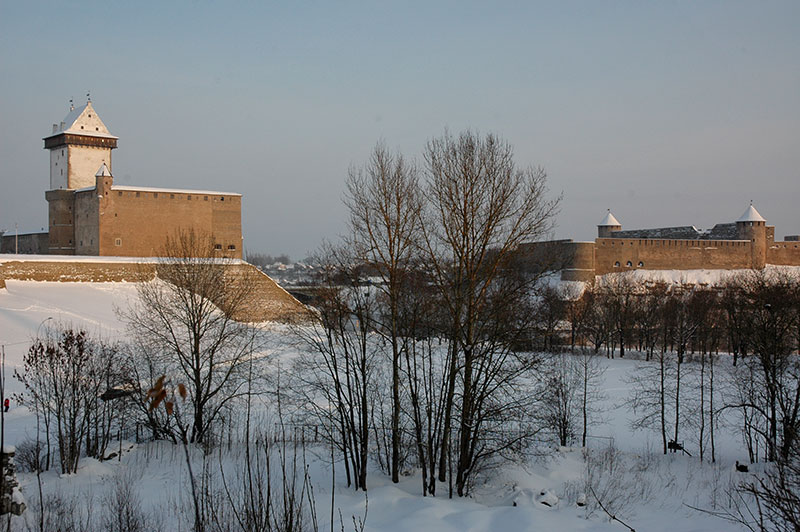
Hermann Castle, Narva, Estonia
It’s the 28th December 2010 and I have just crossed the Russia – Estonia border and am in the city of Narva. Throughout history, Narva has been a trade and border post between various states and empires; Danish, Swedish, Russian and Estonian, and today remains one of the principal border crossings between the EU and Russia. The two empires even face off architecturally across the Narva River, with the originally Danish, thirteenth century Hermann Castle looking across to the somewhat larger Ivangorod Fortress in Russia, built by Tsar Ivan III in the fifteenth century.
I am unable to buy car insurance at the Estonian border, and here my problems begin. Being in the EU with an EU-registered vehicle, I may only purchase a policy issued in the country in which the vehicle is registered (i.e. the UK). However, in order to purchase a valid insurance policy for the truck, it must be in the UK at the time at which the policy is taken out. By exercising my right of freedom of movement, one of the founding principals of the EU, and the right which I most cherish as an individual, I am stuck in a dead-end; my circumstances do not fit in any of the pre-described tick-boxes or spreadsheets by which Western life must be organised, the computers cannot process me and I am in fact, by driving at all in Estonia, breaking the law. Fuck the EU.
I drive cautiously for a kilometre or so to the home of my host Alexander, an ethnic Russian whose parents moved to Estonia during the time that it was part of the USSR, and now finds himself in a country where he does not speak the local language, and has little wish to integrate into Estonian society. For Alexander, his EU passport allows him far greater travel opportunities than most Russians but nevertheless his cultural homeland is undoubtedly east of the Narva River. Alexander is quite typical of the generation of Russians who now live in the independent Baltic states, a demographic anomaly which raises politically sensitive questions of citizenship and equal rights.
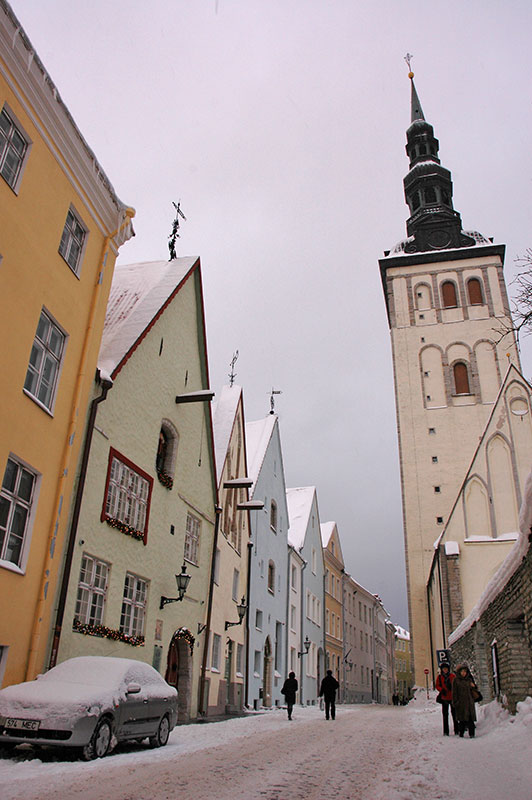
Old City, Tallinn, Estonia
On New Year’s Eve I take a bus to the capital, Tallinn, located on the Baltic coast just across from Helsinki in Finland, a country with whose population ethnic Estonians have both cultural and linguistic ties. I spend the evening in the company of my Estonian host Barbara and a number of other people from across Central Europe. It’s a very enjoyable New Year’s Eve, watching fireworks in the central square, then joining a house-party thrown by a member of the US Embassy in Tallinn, back in Western culture for the first time in more then three and a half years, but it simultaneously feels very odd indeed; I feel I have very little in common with people around me and my mind seems still to be somewhere in the wilderness of inner Asia.
Tallinn is a strikingly attractive city. Whilst Narva still has strong echoes of the USSR, feeling like a cleaner, more tranquil and less policed version of Russia, Tallinn is absolutely European and the attractive, tall and narrow buildings of the city with their steeply pitched roofs are beautiful pieces of Hanseatic architecture, quite reminiscent of northern Germany. Long known as Reval, Tallinn came under the influence of the Teutonic Knights during their Northern Crusades of the thirteenth century, and became the northernmost member of the Hanseatic League in 1285. Coming under (albeit rather loose) Russian influence early in the eighteenth century, Reval eventually became Tallinn in 1920 when Estonia was formally recognised as an independent country, something which would last just twenty years. It was in the Baltic capitals such as Tallinn that some of the most vehement protests emerged in the 1980s USSR, calling for the legalisation of national flags, recognition of national languages, non-communist leadership and ultimately full independence from Moscow. There are virtually no signs of the Soviet Period visible in central Tallinn and with its crowds of tourists and souvenir shops, it feels rather tame. After a couple of days of exploration, I’m ready to leave.

Wooden Houses, Viljandi, Estonia
I take a bus south across the centre of the country to Viljandi, a neat and charming small town of multicoloured wooden houses on narrow streets filled with around a metre of snow. The elegant, cream-coloured Lutheran St. John’s Church, whose crisp and simple lines contrast with the extravagance of many of the Russian Orthodox Churches I have seen over the last few weeks, serves as another reminder of just how culturally different Estonia is from Russia, for here I am already in a traditionally Protestant area. Estonians are clearly not like many of the other non-Russian minorities of the USSR who have been assimilated to various degrees into the modern Russian State; this is a vibrant and clearly wholly independent nation both in culture and in language.
I’m hosted here by Silja, who works at the Viljandi Culture Academy which revives traditional Estonian music and theatre, earning Viljandi its reputation as the country’s cultural capital. It is with her brother however that I indulge in a more universally Nordic tradition; having a long session in their integrated bathroom-come-sauna, eventually getting very drunk and rolling around naked on the snow-filled balcony. Altogether this makes Viljandi a very pleasant and relaxing stop.

Street, Cēsis, Latvia
I take another bus, south again to the cross-border town of Valga, whose Latvian half is known as Valka. Here I board a train and slip into northern Latvia without anything more than a sign; I am back in the Schengen Zone whose borders have been dismantled; a great pleasure for someone who regularly spends hours crossing borders. Immediately I hear a difference in the language, with the distinctively long vowels of Latvian coming over the train’s announcement system. Latvian and Lithuanian are the only two surviving members of the Baltic languages, only very distantly related to Slavic languages and seemingly retaining elements of the ancient Proto-Indo-European language, though their precise evolution is unclear.
I get off the train in the town of Cēsis, described as ‘Latvia’s most Latvian Town’, which I have chosen over Riga as my one stop in the country. As I step out of the station building, I notice for the first time in roughly two months that outdoor temperatures are above zero, though the prospect of spring is still depressingly far off. Cēsis is an immediately likeable place however, located in the hilly Vidzeme Upland and noticeably less manicured than Viljandi, with a centre full of colourful, pleasingly faded (or decrepit) pre-Soviet buildings, and in fact the town bears no architectural trace of the hated occupation whatsoever.

Cēsis Castle, Cēsis, Latvia
While Tallinn seemed strongly Germanic, Cēsis has a more medieval Central European charm; a damp, brooding town of cats flitting into doorways and shabby courtyards glimpsed through street entrances. This atmosphere is enhanced by the Lutheran St. John the Baptist Church, a towering, buttressed thirteenth century basilica with a Gothic bell tower and spire which pierces the damp, grey clouds which hang over the town. Cēsis also has one of the Baltic region’s most impressive castles, dating back to the early thirteenth century and constructed by the Livonian Brothers of the Sword, German warrior-monks who would eventually merge with the Teutonic Order and become the semi-autonomous Livonian Order, ruling what is now Latvia until the Polish-Lithuanian takeover in the sixteenth century.
I find Cēsis an atmospheric and charming place to visit, and it also feels very slightly more Slavic-influenced than Estonia, more Polish than Finnish. But I also find that people are a little cooler here than in Estonia, and far more so than in Russia; people seem to prefer to stay out of each others’ business, often looking away if one catches their gaze.

St. John The Baptist Church, Cēsis, Latvia
On my way south to Lithuania I need to spend a few hours waiting for a connection in Riga, which gives me ample time to reflect on the misery of using public transport. Riga’s bus station is as foul a place as I have found myself in for quite some time. It has the air of villany and seediness that such places have in Russia, though partly disguised with an (admirably) efficient cover which would be utterly out-of-place in Russia; clear information, internet access, no queues, helpful service, and no police. Still, this façade of decency somehow makes it all the more repellent. It’s full of pigeons, flapping up to ledges under the roof, males chasing females, presenting the ever-tantalising prospect of having one defacate on my head. Each dustbin has a sullen, puffy-faced tramp rifling through its contents which I can only imagine are far too meagre to support much of a drinking habit. Inside is the gentle smell of the unwashed; gaunt heroin-addicts patrol around looking for unattended bags; most of the non-vagrant / addict patrons of the waiting room (including myself) appear to be dressed from charity shops, and a good number have the pasty grey-yellow appearance of career alcoholics. Very few people here look like particularly decent individuals.
Perhaps this is normal for bus stations and not a reflection on Riga in particular, but it further embitters me towards the EU and the bureaucratic black-hole it has put me in. I take my scruffy self and my woven nylon bag (which I had to purchase in Narva to carry my belongings) into a shop and purchase a can of larger to further camouflage myself into the human environment.
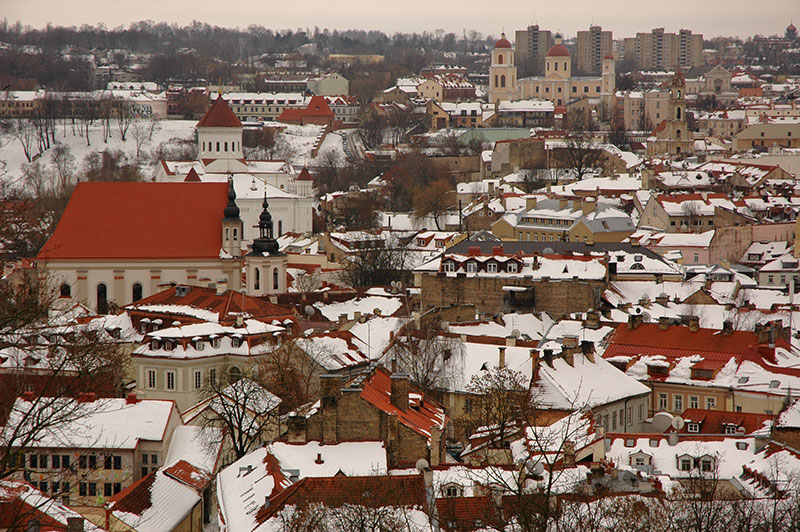
Old City, Vilnius, Lithuania
It’s cold and damp when I arrive in Vilnius, the Lithuanian capital. In contrast to Estonia and Latvia, Lithuania has a long history as a major regional power (largely in union with Poland), and to an even greater extent than modern Poland, is today only a small scrap of its former self. In the thirteenth century, enduring raids and Christianisation by the Teutonic Knights and Livonian Order, the Grandy Duchy of Lithuania emerged in this region of the Baltic coast, spreading southwards into the western lands of the early Eastern Slavic state of Kievan Rus’ as it was fragmented by Monogl and Tatar attacks. Later, the Grand Duchy declared a union with the Crown of the Kingdom of Poland, creating in the fifteenth century the largest state in Europe, covering modern-day Lithuania, Latvia, Belarus and parts of Estonia, Russia, Poland, Ukraine and Moldova. This union persisted as the Polish-Lithuanian Commonwealth until the very end of the eighteenth century, when it was partitioned between Russia, Prussia and Austria. Since this time, the history of Lithuania has very closesly followed that of the other two Baltic states.
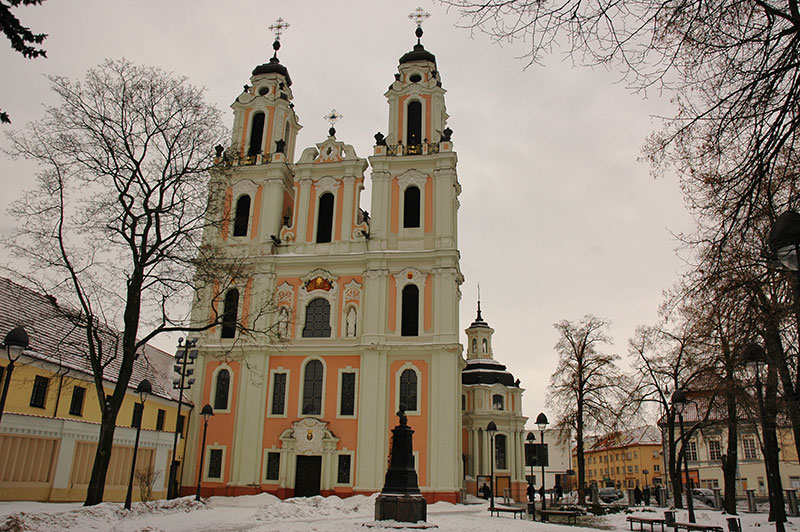
St. Catherine Church, Vilnius, Lithuania
Vilnius is a fairly attractive city, though it seems rather depressing; a city where nobody appears to smile, an aspect hardly improved by the grey weather which hangs endlessly above the entire region. It’s a grim fact that Lithuania has one of the world’s highest suicide rates, though social and economic problems are usually cited as the cause. As capital of the Grand Duchy of Lithuania for more than 450 years, Vilnius has a centre whose scale and grandeur are slightly striking in a city with a population of little more than half a million. From the remains of the ancient castle complex which occupies a hill on the banks of the Neris River, one has a most impressive view of a sea of terracotta-tiled town buildings around Vilnius University, tree-lined avenues and grand plazas such as that in front of the Neoclassical Presidential Palace and Cathedral. What is also evident is the influence of Catholicism here, with the gaudy, candy-coloured Baroque façades of basilicas such as the Church of St. Catherine giving the city a splash of colour.
After Vilnius I spend a few weeks in Poland, firstly with Karolina (whom I had last seen in Kazakhstan in July) in Warsaw and then with Maciej (whom I had last seen in Mongolia in November) in Gdańsk. It is from Gdańsk on the 14th February that I take a bus east, crossing into the Russian exclave of Kaliningrad which makes up something of a fourth Baltic ‘state’, and a very intriguing little region of Russia.
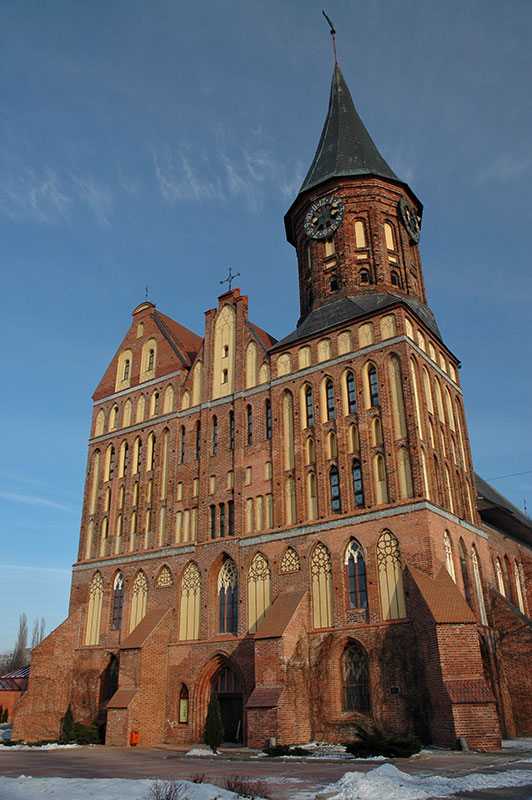
Königsberg Cathedral, Kaliningrad, Kaliningrad Region, Russia
Kaliningrad was long known by its German name of Königsberg and was founded in the thirteenth century by the Teutonic Order, becoming capital of its Lutheran successor state, the Grand Duchy of Prussia following the Protestant Reformation of the sixteenth century. Königsberg became a thriving, multi-ethnic port city and cultural hub, passing into the German Kingdom of Prussia, then the German Empire and into modern Germany. By the outbreak of World War II, save for a five-year occupation in the mid eighteenth century, Königsberg had no historic connection to Russia whatsoever. However, the city was something of a spoil of war granted to the Soviets at the Potsdam Conference, and was renamed in 1946 to Kaliningrad after Mikhail Kalinin, one of the most senior of the Bolshevik cadres who also had no connection to Königsberg. Following the dissolution of the USSR in 1991, the small region of Kaliningrad has found itself a tiny exclave of Russia, wedged inside the EU between NATO members Poland and Lithuania.
My first impression of Kaliningrad is of a standard Russian city with a few more European touches; there are fewer Soviet cars on the streets, for example and a better range of goods available in the supermarkets. Very soon however, I realise that Kaliningrad is actually a very unusual place indeed. The upheavals of the twentieth century are all too evident in modern Kaliningrad; visibly there is virtually nothing physically remaining of Königsberg, which was very comprehensively bombed by the British, during the Second World War. Even for a fan of Soviet Architecture, the modern cityscape of Kaliningrad is not easy on the eye; rows of peeling, pale-grey apartment buildings, broken pavements and the all too visible ‘House of Soviets’ an ugly pile of an unfinished administrative building which was recently painted ahead of a presidential visit. Some of Königsberg’s old gates have been rather carelessly restored, but there are only faint vestiges, in the occasional old apartment building or factory walls, of the old red-brick cityscape.
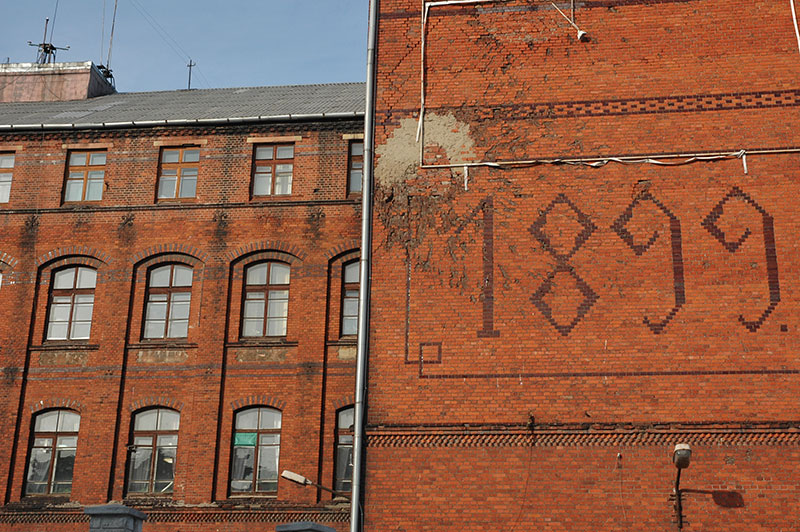
German Factory, Kaliningrad, Kaliningrad Region, Russia
Certainly the most impressive building in the city is the very well restored Königsberg Cathedral, located on a lovely, tranquil island (formerly known as Kneiphof) in the Pregolya River. Kneiphof was once a central district of Königsberg, containing amongst its narrow streets the University of Königsberg where Immanuel Kant, one of the key figures of Western Philosophy and a native of the city, both studied and taught as a professor. Today only the red-brick Gothic cathedral remains, originating in the fourteenth century, left a bombed-out shell in 1945, only to be restored in the 1990s following Kaliningrad’s declassification as a closed city. Kant’s grave and mausoleum still remain, adjoining the cathedral.
Equally as striking as the physical aspect of the city are its demographics; any and all Germans unlucky enough to find themselves in the region at the end of the war were soon expelled from Soviet territory, and Kaliningrad repopulated with Soviet citizens. Since the fall of the USSR, Kaliningrad has been designated a Special Economic Zone and has become something of a manufacturing hub, encouraging further inward migration of Russians from further east. With its tragic history, fall from grace, devastated cityscape and glaring and absolute demographic change, Kaliningrad has a very deeply melancholic air.

Tank Traps, Baltiysk, Kaliningrad Region, Russia
I make a short trip west to the Baltic coast, to what was the westernmost settlement of the USSR, the port of Baltiysk, main base of the Russia Baltic Fleet. It’s a cold but sunny day and I enjoy a short walk along the coast which is covered thickly by large concrete tank traps, themselves partly coated in ice from sea-spray. Like many previously heavily militarised areas of the USSR, Baltiysk has clearly experienced a period of decline; rotting old watchtowers and rusting barbed wire attesting to the financial cutbacks in the Russian armed forces. Nevertheless, as Russia’s only true ice-free port on the Baltic, Baltiysk remains a vital strategic asset and the Baltic Fleet continue to occupy part of the town, including the crumbling, star-shaped seventeenth century Prussian Pillau Fortress which Napoleon stormed in 1807. Elsewhere in town I see old German houses, now owned and lived-in by Russians, giving Baltiysk the same odd, melancholic air as Kaliningrad. I can’t think of anywhere else I’ve been which has witnessed such a sharp demographic change.

German House, Baltiysk, Kaliningrad Region, Russia
I take a night bus out of Kaliningrad to Kaunas in Lithuania, then north to Tallinn and east to Narva where the truck has been parked. My plan to wait out the worst of the winter cold has backfired however and I catch a cold-snap in Narva, with temperatures dropping as low as -33ºC at night. Clear, sunny days of around -20ºC are not unpleasant, but are far from ideal for the car maintenance I need to carry out. The truck has been sitting outside for over seven weeks and is just a large pile of snow when I return and it takes a couple of hours of digging to clear the area around it. I then need to purchase a blow-torch from a hardware shop in order to melt the thick crust of ice and open the rear tailgate and load covers in order to extract my tools. I’m waiting for a shipment from the UK, which will contain a new radiator and new front springs, things which broke beyond repair during the months of rough driving in Mongolia last year, but this involves quite a few days of waiting.
During my days in Narva I come to rather like the place, which seems much like Russia but with a few civic improvements. I’m graciously hosted by Sergei, an ethnic Russian and I spend several days with him smoking and drinking great Estonian beer. On one very mellow afternoon we drive out with a friend of his to the nearby seaside town of Narva-Jõesuu. It’s a perfectly clear, bitingly cold day and the colours of the fresh sea ice and low, reddish sunlight, the crisp fresh air and the light crunching of my footsteps on the ice are especially vivid and memorable impressions.
I meet a number of Sergei’s friends in Narva, all Russian but in different social circumstances. Some, like Sergei hold Estonian passports and are happy integrate into the culture, speak the language and generally seem to be prosperous and worldly. There are also those who choose to take a Russian passport, speak only Russian and are far more like the Russians I know in Russia. There are also members of a third group who I meet; those with neither nationality, but with grey ‘Alien’s Passports’ of a stateless citizen. These are invariably ethnic Russians who do not qualify for naturalisation in Estonia (often due to a lack of language competency) and make up a little publicised human-rights issue in the EU (the situation is actually worse in Latvia which has a larger Russian minority), another demonstration of the demographic problems which the Baltic region has been left with.
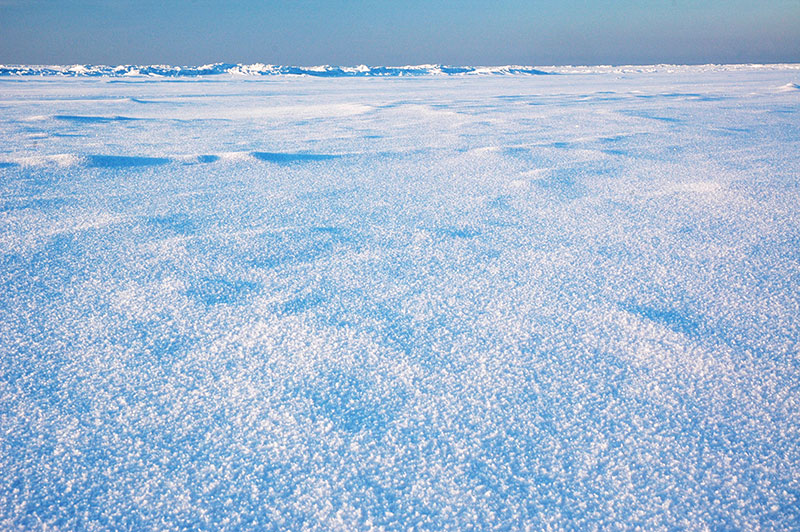
Frozen Baltic Sea, Narva-Jõesuu, Estonia
Eventually the terrible cold relents somewhat, my parts arrive and I fit the radiator despite the still freezing conditions. I charge the truck’s two totally flat batteries and then fire it up after eight weeks of being in the freezer of winter Estonia. It catches first on two, three and then four cylinders, shooting out clouds of unburned diesel until the engine smoothens out. I say my farewells to the numerous people who have hosted and helped me in Narva and head back to the Russian border, relishing my exit from the EU and the end of my stint using public transport. There is a queue system in operation at the border and a toll for entering (the first on my trip) and after waiting my turn I proceed to the border compound. My passport is very carefully inspected for twenty minutes before I am allowed to proceed back into beloved Russia.
I clear Russian customs at around 02:30 and drive south through the night roughly parallel to the Estonian border, reaching the attractive city of Pskov early in the morning. The snow here is thinner than in Estonia and I have a (quite false) glimmer of hope that spring might be on its way. Beyond the city I join the only toll road I have ever encountered in Russia, which is icy, extremely rough in places and outrageously expensive, an unpleasant re-acquaintance with the traditional Russian fact that the legalised mafia which runs so many private industries have almost limitless potential to screw the common man. There are no immigration procedures at the Russia – Belarus border just beyond the village of Dolostsy and after a brief look inside the truck by a customs officer, I am waved through into Belarus.
Stage 24 – Russia: Siberia To Saint Petersburg
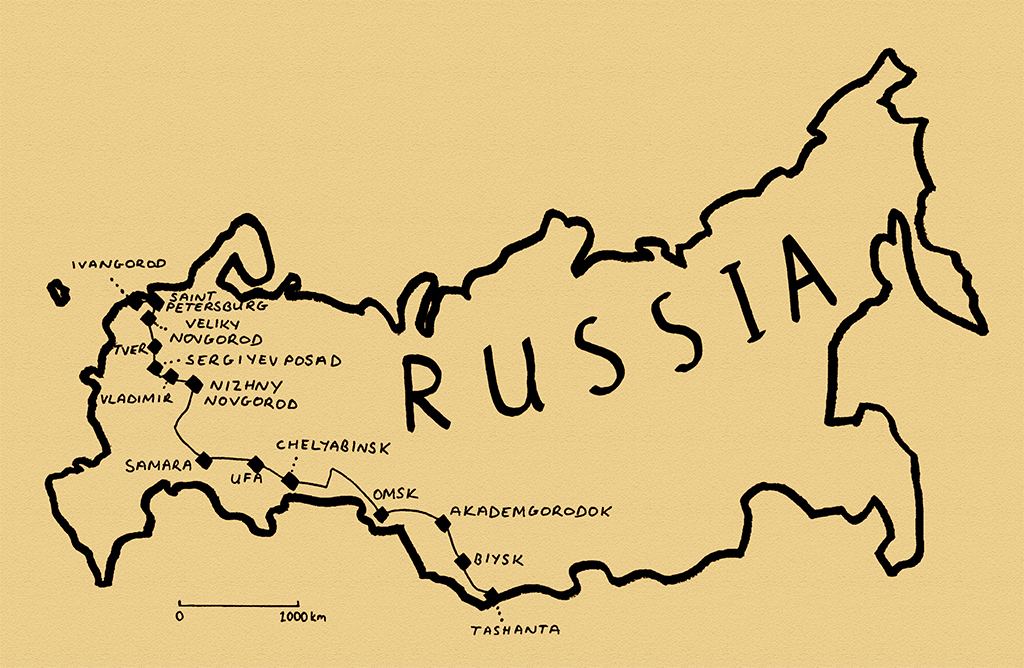
On this six thousand kilometre journey from the rugged mountains of western Mongolia to the Baltic Sea, I would pass straight through the very heart of Russia: into the centre of southern Siberia, over the Ural Mountains, along the Volga and through the most ancient heartland of the country to cities dating from a time when Russia was a far, far smaller entity. The trip would consist of a harsh and at times terrifying drive over several weeks through the onset of the infamous Russian winter, interspersed with the warmth and good company of the Russian people whom I would meet and stay with. As I slowly made my way ever westward, I would at once be effectively travelling backwards in time through Russian history, but at the same time would begin to see something less welcome come across the country; namely the increasing influence of more western values of commerce and consumerism replacing the wildness and rugged beauty of the east. Nevertheless, this winter crossing of a considerable slice of Russia would provide me with a greater understanding of the country’s historical and cultural roots than perhaps any other.
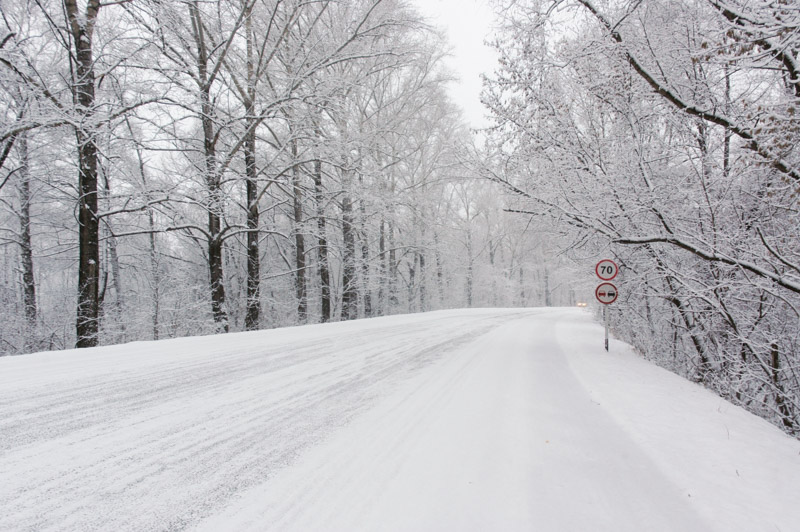
M52, near Biysk, Altai Territory, Russia
It’s the 23rd November 2010 and late in the day on by the time I clear the Russian border post at Tashanta and make my way to the district capital of Kosh Agach. The temperature is around -20ºC and falling, and after having dinner and filling the truck up with fuel I decide to continue driving, descending the glorious, winding Chuya Highway. Despite icy conditions and darkness and in full knowledge of the stunning mountain scenery which lurks in the dark, I continue driving cautiously through the night without stopping and by dawn I am in the snow-covered but comparatively warm lowlands of Siberia, reaching the small city of Biysk by mid-morning. After weeks of travel in Mongolia, my sudden arrival into the familiarity of urban Russia is something of a culture-shock, though a positive one, for it marks an end to the fear of becoming stranded in the trackless, snow-covered wilderness of Mongolia.
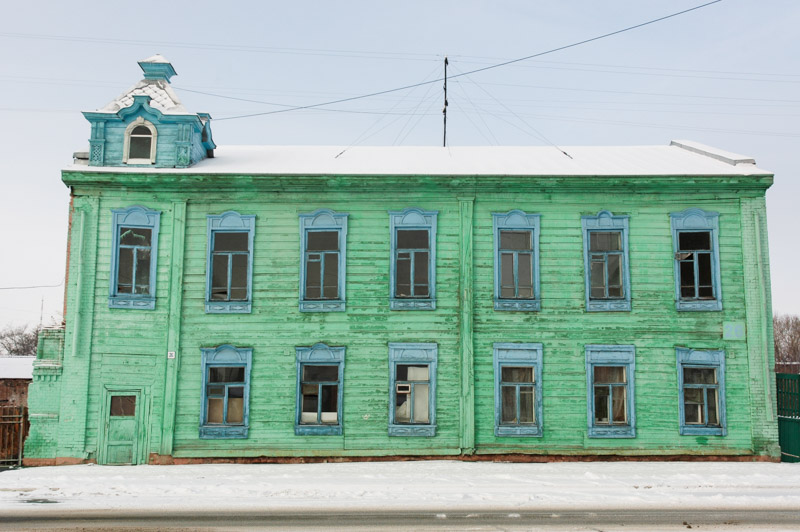
Tsarist Building, Biysk, Altai Territory, Russia
Biysk is a pleasant backwater, an eighteenth century trading post typical of the small Siberian cities which found themselves off the Trans-Siberian mainline when it was completed at the turn of the twentieth century. Time here appears to have moved more slowly than in the dynamic cities on the rail and road-conduits to the north, and there are plenty of examples of Tsarist-era buildings; timeworn structures of decorative whitewashed brickwork or of pastel coloured wooden panelling. Some, such as the City Library appear to be on the verge of collapse, but the city manages to retain a fairly dignified air nevertheless.
After two nights in Biysk I move north towards Novosibirsk, en route encountering the dangerous driving conditions which would underscore my journey all the way to the Baltic. It is in this early winter season that Siberian weather may be particularly unstable as weather systems clash from both north and south, bringing wild swings in temperature. I briefly encounter a phenomenon known as freezing rain: supercooled droplets of liquid water which freeze immediately upon impacting a surface; within minutes my windscreen becomes a sheet of solid ice.
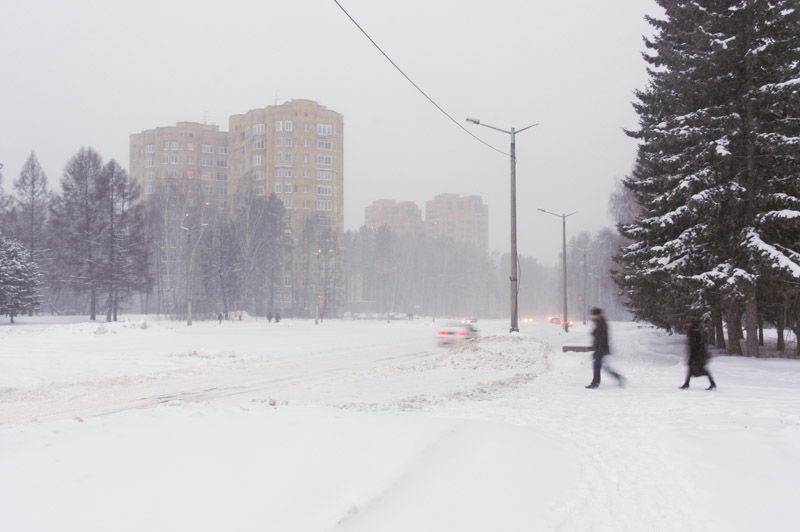
Akademgorodok, Novosibirsk Region, Russia
I stop in the city of Akademgorodok, a suburb of Novosibirsk, location of Novosibirsk State University and the educational and scientific capital of Siberia. Rather than being an intriguing, previously classified Soviet research centre as I had perhaps imagined, Akademgorodok is little more than a large university campus, but my hosts would make my stay extremely memorable. They are Ilyas, a Kazakh from Almaty; Ivan, a local of Novosibirsk and his girlfriend Sasha who comes from the Commander Islands, the last of the Aleutians and surely one of the most remote places in all of Russia, lying well off the eastern coast of Kamchatka.
I am invited into the spacious apartment of my three student hosts and am immediately treated to a tea ceremony by Ilyas. Taking its roots in the Taoist-influenced cultures of China and east-Asia, the tea ceremony is a ritualised preparation and presentation of tea designed to bring out the best flavour of green tea and although certainly not native to Russia or Siberia, there are undertones of the New Age spiritualism which has a nascent following in the post-Soviet world. My three hosts are in fact members of the Tea Club, a social club based somewhat around tea ceremonies, and I am very glad to be invited to one of their meetings in central Novosibirsk one evening. This takes place in a dedicated cultural venue, where I form one of my fondest memories of Russia and Russian people. A small circle of friends gather, mostly academics and artists, bringing musical instruments and relaxing on cushions in a large open room. Tea is made ceremoniously and music played; the atmosphere is totally unpretentious, welcoming and relaxed, and I am infused with a very natural feeling of heightened awareness, something I have hardly felt before. It’s more refined and wholesome than typical western social activities which almost always revolve around drinking alcohol, and a perfect antidote to the stereotypical views of Russians being invariably heavy drinkers. I imagine that most people in the room refrain from drinking alcohol altogether. The music is earthy, imperfect and soulful, played at a volume which does not stifle conversation, and occasional mistakes are laughed off or ignored. Performers are not trying to prove themselves or fit into any pre-described social movement; it is simple, joyful socialisation of a kind which I have only ever experienced in Russia.
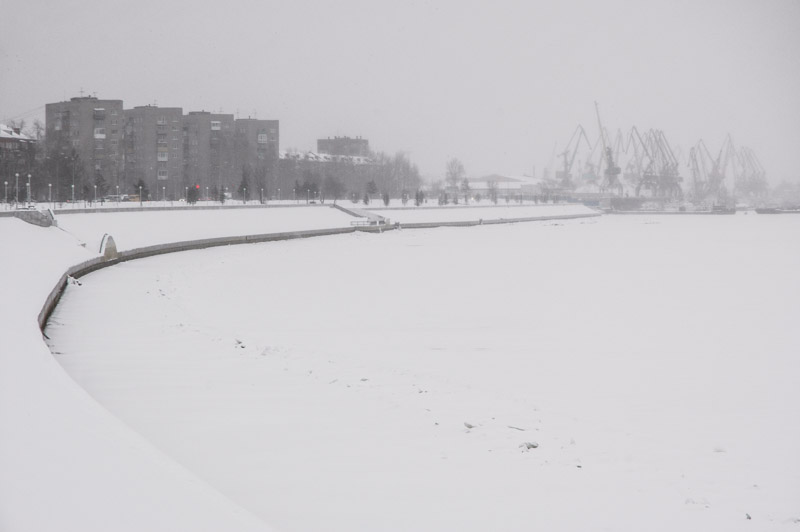
Irtysh River, Omsk, Omsk Region, Russia
I’m sad to have to leave my hosts in Akademgorodok, but I am constantly hurried by the impending depths of winter which could leave me stranded (due to diesel fuel waxing, leaving the truck unusable). I drive west through the night on the M51, the western part of the Trans-Siberian Highway which crosses the snow-covered clearings and patches of now bare birch forest of southern Siberia, to the city of Omsk. Omsk lies on the Irtysh River which here is almost frozen solid and is Siberia’s second city, once briefly acting as the capital of the Provisional All-Russian Government, a final attempt to counter Bolshevism in the chaos of the Russian Civil War. During the Second World War, Omsk (after Samara) was prepared to become the Russian capital in the event of a German occupation of Moscow. Despite these brushes with greatness, Omsk has long-lived in the shadow of Novosibirsk and remains a city of very modest attractions. Temperatures of -25ºC don’t deter some of the locals from drinking vodka at tables outside the market, but I prefer to wait for warmer temperatures, and foolishly set off at midnight, westwards towards Chelyabinsk.
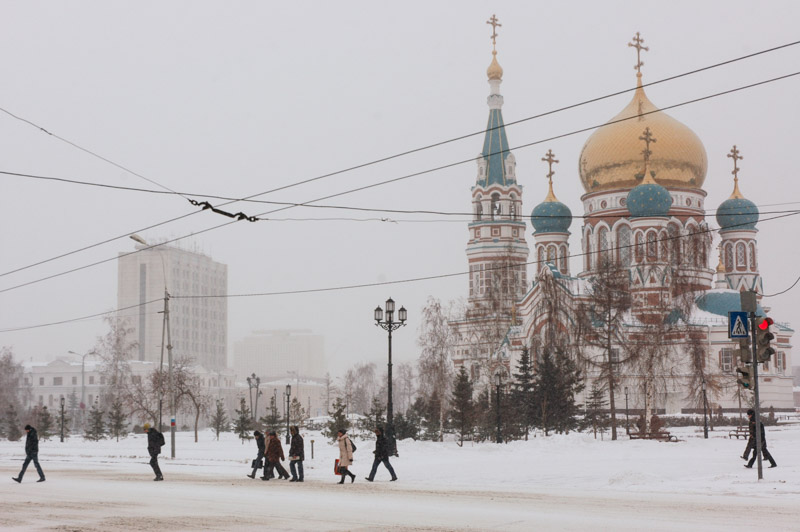
Dormition Cathedral, Omsk, Omsk Region, Russia
A couple of hours into the journey, out in the endless Siberian plains as I am driving along a nearly empty road at perhaps sixty kilometres per hour, the rear of the truck suddenly slides gently to one side, then immediately pirouettes 180º. In the moments that I am travelling backwards I anticipate disaster, but I merely leave the road and sink with a gentle impact into a snow-drift a few metres below the elevated road surface, without any damage at all. Every car which subsequently passes offers assistance, another admirable trait of Russian people, and after little more than an hour a large truck finally arrives which has the power to pull me back up onto the road. No money is asked for; I am merely wished luck in my onward journey. At this point I realise that the sudden increase in temperature to just above freezing has made the road surface a polished ice-rink on which I can barely even stand still without sliding. My summer-rated tyres have almost no grip whatsoever on such a surface.
With great caution and the truck now engaged in four-wheel drive, I resume my journey. The road is rough in places, coated in ice pounded into washboard-like ruts by heavy trucks. Through the day the temperature drops which has the advantage of reducing the amount of dirty brown slush being thrown out by vehicles. I detour via Tyumen through beautiful pine forests, avoiding a section of the M51 which crosses what is now the northern tip of Kazakhstan, rejoining it in Kurgan after dark where I encounter and the very first ripples of the Urals and yet more treacherous driving conditions; the roads are regularly lined by wrecked lorries which have spun off into the thick Siberian snow. At around 01:00 I finally reach Chelyabinsk, at -26ºC. In my state of hyper-awareness following spinning-off the road, I have driven twenty hours non-stop, my personal endurance record.
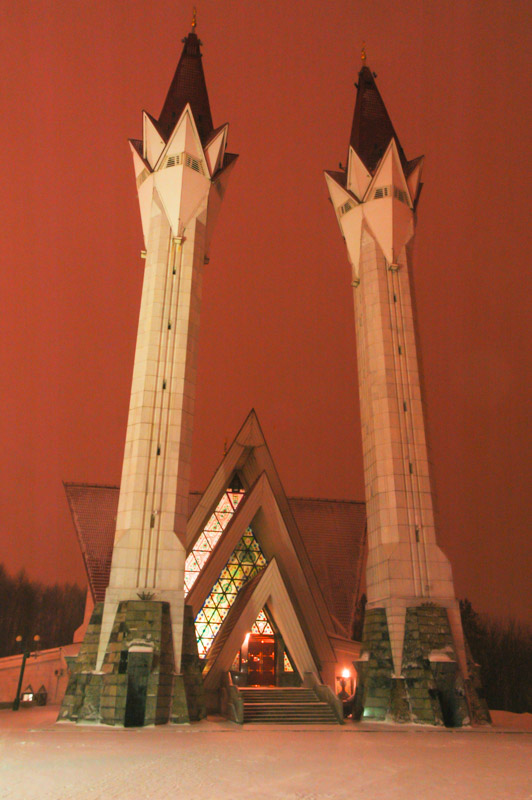
Lala Tulpan Mosque, Ufa, Bashkortostan Republic, Russia
I’m hosted in Chelyabinsk by the Mayarov Family in their large lakeside house. The Mayarov’s are a good example of ‘Old Money’ in modern Russia, living in a self-built house with a front door like a bank vault and a heated underground garage. The welcome is typically Russian however, with long meals in the family kitchen, great home cooked food and only a little vodka. Chelyabinsk is a large industrial city typical of the Ural region to which industry was evacuated and subsequently developed to counter the threat of a Nazi invasion of western Russia, and I spend five days in the city relaxing and making friends before continuing my journey west.
West of Chelyabinsk is the infamous M5 Highway which winds over the low ridges of the Urals into European Russia. The road is choked with lorry traffic and is a mess of brown salty snow and slush, creating endless visibility problems for me with my windscreen washer bottle having frozen solid weeks ago somewhere in Mongolia. The trip is however largely uneventful and I arrive without incident in Ufa, capital of the Bashkortostan Republic. I am hosted here by Alina and Milya, two beautiful, intelligent, English-speaking mixed Bashkir/Tatar sisters who live in the city with their mother. The Bashkirs and their neighbouring Tatars are the two dominant nations of a heterogeneous group of Kipchak nations, Turkic nomadic groups with both Caucasian and Mongoloid features who spread into the Ural and Volga regions in the 11th and 12th Centuries and subsequently became swept up in the Mongol and Turkic nations which made up the Golden Horde, led by Ögedei Khan, second son of Chnggis Khan, who invaded and conquered ancient Rus’ (the forebear of modern Russia) in 1237-40.
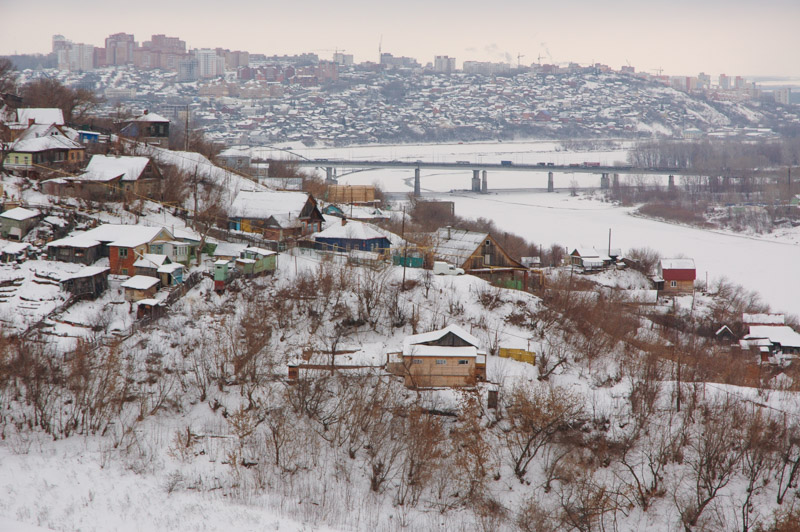
Belaya River, Ufa, Bashkortostan Republic, Russia
The Golden Horde subjugated Rus’ for almost 250 years, until a new generation of Russian tsars (ceasars) emerged following the breaking of the Tatar Yoke, with leaders such as Ivan IV (Ivan the Terrible) ruling over a new Russian Empire which began to reconquer lands inhabited by the various Kipchak groups. Despite merely extracting a tribute rather than being a fully occupying force, there was naturally a degree of inter-marriage between the occupiers and the natives of Rus’ and hence comes the expression ‘scratch a Russian and you’ll find a Tatar’. Today the Tatars are, after Slavs, the largest ethnic group in Russia and are well-integrated into Russian society, as demonstrated by Ufa, the vibrant and dynamic capital of the Bashkirs. Here there is not the atmosphere of racial animosity one finds in parts of the Caucasus, instead there is a more genuine blending of Tatar and modern Russian identities. Such is the extent of assimilation however that, despite concessions to national identity such as the Lala Tulpan (flowering tulip) mosque, the third-largest in Russia, one wonders how long an independent Tatar identity will survive in the modern Russian state before facing total assimilation, perhaps the ultimate reversal of the haunting Tatar Yoke which remains, deeply, in the Russian people’s collective psyche.
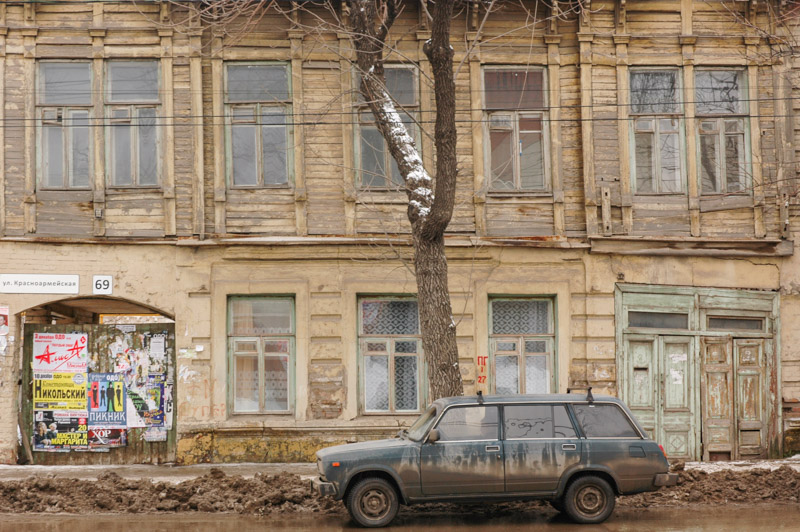
City Centre, Samara, Samara Region, Russia
From Ufa I drive south-west towards the Volga, to the city of Samara which sits on a long, looping bend of the river, on its left bank. In the late sixteenth century Samara was established as an eastern border post of the Russian Empire and in the Soviet period, renamed as Kuybyshev, became a major industrial centre for the manufacture of aircraft and firearms. Today, despite being the country’s sixth largest city, Samara retains a slightly faded charm and comes as a pleasing surprise in a country where many western cities have been architecturally marred by bland and inconsistent modern architecture. The old centre, which spreads down to the sandy beaches of the Volga has a slightly untouched feel with Tsarist-era wooden houses with elaborately carved window frames, often showing a distinct lean and once grand apartment buildings in pastel shades of yellow, pink and green, decorated with often crumbling stucco architraves and balconies. The streets are lumpy, with the asphalt pushing up between the tram lines, and there is a general air of classy neglect.
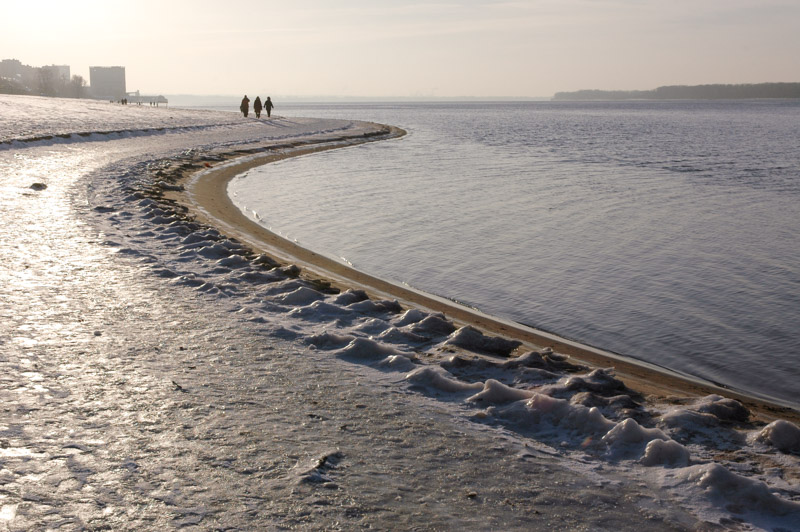
Volga River, Samara, Samara Region, Russia
Samara’s riverside setting also lends it a slight air of port-city seediness, with a long embankment running above sandy beaches packed with sunbathers in summer, past occasional clumps of trees and a number of ferry terminals from where boats depart on pleasure cruises. Across the river are the low Zhiguli Mountains, occupying the inner radius of the Samara Bend, a large loop in the Volga once famous as the redoubt of pirates who would prey upon river traffic. These mountains give their name to the ubiquitous Zhiguli car made in nearby Tolyatti, as well as the Zhigulevskoye Beer which was universally famous in the USSR and was first made here by an Austrian in the red-brick riverside brewery, where locals queue to buy beer in large plastic bottles and can even take river cruises from a dedicated brewery-jetty. Now, in mid-December the river is still unfrozen but the beaches and ferry terminals are quiet and there is only a gorgeous, deep-red sunset behind the smokestacks of nearby Novokuybyshevsk to admire. Samara, lacking the flimsy ostentation of many of the country’s more westerly cities feels authentically Russian, an easy-going, unpolished worker’s city, and quite possibly my favourite in Russia.
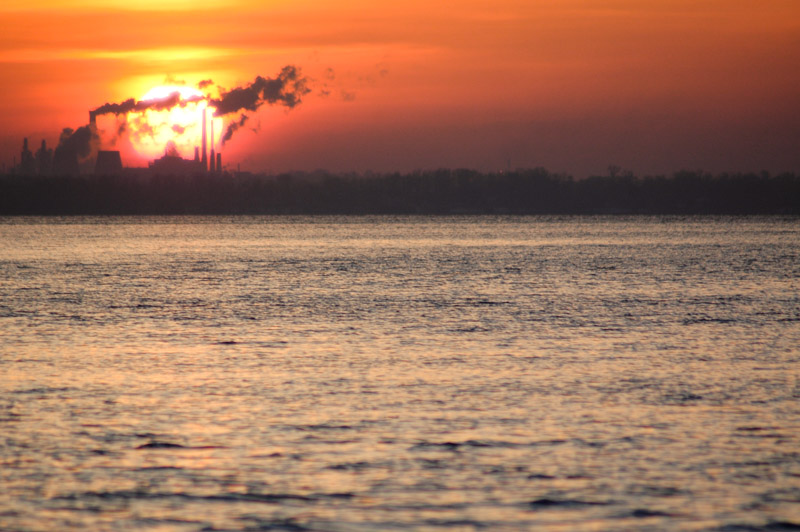
Sunset Behind Novokuybyshevsk, Samara Region, Russia
After four days in Samara I continue west and then north one afternoon, cutting out a large dog-leg in the Volga and driving via Syzran, Saransk and Arzamas through the night to arrive in Russia’s fifth-largest city, Nizhny Novgorod, one morning. Lying at the confluence of the Volga and Oka Rivers, Nizhny (Lower) Novgorod was newly-founded at the time of the Mongol invasion, and like Moscow and Tver manage to avoid destruction on account of its insignificance. As the medieval state of Rus’ slowly detached itself from the economically draining Tatar Yoke throughout the fifteenth century, Nizhny Novgorod served as a bulwark in the Russian expansion into the Khanate of Kazan, one of the successor-states of the Golden Horde. Later, in the crisis and chaos which followed the death of Ivan the Terrible in 1584 with no real successor (he had murdered his only intellectually-able son in a fit of rage) known in Russia as the Time of Troubles, it was from Nizhny Novgorod that Minin and Pozharsky rode to remove the Polish from Moscow, restoring the dignity of the nation once again and ultimately establish the Romanov Dynasty, which led Russia until the Bolshvik takeover in 1917.
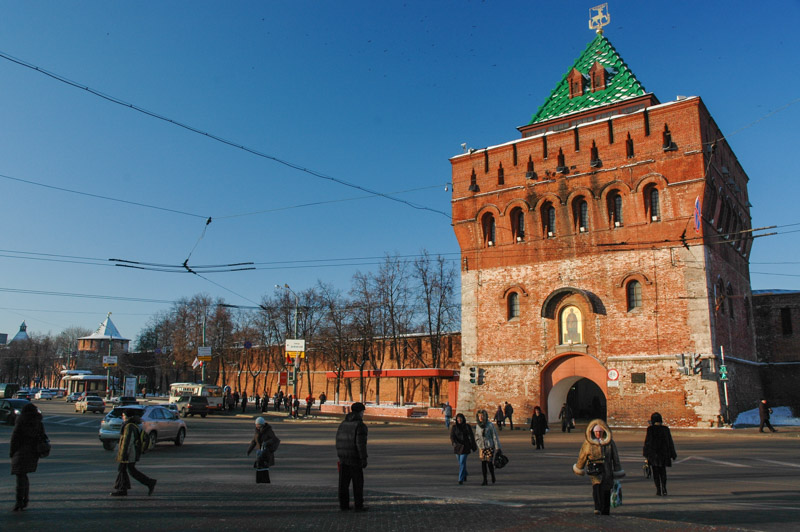
Kremlin, Nizhny Novgorod, Nizhny Novgorod Region, Russia
At the centre of Nizhny Novgorod, as in many Russian cities, lies a kremlin (fortress), here one of the country’s oldest; a bulky, red-brick sixteenth century structure which seems to convey well the medieval power of the emerging state of Russia, and still houses the city administration. From the kremlin there are pleasant views over the Oka to the heavily industrialised right bank where during Soviet times, when the city was known as Gorky, the presence of military research and production facilities caused the city to be closed to outsiders. Outside the kremlin however, the city is thoroughly modernised and while by no means unpleasant, it lacks the antiquated charm of Samara.
It’s under 250 kilometres west from Nizhny Novgorod to the city of Vladimir, which marks my entry into the ancient heartland of medieval Russia, an area now known as the ‘Golden Ring’, and more traditionally as Zalesye (‘beyond the forest’) in Russian. Here lie the cities of the ancient principalities of Rus’, which defined the protoypal Russian state between the times of the earliest waves of Slavic migration from Kiev until the Mongol invasion. Vladimir is one of Russia’s oldest cities and together with the nearby town of Suzdal made up the Principality of Vladimir-Suzdal, one of the successor states to Kievan Rus’ and the forerunner of the Grand Duchy of Muscovy, from which the modern Russian state was born. Vladimir is an unusually beautiful city set on a number of hills, separated by bare deciduous forest now dusted with fresh snow.
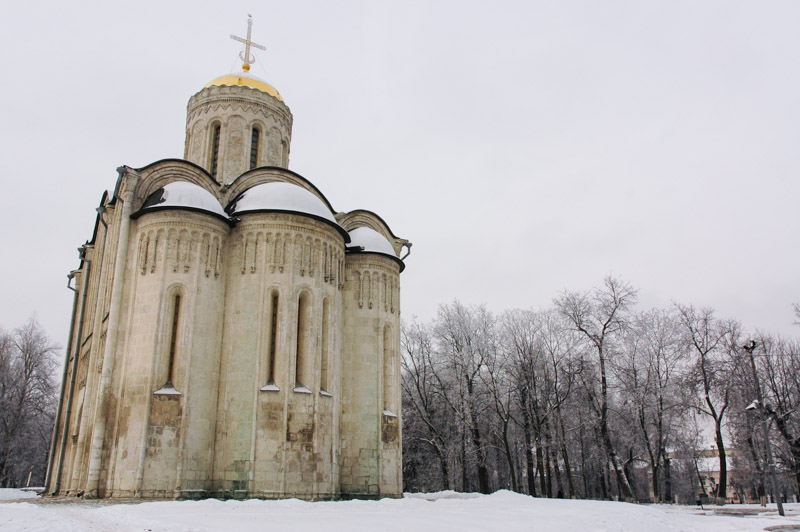
Cathedral Of Saint Demetrius, Vladimir, Vladimir Region, Russia
From this white landscape rise the famous White Monuments of Vladimir; the spectacular Dormition Cathedral with its golden domes so typical of Russian Orthodox architecture and the nearby Cathedral of St Demetrius, both masterpieces of the twelfth century, carved in fine white stone. St Demetrius is particularly eye-catching; a restrained, single-domed cross-Church with the simple, neat proportions and hemispherical dome heavily borrowed from the Byzantine Church architecture which apparently so awed the first Slavic envoys to Constantinople in the ninth century. The walls of St Demetrius are covered in beautiful stone carvings of saints performing miracles and of mythical animals, whose survival through the Mongol invasion, subsequently tumultuous history of Imperial Russia, and often callous destruction of the Soviets is most surprising. The cathedral is almost certainly the most beautiful building I have seen in Russia and must rank with the finest masterpieces of Armenia as one of the world’s finest pieces of Christian architecture.
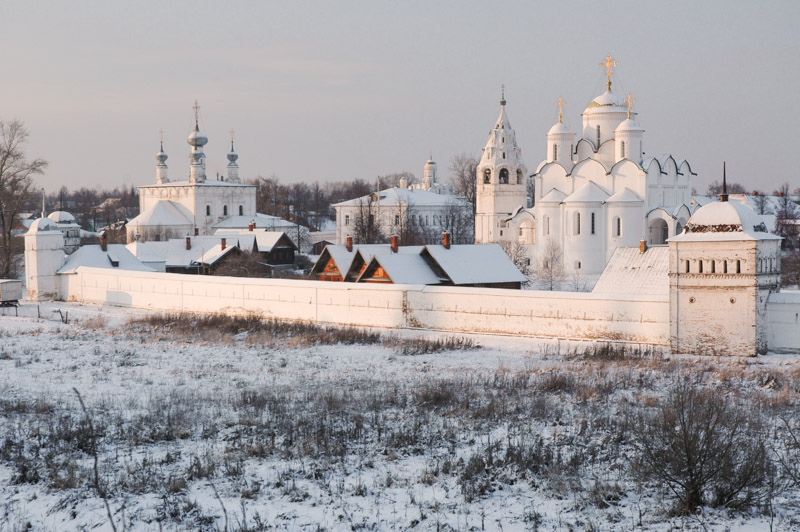
Intercession Convent, Suzdal, Vladimir Region, Russia
I make a day-trip from Vladimir to the small nearby town of Suzdal which was part of various principalities during the early stages of Russian history, eventually joining the Grand Duchy of Muscovy (like nearby Vladimir) in the fourteenth century. Suzdal subsequently became something of a religious centre and remains packed with churches, cathedrals and monasteries, mostly from the eighteenth century and notable more for their sheer number and diversity of form and styles than for the beauty of any particular example; certainly there is nothing to compare to the cathedrals of Vladimir. It’s also something a tourist trap, quite unusual in a country where domestic tourism is rather under-developed, and foreign tourism hardly encouraged. Nevertheless on a cold weekday the number of tourists is modest and it’s very enjoyable to walk through the surrounding countryside, taking in the myriad examples of Russian religious architecture.
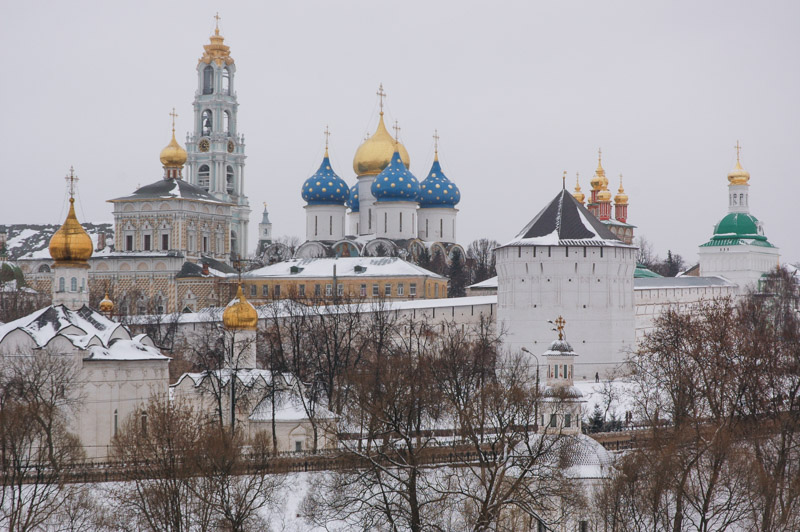
Trinity Lavra Of Saint Sergius, Sergiev Posad, Moscow Region, Russia
From Vladimir I continue west until I just enter Moscow Region, stopping in the town of Sergiev Posad which lies just off the outermost of Moscow’s five concentric orbital roads. Sergiev Posad (posad referring to a usually fortified settlement attached to a kremlin or monastery) is famous for the Trinity Lavra of St. Sergius, today the most important Russian monastery and home of the Russian Orthodox Church. Built initially in the fourteenth century, then rebuilt during the fifteenth century following destruction in a Tatar raid, the lavra (a type of monastery complex) was patronised by Ivan the Terrible who heavily fortified it in the sixteenth century as part of the defences of Moscow. The grounds of the lavra throng with pilgrims and visitors who come to see the relics of St. Sergius of Radonezh, the ancient painted icons and take away bottles of holy water. Architecturally it is an impressive fortified complex, marked by its soaring baroque bell-tower and the iconic blue onion domes, painted with golden stars, of the Assumption Cathedral. This gaudiness combined with the fervour of the pilgrims seems to have as much in common with the dazzling, colourful faïence and ritualistic shrine-worshipping of the Islamic cultures of the east, as it does with the grey and restrained Protestant rite of much of Western Europe. After years of Soviet repression, the Russian Orthodox Church has made a considerable comeback, with its higher members closely linked to the Russian government and priests all-too-often mimicking the new Russian business-class, conveying themselves in black SUVs with blacked-out windows.
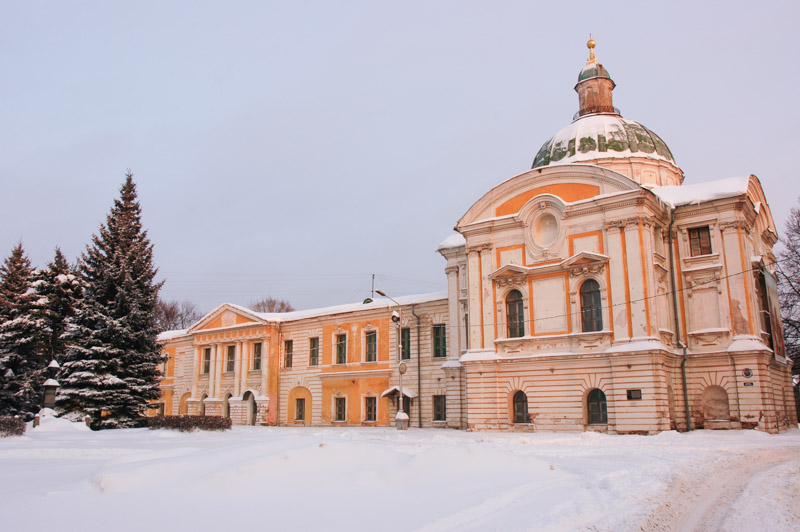
Imperial Travel Palace, Tver, Tver Region, Russia
Not wishing to get any closer to Moscow I make my way anti-clockwise around the city, through Dmitrov and Klin (where Tchaikovsky spent his final years) on terrible roads lined with spun-off vehicles, onto the M10 Highway which links Moscow to Saint Petersburg. I stop for the night in the city of Tver, another once powerful principality in Medieval Russia, only to be eclipsed in importance by Moscow like Nizhniy Novgorod or Vladimir. The Soviet period robbed Tver of the last of its remaining ancient monuments, though the distinctly faded travelling palace of Catherine the Great remains, harking back to a time in Imperial Russia when Tver was a rest-stop on the road between the two great cities. Tver is also the final city on my route which lies on the Volga, whose source is around 150 kilometres away to the west. Here the Volga, already almost two hundred metres across, has frozen solid, allowing me to walk across the surface of Europe’s largest river, just a week after leaving Samara where it was still completely open.
Beyond Tver I continue on the M10, covered in snow and packed with impatient lorries whose drivers take particular exception to my self-imposed speed limit of fifty kilometres per hour. One flings a plastic bottle at me as he passes, another sounds his horn angrily while overtaking, though I see him crashed head-first into the forest soon after. This endless carnage of twisted wreckage, the long hours of intense concentration and the constant proximity to disaster are starting to show on my nerves, and driving becomes rather wearisome. In one small town a policeman stops me and holds out his radar-gun, showing a reading of eighty-one kilometres per hour. My incredulous laughter seems to immediately dampen his hopes of a pay-off, and I continue my fifty kilometre per hour journey north.
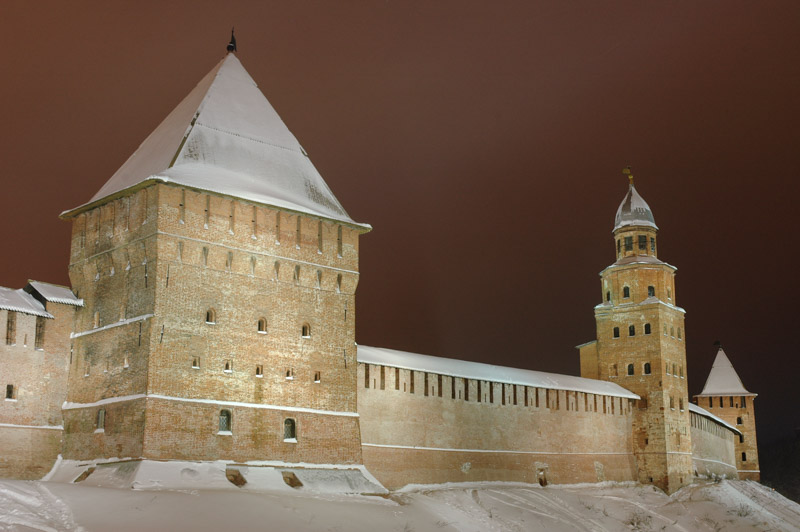
Kremlin, Veliky Novogorod, Novgorod Region, Russia
My destination is the city of Veliky Novgorod, the most historic city in Russia proper. It was in this region that Russian civilisation began; where the earliest Eastern Slavic state emerged from an area populated by tribes of Slavic and Finnic / Uralic people. While the precise events of the Russian foundation myth are lost in semi-legendary and sometimes controversial histories, the balance of evidence suggests that a ruling class of Varangian (Viking) origin established the earliest settlements of Rus’, led by a cheiftan known as Rurik who quickly assimilated the customs and language of the native Eastern Slavs, and whose successor Oleg of Novgorod went on to found Kievan Rus’, the cultural foundation-stone of modern Russia, Ukraine and Belarus. The original settlement in the region was known as Holmgard, which was superseded by nearby Novgorod, thus explaining why the name of Russia’s oldest city ironically means ‘New City’. In 1136, when Kievan Rus’ was in decline, the city-state known as the Novgorod Republic was established, stretching from modern-day Estonia to the Urals and constituting one of medieval Europe’s largest states. Novgorod also survived the Mongols, but would eventually lose its power when absorbed into the Grand Duchy of Muscovy in 1478 by Ivan III, forever to live in Moscow’s shadow.
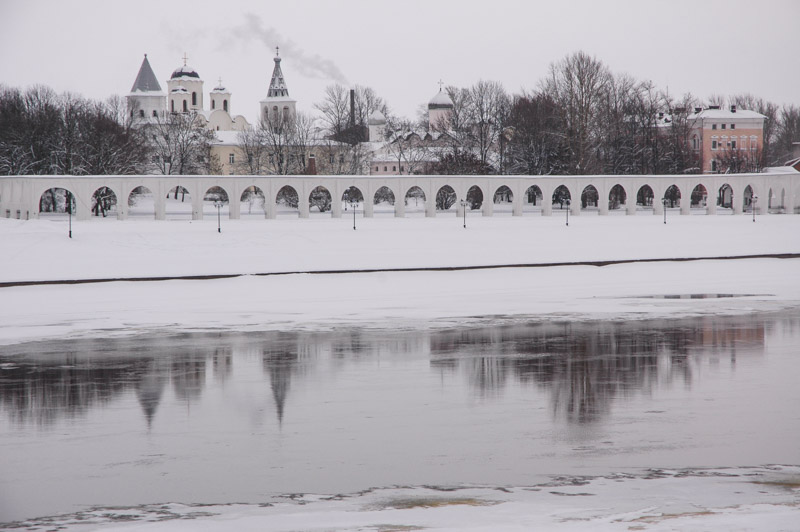
Yaroslav’s Court, Veliky Novogorod, Novgorod Region, Russia
Novgorod is a beautiful city, in some ways one of the nicest in Russia, filled with ancient monuments to attest to its long history. Particularly striking is the central Kremlin dating from the late fifteenth century and very finely executed in red brick, my favourite kremlin in the country. Within the Kremlin is the Cathedral of St. Sophia, burial place of Yaroslav the Wise, a leader of the principalities of both Novgorod and Kievan Rus’ dating from the mid-eleventh century, making it the oldest Russian Orthodox Church in the country. Also within the kremlin are Russia’s oldest palace, bell-tower and clock tower, and a huge bronze sculpture dating from 1862 and known as the ‘Millenium of Russia’, which glorifies a thousand years of Russian history. Opposite the kremlin, beyond its moat and a small forested park is the city’s modern central square and a huge, imposing Soviet regional administration building, adding an example of Soviet gigantism to the catalogue of Russian architectural styles.
Despite all its historical appeal, it is in Novgorod that I start to feel in earnest the insidious approach of Western Europe, with dull, imposed order replacing the natural spontaneity and disorder of life, over-manicured spaces taking the place of the endless wilderness intrinsic to much of Russia. The buildings have been restored to perfection and there is a touch of soullessness which rather negates what could be a highly atmospheric city.
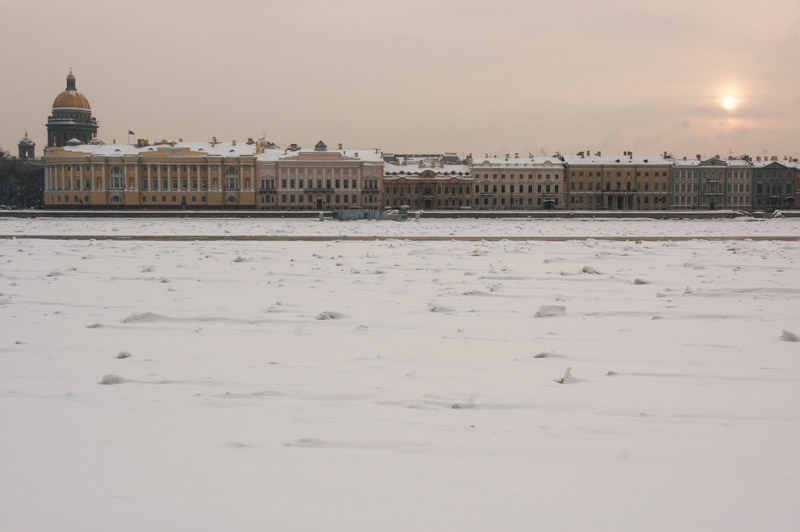
Neva Waterfront, Saint Petersburg, Russia
My next and final destination in Russia is perhaps the country’s most celebrated city, the physical embodiment of Russia’s western, European face. The unsettled period of Russian history known as the ‘Time of Troubles’ ended with the establishment of the Romanov Empire in 1616, a dynasty who would rule the country for 301 years, transforming it into a vast empire even larger than today’s Russia, building the Russian economy with the introduction of serfdom which bound the previously wandering peasants to their landowners for life, thus greatly increasing agricultural output. Perhaps the most important scion of the Romanovs, and one of the few uncontroversially great rulers in Russian history was Peter the Great, a driven and ambitious young king who was captivated by the West and by the people and ideas of the Enlightenment. Peter was particularly obsessed by shipbuilding and the idea of naval power, and devoted immense resources to the establishment of year-round ports on the Black Sea and the Baltic. Employing the kind of ruthless militarism which permeates Russian history, Peter seized a swathe of the Baltic Coast from Sweden during the Great Northern War and built his own capital from scratch: Saint Petersburg.
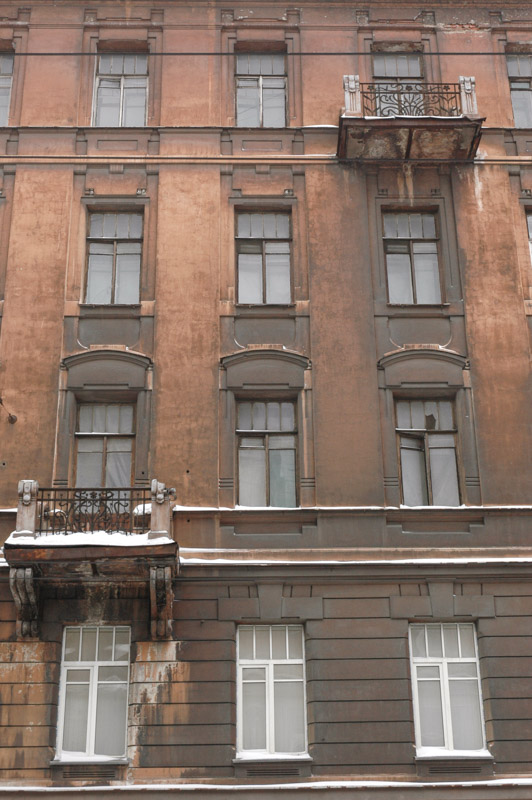
Apartment Building, Saint Petersburg, Russia
Saint Petersburg, Russia’s so-called ‘window to the west’ is unique among Russian cities; an elegant and harmonious imperial capital poised on the Baltic and looking outwards towards the wider world. Peter the Great was the first monarch to leave Russia, and true to Russian style, his extravagant capital was built to be larger and grander than anything in Western Europe, including Versailles. The city would become synonymous with the Romanovs, and only lost its status as capital in 1917 when Lenin returned from exile in Finland and led the Red Guards in the October Revolution, soon having the entire Romanov family murdered, and moving the capital back to Moscow. Nevertheless, Saint Petersburg remains in many ways Russia’s cultural capital and is a far more appealing city than the dismal sprawl of Moscow.
As I drive into Saint Petersburg late in the evening, a city different from any other in Russia emerges with tall, long avenues of Baroque buildings instead of the standard Soviet apartment blocks, built in long, continuous rows set aside wide, gently curving roads and elegant canals. Immediately I feel a slight atmosphere of iniquity, a touch of fallen empire, a city with plenty of character. My hosts Alexei and Ksenya live in the very heart of Saint Petersburg, alongside Griboyedova Canal, very close to the location of the old woman’s house in Dostoyevsky’s Crime and Punishment. From the exterior, the apartment building is a fine example of faded grandeur, damp-looking and raffishly unkempt, but the interior is comfortable and modern with high ceilings and in all likelihood better build-quality than the elsewhere ubiquitous Soviet apartment buildings. Alexei and I step out into the street together the next morning; him cursing the the mayor for not clearing the knee-high mounds of filthy snow from the streets, and me cursing the appalling cold. Despite being just -11ºC, the damp air from the Baltic is truly numbing and feels far colder than -25ºC in dry, continental Siberia.
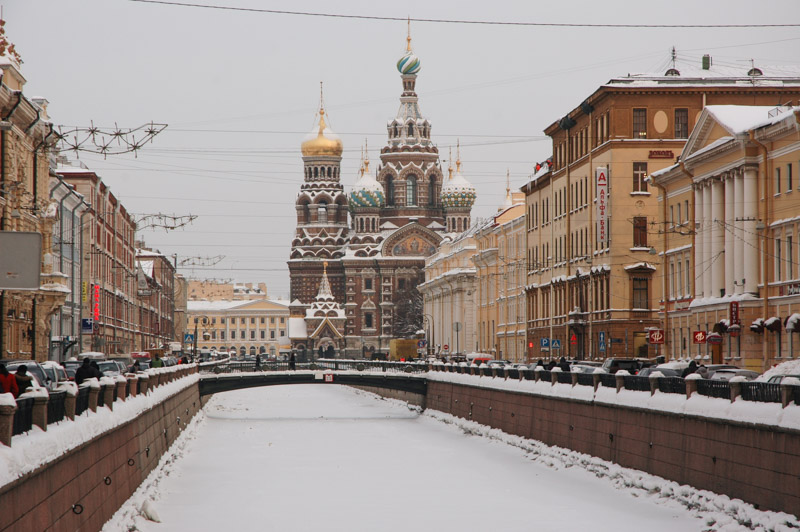
Church Of The Saviour On Spilled Blood, Saint Petersburg, Russia
With only a few days to spend in the city I limit myself to an overview of the centre; passing the imposing Baroque Vorontsov Palace, now the Museum of Russia; onto Nevsky Prospect, named after Alexander Nevsky, a Grand Prince (later saint) of ancient Rus’; looking down the far end of Griboyedova Canal to the slightly gaudy Church of the Saviour on Spilled Blood, named for and built on the site of the assassination of Tsar Alexander II in 1881. Turning north I cross the Neva River, looking back to a magnificent view across a frigid expanse of wind-sculpted snow and ice to the vast Winter Palace and Hermitage, seat of the Romanov Tsars and Tsarinas. The damp, bitterly cold wind makes the waterfront almost unbearable and together with the short, dark days where the sun hardly seems to climb above the rooftops, I decide that Saint Petersburg would better be visited one summer in the future, and I am soon ready to leave.
I leave Alexei and Ksenya one morning, ready to drive the very final stretch of my trip across Russia to the Estonian border. Shortly after starting however, in the middle of rush-hour traffic, the truck starts to splutter and lose power as if it is running out of fuel, then finally comes to a halt. In over 120,000 kilometres of often rough travel during the last three and a half years, this is the first time it has ever stopped. After trying in vain to locate the problem, I tie a rope to the front of the truck and wave it at passing traffic. Within minutes a van driver stops, tows me several kilometres across the city, helps me get the truck off the road and then refuses even the suggestion of payment. Saint Petersburg may be an outwardly Western city, but this single experience demonstrates that here, the spirit of the Russian people which so sets them apart from Westerners is clearly still present.
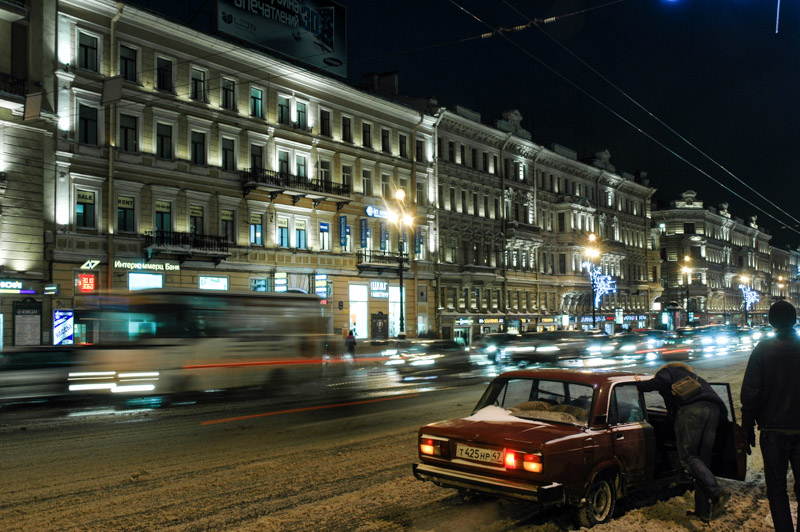
Nevsky Prospect, Saint Petersburg, Russia
Despite having my faith in humanity confirmed, I am still left with the prospect of an immobile truck, and after a little more diagnosis, some beer-drinking and a little anxious thought, I suspect that my fuel has started to gel and has blocked the strainer in the fuel tank. My solution is Russian; to burn Alexei’s petrol stove under the fuel tank in order to melt the wax. It is whilst watching the roaring stove under the tank that I notice the real cause of my breakdown; a long, aftermarket copper brake pipe which has been poorly fitted by a previous owner has somehow fouled on the rubber fuel hose and starved the engine of fuel. I straighten the kink and am utterly delighted when the truck fires straight back to life.
Two days later than intended I leave Russia’s second city and drive the final 160 kilometres to Ivangorod, a Russian fortress established in the late-fifteenth century by Ivan III which has at times been part of Sweden and later Estonia. Across the Narva River is modern-Estonia and a beast perhaps more daunting than the Russian Winter: The European Union.
 EurasiaOverland