
Stage 7 – Pakistan: The Indus Valley [3/3]
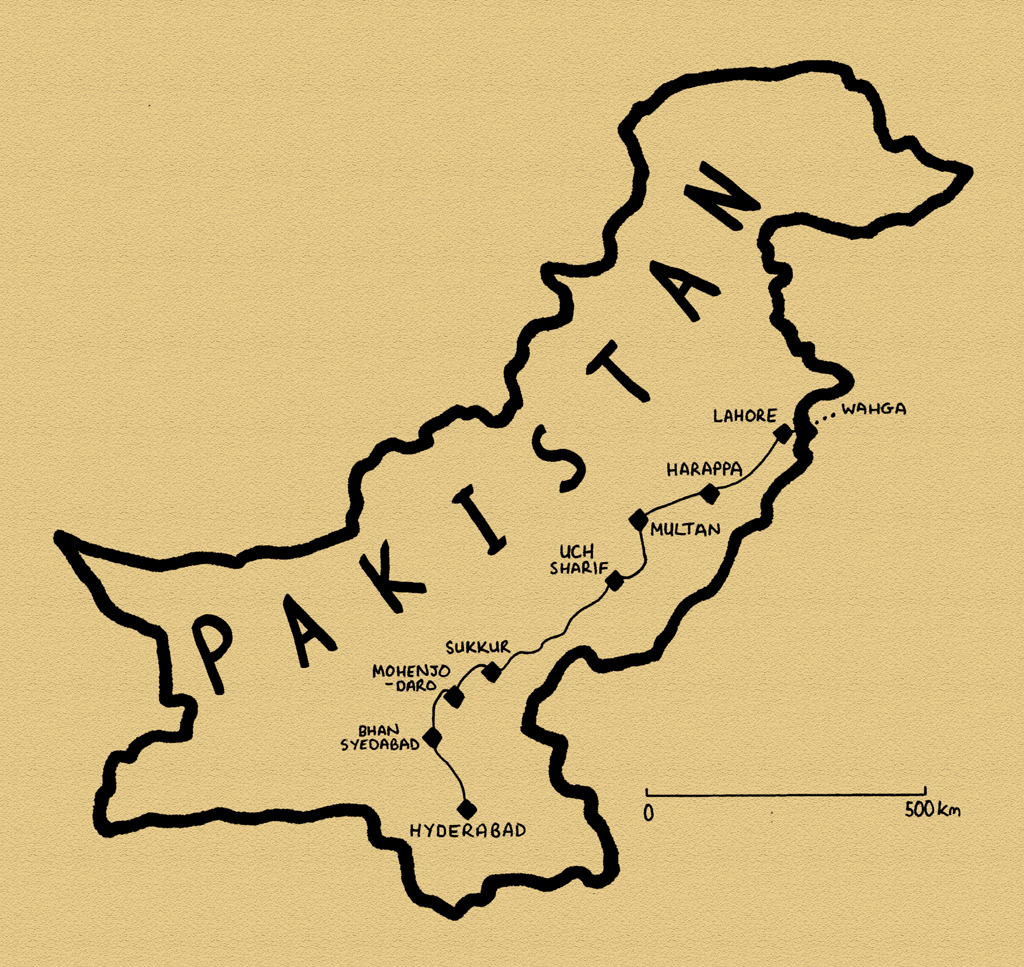
In my unplanned four-week stay in Hyderabad I had become very much attached to my adoptive family, to the city and to the magical province of Sindh, but deep down, I needed to continue my journey eastwards across the Indian Subcontinent (though Shahana suggested that I stay and settle down with a local girl). My immediate onward journey would take me up the Indus Valley, from the tranquil backwaters of Sindh into the more hectic Punjab, a great swathe of agricultural land watered by the great rivers which flow down from the Himalaya. I would pass the intriguing ruins of the Indus Valley Civilisation; the earliest recorded in South Asia, and the teeming modern cities of Punjab, before leaving Pakistan at Wahga; the only international border crossing with India accessible to foreign travellers. Always in my mind however were the people of Sindh, a place I missed almost immediately.

Ranikot Fort, Sindh, Pakistan
It’s the 28th February 2008 when I say my goodbyes to the family in Hyderabad and resume my journey up the Indus Valley. I take National Highway 55 northwards following a corridor between the right bank of the Indus and the barren Kirthar Mountains, which mark the edge of Balochistan through which I passed last month. In the town of Sann, I turn off the highway, leaving the irrigated farmland and driving through a scrubby plain towards the hills, where after almost thirty kilometres I reach a defile which has been fortified in the Talpur-era with a defensive wall. This circular wall, supposedly thirty two kilometres in length, encloses Ranikot Fort which, if it may be considered such, would be the world’s largest fortress. Once a no-go area famous for dacoits (bandits) during Sindh’s troubled years in the 1980s and 90s, Ranikot is a wonderfully tranquil spot which I have all to myself. From the eastern Sann Gate, I ascend the steeply climbing wall, which looks like a narrow-gauge Great Wall of China, though has recently been rather clumsily restored. I am rewarded with expansive views in all directions; to the east is the floodplain of the Indus, the traditional western boundary of India, while to the west is the tortured rock of the Kirthars; dramatic peaks and ridges thrust up by the collision of the Indian Subcontinent into Eurasia. Picking its way along nearby ridgelines, towards what seems like pure wilderness, Ranikot’s defensive wall is dotted with distant watchtowers, all but unknown to the outside world.
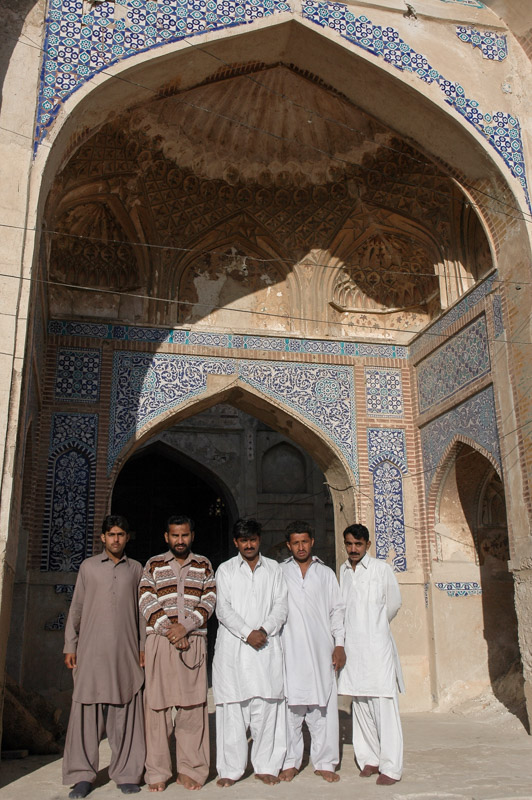
Jamia Mosque, Khudabad, Sindh, Pakistan
I stop for the night with a friend of Shahana’s, Sayyid Hajenshah, a local businessman, zamindar (feudal landlord) and close friend of the Chief Minister of Sindh, whose compound lies in the small town of Bhan Syedabad, a little beyond Sehwan. I arrive without warning and am met by one of the the man’s staff who directs me to park the truck in a garage, escorts me to the uthak (guesthouse) and brings me a cold drink before politely inquiring who I am. Hajenshah himself is unfortunately absent, so I have the luxury of occupying his personal suite. One of his guards comes in to make sure I am comfortable and have everything I need. He lays his shotgun against a wall, then pulls out a bottle of Scotch. After spending the whole day out in the burning sunlight on the road and at the fort, it takes quite some time for my eyes to adjust to the cool, dark room, and I realise that I am slightly sunburned. Despite not being even being March, the light outside is blinding and I can only imagine the ferocity of high summer.
I leave early the next morning, stopping first in nearby Khudabad which feels like a large village but was once the capital of Sindh as seat of the Kalhora Dynasty (vassals of the Mughals) until the title was transferred to Hyderabad in 1768. Just off the road is the slightly neglected though surprisingly beautiful early eighteenth century Jamia Mosque. The mosque sits above the dusty village and the fields which surround it on a plinth reached by a semicircular staircase. Ten steps lead to a triple-arched facade of flaking faïence, and an interior of finely painted stucco. Outside in the dazzling light, a class of schoolboys file along a path in dazzling orange uniforms, standing out against the haze of smoke and dust which hangs above the green fields in the morning air.
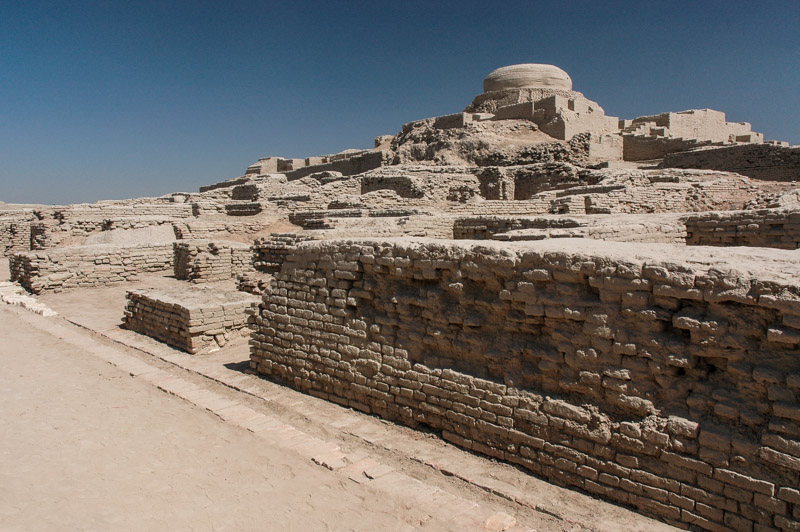
The Citadel, Mohenjo-Daro, Sindh, Pakistan
My next stop is one of the few places in Sindh which is at all known to the outside world: the Indus Valley (Harappan) Civilisation city of Mohenjo-Daro. These burning, dusty, dry flatlands astride the Indus are in fact one of humanity’s cradles of civilisation and Mohenjo-Daro, founded around 3500 BCE, was one of the world’s earliest major cities. Visually less arresting than Giza’s pyramids, Mohenjo-Daro is impressive instead for its skilled civil engineering: the beautifully paved, wide irrigation channels bringing water into the city; the narrow, partly-covered sewage channels taking waste out; a raised well-shaft, keeping out polluting floodwater and walled rubbish dumps. There is also very clear urban planning, with the city built on a regular grid and divided into two sections. The Citadel is the compact city centre with a communal bath, halls and more opulent housing, topped by the recognisable ruins of a much later and unrelated, second century CE Kushan stupa, built a staggering sixteen centuries after Mohenjo-Daro was abandoned. The rest is the Lower City with rectilinear living blocks for the lay-folk, complete with wide streets, staircases and drainage channels, all magnificently preserved. Somehow, the human-scale and recognisable features of a city clearly made by an advanced society make it more impressive than a singular monument to a megalomaniacal ruler or long-dead cult.
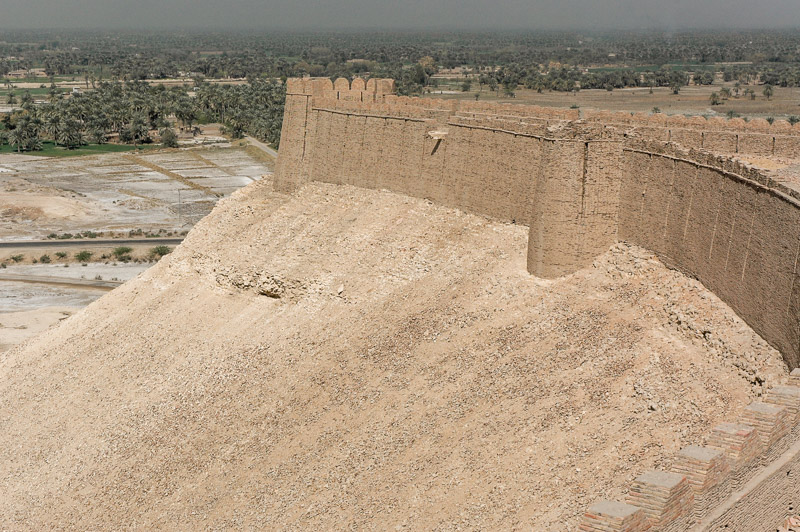
Fort Ahmedabad, Kot Diji, Sindh, Pakistan
From Mohenjo-Daro I pass through Larkana, home of the Bhutto Family, then head east to the shambolic riverside city of Sukkur, the third-largest in Sindh, where I am hosted by Asif, whom I meet at an ice-cream parlour. I notice a slightly different atmosphere in this northern part of Sindh; it’s noticeably more conservative than Hyderabad, and I see the odd burqa, a blanket-like garment which completely covers a woman from sight. It’s done as much out of ancient tribal customs as from Islamic piety and Asif’s home is no exception. The family practice purdah (curtain), referring to the practice of completely separating male and female sections of the house, so that a male visitor will never set eye upon any females in the building. Meals are slid through a curtained doorway, and the door quickly closed behind. We eat dinner with his father, who mutters ‘Allahu Akbar’ between each mouthful. It’s quite a contrast to my ‘second’ family down in Hyderabad.

Sukkur Barrage, Sindh, Pakistan
In the morning I get on a minibus to the nearby town of Kot Diji, where a beautiful and imposing late eighteenth century Talpur Fort Ahmedabad sits on a mound looking out across a sea of green palms and the outliers of the Rohri Hills, which punctuate the edge of the desert like islands. Below the fortress are the remains of a Harappan city, the majority of which is though to be covered by the fort. In the afternoon I return to Sukkur and join Asif to visit a couple of minor shrines, then go for a stroll along the Indus embankment. As a hazy, orange sun dips behind the vast Sukkur Barrage, a blind river dolphin jumps out of the murky Indus waters held up behind the dam. The deafening roar of motorcycles and autorickshaws is just distant enough to make the place almost tranquil, and I savour my last evening in Sindh, this beguiling province which I had unexpectedly fallen in love with.

Tomb of Bibi Jawindi, Uch Sharif, Punjab, Pakistan
Leaving Sukkur the next morning, I cross the Indus a final time, almost mesmerised by the sixty-six arched locks of the fifteen-hundred metre long barrage, the head of the world’s largest irrigation system, built by the British and completed in 1932. Without the life-giving, silty Himalayan waters of the Indus, Sindh would be a burning desert plain, but instead, rather like Mesopotamia or the Nile Valley, it is a landscape which has nurtured one of humanity’s earliest civilizations.
I join National Highway 5 heading north-east and by late morning cross the provincial boundary into Punjab where I notice a change in the landscape immediately. The agriculture is more intensive, the settlements look more prosperous, and there are large, industrial suburbs outside cities. The atmosphere changes too; gone is the gentle, relaxed atmosphere of Sindh, replaced with a more hectic, business-like air. The Punjabis enjoy the highest standards of living in Pakistan, the best infrastructure, and exert considerable political and economic influence over the country. The Army, by far the most powerful organ in the country, is dominated by Punjabis. It is perhaps understandable then that the Punjabis are collectively not particularly well-liked by the other nations of Pakistan. Just as the Baloch see their gas piped down from Sui to Punjab as a one-way deal, so the Sindhis watch much of the income generated by Karachi, Pakistan’s largest city, disappear up the road to into Punjab.
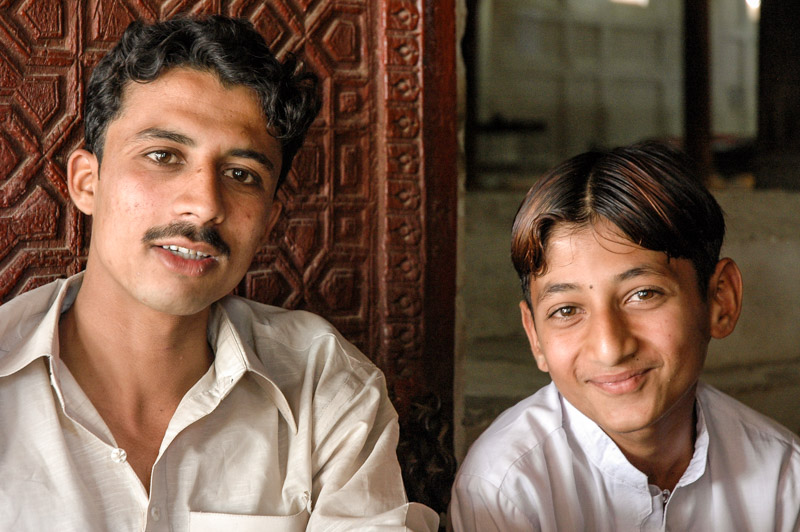
Punjabi Man and Boy, Uch Sharif, Punjab, Pakistan
My first stop in Punjab is the ancient town of Uch Sharif, which may have been established by Alexander the Great on the Indus (which has since changed course) and today is a pleasant country town. Uch Sharif is famous however as the adopted home of the Sufi saint and missionary Jalaluddin Surkh-Posh Bukhari, who arrived here in 1244 from his native Bukhara as part of a wave of Islamic arrivals who would spread Islam far deeper into the Indian Subcontinent than the initial incursion made by the Arab Muhammad bin Qasim in the early eighth century. Bukhari’s shrine, remodelled and rebuilt long after his death is however upstaged by three nearby shrines, each in the Turkic-influenced style of southern Punjab, built of red brick on an octagonal base, variously decorated with glazed turquoise tiles from nearby Multan and surrounded by simple grave-mounds of the native grey-white alluvium. The most exquisite of the three is the fifteenth century shrine of Bibi Jawindi, a great-granddaughter of one of Bukhari’s grandsons, which has tapering ornamental bastions topped with distinctive petal-like mouldings. Sadly, all three of these venerable shrines are mere facades, for a flood in 1817 washed away much of their structure, leaving them little more than magnificent, teetering walls. Bukhari’s shrine remains intact and active, though the atmosphere seems more business-like and less innocently welcoming than many of the shrines of Sindh, and so I push on northwards.
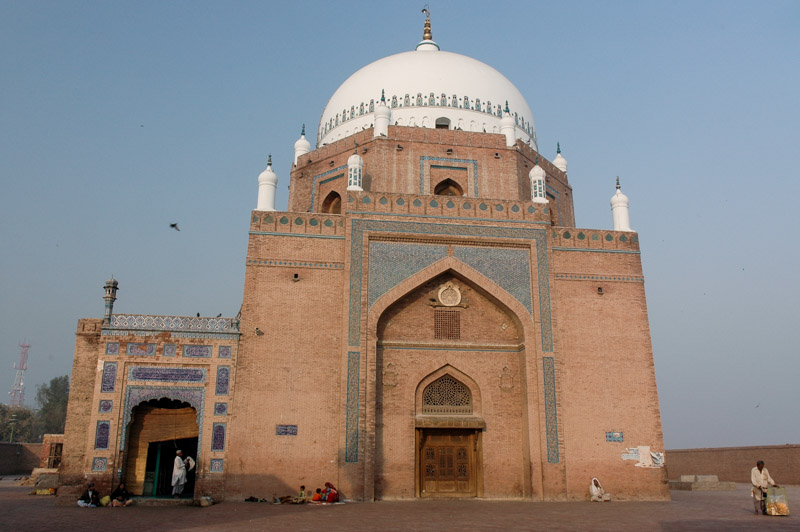
Shrine of Bahauddin Zakariya, Multan, Punjab, Pakistan
I stop for the night at the roadside and push on early the next morning towards Multan, the largest city in southern (Pakistani) Punjab. The name Punjab derives from the Persian ‘panj ab‘, meaning ‘five rivers’, which are the Jhelum, Chenab, Ravi, Sutlej, and Beas. These all flow south-westwards from the Himalaya, meeting at various points around Multan before flowing into the Indus near Uch Sharif. This generously watered swath of land has long been the breadbasket of India and has naturally attracted invaders and settlers for millennia, nurturing the culture of modern South Asia. It was here that, more than three thousand years ago, the first texts of the Rigveda were formulated: the oldest religious texts still in use today. It’s no surprise then to find that Multan is one of the oldest surviving cities of the subcontinent, is mentioned in the ancient Hindu epic Mahabharata, and is a truly ancient pilgrim city which long pre-dates Islam. Situated on a natural route between Central Asia, the plains of India and the Arabian Sea, it has a long history of riches and ruin; it was the first city taken by bin Qasim and swapped hands between the Seleucid Greeks, the Umayyads, the Ghaznavids, the various dynasties of the Delhi Sultanate, the Timurids, the Mughals, the Sikhs and finally the British, before becoming part of modern Pakistan.

Shrine of Shah Rukn-e Alam, Multan, Punjab, Pakistan
I enter the city at first light, in the calm of dawn before the day’s frantic traffic, crowds and noise overwhelm the cool dawn air. In Multan’s winding streets and time-worn, low-rise housing, I immediately sense a place of great age; a city whose millennia of history have woven a richness which belies its current status as merely a provincial city. An old saying tells that Multan is famous for gard, garma, gada o goristan (dust, heat, beggars and tombs), an accolade my own experience would give me no reason to dispute. I start at the city centre, in what once was Multan Fort but is now a pleasant urban park with only some low walls and the lonely, pink-arched Qasim Gate remaining of the fort, which was devastated by both the Sikhs and British in the nineteenth century. Within the park are Multan’s most celebrated shrines. The earlier of the two dates from the twelfth century and belongs to the Punjabi Sufi Bahauddin Zakariya; an elegant cubic-based structure with an octagonal-based dome, decorated by turquoise tiles, which is considered the archetype of the shrines of southern Punjab. The second, thirteenth century shrine is yet more impressive; similar in style to those of Uch Sharif, though intact, and belongs to the Multani Sufi Shah Rukn-e Alam, the ‘Pillar of the World’. The exterior of the shrine is richly decorated in bands of faïence, with a tapering octagonal base divided between eight powerful bastions. Inside, pilgrims from Multan and beyond pray at the Shah’s elevated tomb, set in an ornamented small pavilion of polished marble.

Pilgrim, Shrine of Shamsuddin Sabzwari, Multan, Punjab, Pakistan
Once outside again, the early calm has vanished and Multan has come to life. Groups of visitors are flocking towards the shrines with families sitting in the freshly-swept courtyards. Multan’s famous beggars are out in force; business-like in their wheedling persistence. In the park a wandering masseur rattles his bottles of oils, offering massage and ear-cleaning services to clients while they lie on the grass. Away from the central fort area I pass the impressive British-era Municipal Office and then head off to find more shrines. The first of these belongs to the fourteenth century Shamsuddin Sabzwari, a Sufi from Sabzevar in what is now Iran, which teems with pilgrims who light butter candles in small clay dishes, squatting with their hands clasped together in benediction. The second is the rather quiet tomb of the eleventh century Sufi Shah Yusuf Gardez from Gardez in what is now eastern Afghanistan; evidently far less popular with pilgrims but a very unusual box-like shrine completely covered in glazed tiles, with a dark, mirror-tiled interior.
Aside from the rich legacy of these Sufi missionaries, Multan has a sprawling central bazaar which makes up much of the city centre; a maze of old alleyways, timeworn by centuries of shoppers. Finding the minaret of the modern Ismailia Mosque open, I climb a long spiral staircase for a view out across the bazaar. The teeming lanes of the bazaar are covered with grubby tarpaulins to fend off the ferocious heat, which can exceed fifty degrees in summer. These lanes merge into shambolic suburbs, a sea of light greys and browns which give the impression that the entire city might be made from dust. Amidst the nearby roofs, invisible from street-level, a steeple-like shikhara roof of a Jain temple sticks out from the formless brick-box architecture; despite the influence of Sufi missionaries and the rather less glorious partition of India, the ancient, indigenous beliefs of the subcontinent still have a foot-hold in old Multan.

Harappa, Punjab, Pakistan
After two full days in Multan, I head off towards Lahore and the Indian border, though there is one last stop of interest on the arrow-straight dual carriageway of National Highway 5 as it runs through the burgeoning Punjabi countryside. Here, next to the small village of Harappa is the type-site of the Indus Valley (Harappan) Civilisation, the first of the sites to be excavated in the 1920s. Shamelessly raided for railway ballast by the British in the nineteenth century, there is far less to see at Harappa than at Mohenjo-Daro, though traces of the same highly developed urban planning remain. Harappa’s small museum is however fascinating, showing the extent of the civilisation, with city sites found as far as the Oxus in northern Afghanistan and the Rann of Kutch in Gujarat. There is also evidence of trade with other contemporary civilisations; with the Egyptians and the Elamites on the fringes of Mesopotamia and a number of seemingly linked cultures in southern Iran. The Harappans made touchingly beautiful artefacts with striking features that can be seen in contemporary South Asian culture; use of the Swastika, women wearing earrings, nose-studs and decorative bangles on their arms, perhaps as social indicators. Yet despite such a rich legacy, the Indus Valley Civilisation is shrouded in mystery; their distinctive hieroglyphs remain undeciphered, leaving many questions unanswered. Were the Harappans native Dravidians? What caused the decline of their civilisation? Were they displaced by Aryan arrivals? Who are their modern ancestors? The Harappan Civilisation remains a tantalising unknown in the early human history of the Indian Subcontinent.
I reach Lahore on a suddenly cold evening and meet Nabeel, a self-made businessman, philanthropist, Prince-fan and ludo player. He takes me to one of Lahore’s most (in)famous shrines; that of Baba Shah Jamal, a sixteenth century Lahori Sufi and descendant of Jalaluddin Surkh-Posh Bukhari. Each Thursday night, vast crowds of young men come to the shrine under the apparent pretences of piety. As the darvishes beat out a deafening, fast rhythm on their dhol drums, some perform a whirling, trance-like dhammal as the crowd becomes more deeply intoxicated, issuing billowing clouds of hashish smoke into the evening air. Scuffles and fights break-out occasionally, pickpockets circulate through the jostling crowds and rickshaw drivers tout for fares. I can’t see anything spiritual at this event, which has the air of an illegal rave rather than a holy shrine; whilst the musicians are skilled and bona fide, the crowds of frustrated, drugged young men seem to be pushing the boundaries of Sufism a little too far to be believed. There’s an unpleasant atmosphere and I indicate to Nabeel that I’d prefer to leave. He tells me it’s a good idea, as things are likely to kick-off later on.

Gate of Freedom, Wahga, Punjab, Pakistan
Lahore is a city I have fond memories of from my first visit to Pakistan in 2003, but in view of the extra time I have spent in Sindh, I decide to push on to India. I take an overnight bus to collect my passport from the Indian Embassy in Islamabad, then return the following morning to Lahore. After saying goodbye to Nabeel, I drive the last thirty kilometres in Pakistan, now on the ancient Grand Trunk Road, east to the Indian frontier at Wahga. During the terrible events of Partition in 1947, perhaps half a million were killed; not from any war, but simply from animosity between the Hindu, Muslim and Sikh communities. This front-line in the vast population exchange where Muslims fled west and Hindus and Sikhs east, was left drenched in blood and strewn with bodies. So widespread were the carcasses of the dead that they could be smelt across the region; even the vultures became picky in what they stripped from the cadavers, such was the plethora of carrion. I complete border formalities in the early afternoon and then proceed to the International Border. Touchingly, the last border gate which faces India is named in Persian: ‘Bab Azadi‘ (Gate of Freedom).
I’m sad to leave Pakistan, especially my adopted family in Sindh, a place I could quite easily see myself calling home. My trip up the Indus Valley has been a fascinating journey through the western boundary of the Indian Subcontinent, the frontier through which all its most important cultural influences arrived, to be incorporated into its complex modern culture. Yet as I progressed northwards into Punjab, an air of tension built up with distance from the tranquil, timelessness of Sindh. There seems little hope of finding solace in the crowds of northern India.
 EurasiaOverland